Archive
03/03/2015 – Ephemeris – The bright spots on Ceres are still a mystery
Ephemeris for Tuesday, March 3rd. The Sun will rise at 7:17. It’ll be up for 11 hours and 15 minutes, setting at 6:32. The Moon, 2 days before full, will set at 6:30 tomorrow morning.
The Dawn spacecraft is approaching the asteroid Ceres. It will be gently captured by Ceres on the 6th. This as an update from the date I gave you yesterday. Then the spacecraft will spiral closer and closer to the asteroid over the next few months. There is a mystery spot on Ceres, a bright spot that was visible by the Hubble Space Telescope orbiting Earth. As Dawn got close enough to resolve Ceres it too saw the bright spot. As the spacecraft got even closer the spot showed to be smaller and smaller. I thought it might be a crater that penetrated into Ceres icy interior. But the latest image, taken February 19th shows that the bright spot has a companion spot, both inside a crater and still too small to resolve. It’s still a mystery.
Times are for the Traverse City/Interlochen area of Michigan. They may be different for your location.
Addendum
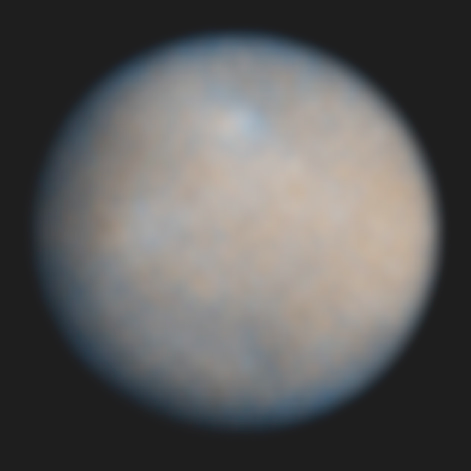
Hubble’s best photo of Ceres. Note the white spot near the top of the image. Image Credit: NASA, ESA, J. Parker (Southwest Research Institute), P. Thomas (Cornell University), L. McFadden (University of Maryland, College Park), and M. Mutchler and Z. Levay (STScI)
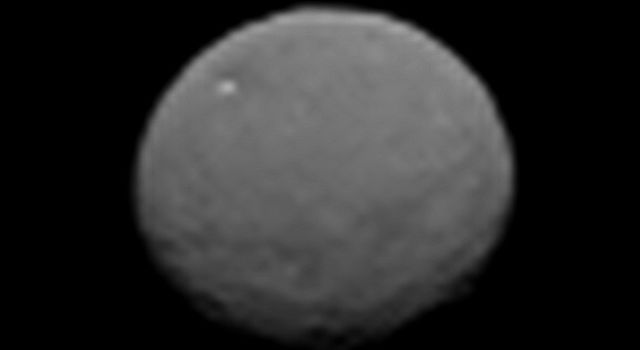
The white spot shows as Dawn approaches Ceres. Credit: NASA/JPL.
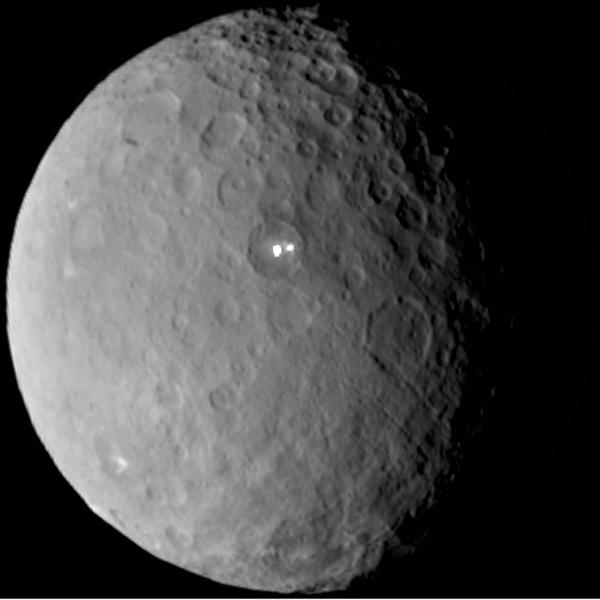
The bright spot is two. Picture taken February 19, 2015 from 29,000 miles (46,700 km). Credit: NASA/JPL-Caltech/UCLA/MPS/DLR/IDA.
This photo will be the best photo of the bright spots until the end of April, an Dawn maneuvers over the night side of Ceres.
On March 2nd NASA held a Dawn Mission Pre- Close Approach News Briefing which can be found on YouTube.
05/12/2014 – Ephemeris – NASA’s OSIRIS-REx mission to an asteroid
Ephemeris for Monday, May 12th. Today the sun will be up for 14 hours and 42 minutes, setting at 9:00. The moon, 2 days before full, will set at 5:37 tomorrow morning. Tomorrow the sun will rise at 6:16.
Construction is beginning on a spacecraft called OSIRIS-REx, which is slated to be launched in September of 2016 to reach asteroid Bennu in 2018 and retrieve a 2 or so ounce sample and return it in 2023. It is important to discover the physical features of near earth asteroids or NEOs, and so learn how best to deflect them, or even mine them for resources. If you’d like your name to ride along on the spacecraft to orbit the Sun forever, well for several billion years; and be apart of the return capsule, which will probably reside at the Smithsonian at the end of its travels, go to the Planetary Society website at http://www.planetary.org/get-involved/messages/bennu/, and sign up yourself and your family. Be part of space history.
Times are for the Traverse City/Interlochen area of Michigan. They may be different for your location.
Addendum
Mission webpage: http://www.asteroidmission.org/
NASA mission page: http://www.nasa.gov/mission_pages/osiris-rex/#.U3Br1HbDuBw
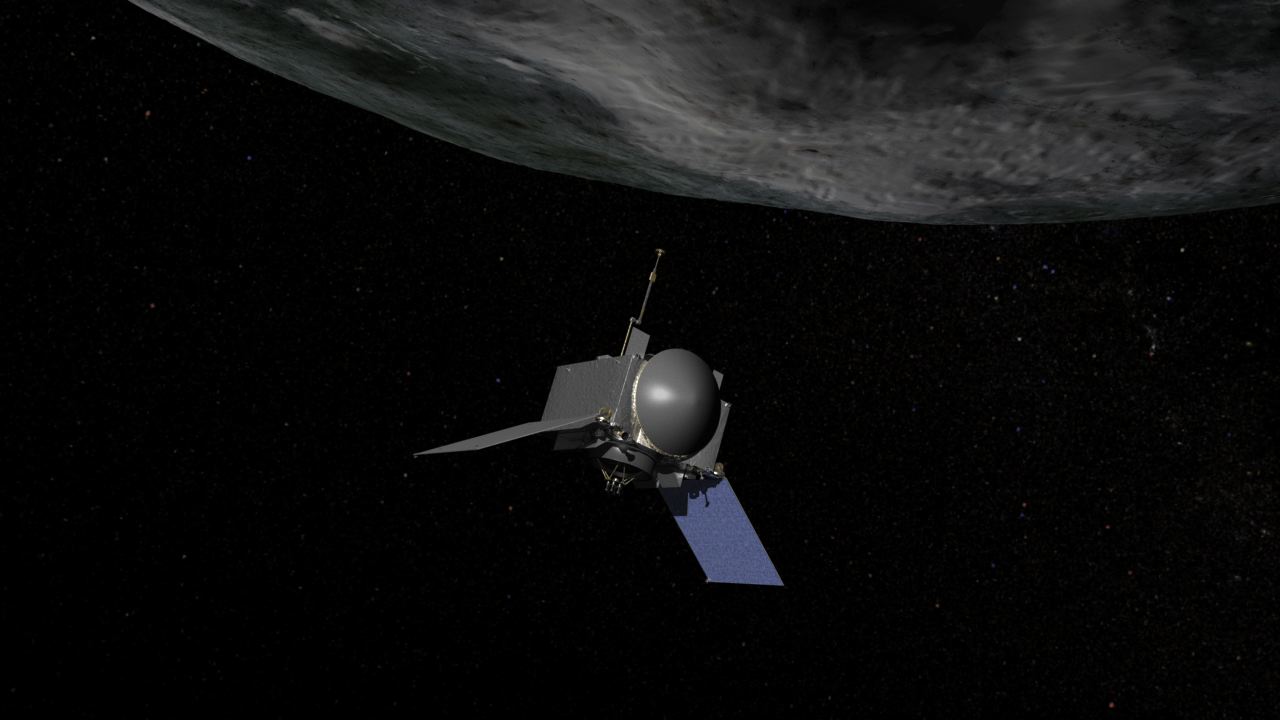
Artist’s conception of OSIRIS-REx about to collect a sample from asteroid Bennu. Image Credit:
NASA/Goddard/Chris Meaney
01/16/2014 – Ephemeris – NASA/JPL Solar System Ambassador
Ephemeris for Thursday, January 16th. The sun will rise at 8:15. It’ll be up for 9 hours and 14 minutes, setting at 5:29. The moon, 1 day past full, will rise at 6:25 this evening.
I am proud to announce that I have been appointed one of the NASA Jet Propulsion Laboratory’s new 38 new Solar System Ambassadors for 2014. Solar System Ambassadors are volunteers that host star parties, and provide presentations about space, the universe, and NASA missions to promote awareness of the STEM or Science, Technology, Engineering and Math fields as career choices or at least to encourage the students to become more science literate voters. Ambassadors work with school classes, scout groups and non-profit organizations. Being now newly retired I have the freedom of daytime visits. I will be serving the northwestern Lower Peninsula of Michigan. Interested? The easiest way to initially contact me by email is at info@gtastro.org or bob@bjmoler.org.
Times are for the Traverse City/Interlochen area of Michigan. They may be different for your location.
Our Past and Future in Space – A Personal View
This is a piece I wrote for the Grand Traverse Astronomical Society’s Stellar Sentinel in the January
I’ve witnessed the space program since before Sputnik. I watched the United States Vanguard program from its inception to attempt the launch the first satellite. It turns out that the Russians and the US Army beat Vanguard for the first successful US satellite. The three and a quarter pound satellite Vanguard 1 launched in 1958, with the first solar cell power is the only satellite from the early days still in orbit. Though silent it is still being tracked.
Back to Sputnik. It was a real surprise one October evening, while watching TV a news flash came over the TV announcing that the USSR (Russians for you younger folk) had launched a satellite. They showed a dot crossing the screen and the beep beep beep it emitted as if to say: “We’re in orbit and you’re not!” It turned out that it’s not nice to mess with America’s pride. We beefed up our science teaching, and math. I was old enough to miss most of the new math. Now helping my youngest granddaughter with her 4th grade math homework I’m learning a newer math, and as an old computer programmer I’m seeing how they now break problems into manageable bits, just like I do now, but wasn’t taught to me in school.
Back to the past. The 1960s were a heady time for space buffs. The manned Mercury, Gemini programs leading to the magnificent Apollo lunar landings. Along the way we sent spacecraft beyond the moon to Venus and then to Mars. After the Apollo 11 landing the will to proceed with the last three Apollo landing died in Congress, and the general public had the “been there done that” attitude, while scientists and we astronomers amateur and otherwise though it was just getting interesting. The first and last geologist who went to the moon did so on the last flight.
The next big NASA project was the Space Shuttle, which was supposed to save money and make access to space routine. Unfortunately it was built on a starvation budget which ultimately drew out its development time and weakened the spacecraft due to the shortcuts that were taken to keep it almost within budget. It was built to hopefully make trips to a space station that it didn’t begin to construct until the latter third of its lifetime. After the fiery demise of the second shuttle with its seven person crew it was finally determined that the shuttle was indeed too fragile to fly, and the program was abandoned after the International Space Station (ISS) was completed.
Without the space shuttle we have to bum rides to the ISS from the Russians whose 1960’s technology Soyuz space capsules are still perfectly capable vehicles. The Soyuz capsules also serve as life boats for the ISS. Maybe in a few years one of the commercial space companies will have a manned spacecraft ready to go. The three contenders that have received NASA grants are SpaceX, Boeing, and Sierra Nevada. NASA’s working on the Orion Capsule, to take astronauts past the moon, to the asteroids and to Mars.
Whatever we send to these destinations the Orion capsule will not be the living quarters. It’s for launch and reentry. The rest of the spacecraft will most likely be much larger with a rotating component to provide artificial gravity. The actual manned mission would be preceded by cargo missions to establish a habitat and a martian launch vehicle. It’s possible that the martian moon Phobos would be a staging area for a possible martian landing. This seems to be the thinking of the Russians who have sent, or tried to send spacecraft to Phobos, including the failed Phobos Grunt (Soil) mission of a year ago. The Russians found out that you can’t do this stuff on the cheap. That and that fact that Russia has had miserable luck with Mars.
The current guesstimate on the time of a manned landing on Mars is the 2030s. Back in the late 90’s after the successful Mars Pathfinder mission, I answered a Planetary Society member questionnaire as to my opinion as to when a manned landing on Mars would happen. I guessed 2030. It may be optimistic by a decade or two. The first man or woman to set foot on Mars is probably in grade school right now.
A good dress rehearsal for landing on Phobos or Mars would be a trip to a near earth asteroid. These will be a shorter trip than to Mars. As it happens one docks with an asteroid rather than lands on it. Other than that, we must learn a lot more about asteroids if we are able to defend the earth from them. So asteroid missions are not only good practice, but vital in learning how to defend ourselves from one on an intercept course.
The current China’s Chang’e 2 mission started as a photo mission to the moon, It was then sent to the earth-sun Lagrangian 2 or L2 location, One million miles directly opposite the sun from the earth. From there it was sent to fly by the asteroid Toutatis, which it did in December 2012. Maybe the Chinese have something. Maybe L2 might be a place to hold in reserve asteroid defense rockets. They’re outside the gravity well of the earth, so can be pre-positioned to launch to intercept an asteroid.
To practice living off the land on Mars, a lunar mission to the poles of the moon may be necessary. The moon’s low angular tilt means that lunar craters at the poles contain water ice and other frozen volatile compounds. South polar permanently shadowed craters are known to contain water ice. Also with permanent sunlight at the crater rims, solar power can be readily available. Problem is the lunar poles are part of the lunar highlands, some very rugged terrain. It makes landing there way more than exciting.
Mars has water, lots of it, either at the polar caps, and/or located as permafrost below the surface and possible methane good for rocket fuel. If water in sufficient quantities is found, then hydrogen and oxygen can be made for breathable oxygen and again rocket fuel. A manned martian population will have to be much more self-sufficient than a lunar one. Care packages to Mars can only be sent at 26 month intervals, while the moon is only 3 days away by rocket.
One of the big questions with space exploration is manned versus robotic missions. Actually I’m in favor of both. First must come the robotic missions to survey the lay of the land, the atmosphere and determine the feasibility of even sending astronauts. That’s what we’re doing to Mars. We will have to determine what life Mars has or had before we send people who will bring their own biological contamination. Even the Curiosity rover may have brought organic contamination to Mars. It may have been sterile but it came from a planet loaded with the stuff.
Robots can go to places humans can never go: Deep inside the radiation fields of Jupiter, onto the surface of Saturn’s moon Titan. Suicide plunges into the atmosphere’s of the gas giant planets. Other than that they don’t need the care and feeding of humans, and are much cheaper than a human mission, humans are much more adaptable, able to thing on the spot. Of course the humans that operate the robots are pretty good at improvising with their charges too.
Currently NASA is doing all its current and future missions with one half of one percent of the federal budget. Recent events in the Congress of the United Stated don’t give me much hope that that will improve. Congress is still starving NASA. They want all these great things, like the Space Launch System, but won’t finance it well enough to do it right. I fear the cutting of corners and eliminating science programs to finance their big rocket that currently has no manifest.
The climate scientists are quite positive that the climate is warming and 90% sure that humans are causing it. The last and next chairmen of the House Science, Space and Technology Committee are climate change deniers. What’s the chance of anything positive coming out of that committee?
09/17/2012 – Ephemeris – Cygnus and the search for exo-planets
Ephemeris for Monday, September 17th. The sun will rise at 7:24. It’ll be up for 12 hours and 24 minutes, setting at 7:48. The moon, 2 days past new, will set at 8:21 this evening.
Nearly overhead at 10 p..m. is the constellation Cygnus the swan. The bright star Deneb is at the tail of this flying swan with its wings outstretched, flying south through the Milky Way. Cygnus is located at a point in the Milky Way in the direction the sun’s orbiting the center of the Milky Way. That is the approximate direction the Kepler spacecraft is staring. Launched in 2009 the Kepler spacecraft has been slowly drifting away from the earth in a trailing orbit of the sun. It is monitoring over 100,000 stars continuously looking for transits of planets across their stars. So far some 2300 suspects have been found. They have to be confirmed by ground based telescopes before being officially cataloged. So far close in planets to their stars have been discovered.
Addendum
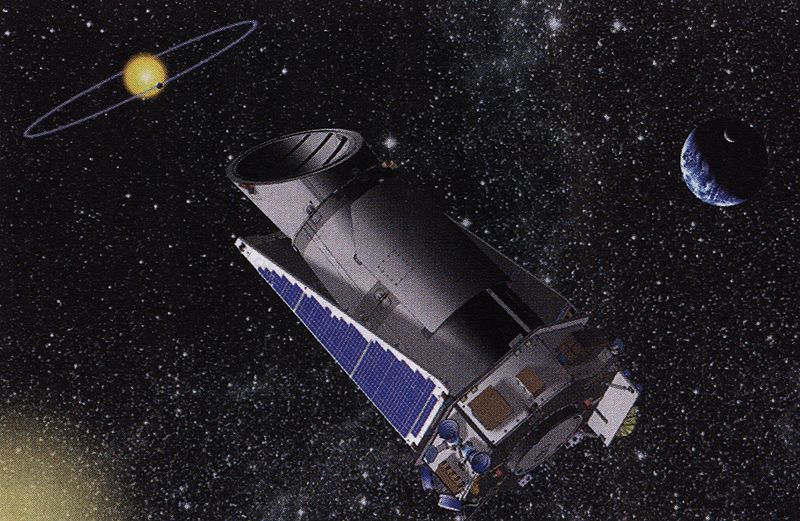
Kepler Spacecraft. Credit NASA.
Click image to enlarge.
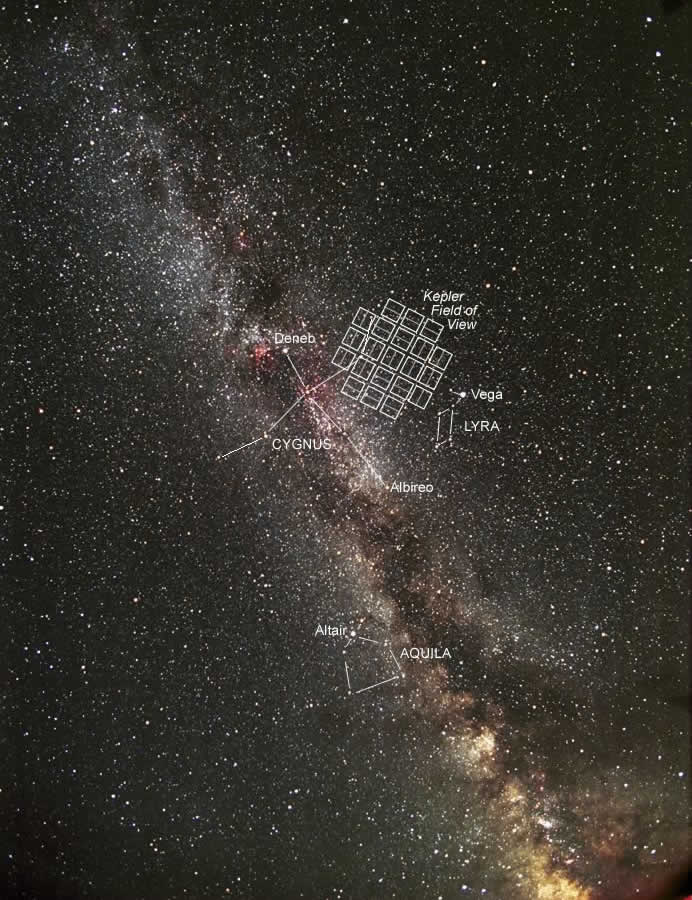
Kepler field of view. Credit C. Roberts, NASA.
Click image to enlarge.
Link to Kepler’s home page: http://kepler.nasa.gov/
07/12/11 – Ephemeris – Dim prospects for the James Webb Space Telescope
Tuesday, July 12th. Today the sun will be up for 15 hours and 18 minutes, setting at 9:27. The moon, 3 days before full, will set at 4:24 tomorrow morning. Tomorrow the sun will rise at 6:09.
The US House Appropriation Committee is planning to cancel the Jame Webb Space Telescope. This follow on to the wildly successful Hubble Space Telescope, is, like its predecessor over budget and behind schedule. The Webb will gather over 6 times the light as the Hubble, and operate in the infrared where the action is in astronomy now a days. As it is currently funded the Webb telescope might not be launched by 2018. They are cutting NASA’s budget by 1.6 billion dollars and want to mandate instead the development of a heavy lift rocket, for which there is no immediate use. As it is the commercial SpaceX company supposedly can upgrade their current Falcon 9 rocket to a Falcon Heavy quicker and cheaper than NASA can produce their heavy rocket.
* Times are for the Traverse City/Interlochen area of Michigan. They may be different for your location.
Addendum

Artist's view of the James Webb Space Tellescope. Courtesy NASA.

Artist's conception of the Falcon Heavy rocket. Courtesy SpaceX.
What we used to know about Mercury
On Thursday evening, 8:45 p.m. March 17 EDT (12:45 a.m. March 18 UTC) the MESSENGER spacecraft will complete the second of NASA’s 2011 planetary trifecta when it will, if all goes well, fire its rocket engine to drop into orbit of the tiny planet Mercury. We’ve had six quick peeks at Mercury so far. Three by the Mariner 10 spacecraft in the 1970’s which looked at the same half of the planet due to Mercury’s unique rotational period. And three more by MESSENGER as it used Mercury to put on the breaks, so it would be going slow enough this time, so it’s rocket engine could drop it into polar orbit of the planet.
At first blush, Mercury looks like the moon. But it’s not. The moon is light, being made up, apparently, of mostly the crustal materials expelled by the earth and another Mars sized body. So it has a relatively small core. Mercury, on the other hand has a large core, and is the second densest planet at 5.43 grams per cubic centimeter. It’s only beaten out by the earth’s 5.52 g/cm3.
We’re going to learn a lot more about Mercury in the next year or so as MESSENGER maps Mercury and the complex interaction between it and the solar wind and magnetic field coming from the sun. Lets look back at the early history of our knowledge of Mercury.
It seems the that early Greeks noticed this elusive planet. They saw it in the morning sometimes, and then they saw it in the evening. At first they thought it was two separate planets that they gave the name Hermes in the evening and Apollo in the morning before they figured out that it was the same planet. The name Mercury we know the planet by today is the Roman equivalent of Hermes.
Another revelation came later. In my youth Mercury was thought to be in tidal lock with the sun, like our moon is to the earth. The rather poor markings found on the planet seen low in the sky at dusk and dawn seemed to bear that out an 88 day rotation to match its 88 day revolution of the sun. It wasn’t until 1965 that radar observations proved that the rotation was 2/3 of 88 days. Every 2 orbits of the sun Mercury rotates 3 times. It seems that the best times to spot Mercury are when it’s in the same part of its orbit, but basically every other return to that spot. Funny thing. The northern hemisphere’s best views of Mercury are for its eastern elongation on spring evenings and western elongations on autumn mornings. In effect we’re viewing Mercury at the same point in its orbit, when it is near its perihelion, when it is closest to the sun. The southern hemispheric observers get to see more favorable views of Mercury, when it’s farthest from the sun.
As we’ve found with all the planets that we’ve gotten a close look at, the generalities of our long-standing ignorance is brushed away. Each planet is its own unique place in the sun.
Taken from my March, 2011 article in the Stellar Sentinel,the newsletter of the Grand Traverse Astronomical Society.
Here is the MESSENGER web page. This mission is run for NASA by the Johns Hopkins Applied Physics Laboratory.

MESSENGER’s First Look at Mercury’s Previously Unseen Side
Credit: NASA/Johns Hopkins University Applied Physics Laboratory/Carnegie Institution of Washington
 Bob Moler's Ephemeris Blog