Archive
Aldebaran Occultation November 26, 2015 from Northern Michigan
On the early morning of November 26th, that’s Thanksgiving morning here in the US, The Moon will pass in front of, or occult, the bright star Aldebaran in Taurus the bull. The event is called an occultation.
Three first magnitude stars can be occulted by the Moon, Aldebaran, Regulus in Leo the lion, Antares in Scorpius the Scorpion, and Spica in Virgo the virgin, since these stars lie within 5 1/2 degrees of the ecliptic, the plane of the Earth’s orbit. The Moon’s orbit is inclined to it by 5º 14′. Also because the Moon’s orbit precesses over a period 18.6 years they occur over the Earth in monthly series every 18.6 years. There are 43 monthly occultations that will occur in this series, which actually started in January. This is the best of them so far. We’ll have another on the evening of January 19th next year. Below is a chart of the event from the Astronomical Almanac Online which can be accessed here: http://asa.usno.navy.mil/.
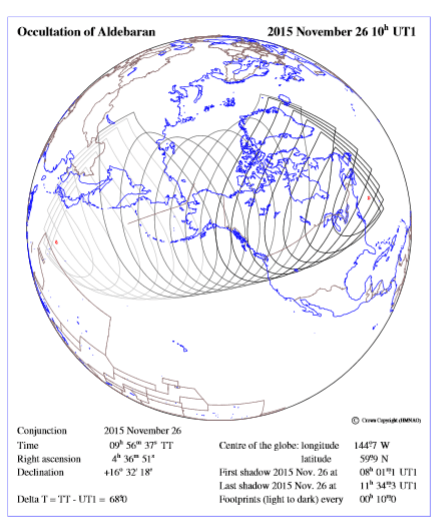
Map of the area where the occultation of Aldebaran is visible. Credit: Astronomical Almanac Online – U.S. Nautical Almanac Office, United States Naval Observatory (USNO), in the United States and Her Majesty’s Nautical Almanac Office (HMNAO), United Kingdom Hydrographic Office (UKHO), in the United Kingdom.
The occultation will be visible for locations within the nested grid of curved lines.
The two important events of the occultation is the star’s disappearance and reappearance. The times of these two events depend on your location, and are scientifically useful in determining the precise position of the Moon.
I’ve worked out the timings for my location about half way between Traverse City and Interlochen, so they should be within a couple of minutes of your observed time if you’re within 30 or so miles. Go out early, the earlier the better. The Moon will be especially bright, being only 12 hours after the instant the Moon will be full. Binoculars or a small telescope will be necessary to spot Aldebaran. The farther away Aldebaran is away from the Moon the easier it can be picked up. Note as a rule of thumb, the Moon moves its own diameter against the stars in about an hour.
For the Traverse City/Interlochen area I calculate the disappearance of Aldebaran at 5:38 a.m.
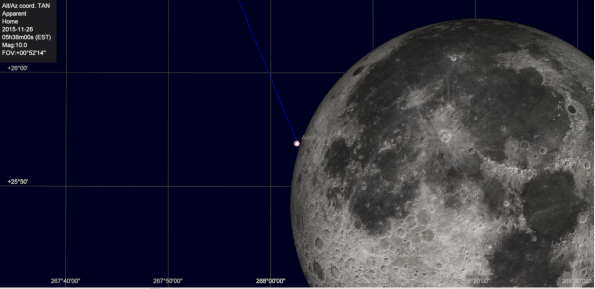
Aldebaran just prior to it’s disappearance behind the Moon from Interlochen/Traverse City. Created using Cartes du Ciel (Sky Charts).
For the Traverse City/Interlochen area I calculate the reappearance of Aldebaran at 6:29 a.m.
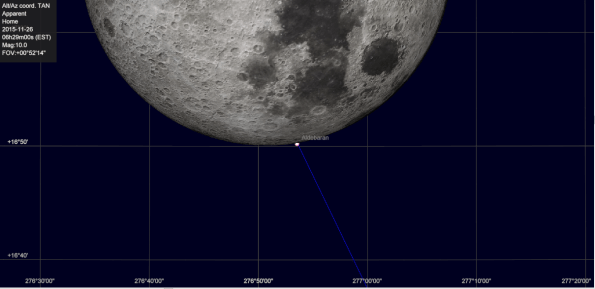
Aldebaran just after it’s reappearance from behind the Moon from Interlochen/Traverse City. Created using Cartes du Ciel (Sky Charts).
The Moon will be low in the western sky.
Timings for 3 locations in Michigan
This can be used to approximate the occultation time for other locations in Michigan.
City(s)                    Disappears  Reappears Location
Ironwood          5:33 a.m.   6:25 a.m. Northwestern corner of the
                                        Upper Peninsula (UP) of
                                        Michigan
Interlochen/      5:38 a.m.   6:29 a.m. Northwestern lower Michigan
   Traverse City
Monroe            5:45 a.m.   6:29 a.m. Southeastern corner of Michigan
Estimating timings for your location
I used Cartes du Ciel the free software that I have a link to on the right. Make sure that the program is set for topocentric positions under Setup/Solar System. And you have entered your position under Setup/Observatory. You can find your location in Google Earth.
You can also use Stellarium. Just make sure the Moon is normal sized.
In both programs you can lock the Moon or Aldebaran in the center of the screen Pick a time in advance of the occultation and using the set time window walk the star towards the Moon, mark the time. Then walk the star out from the Moon and record the reappearance time. That’s it.
This should work with other planetarium programs too.
08/31/2015 – Ephemeris – Previewing the skies of September – Part 1
Ephemeris for Monday, August 31st. The Sun will rise at 7:03. It’ll be up for 13 hours and 18 minutes, setting at 8:21. The Moon, 2 days past full, will rise at 9:31 this evening.
Let’s look forward to the skies of September. The sun will moving at its greatest speed in its retreat to the south. Daylight hours in the Interlochen/Traverse City area and will drop from 13 hours and 15 minutes tomorrow the 1st. to 11 hours 46 minutes on the 30th. The altitude of the sun above the southern horizon at local noon will be 54 degrees tomorrow, and will descend to 42 degrees on the 30th. The Straits area will see the sun a degree lower. The season of summer is getting short, so enjoy it while you can. Summer ends and autumn begins at 4:20 a.m. on September 23rd. Saturn is setting before midnight now, but Venus and Mars are appearing in the morning sky soon. Tomorrow we’ll look at September’s lunar eclipse.
Times are for the Traverse City/Interlochen area of Michigan. They may be different for your location
Addendum
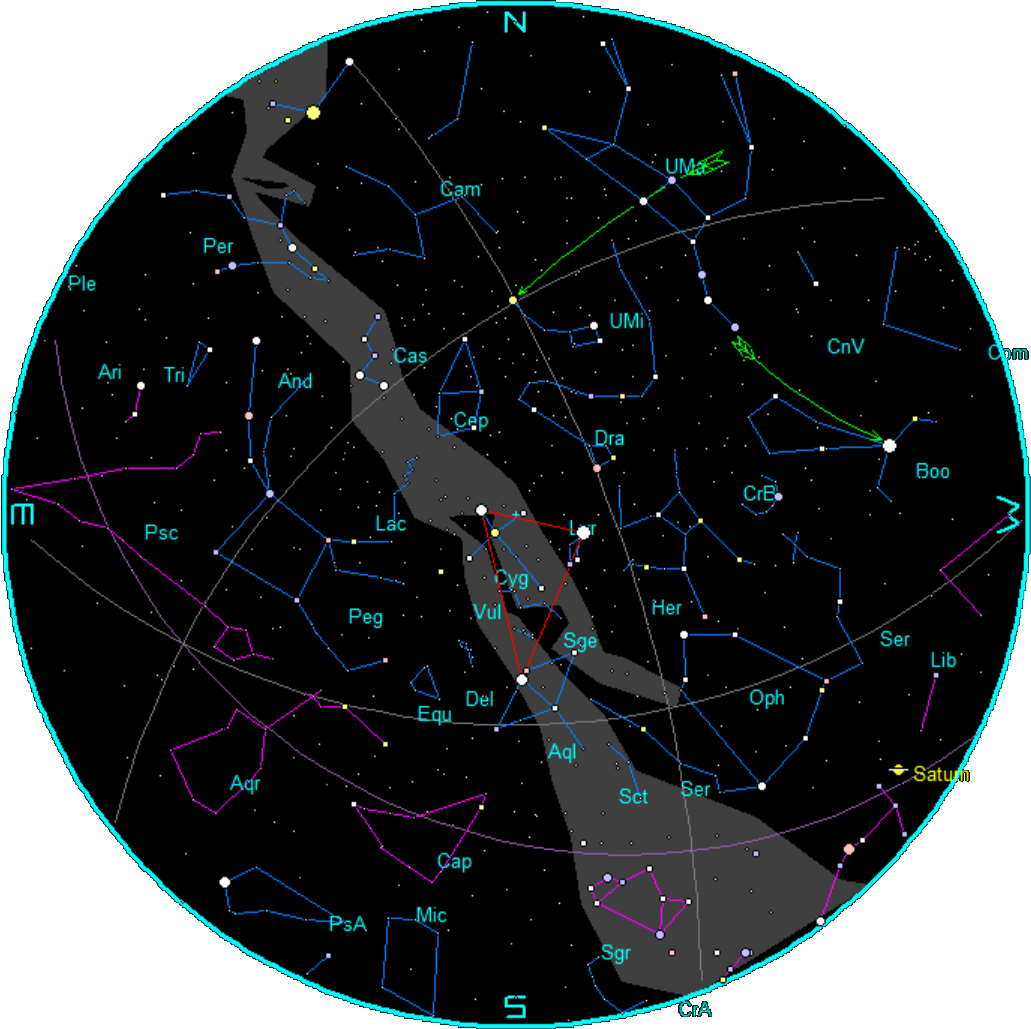
Star Chart for September 2015. Created using my LookingUp program.
The planets and stars are plotted for the 15th at 10 p.m. EDT. That is chart time. Note, Traverse City is located 1 hour 45 minutes behind our time meridian. To duplicate the star positions on a planisphere you may have to set it to 1 hour 45 minutes earlier than the current time.
Evening astronomical twilight ends at 10:04 p.m. EDT on August 1st, decreasing to 9:02 p.m. EDT on the 30th..
Morning astronomical twilight starts at 5:19 a.m. EDT on August 1st, and increasing to 6:01 a.m. EDT on the 30th.
Add a half hour to the chart time every week before the 15th and subtract and hour for every week after the 15th.
For a list of constellation names to go with the abbreviations click here.
The green pointer from the Big Dipper is:
- Pointer stars at the front of the bowl of the Big Dipper point to Polaris the North Star.
- Follow the arc of the Big Dipper’s handle to Arcturus.
- The Summer Triangle is shown in red.
Calendar of Planetary Events
Credit: Sky Events Calendar by Fred Espenak and Sumit Dutta (NASA’s GSFC)
To generate your own calendar go to http://eclipse.gsfc.nasa.gov/SKYCAL/SKYCAL.html
Times are Eastern Daylight Time on a 24 hour clock. Some additions made to aid clarity.
Conjunctions like the Mars-Regulus: 0.8° N means Regulus will appear 0.8° north of Mars.
| Sep | 01 | Tu | Venus: 25° W | |
| 04 | Fr | 05:59 | Mercury Elongation: 27.1° E | |
| 05 | Sa | 01:09 | Moon-Aldebaran: 0.6° S Occultation?* | |
| 05 | Sa | 05:54 | Last Quarter | |
| 06 | Su | 13:06 | Moon North Dec.: 18.2° N | |
| 10 | Th | 01:53 | Moon-Venus: 2.9° S | |
| 13 | Su | 02:41 | New Moon | |
| 13 | Su | 02:55 | Partial Solar Eclipse (Southern tip of Africa to Antarctica) | |
| 14 | Mo | 00:38 | Moon Ascending Node | |
| 14 | Mo | 07:28 | Moon Apogee: 406500 km | |
| 18 | Fr | 22:54 | Moon-Saturn: 3.1° S | |
| 21 | Mo | 04:59 | First Quarter | |
| 21 | Mo | 08:02 | Moon South Dec.: 18.1° S | |
| 23 | We | 04:20 | Autumnal Equinox | |
| 24 | Th | 15:38 | Mars-Regulus: 0.8° N | |
| 27 | Su | 17:04 | Moon Descending Node | |
| 27 | Su | 21:46 | Moon Perigee: 356900 km – Super moon | |
| 27 | Su | 22:48 | Total Lunar Eclipse | |
| 27 | Su | 22:50 | Full Moon – Harvest Moon | |
| 30 | We | 10:36 | Mercury Inferior Conjunction with the Sun | |
| Oct | 01 | Th | Venus: 43.6° W |
* For the Grand Traverse Region the Moon will rise at 12:10 a.m. occulting Aldebaran. Aldebaran will appear at the Moon’s unilluminated top right edge at approximately 12:40 a.m.
Note: All lunar conjunctions in the table above are geocentric. Double check with a program like Stellarium to check on the position of the body with respect to the moon for your location.
03/12/2015 – Ephemeris – Tonight’s a big night for Jovian satellite events
Ephemeris for Thursday, March 12th. The Sun will rise at 8:01. It’ll be up for 11 hours and 43 minutes, setting at 7:44. The Moon, 1 day before last quarter, will rise at 2:40 tomorrow morning.
Tonight will be a busy one in Jupiter’s system for those watching with telescopes. As it gets dark Jupiter’s moon Io will be in front of Jupiter and very difficult to spot. It’s shadow may be seen as a tiny inky black dot on the face of the planet. Io will move off the planet at 8:55 p.m., This will be followed by the shadow at 9:42 p.m. The fun isn’t over because the moon Europa will be appearing to approach Jupiter as Io leaves it. Europa will disappear behind Jupiter at 12:06 a.m. It will stay hidden until 4:32 a.m. Europe will clear the planet earlier, but will still be in Jupiter’s shadow until 4:32. When a moon’s in shadow, it is said to be eclipsed. When behind the planet it is occulted and when in front of Jupiter it is in transit.
Times are for the Traverse City/Interlochen area of Michigan. They may be different for your location.
Addendum
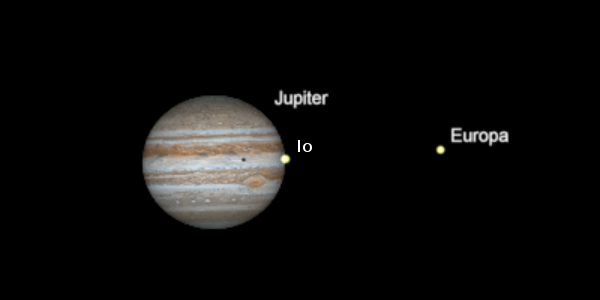
Io transit end at 8:55 p.m., March 12, 2015. Note Io’s shadow will leave the face of Jupiter at 9:32 p.m. Created using Cartes du Ciel (Sky Charts).
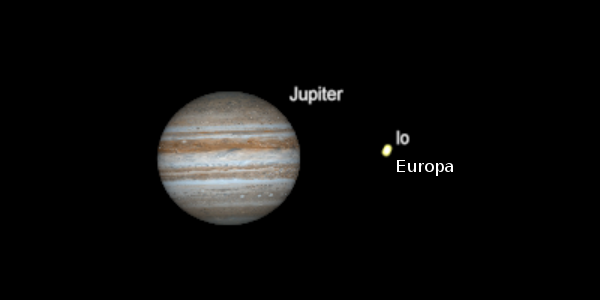
Io passes Europa about 10:20 p.m. March 12, 2015. Created using Cartes du Ciel (Sky Charts).
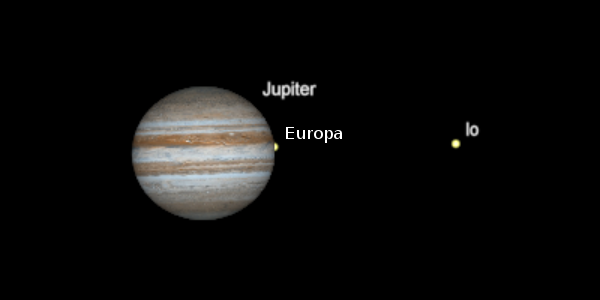
Europa’s occultation begins at 12:06 a.m., March 13, 2015. Created using Cartes du Ciel (Sky Charts).
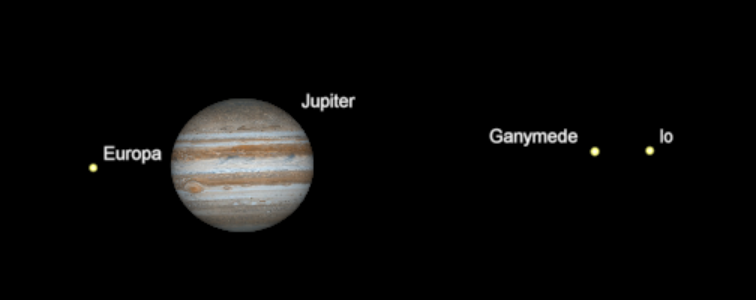
Europa emerges from eclipse by Jupiter’s shadow at 4:32 a.m., March 13, 2015. Note that Ganymede has entered the picture. It appeared to pass Io at about 3:30 a.m. Created using Cartes du Ciel (Sky Charts).
03/18/2014 – Ephemeris – Thursday a.m. many folks including New Yorkers will see a bright star wink out
Ephemeris for Tuesday, March 18th. The sun will rise at 7:49. It’ll be up for 12 hours and 3 minutes, setting at 7:52. The moon, 2 days past full, will rise at 10:15 this evening.
On Thursday morning the 20th around 2 a.m. the star Regulus, the brightest star in the constellation Leo the lion will wink out for up to 14 seconds for observers in New York City. That will be exceptionally cool, because Regulus is one of the few stars actually bright enough to be visible from that metropolis. Regulus will not be at fault, but for a narrow band of the earth running northwest of there the asteroid 163 Erigone will pass in front of Regulus in an extremely rare occultation of a bright star. This will allow observers on the ground to time the duration of the event and put together the silhouette of the asteroid, which is thought to be 45 miles wide. Observers have in the past spotted secondary occultations of another asteroid and discovered an asteroid satellite.
Times are for the Traverse City/Interlochen area of Michigan. They may be different for your location.
Addendum
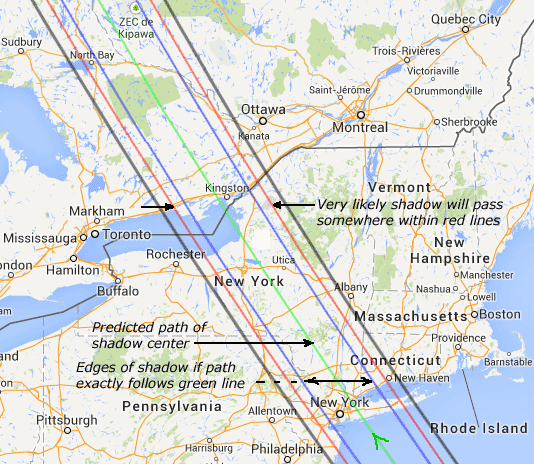
Part of the occultation path of Regulus. See link below. Credit: Geoff Hitchcox / IOTA and Sky & Telescope magazine
Here’s a link to the Sky and Telescope site with lots more information. Clicking on their map will bring up an interactive Google earth map.
07/15/2013 – Ephemeris – The moon will appear near Spica tonight
Ephemeris for Monday, July 15th. Today the sun will be up for 15 hours and 12 minutes, setting at 9:24. The moon, at first quarter today, will set at 12:48 tomorrow morning. Tomorrow the sun will rise at 6:12.
The moon this evening is very close to the bright star Spica. It might take a pair of binoculars to spot it in the glare of the moon. Spica will be just above left of the moon tonight. For other spots on the earth the moon will actually pass in front of the star. The event is called an occultation, from the word occult meaning hidden. Simply put the moon will pass in front of or hide the star for up to an hour. The chief beneficiary of this occultation is the state of Hawai’i. Occultations are one of the best ways to measure the position, diameter and shape of distant asteroids and Kuiper belt objects that are too small to measure otherwise. Satellites of these objects have also been discovered this way.
Times are for the Traverse City/Interlochen area of Michigan. They may be different for your location.
Addendum
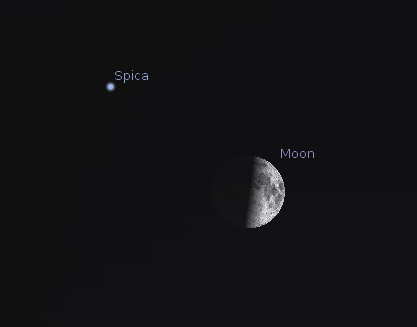
Spica and the Moon at 10 p.m. on July 15, 2013. Created using Stellarium.
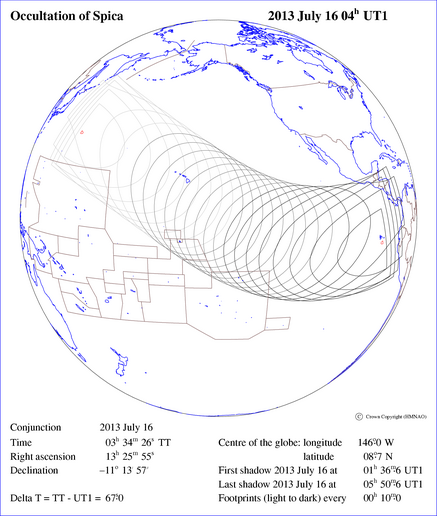
Path on the Earth where the occultation of Spica will be visible. Credit Astronomical Almanac Online.
The Astronomical Almanac Online ( http://asa.usno.navy.mil/) “is a joint publication of the U. S. Nautical Almanac Office, United States Naval Observatory (USNO), in the United States and Her Majesty’s Nautical Almanac Office (HMNAO), United Kingdom Hydrographic Office (UKHO), in the United Kingdom.”
 Bob Moler's Ephemeris Blog