Archive
08/10/2021 – Ephemeris – Tomorrow night, all night, will see the peak of the Perseid Meteor Shower.
This is Bob Moler with Ephemeris for Tuesday, August 10th. Today the Sun will be up for 14 hours and 16 minutes, setting at 8:55, and it will rise tomorrow at 6:40. The Moon, 2 days past new, will set at 10:27 this evening.
Back before astronomers recognized the major meteor shower that occurs at this time of year, the streaks of light in the sky of “falling” or “shooting” stars were called, by Christians, the Tears of Saint Lawrence, who was martyred on this day in the year 258. The bits of comet debris ranging in size from the size of sand grains to that of a pea hit our atmosphere at 38 miles (59 kilometers) per second and quickly vaporize due to friction, causing the streak of light we call meteors. They are called the Perseids since they appear to come from the constellation of Perseus, located in the northeastern sky. They will be best seen tomorrow night and into Thursday morning, with rates of up to one a minute, on average, in the early morning hours.
The astronomical event times given are for the Traverse City/Interlochen area of Michigan (EDT, UT – 4 hr). They may be different for your location.
Addendum
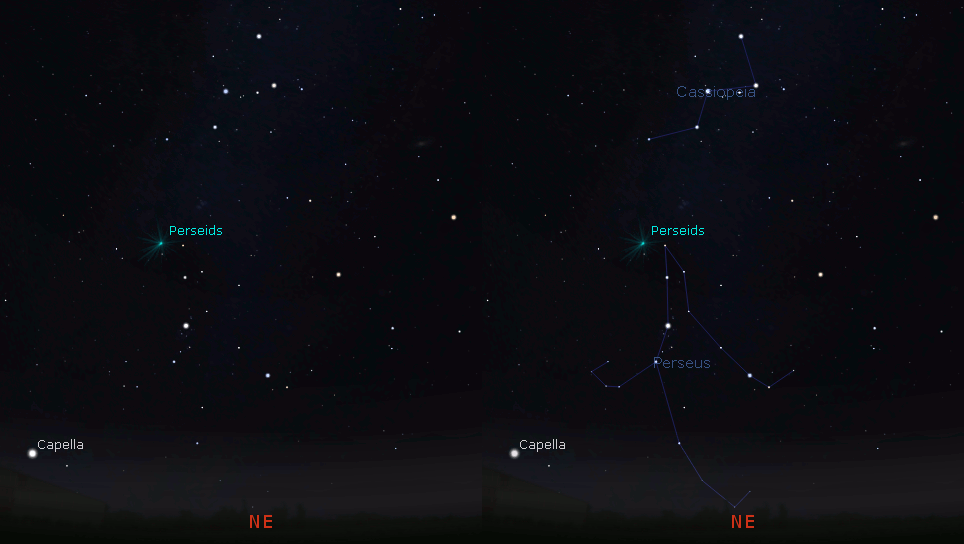
Perseid Radiant finder automation for midnight, August 11th. Created using Stellarium and GIMP.
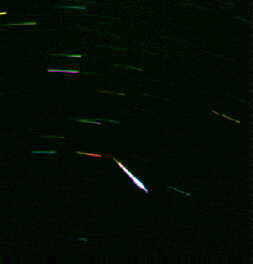
My best Perseid photo. From the 70s. The stars are trailed because this is a time exposure of perhaps 15 minutes and the camera is on a fixed tripod which rotates with the Earth.
06/28/2021 – Ephemeris – The summer Milky Way
This is Ephemeris for Monday, June 28th. Today the Sun will be up for 15 hours and 32 minutes, setting at 9:32, and it will rise tomorrow at 6:00. The Moon, 3 days before last quarter, will rise at 12:50 tomorrow morning.
Last night we had the latest sunset of the year. That’s great news for star gazers who like dark skies and the Sun is not among the stars they want to gaze at. But it won’t get noticeably darker earlier in the evening until late July. But when that does happen, the glory of the summer Milky Way becomes visible. On top of that, the peak night of the Perseid meteor shower, the night of August 11th and morning of the 12th. The three-day-old Moon that night won’t bother the meteor shower at all. The winter sky has the Milky Way also, but we are then looking out, away from the center of our galaxy. It’s hard to tell there’s a milky band there at all. In summer, we are looking toward the more populated parts of our galaxy. It’s a wonder to behold.
The astronomical event times given are for the Traverse City/Interlochen area of Michigan (EDT, UT-4). They may be different for your location.
Addendum
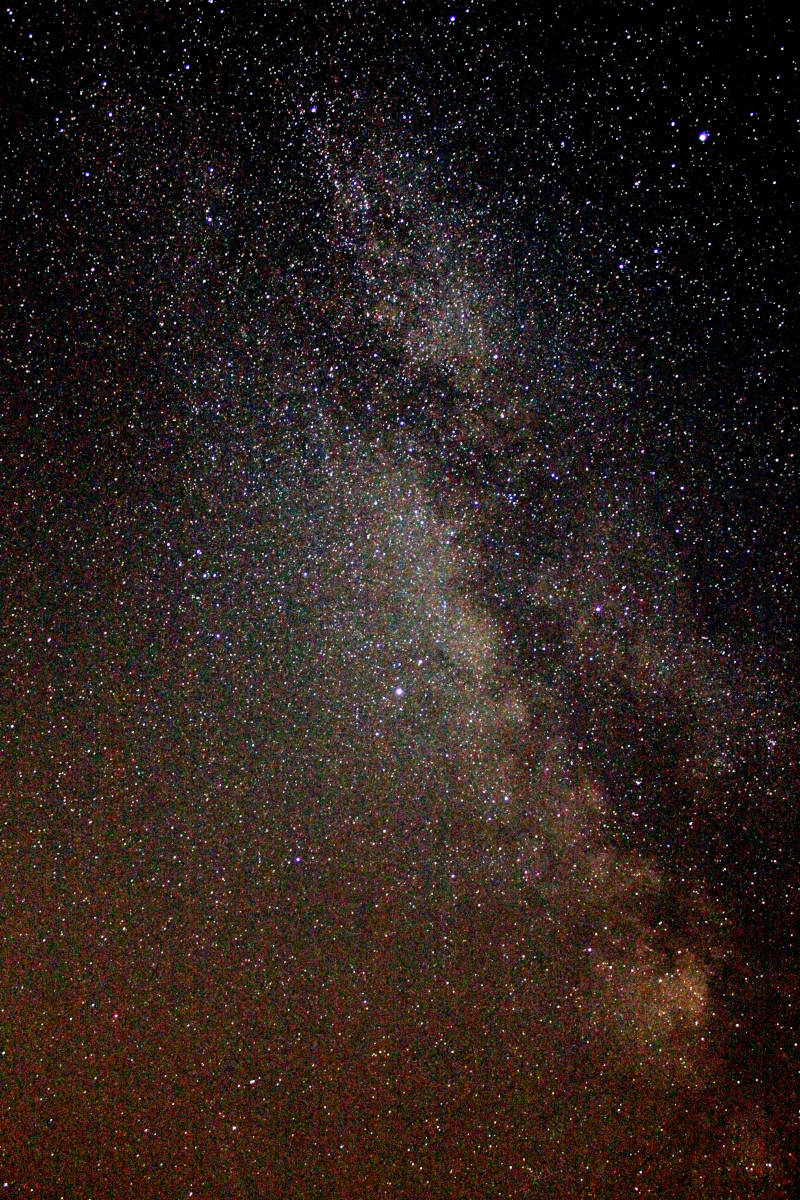
The Milky Way from Cygnus to Scutum. This image, actually a stack of 5 images, was taken on August 12, 2018. I was hoping to record Perseid meteors. It was a poor showing, as none appeared in these images. We were hampered that year by smoke from the western US wildfires, which really affected the lower part of this image, which was still pretty high up in the sky, by giving it a red tinge. Featured here is the Great Rift, a series of dust clouds that split the Milky Way into two sections, subject of previous and future programs. Click on the image to enlarge. Credit: Bob Moler (me).
07/27/2020 – Ephemeris – Two meteor showers, one near peak, another just starting
This is Ephemeris for Monday, July 27th. Today the Sun will be up for 14 hours and 49 minutes, setting at 9:13, and it will rise tomorrow at 6:25. The Moon, at first quarter today, will set at 1:18 tomorrow morning. | Tonight’s first quarter Moon will hinder the viewing of Comet NEOWISE and the Southern Delta Aquariid meteor shower until after moonset at 1:18 am. The meteor shower radiant will start out low southeastern sky and end up in the south as twilight brightens. It is usually during this meteor shower that the first Perseid meteors show up. The Perseid meteor shower is the most watched meteor shower of the year. It’s great every year except when there’s a bright Moon. This year the Perseids will reach their peak hourly numbers on the morning of August 12th after sunrise, unfortunately. The Moon will interfere after it rises at 12:46 am, which leaves two hours of moonless meteor viewing earlier on the evening of the 11th.
The event times given are for the Traverse City/Interlochen area of Michigan. They may be different for your location.
Addendum
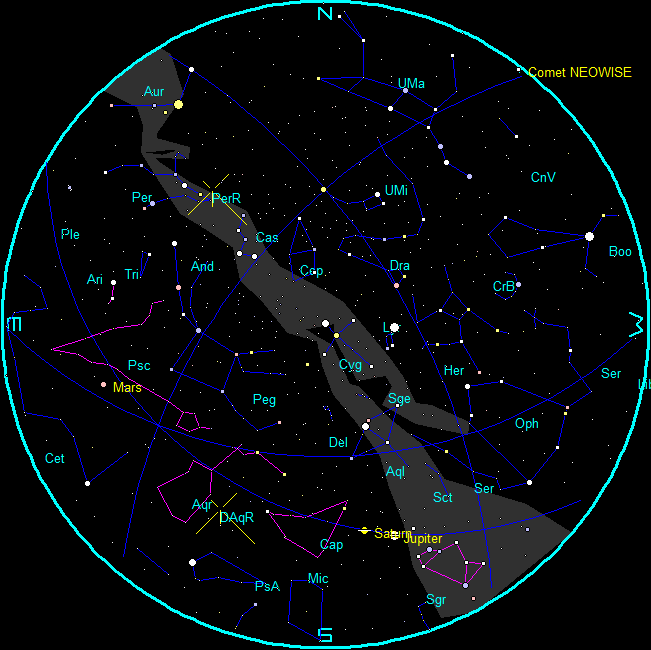
The Sky Dome at 2 am tomorrow morning July 28, 2020 at 2 am. DAqr is the approximate location of the Southern Delta Aquariid meteor shower and PerR is the approximate location of the Perseid radiant. Created using my LookingUp program.
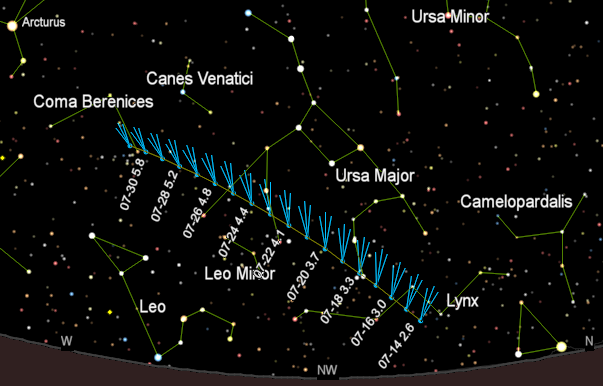
Comet NEOWISE in the evening for July 14, 2020 to July 31, 2020. The horizon is for July 14th at 11 p.m. Click on the image to enlarge. Created using Cartes du Ciel (Sky Chart).
08/05/2019 – Ephemeris – Previewing the Perseid meteor shower
Ephemeris for Monday, August 5th. Today the Sun will be up for 14 hours and 30 minutes, setting at 9:03, and it will rise tomorrow at 6:34. The Moon, 2 days before first quarter, will set at 12:01 tomorrow morning.
After the Moon sets in the morning hours for the next week and a half the numbers of meteors visible will increase each night. These are members of the Perseid meteor shower of August. The peak this year is expected to be during the morning of the 13th. However by then the Moon will be nearly full. These meteors are the result of debris left along the orbit of Comet 109P/Swift-Tuttle shed by innumerable visits to the inner solar system. Every year at this time the Earth passes through this trail of debris which intersects its orbit giving rise to the meteor shower. We call them the Perseids, because they appear to come from the direction of the constellation Perseus the hero, which is first seen in the early evening low in the northeast.
The times given are for the Traverse City/Interlochen area of Michigan. They may be different for your location.
Addendum
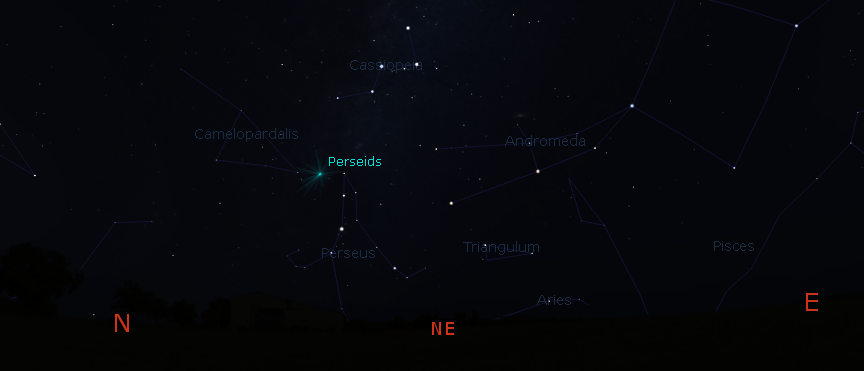
The Perseid radiant is located off the highest star in Perseus as it ascends the sky at about 10:30 p.m. The Perseid radiant is circumpolar for observers in northern Michigan. Click on the image to enlarge. Created using Stellarium.
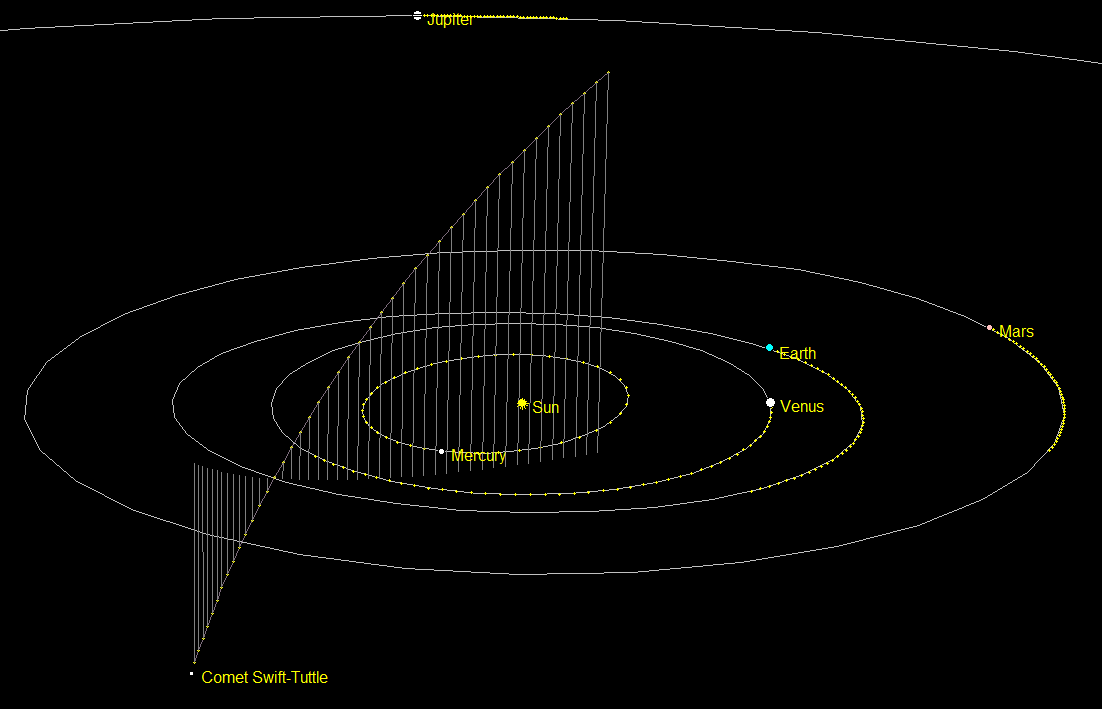
The passage of Comet 109P/Swift-Tuttle through the inner solar system November 1, 1992 to January 30, 1993. The meteoroids shed by the comet on its numerous trips close to the Sun lie close to that orbit. Note that its orbit intersects with the Earth’s orbit. That’s where the Earth will be around August 12-13 every year. Created using my LookingUp program.
08/10/2018 – Ephemeris – A busy weekend here and in the skies
Ephemeris for Friday, August 10th. The Sun rises at 6:39. It’ll be up for 14 hours and 16 minutes, setting at 8:56. The Moon, 1 day before new, will rise at 6:45 tomorrow morning.
It’s a busy weekend for the Grand Traverse Astronomical Society. Members will be on Front Street in Traverse City tonight for Friday Night Live with views of the Sun and later a look at the planet Saturn and its rings, weather permitting. On Saturday, again weather permitting members will be part of Sleeping Bear Dunes Port Oneida Fair with a Sun ‘n Star Party from 4 to 6 p.m. and from 9 to 11 p.m., though members will still be there in between. The location for that event is the Thoreson Farm on South Thoreson Road off M22, near Port Oneida Road. On tap will be Venus, Jupiter, Saturn, Mars and some of the Perseid meteors on the night before its peak night, plus some of the deep sky wonders of the summer Milky Way.
The times given are for the Traverse City/Interlochen area of Michigan. They may be different for your location.
Addendum

Viewing the Sun with a while light filter at Friday Night Live using Ron Uthe’s telescope at Friday Night Live. Credit Bob Moler
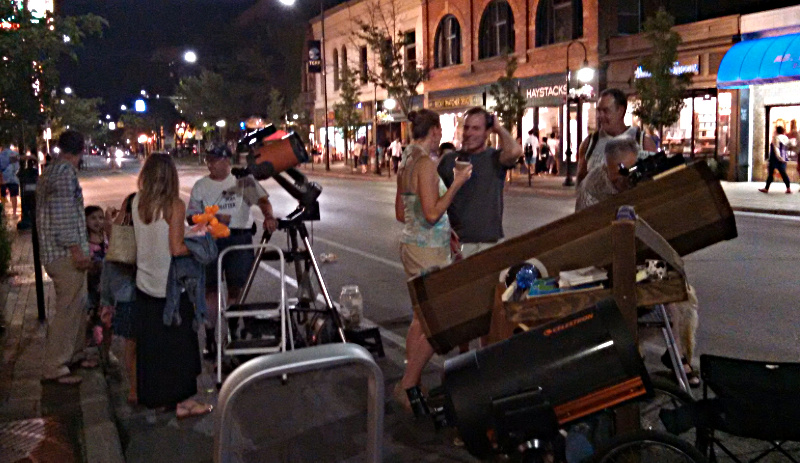
After Friday Night Live was over Saturn was visible until about 11 p.m. Credit: Bob Moler.
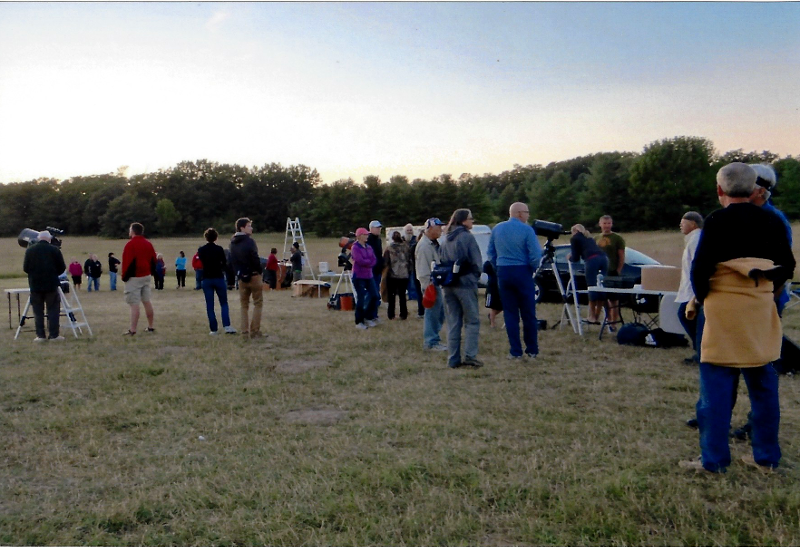
Star Party at the Sleeping Bear Dunes National Lakeshore, Thoreson Farm August 2013. Credit Eileen Carlisle.
08/09/2018 – Ephemeris – How to observe the Perseid Meteor Shower
Ephemeris for Thursday, August 9th. The Sun rises at 6:38. It’ll be up for 14 hours and 19 minutes, setting at 8:57. The Moon, 2 days before new, will rise at 5:30 tomorrow morning.
Now through most of this month and reaching peak numbers Sunday evening and Monday morning the Perseid meteors will be shooting through our skies. Where to look? Up is the direction. All over the sky. They will seem to come from the northeast on parallel paths, like driving through a snow storm at night, the snowflakes will diverge from right in front of you. The numbers will generally increase as that radiant point rises higher in the sky. A diligent experienced, and undistracted, observer may see up to 100 or more an hour. Casual observers will see much less. The longest meteor streaks will be seen early in the evening when the meteoroids enter the atmosphere at 37 miles (59 km) per second at a very shallow angle, so last a bit longer. Bring a blanket, dress warmly and enjoy the show!
The times given are for the Traverse City/Interlochen area of Michigan. They may be different for your location.
Addendum
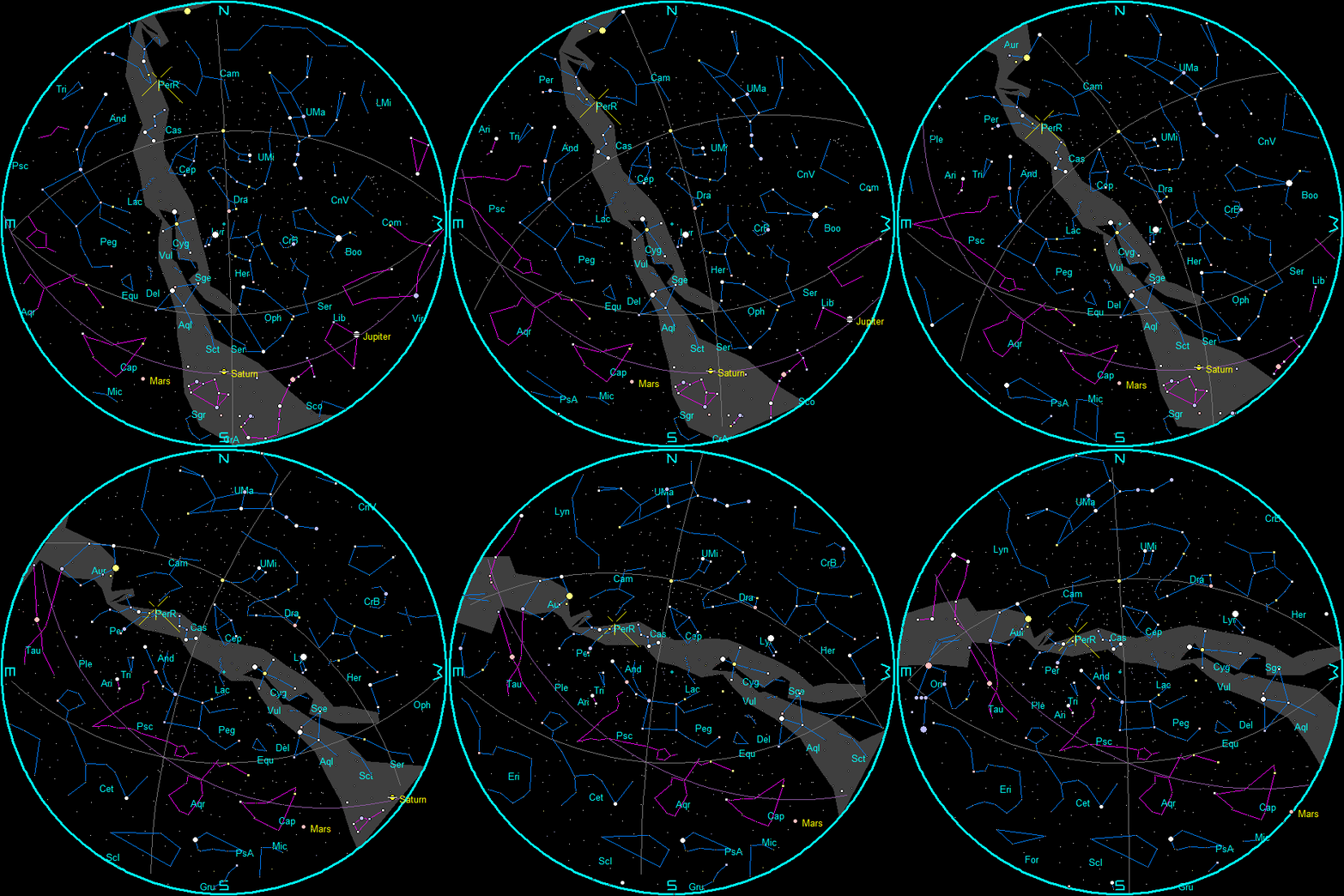
The sky dome for the night of the Perseid shower maximum at 1 hour intervals from 10:30 p.m. to 4:30 a.m. Click on image to enlarge. Created using my LookingUp program and GIMP.
For locations other than the Traverse City/Interlochen area the 10:30 step is approximately an hour and a half after sunset.
My best Perseid photo. From the 70’s.
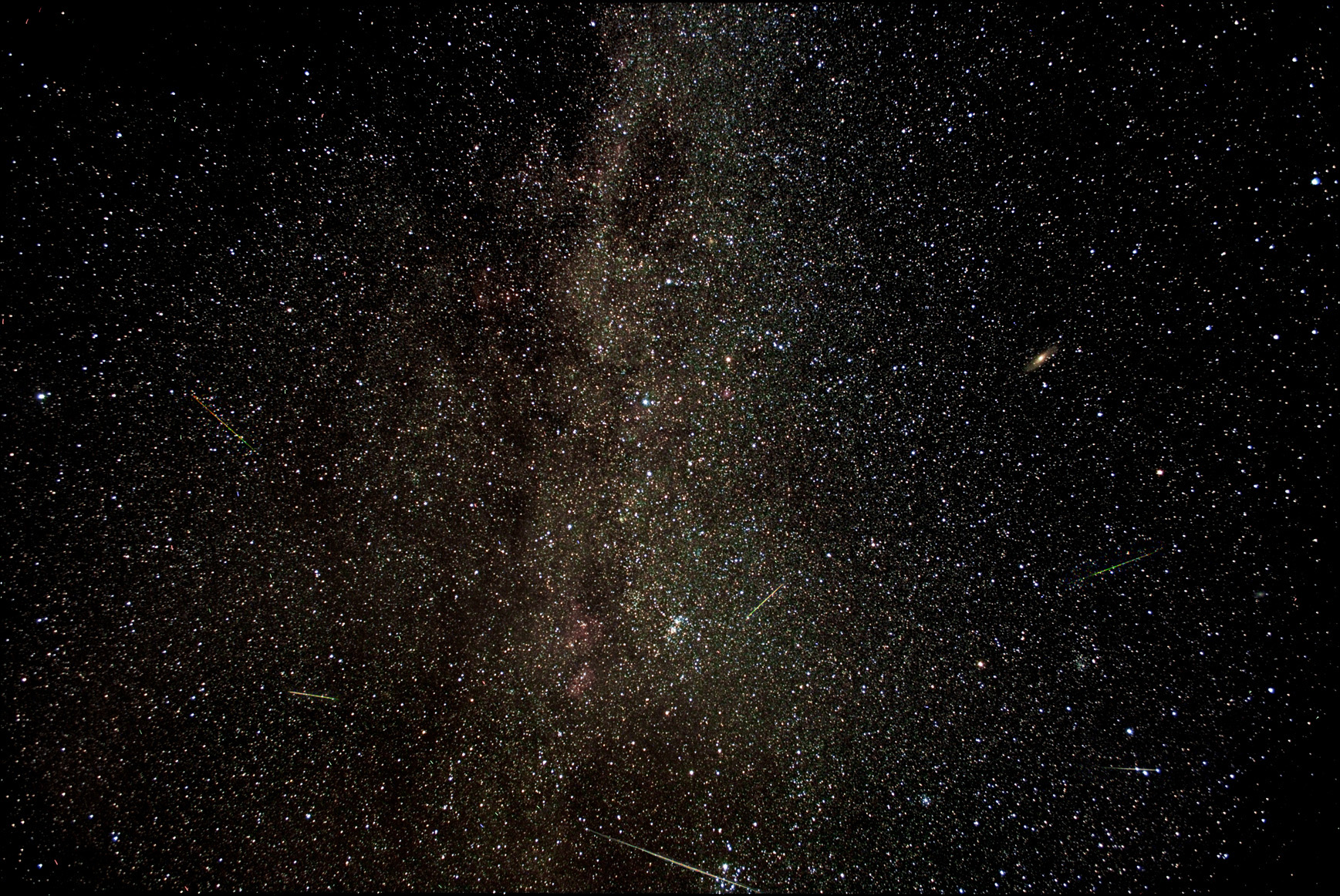
Here are some meteors seen in the 2007 Perseid meteor shower taken by Scott Anttila. The image is centered on Cassiopeia. The radiant is low and a bit left of center in the image. The Double Cluster is seen below center and the Great Andromeda Galaxy is seen on the right just above center.
The logic of taking meteor photos pointing near the radiant is the he meteors appear to travel slower there because they are coming mostly toward the camera and have a better chance of being picked up. My photograph was unguided, so the stars trailed. Scott’s was guided.
08/07/2018 – Ephemeris – The source of the Perseids
Ephemeris for Tuesday, August 7th. The Sun rises at 6:35. It’ll be up for 14 hours and 24 minutes, setting at 9:00. The Moon, 3 days past last quarter, will rise at 3:18 tomorrow morning.
The Perseid meteor shower will reach its peak Sunday night and Monday morning, less than a week from now. The meteor shower is caused by tiny particles shed by the comet 109P/Swift-Tuttle on past trips through the inner solar system. The 109P means it was recognized as the 109th comet to have seen to return to the vicinity of the Sun to be rediscovered in 1992. Lewis Swift and Horace Tuttle first discovered the comet independently in 1862. The orbit of the comet fit the orbits of the meteoroids that produce the Perseid meteor shower each year. The comet will return in 2126 after retreating to 51 times the Earth’s distance from the Sun, deep in the Kuiper belt, leaving behind a trail of meteoroids.
The times given are for the Traverse City/Interlochen area of Michigan. They may be different for your location.
Addendum
The passage of 109P/Comet Swift-Tuttle through the inner solar system November 1, 1992 to January 30, 1993. The meteoroids shed by the comet on its numerous trips close to the Sun lie close to that orbit. Note that its orbit intersects with the Earth’s orbit. That’s where the Earth will be around August 12-13 every year. Click on the image to enlarge. Created using my LookingUp program.
08/06/2018 – Ephemeris – The meteors of August, the Perseids are showing up now
Ephemeris for Monday, August 6th. The Sun rises at 6:34. It’ll be up for 14 hours and 27 minutes, setting at 9:01. The Moon, 2 days past last quarter, will rise at 2:27 tomorrow morning.
Over the past several weeks folks outdoors at night might have been seeing some shooting stars or meteors appearing to zip past in the sky. The ones I’m talking about seem to come from the northeast. These are the precursors of the Perseid meteor shower which will reach its peak on the night of August 12 and 13 this year. Over the millennia the meteoroid stream that feeds the meteors to our skies has spread out to last over a month from the latter half of July to three-quarters of August. We’ll meet the culprit for this show tomorrow. I try to use the proper terminology for all this. Meteoroid is the tiny body in space. In the Perseid’s case the size of a grain of sand to a pea. Meteor is the streak we see in the sky as it burns up. Meteorite is the body that makes it to the ground. To my knowledge no Perseid meteoroid has made it that far.
The times given are for the Traverse City/Interlochen area of Michigan. They may be different for your location.
Addendum
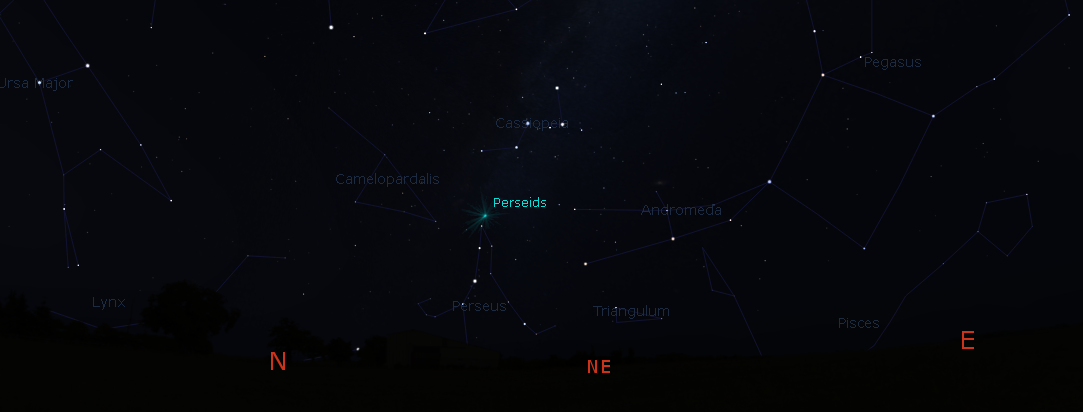
The Perseid radiant at 11 p.m. tonight, August 6, 2018. Note that the radiant position is different from what I show on my charts for the month. The radiant there is for the night of the Maximum, August 12th. The radiant point shifts with time due to Earth’s changing position with the meteoroid stream. Click on image to enlarge. Created using Stellarium.
Ephemeris Extra – The great meteor shower of August
This post from the Grand Traverse Astronomical Newsletter “Stellar Sentinel” was written for August of 2018. The dates and times of the peak may change a bit from year to year.
The Perseid meteor shower is the second most active annual meteor shower. The most active is the Geminids of December during a period that’s cold and generally very cloudy here in Northern Michigan. Consequently, I’ve never seen a Geminid meteor.
The Perseid meteor shower is the most famous as the August meteor shower, coming on the warm summer month. In Northern Michigan the radiant of the shower, the point in the sky from which they appear to come, is circumpolar, which means they are visible anytime in dark skies from dusk to dawn.
The Perseids are so named because they appear to come from near the constellation of Perseus the hero, an autumn constellation that starts the evening low in the northeast and rises and moves to high in the east near dawn. In earlier times these meteors were called the Tears of St. Lawrence, who was martyred in AD 255. His Feast day is August 10th, the day he died, which falls very close to the peak activity of the shower.
The Perseid meteors are visible for over a month from about July 17th to August 24th, with peak activity between August 12th at 4 p.m. to August 13th at 4 a.m. EDT. So the peak activity will partially be during our night hours, and the one day old Moon will not interfere at all. The peak hourly rate may reach 100 per hour at times. All things being equal, the higher the radiant is in the sky the greater the numbers of meteors seen. The Perseid radiant will be rising all night, being highest as the first light of dawn appears. Even though the numbers of meteors are fewer I like to start looking by 10:30 p.m. With the radiant low in the sky, the meteoroid particles we see are almost skimming the atmosphere, lasting longer. There’s is nothing so cool as to see a bright Perseid meteor seeming to fly along the Milky Way. The radiant point is in the Milky Way between Perseus below, and Cassiopeia above.
The Perseid radiant is located off the highest star is Perseus as it rises about 11 p.m. August 12, 2018. Click on the image to enlarge. Created using Stellarium.
Observing this meteor shower is very easy and one needs no special equipment. A blanket to lie on, mosquito repellent, warm clothes, some water and snacks, if staying the night, and a dark location. My preferred location is the Dune Climb at the Sleeping Bear Dunes National Lakeshore. It has no light, except the occasional car lights and has modern restroom facilities and a low horizon except in the west. I supposed one could climb up the dune to get rid of even the car lights. Even though the radiant is in the northeast, the meteors will appear all over the sky.
Binoculars are nice to take a break to explore the Milky Way and to observe the smoky train left by a particularly bright meteor. These can be viewed for a minute of more and deform and twist due to the different wind directions and speeds at different altitudes.
What causes the Perseid meteor shower and why does it occur at the same time every year?
The Perseid meteor shower, like all meteor showers are caused by the debris left along the orbits of comets. If the comet’s orbit crosses close to the Earth’s orbit we can get a meteor shower. Comets spend the majority of their time far from the Sun, where it’s very cold, and are in very elongated orbits.
Comets are made from rocky bits, dust and frozen gasses. As the comet comes into the inner solar system the Sun heats it up and the frozen gasses sublimate, are ionized by the Sun’s radiation and are caught into the thin ion tail. This liberates the comet’s fine dust which is blown away from the Sun by the pressure of sunlight into a broad dust tail. Larger particles end up traveling in the comet’s path, and are affected mainly by the Sun and the various gravitational tugs of the planets.
The comet responsible for the Perseids is 109P/Swift-Tuttle. It was independently discovered by L. Swift and P. Tuttle in 1862. It was recorded as being seen in 69 BC by, you guessed it, the Chinese. It’s a big comet, with a nucleus some 16 miles in diameter, and it crosses the Earth’s orbit, so it is a potentially hazardous object, and if it hit the Earth, would wreak more damage than the asteroid that killed the dinosaurs. From the 1862 appearance the comet was given a period of 120 years. It didn’t show in 1982. An observation of the previous appearance of the comet in 1737 allowed a recalculation of the orbit and a new return year of 1992. That was correct. The comet was recovered that year.
The comet will return in 2126. The calculations used to predict the 1992 return suggested that the comet could possible collide with the Earth. However observations of the 1992 appearance of the comet determined that the comet, though it would pass close to the Earth, is not a hazard. But it should be really bright. I can’t wait!
08/08/2017 – Ephemeris – The Harvest Moon effect starts showing up 2 months early
Ephemeris for Tuesday, August 8th. The Sun rises at 6:37. It’ll be up for 14 hours and 20 minutes, setting at 8:58. The Moon, 1 day past full, will rise at 9:34 this evening.
The Harvest moon is nearly 2 months away, but some of its effects are starting to be felt now. I call it the Harvest Moon Effect. The Harvest Moon is a bit late this year, October 5th. It’s defined as the nearest full moon to the autumnal equinox. However from August to October the rising times of the full Moon and nights after for the next week don’t advance very fast. On average the Moon rises 50 minutes later each night. Between tonight and tomorrow night the interval will be 32 minutes. This is kind of a bummer this weekend when the Perseid meteor shower reaches peak. As with most meteor showers, the most meteors seen are after midnight. Saturday night’s Perseid peak has the Moon, six days after full rising at 11:36 p.m.
The times given are for the Traverse City/Interlochen area of Michigan. They may be different for your location.
Addendum
Moonrise time intervals for the rest of this week:
| Date | Moonrise | Difference |
| 08/08/17 | 9:34 p.m. | |
| 32 minutes | ||
| 08/09/17 | 10:06 p.m. | |
| 30 minutes | ||
| 08/10/17 | 10:36 p.m. | |
| 30 minutes | ||
| 08/11/17 | 11:06 p.m. | |
| 30 minutes | ||
| 08/12/17 | 11:36 p.m. | |
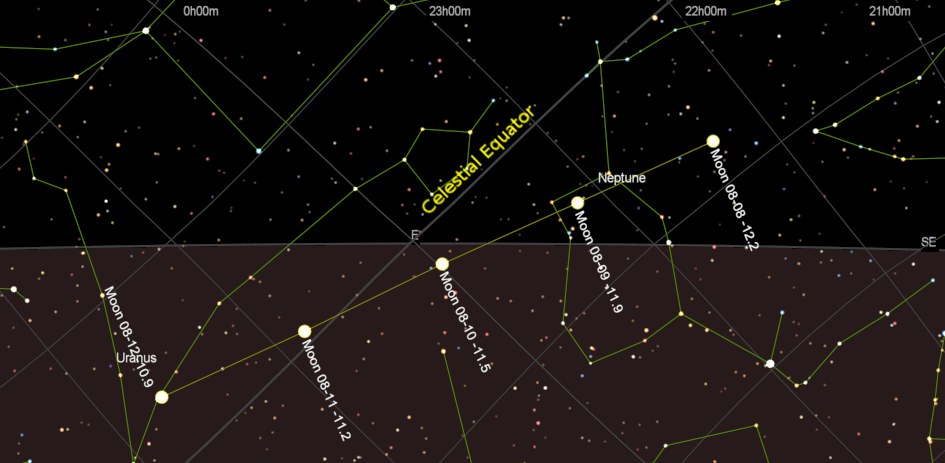
Harvest Moon Effect for this week. Note how shallow the path of the Moon is in relation to the eastern horizon. I’ve made the earth transparent so we can see the Moon below the horizon. As the Earth rotates the Moon will rise in a direction parallel to the celestial equator. In contrast the Moon’s path around March is steeper than average, so the interval in consecutive lunar rise times is much longer than the 50 minute average. Created using Cartes du Ciel (Sky Charts).
 Bob Moler's Ephemeris Blog