Archive
Ephemeris: 11/04/2025 – The Persephone Period starts tomorrow
This is Bob Moler with Ephemeris for Election Day for some, Tuesday, November 4th. Today the Sun will be up for 10 hours and 1 minute, setting at 5:26, and it will rise tomorrow at 7:26. The Moon, 1 day before full, will set at 7:41 tomorrow morning.
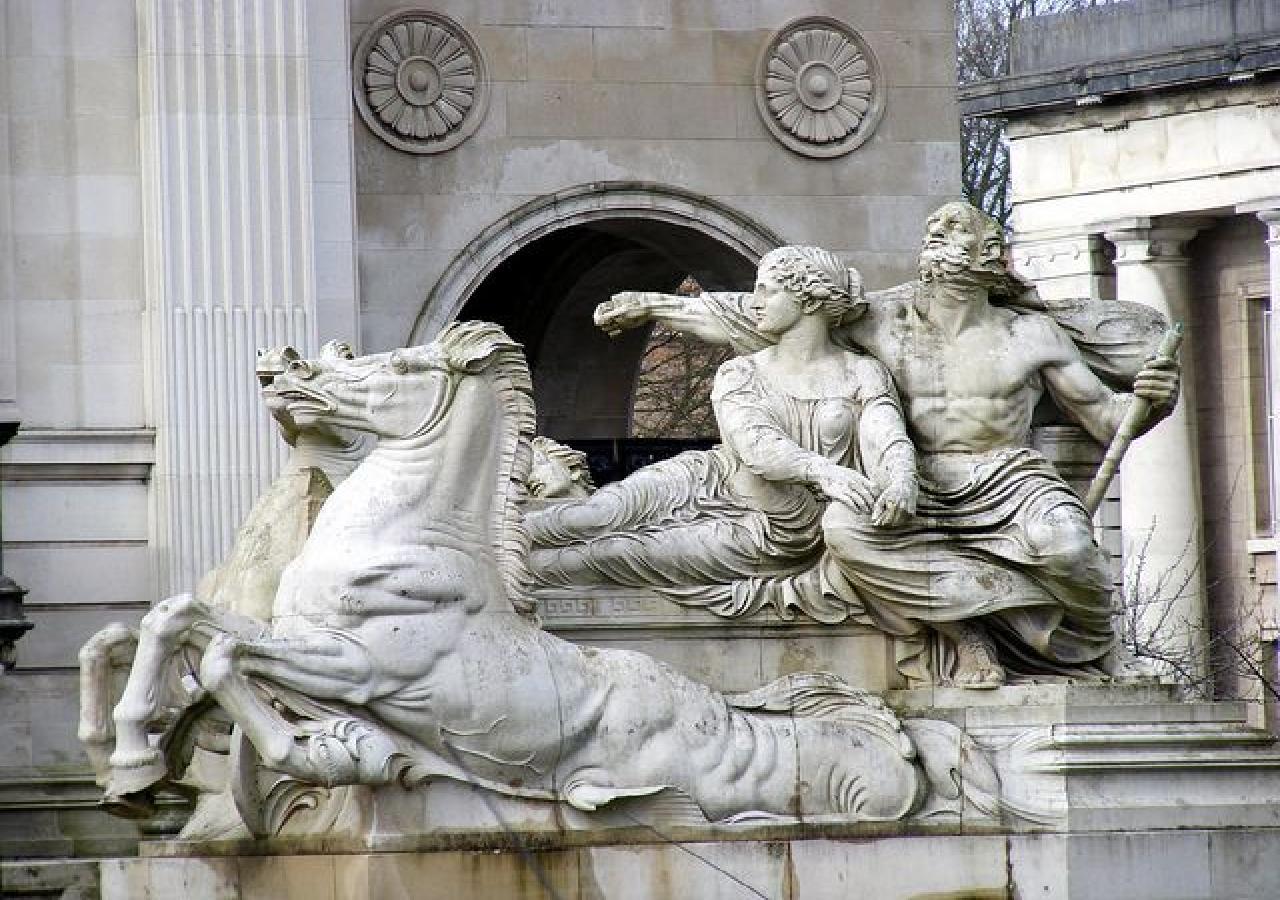
Tomorrow the daylight hours drops below 10 hours. This begins something which has been called the Persephone Period. It is named after the Greek goddess Persephone, goddess of spring, who is abducted by Hades the god of the underworld to be his bride. When he did, all the vegetation on the earth began to die. So he had to allow her to appear above ground for a part of the year so that the vegetation and the grain would grow. So the Persephone Period is the time when she is in the underworld. It lasts from now to early February. That may have worked for a country like Greece around the Mediterranean, but we have harsher weather here. It takes a much longer time for spring to arrive.
The astronomical event times given in this blog are for the Traverse City/Interlochen area of Michigan (Lat 44.7° N, Long 85.7° W; EDT, UT – 4 hours) unless stated otherwise. Times will be different for other locations.
Addendum
02/06/2023 – Ephemeris – The Persephone Period is ending
This is Ephemeris for Monday, February 6th. Today the Sun will be up for 10 hours and 2 minutes, setting at 5:58, and it will rise tomorrow at 7:54. The Moon, 1 day past full, will rise at 6:53 this evening.
All over the Interlochen Public Radio broadcasting region, the Persephone period is ending. What’s the Persephone period? The Persephone period is a time when the daylight hours drop below 10 hours a day. Around here, this would affect natural lighted greenhouses, since our world is still covered in snow. This is because plants don’t grow very well with less than 10 hours of sunlight. It is named for the Greek goddess Persephone, who is goddess of crops that are sewn. She was kidnapped by her uncle Hades, the god of the Underworld, and was made his bride and became Queen of the Underworld. However, every time she went down to the underworld all the plants on the surface of the earth died, so Zeus made an arrangement with Hades that she could only be in the underworld for part of the year.
The astronomical event times given are for the Traverse City/Interlochen area of Michigan (EST, UT –5 hours). They may be different for your location.
Addendum
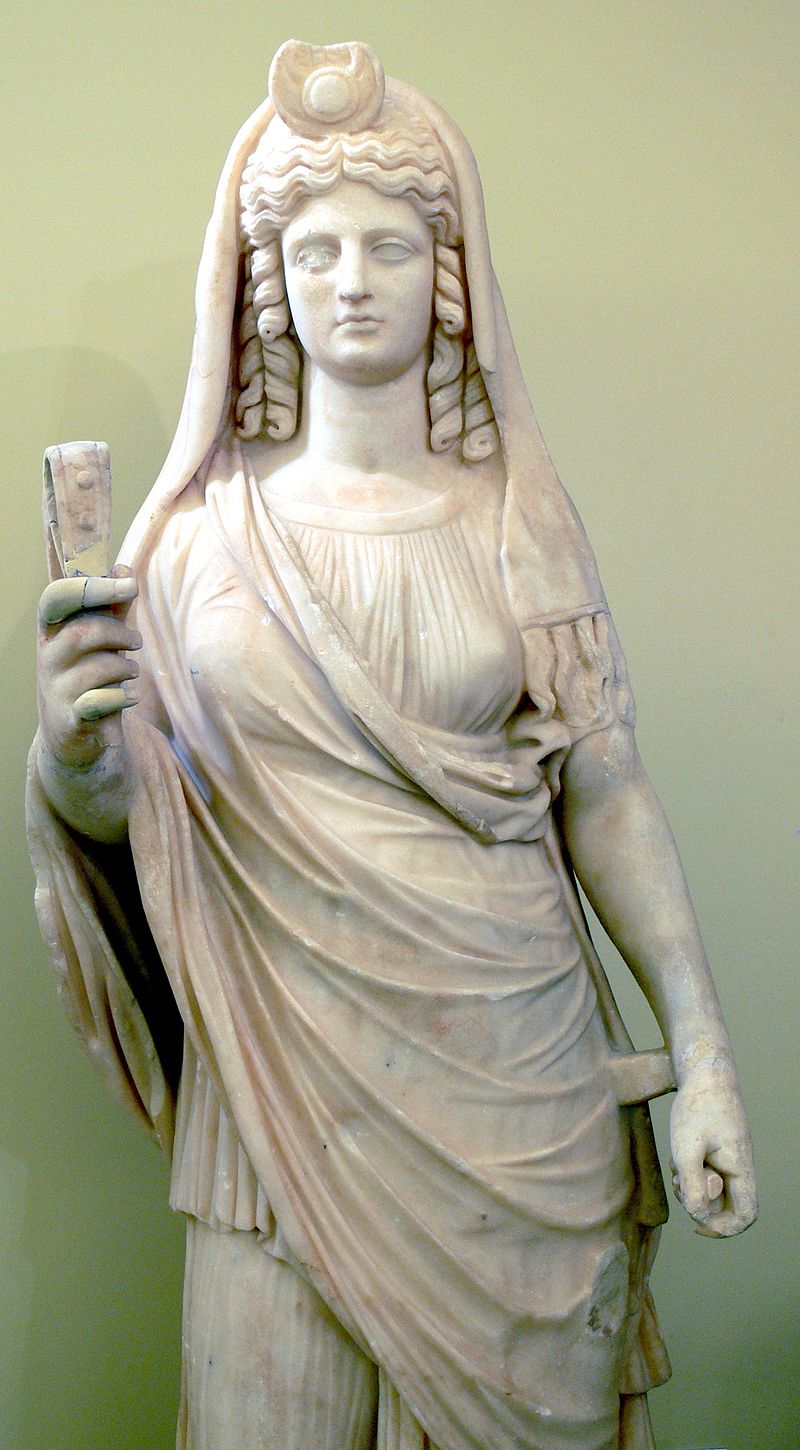
Statue of Persephone-Isis at the Heraklion Archaeological Museum, Crete. Credit: Wolfgang Sauber.
In the Interlochen/ Traverse City area, the Persephone period runs from about November 5th to about February 6th. Of course, we make up for it in late spring and early summer with up to 15 1/2 hours of daylight near the summer solstice.
05/14/2015 – Ephemeris – The constellation Virgo in mythology
Ephemeris for Thursday, May 14th. Today the Sun will be up for 14 hours and 46 minutes, setting at 9:02. The Moon, 3 days past last quarter, will rise at 4:51 tomorrow morning. Tomorrow the Sun will rise at 6:14.
Tonight in the sky: to the left of the constellation of Leo the lion, which lies in the west-southwest at 11 p.m. is the next constellation of the zodiac: Virgo the virgin, is seen in the south. Virgo is a large constellation of a reclining woman holding a stalk of wheat. The bright star in the center of the constellation, Spica, is the head of that spike of wheat; and as such ruled over the harvest in two of Virgo’s guises as the goddesses Persephone and Ceres. Virgo is also identified as Astraea the goddess of justice. The constellation of Libra, the scales, is found just east of her. Early Christians saw Virgo as the Virgin Mary. Virgo is the home of the Virgo Cluster of thousands of galaxies.
Times are for the Traverse City/Interlochen area of Michigan. They may be different for your location.
Addendum
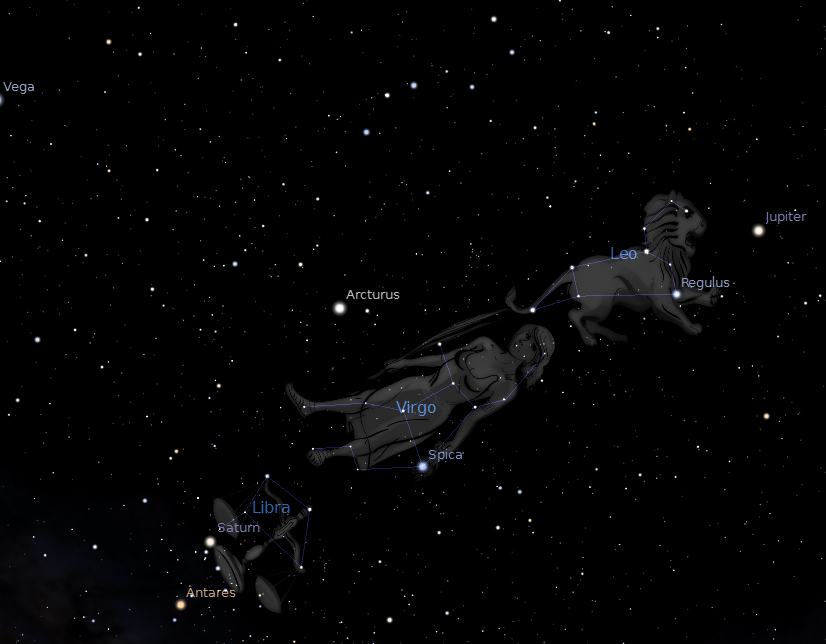
Virgo with the also mentioned constellations of Leo and Libra for 11 p.m., May 14, 2015. Created using Stellarium.
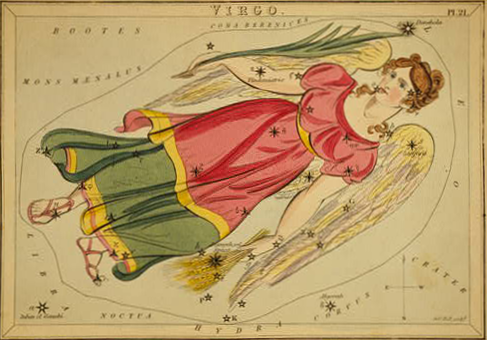
Virgo as depicted in Urania’s Mirror, a set of constellation cards published in London c.1825. From the Library of Congress. H/T Wikipedia.
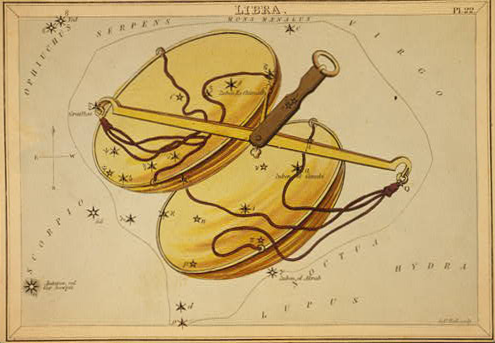
Libra as depicted in Urania’s Mirror, a set of constellation cards published in London c.1825. From the Library of Congress. H/T Wikipedia.
05/30/2013 – Ephemeris – The constellation of the harvest, Virgo
Ephemeris for Thursday, May 30th. Today the sun will be up for 15 hours and 17 minutes, setting at 9:19. The moon, 1 day before last quarter, will rise at 1:42 tomorrow morning. Tomorrow the sun will rise at 6:00.
Tonight in the sky: to the south, with the bright Saturn to the left of the bright star Spica is the constellation and member of the of the zodiac: Virgo the virgin. Virgo is a large constellation of a reclining woman holding a stalk of wheat. The bright star in the center of the constellation, Spica, is the head of that spike of wheat; and as such it ruled over the harvest in two of Virgo’s guises as the goddesses Persephone and Ceres. Virgo is also identified as Astraea the goddess of justice. The constellation of Libra, the scales, which she is associated with, is found just east of her low in the southeast. Early Christians saw Virgo as the Virgin Mary. Virgo is the host to a grand cluster of galaxies.
Times are for the Traverse City/Interlochen area of Michigan. They may be different for your location.
Addendum
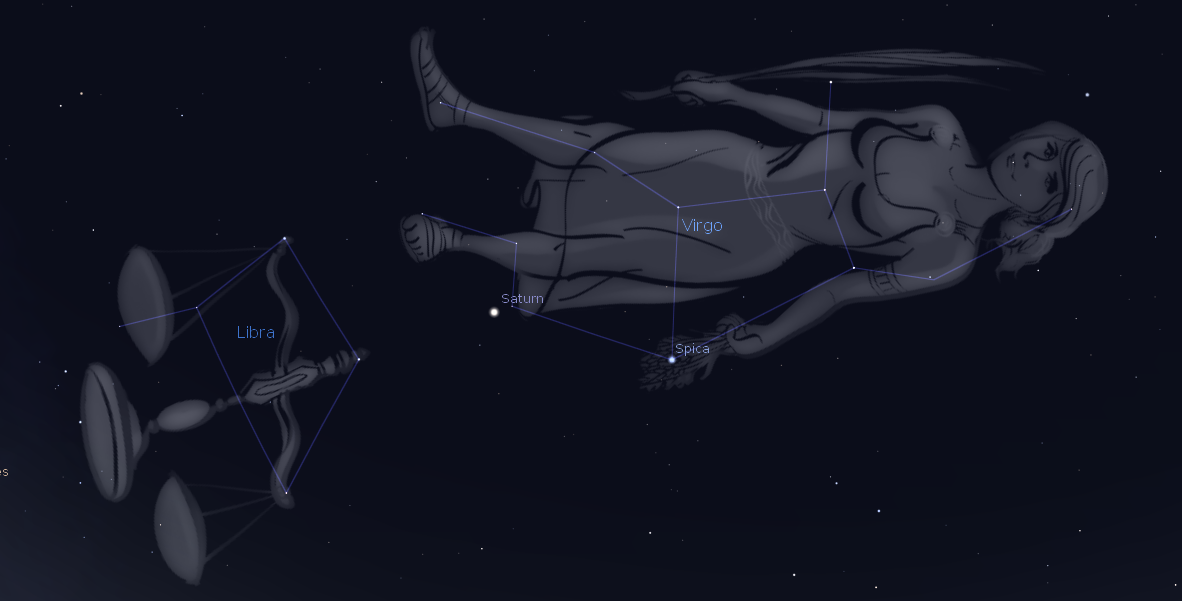
Virgo, Saturn and Libra at 11 p.m. on May 30, 2013. Created using Stellarium.
04/12/2012 – Ephemeris – The constellation Virgo the virgin
Ephemeris for Thursday, April 12th. The sun will rise at 7:02. It’ll be up for 13 hours and 21 minutes, setting at 8:24. The moon, 1 day before last quarter, will rise at 3:02 tomorrow morning.
Tonight in the sky: to the left of the constellation of Leo the lion, which lies in the south at 10 p.m. is the next constellation of the zodiac: Virgo the virgin, seen in the south southeast. Virgo is a large constellation of a reclining woman holding a stalk of wheat. The bright star in the center of the constellation, Spica, is the head of that spike of wheat; and as such ruled over the harvest in two of Virgo’s guises as the goddesses Persephone and Ceres. The planet Saturn is also in Virgo this year to the left of Spica. Virgo is also identified as Astraea the goddess of justice. The constellation of Libra, the scales, is found just east of her a couple of hours later, not yet risen at 10 p.m. Early Christians saw Virgo as the Virgin Mary.
* Times are for the Traverse City/Interlochen area of Michigan. They may be different for your location.
Addendum
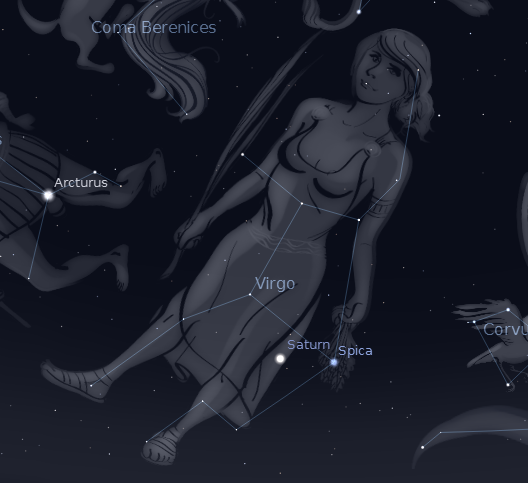
Virgo 2012. Created using Stellarium.
 Bob Moler's Ephemeris Blog