Archive
03/24/2014 – Ephemeris – The spring constellation of Leo the lion
Ephemeris for Monday, March 24th. The sun will rise at 7:38. It’ll be up for 12 hours and 21 minutes, setting at 7:59. The moon, 1 day past last quarter, will rise at 4:09 tomorrow morning.
Tonight about 10:00 the constellation of Leo the lion can be seen half way up the sky in the east-southeast. The head and mane of a male lion is seen as a backward question mark. This pattern of stars is also called the sickle. The bright star that is the dot at the bottom is Regulus, the “Little King Star”. To the lower left is a triangle of stars that is the lion’s hind end with the star Denebola at the far end. It is said that the reason the figure of a lion came to be seen in the stars here is because lions came from the desert, driven by the heat, to drink from the river Nile the time of the year that the sun was in this part of the sky. Leo is one of the constellations of the Zodiac. Leo can also be found by first locating the Big Dipper high in the northeast. Imagine a hole drilled in the bowl of the dipper and the water will fall on Leo’s back.
Times are for the Traverse City/Interlochen area of Michigan. They may be different for your location.
Addendum
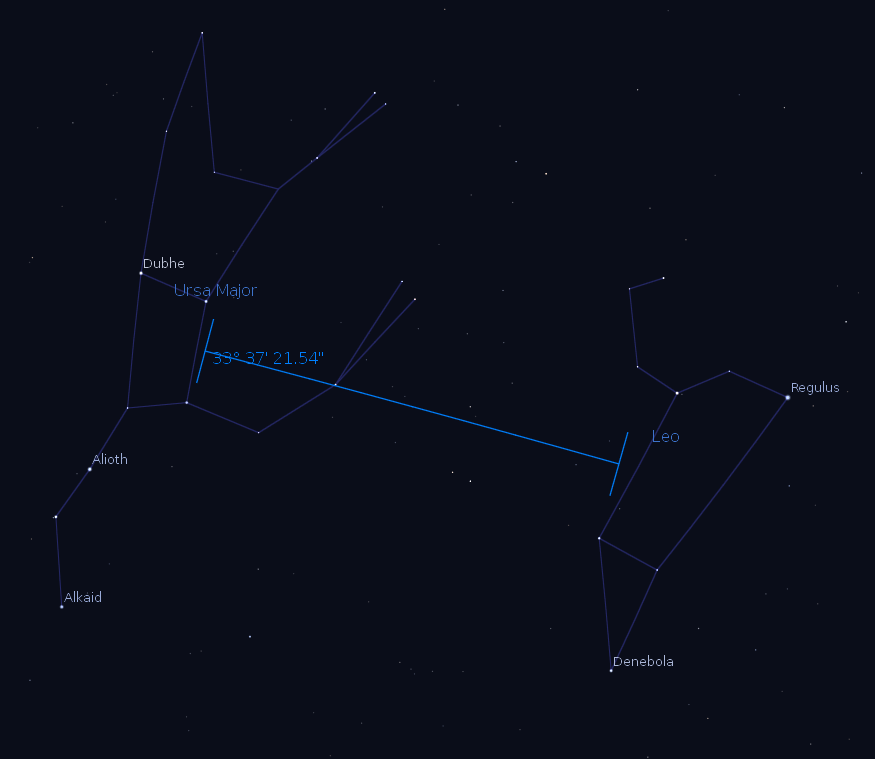
Leo and the Big Dipper (Ursa Major) using the angle measuring tool as an arrow. Date: March 24, 10 p.m. Created using Stellarium.
03/18/2014 – Ephemeris – Thursday a.m. many folks including New Yorkers will see a bright star wink out
Ephemeris for Tuesday, March 18th. The sun will rise at 7:49. It’ll be up for 12 hours and 3 minutes, setting at 7:52. The moon, 2 days past full, will rise at 10:15 this evening.
On Thursday morning the 20th around 2 a.m. the star Regulus, the brightest star in the constellation Leo the lion will wink out for up to 14 seconds for observers in New York City. That will be exceptionally cool, because Regulus is one of the few stars actually bright enough to be visible from that metropolis. Regulus will not be at fault, but for a narrow band of the earth running northwest of there the asteroid 163 Erigone will pass in front of Regulus in an extremely rare occultation of a bright star. This will allow observers on the ground to time the duration of the event and put together the silhouette of the asteroid, which is thought to be 45 miles wide. Observers have in the past spotted secondary occultations of another asteroid and discovered an asteroid satellite.
Times are for the Traverse City/Interlochen area of Michigan. They may be different for your location.
Addendum
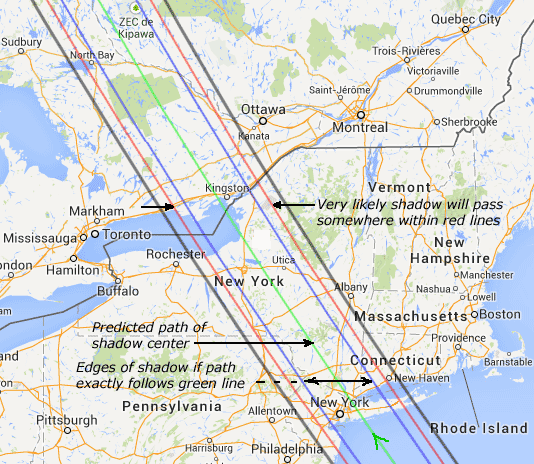
Part of the occultation path of Regulus. See link below. Credit: Geoff Hitchcox / IOTA and Sky & Telescope magazine
Here’s a link to the Sky and Telescope site with lots more information. Clicking on their map will bring up an interactive Google earth map.
03/03/2014 – Ephemeris – The dim zodiacal constellation of Cancer the Crab
Ephemeris for Monday, March 3rd. The sun will rise at 7:16. It’ll be up for 11 hours and 16 minutes, setting at 6:33. The moon, 2 days past new, will set at 9:44 this evening.
At 9 this evening, the faint constellation, and member of the Zodiac, Cancer the crab is located in the south-southeast half way between the bright stars Castor and Pollux of the constellation Gemini, high in the south and the bright star Regulus in Leo the lion in the east Cancer is very dim, looking like an upside-down Y. In the center of Cancer is a fuzzy spot to the unaided eye. In binoculars or a low power telescope this fuzzy spot becomes a cluster of stars. It is the Beehive cluster. At 525 light years away, it is one of the closest star clusters, but more distant than the Pleiades and Hyades the face of Taurus the bull. Back a few thousand years ago Cancer was the farthest north of the constellations, Gemini has that honor today.
Times are for the Traverse City/Interlochen area of Michigan. They may be different for your location.
Addendum
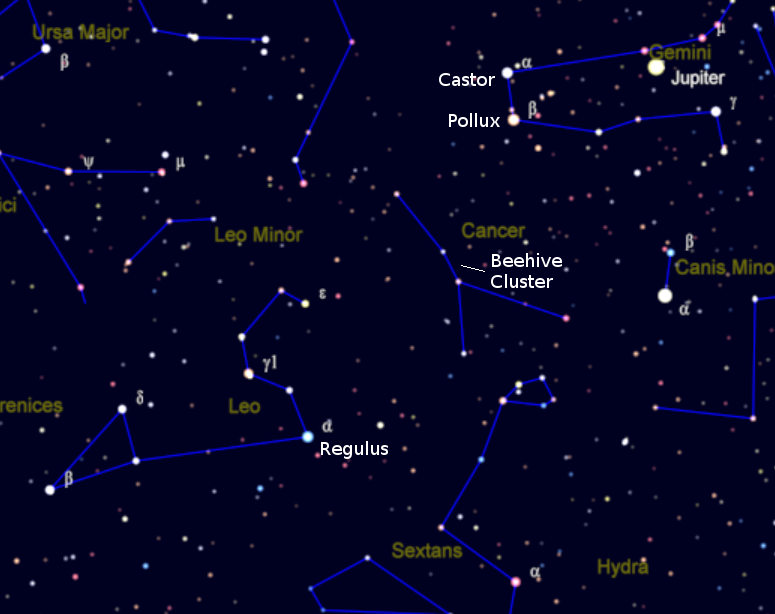
The constellation Cancer the crab at 9 p.m. March 3, 2014. Created using Cartes du Ciel (Skycharts).
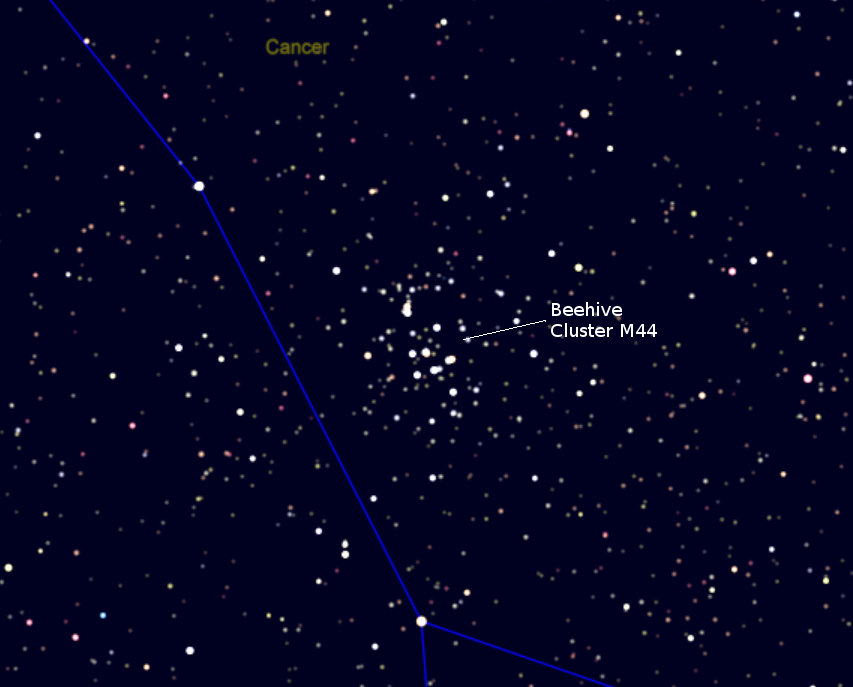
The Beehive star cluster, M44. Its ancient name was the Praesepe or manger when glimpsed by the naked eye. Created using Cartes du Ciel (Skycharts)
05/06/2013 – Ephemeris – The Constellation Leo the Lion and its meaning to the ancients
Ephemeris for Monday, May 6th. The sun rises at 6:25. It’ll be up for 14 hours and 28 minutes, setting at 8:53. The moon, 3 days before new, will rise at 5:03 tomorrow morning.
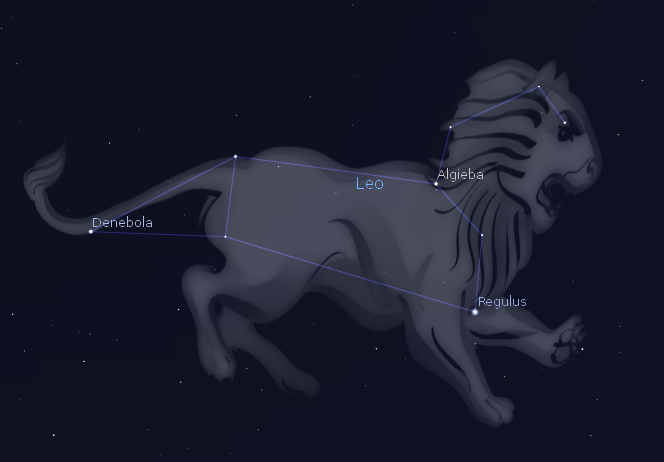
Leo the lion’s image as displayed by Stellarium for May 6, at 10 p.m. due south.
The constellation of Leo the lion is seen in the south at 10:30 p.m. Regulus lies at the bottom of a backwards question mark of stars that are his head and mane. This backwards question mark is also known as the asterism or informal constellation of the Sickle. To the left of the Sickle is a triangle of stars that are his haunches. As the lion is the king of beasts it is fitting that its brightest star Regulus means “Little King Star”. It was thought in ancient Egypt that the heat of summer, when the sun was in Leo drove the lions to drink the waters of the Nile. The lion was also the symbol of the Israelite tribe of Judah, from Jacob’s prophesy in Genesis, and as such may have played a part in the origin of the Star of Bethlehem.
Times are for the Traverse City/Interlochen area of Michigan. They may be different for your location.
03/28/11 – Ephemeris – The bright star Regulus
Monday, March 28th. The sun will rise at 7:31. It’ll be up for 12 hours and 33 minutes, setting at 8:04. The moon, 2 days past last quarter, will rise at 5:05 tomorrow morning.
Regulus is the brightest star in the constellation of Leo the lion. Leo is high in the southeast at 10 p.m. It can be found by imagining a leak in the bottom of the Big Dipper. The water would fall on Leo’s back. Regulus is the star lower right corner of the constellation. Alluding to the lion’s status in the animal kingdom, Regulus is the little king star. It is dead last in order of brightness of the 21 first magnitude stars, 1/13th the brightness of Sirius the brightest star low in the southwest at the same time. To the Babylonians it was the king, the 15th of their constellations that marked the passage of the sun. Regulus is about 77 light years away, and 150 times the brightness of the sun. [It is a rapidly spinning ellipsoid 3 and a half times the sun’s mass.]
* Times are for the Traverse City/Interlochen area of Michigan. They may be different for your location. Text in brackets was omitted from the recorded program due to time constraints.
Addendum
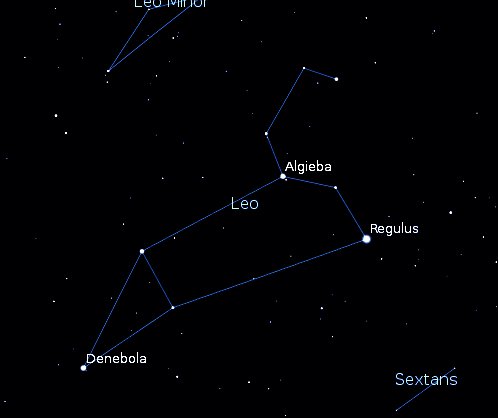
Leo in the southeast. Created using Stellarium.
 Bob Moler's Ephemeris Blog