Archive
02/20/2014 – Ephemeris – Winter Circle plus 1
Ephemeris for Thursday, February 20th. The sun will rise at 7:34. It’ll be up for 10 hours and 43 minutes, setting at 6:18. The moon, 2 days before last quarter, will rise at 12:27 tomorrow morning.
The winter skies are blessed with more first magnitude stars than any other season. Six of these stars lie in a large circle centered on the seventh. This circle is up at 9 p.m. Starting high overhead is Capella in Auriga the charioteer. Moving down clockwise is Aldebaran in the face of Taurus the Bull. Then down to Orion’s knee we find Rigel. Down and left is the brightest star of all Sirius the Dog Star in Canis Major, lowest of these stars in the south-southeast. Moving up and left is Procyon in Canis Minor, Above Procyon is Pollux in Gemini the twins. All these are centered on Betelgeuse the bright red star in Orion’s shoulder. The interloper this year is Jupiter which is situated in Gemini and outshines them all.
Times are for the Traverse City/Interlochen area of Michigan. They may be different for your location.
Addendum
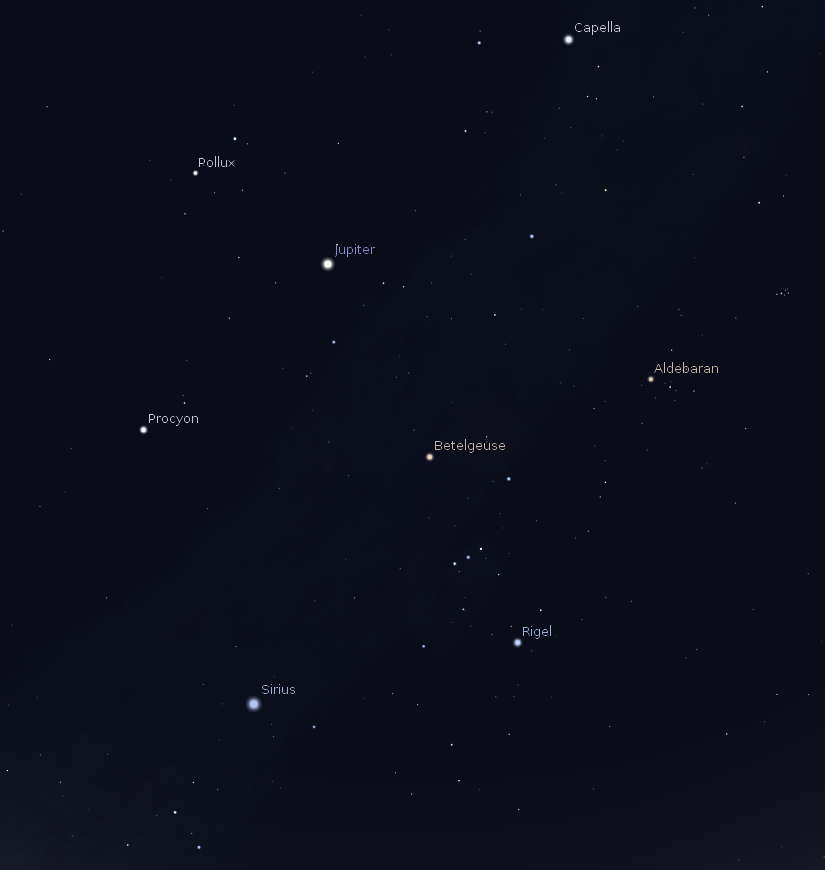
The Winter Circle plus Jupiter at 9 p.m. on February 20, 2014. Created using Stellarium.
12/16/2013 – Ephemeris – Orion’s bright blue-white star Rigel
Ephemeris for Monday, December 16th. The sun will rise at 8:13. It’ll be up for 8 hours and 49 minutes, setting at 5:03. The moon, 1 day before full, will set at 8:07 tomorrow morning.
Last week I talked about the star Betelgeuse the bright red star in the top left of Orion’s rectangle in the hunter’s shoulder. Orion is seen in the southeast at 9 in the evening. The blue-white star in Orion’s opposite corner is usually brighter. It is Rigel whose longer Arabic name of which Rigel is the first part means Left Leg of the Giant. Rigel is a giant itself, actually a super giant star, which is more a measure of its mass than its size, that of 17 solar masses. Its surface temperature is more than twice as hot as the sun. It is 130 thousand times as bright as the sun and 74 times its diameter. Its distance is around 860 light years. A telescope might reveal a close companion star to Rigel, off the edge of the bright arc light image of Rigel itself.
Times are for the Traverse City/Interlochen area of Michigan. They may be different for your location.
Addendum
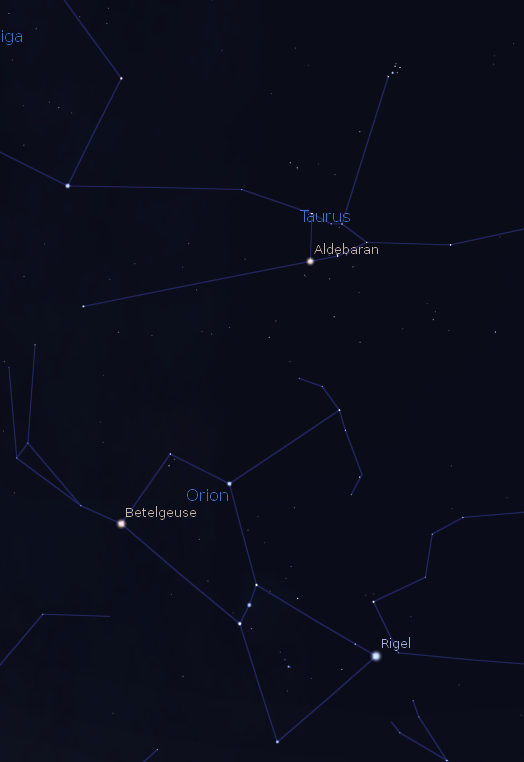
Taurus and Orion with Orion’s brightest stars named. Created using Stellarium.
12/03/2013 – Ephemeris – Orion rises
Ephemeris for Tuesday, December 3rd. The sun will rise at 8:01. It’ll be up for 9 hours and 1 minute, setting at 5:03. The moon, 1 day past new, will set at 6:07 this evening.
At 9 p.m. the constellation of Orion the giant hunter will be rising in the east southeast, with its belt stars nearly vertically aligned. The belt stars are contained within a tilted rectangle of four bright stars that’s leaning to the left. The brightest of the top stars is Betelgeuse a bright red star about the hue of the planet Mars. It’s a huge red giant star. Both top stars are Orion’s shoulders. The other shoulder star is Bellatrix. The bottom stars are Orion’s knees. The brightest, diagonally opposite from Betelgeuse is Rigel, a bright blue-white giant star. The other knee star is named Saiph. Orion is home to a beautiful nebula or cloud of gas, which we’ll explore later this winter. Jupiter is the bright stellar looking object to the left of Orion.
Times are for the Traverse City/Interlochen area of Michigan. They may be different for your location.
Addendum
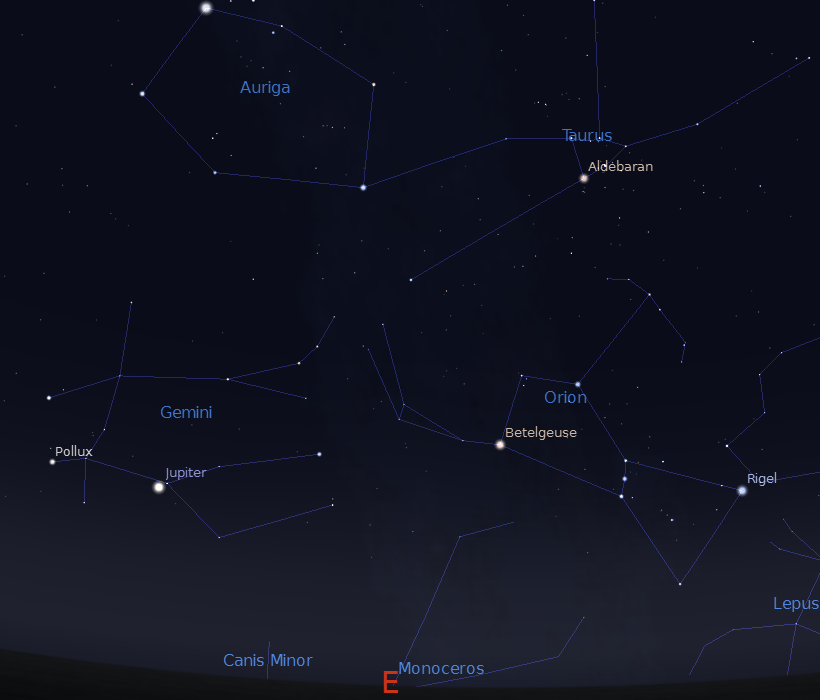
Orion Rising and other winter constellations at 9 p.m. December 3, 2013. Created using Stellarium
03/04/2013 – Ephemeris – The Winter Circle
Ephemeris for Monday, March 4th. The sun will rise at 7:14. It’ll be up for 11 hours and 20 minutes, setting at 6:34. The moon, at last quarter today, will rise at 2:34 tomorrow morning.
The winter skies are blessed with more first magnitude stars than any other season. Six of these stars lie in a large circle centered on the seventh. This circle is up all evening now that we are in the heart of winter. Starting high overhead is Capella in Auriga the charioteer. Moving clockwise and downward, we come to Aldebaran in the face of Taurus the Bull and brighter nearby Jupiter. Then down to Orion’s knee we find Rigel. Down and left is the brightest star of all Sirius the Dog Star in Canis Major Orion’s large hunting dog, lowest of these stars in the south. Moving up and left there is Procyon in Canis Minor Orion’s other hunting dog, Then above is Pollux in Gemini the twins. All are centered on Betelgeuse in Orion.
Times are for the Traverse City/Interlochen area of Michigan. They may be different for your location.
Addendum
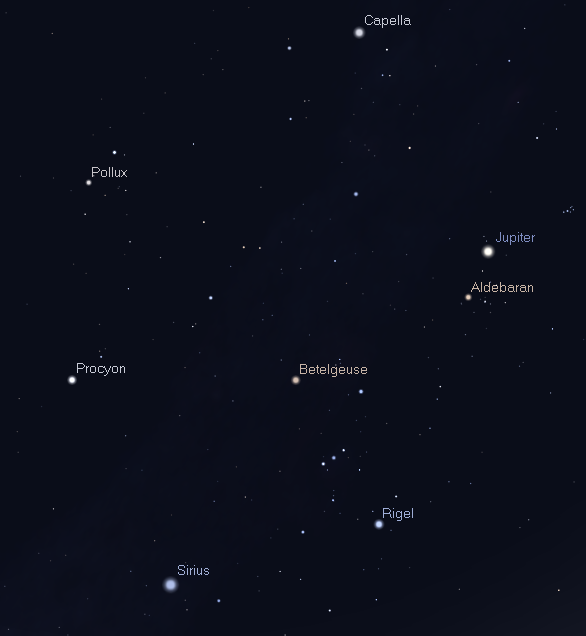
The Winter Circle and Jupiter for March. Created using Stellarium.
01/25/2013 – Ephemeris – The star names of Orion
Ephemeris for Friday, January 25th. The sun will rise at 8:08. It’ll be up for 9 hours and 33 minutes, setting at 5:42. The moon, 1 day before full, will set at 7:23 tomorrow morning.
The constellation of Orion the hunter is visible in the south at 9 p.m. The stars of Orion are interesting in themselves. Starting at the top left of the seven bright stars of Orion’s torso is Betelgeuse the bright red star, whose name means something like “Armpit of the Giant”. The star in Orion’s other shoulder is Bellatrix the “Amazon Star”. Below are the three stars of Orion’s belt, from left to right; Alnitak, Alnilam and Mintaka. Their names mean “Girdle”, “Belt of Pearls”, and “Belt” respectively. Down to Orion’s knees we look on the left to the star Saiph which means “Sword”, though it is some ways from the stars of Orion’s sword. Finally there’s the bright blue-white star Rigel whose name means “left Leg of the Giant”.
Times are for the Traverse City/Interlochen area of Michigan. They may be different for your location.
Addendum
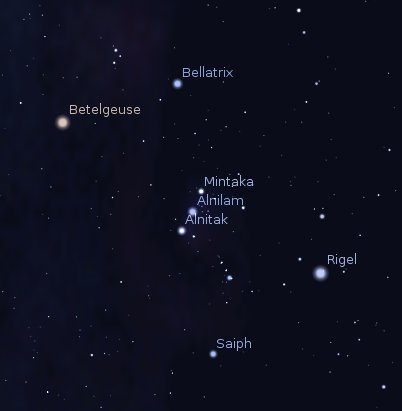
Orion with star names
01/17/2013 – Ephemeris – The blue super-giant star Rigel
Ephemeris for Thursday, January 17th. The sun will rise at 8:14. It’ll be up for 9 hours and 16 minutes, setting at 5:31. The moon, 1 day before first quarter, will set at 12:41 tomorrow morning.
Tuesday I talked about the star Betelgeuse the bright red star in the top left of Orion’s upright rectangle. Orion is seen in the south in the evening. The blue-white star in Orion’s opposite corner is usually brighter. It is Rigel whose longer Arabic name of which Rigel is the first part means Left Leg of the Giant. Rigel is a giant itself, actually a super giant star, which is more a measure of its mass than its size, that of 50 solar masses. Its surface temperature is more than twice as hot as the sun. It is 57 thousand times as bright as the sun and 50 times its diameter. Its distance is 860 light years. Those with telescopes might be able to spot a close companion star to Rigel, just at the edge of the bright arc light image of Rigel itself.
Addendum
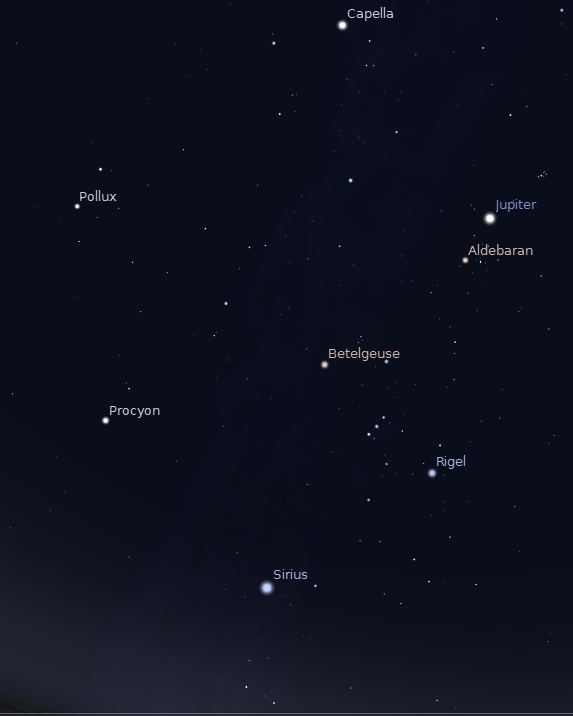
Rigel in the winter circle of bright winter stars plus Jupiter.this year. Created using Stellarium.
12/03/2012 – Ephemeris – Orion rising
Ephemeris for Monday, December 3rd. The sun will rise at 8:01. It’ll be up for 9 hours and 1 minute, setting at 5:02. The moon, 3 days before last quarter, will rise at 9:56 this evening.
Off in the southeast at 9 in the evening the great constellation of Orion will be seen now. This is the most famous of all constellations world wide. We think the Big Dipper is a big deal. It’s not even a constellation, being the hind end of the great bear Ursa Major. However it’s invisible if one travels far enough south of the equator. Orion is now a rectangle of stars tilted to the left as he rises. With three stars in a straight line in the center. They are aligned nearly vertically. Orion is a giant hunter. The rectangle depict his shoulders and knees. Among its other bright stars Orion contains two of the brightest. The upper left star is the famous red giant star Betelgeuse. The lower left star is the blue=white super giant Rigel.
Times are for the Traverse City/Interlochen area of Michigan. They may be different for your location.
Addendum
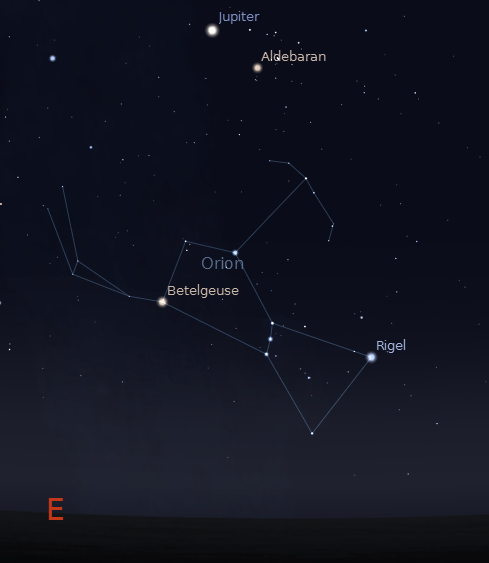
Orion rising at 9 p.m. December 3, 2012. Created using Stellarium.
02/20/2012 – Ephemeris – The Winter Circle
Ephemeris for President’s Day, Monday, February 20th. The sun will rise at 7:35. It’ll be up for 10 hours and 41 minutes, setting at 6:17. The moon, 1 day before new, will rise at 7:01 tomorrow morning. | The winter skies are blessed with more first magnitude stars than any other season. Six of these stars lie in a large circle centered on the seventh. This circle is up at 9 p.m. Starting high overhead is Capella in Auriga the charioteer. Moving down clockwise is Aldebaran in the face of Taurus the Bull. Then down to Orion’s knee we find Rigel. Down and left is the brightest star of all Sirius the Dog Star in Canis Major, lowest of these stars in the south southeast. Moving up and left is Procyon in Canis Minor, Above Procyon is Pollux in Gemini the twins. All these are centered on Betelgeuse the bright red star in Orion’s shoulder.
* Times are for the Traverse City/Interlochen area of Michigan. They may be different for your location.
Addendum
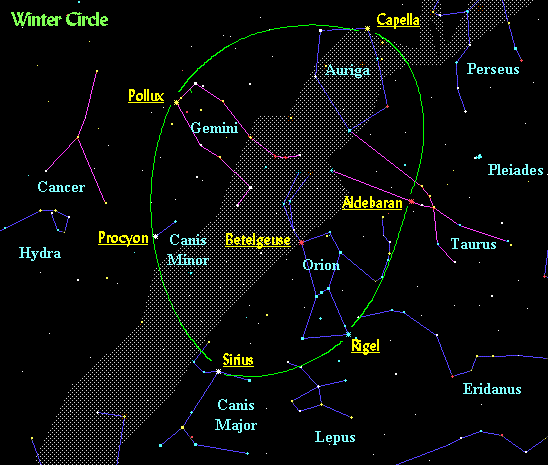
The Winter Circle of 1st magnitude stars
01/12/2012 – Ephemeris – Orion’s Belt
Thursday, January 12th. The sun will rise at 8:17. It’ll be up for 9 hours and 6 minutes, setting at 5:24. The moon, 3 days past full, will rise at 9:40 this evening.
Orion’s belt of three stars is one of the most noticeable star groupings in the sky. There are no other group of three bright stars in a straight line visible anywhere else in the sky. The star’s names from left to right are Alnitak, Alnilam and Mintaka. They are actually a bit farther away than the other bright stars of Orion. Alnilam, the center star is over three times the distance of red giant Betelgeuse above them and over twice as far as blue white giant star Rigel below them. Alnilam is 375 thousand times brighter than the sun according to the SIMBAD Astronomical Database. These three stars were also known as Frigga’s Spindle by the Norsemen. Frigga also known as Freya is the goddess we get the name of the day of the week Friday.
* Times, as always are for the Traverse City/Interlochen area of Michigan.
Addendum
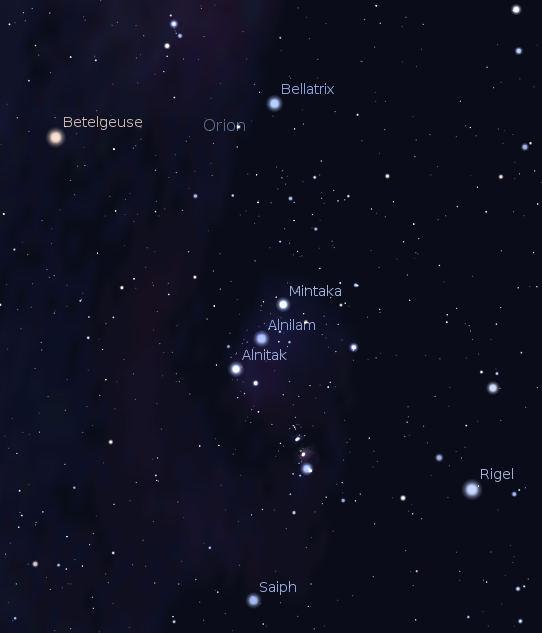
Torso of Orion centered on his belt. Created using Stellarium.
12/16/11 – Ephemeris – The constellation Orion rising
Friday, December 16th. The sun will rise at 8:12. It’ll be up for 8 hours and 50 minutes, setting at 5:03. The moon, 1 day before last quarter, will rise at 11:49 this evening.
At 9 p.m. the constellation of Orion the giant hunter will be rising in the east southeast, with its belt stars nearly vertically aligned. The belt stars are contained within a tilted rectangle of four bright stars that’s leaning to the left. The brightest of the top stars is Betelgeuse a bright red star. It’s a huge red giant star. Both top stars are Orion’s shoulders. The other shoulder star is Bellatrix. The bottom stars are Orion’s knees. The brightest, diagonally opposite from Betelgeuse is Rigel, a bright blue-white giant star. The other knee star is named Saiph. Orion is home to a beautiful nebula or cloud of gas, which we’ll explore later this winter, visible in binoculars it is located right and below Orion’s belt stars.
* Times, as always are for the Traverse City/Interlochen area of Michigan.
Addendum
Orion with star names
 Bob Moler's Ephemeris Blog