Archive
08/25/2022 – Ephemeris – Looking to the heart of the Milky Way
This is Bob Moler with Ephemeris for Thursday, August 25th. Today the Sun will be up for 13 hours and 34 minutes, setting at 8:31, and it will rise tomorrow at 6:58. The Moon, 2 days before new, will rise at 5:52 tomorrow morning.
Behind a dark cloud in the Milky Way, just above the spout of the teapot asterism or informal constellation that we see of the zodiacal constellation of Sagittarius, lies the very center of our Milky Way Galaxy. It cannot be seen in visible light, but can be detected with radio waves and infrared light that can penetrate the clouds of dust between. In 1932 Bell Laboratory physicist and radio engineer, Karl Jansky, discovered a source of radio static that came from that region of sky. It was subsequently given the designation Sagittarius A. It turns out that within that source there is an object called Sagittarius A* (Pronounced Sagittarius A Star), invisible in the near infrared, but with the mass of four million suns. It was recently imaged as the black hole at the center of our galaxy.
The astronomical event times given are for the Traverse City/Interlochen area of Michigan (EDT, UT – 4 hours). They may be different for your location.
Addendum
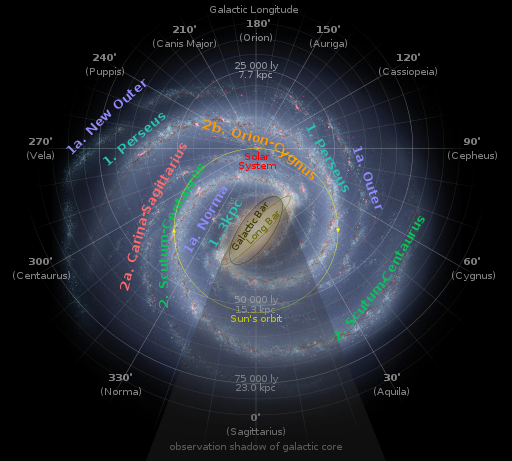
Our place in the Milky Way. Note that we appear to be in a barred spiral galaxy. The arms are numbered and named. 3kpc is the 3 kiloparsec arm. 3kpc = 9,780 light years. The Sun is about 27,000 light years from the center. Credit NASA and Wikimedia Commons, via EarthSky.org
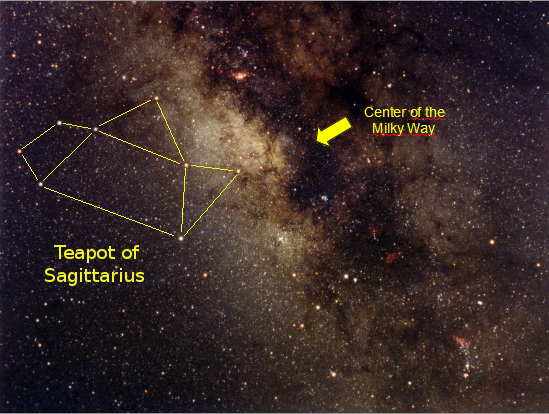
Location of the center of the Milky Way and the Teapot of Sagittarius. It’s behind that dark cloud.
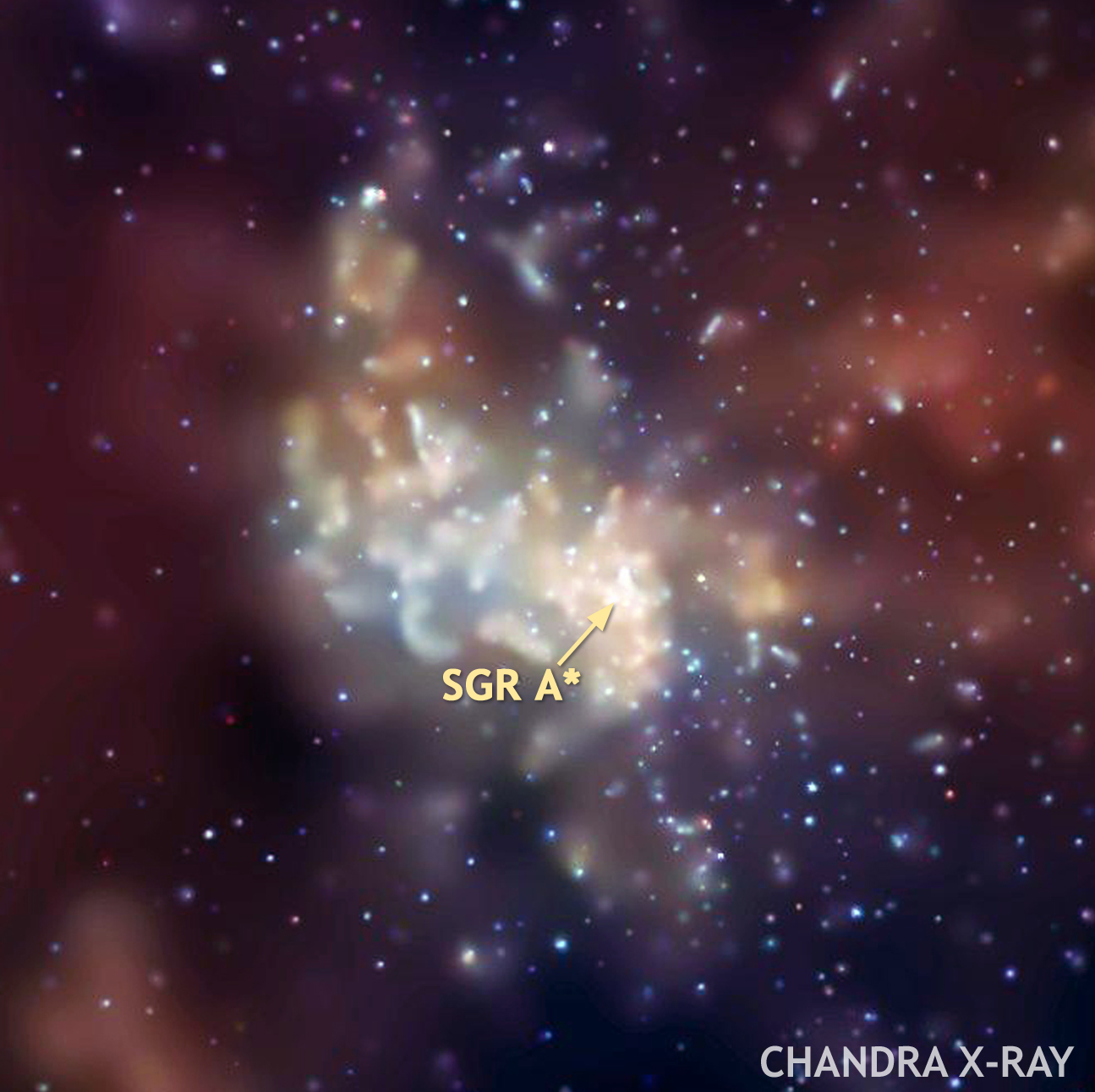
An image from the Chandra X-ray Telescope of the center of the Milky Way. SGR A or Sagittarius A is a radio source. SGR A*, pronounced Sagittarius A Star, is the 4 million solar mass black hole in the center of the Milky Way Galaxy. Credit NASA.
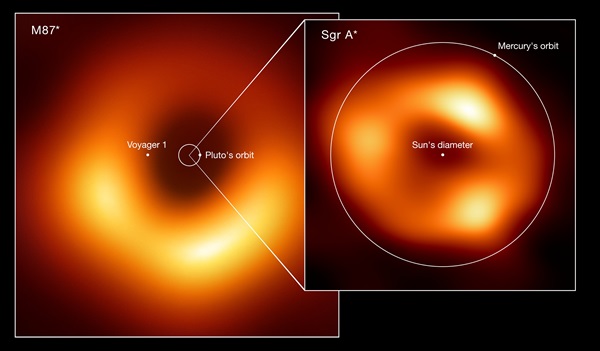
M87* size compared to Sagittarius A*. The size of a black hole is directly related to its mass. The asterisk * is pronounced “Star”. Credit: Event Horizon Telescope Collaboration.
The black hole images were reconstructed from data from 8 sub millimeter radio telescopes and arrays of the Event Horizon Telescope Collaboration. The telescopes were located from Greenland to the South Pole and From Hawai’i to Europe. The data from the telescopes, observing the black holes simultaneously, were combined to act like a single telescope with the diameter of the Earth in order to resolve the black holes.
04/09/2019 – Ephemeris – Tomorrow we may be able to see the supermassive black hole at the center of our galaxy
Ephemeris for Tuesday, April 9th. Today the Sun will be up for 13 hours and 10 minutes, setting at 8:20, and it will rise tomorrow at 7:07. The Moon, 3 days before first quarter, will set at 1:00 tomorrow morning.
There’s a great bit of excitement in astronomical circles for tomorrow’s release of an image of the event horizon of the supermassive black hole at the center of our Milky Way Galaxy, 27 thousand light years away. The black hole is designated Sagittarius A*. Pronounced Sagittarius A Star. Sagittarius is the constellation it’s located in, capital A for the first radio source found in that constellation and an asterisk, pronounced Star. Eight highly accurate radio telescopes located from Greenland to the south pole, from Hawaii to Europe simultaneously record signals and record them to computer disks. The data are processed together to produce an image with the resolving power of a telescope the diameter of the Earth. The event horizon is smaller than our solar system.
The times given are for the Traverse City/Interlochen area of Michigan. They may be different for your location.
Addendum
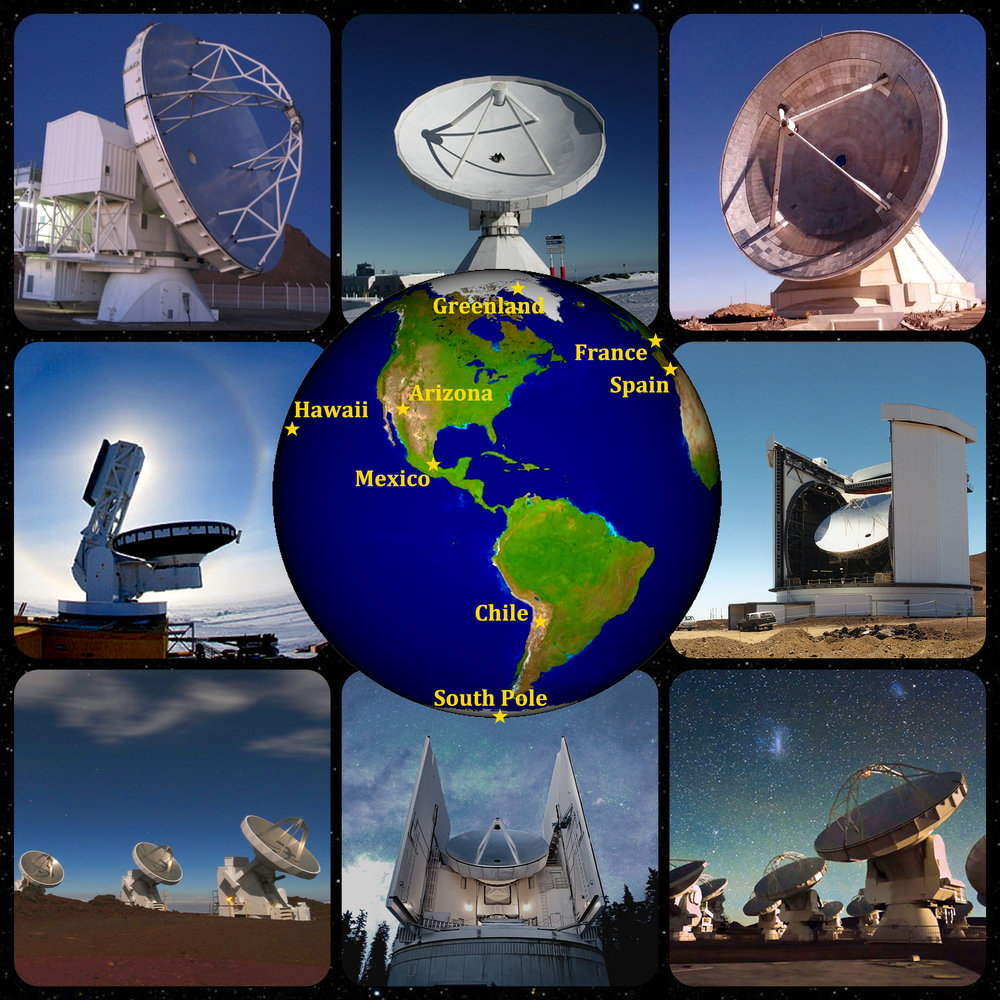
Event Horizon Telescope component radio telescopes. Credits: © APEX, IRAM, G. Narayanan, J. McMahon, JCMT/JAC, S. Hostler, D. Harvey, ESO/C. Malin
For more information see this news article from the AAAS Science Magazine: https://www.sciencemag.org/news/2019/04/here-s-what-scientists-think-black-hole-looks.
For a non-technical explanation of black holes and the event horizon check this out: https://www.sciencealert.com/black-holes.
09/18/2012 – Ephemeris – The center of the Milky Way
Ephemeris for Tuesday, September 18th. The sun will rise at 7:25. It’ll be up for 12 hours and 21 minutes, setting at 7:46. The moon, 3 days past new, will set at 8:58 this evening.
Look to the south southwest at 10 p.m. At the constellation of Sagittarius, which looks like a teapot. It’s located at the south end of the Milky Way. Just off the spout of the teapot lies, beyond the clouds of stars, gas and dust, at a distance of about 27,000 light years, the center of the Milky Way. The center contains a 4 million sun mass black hole with a bevy of stars orbiting around it like planets orbit the sun. Black holes are so massive that, nothing, not even light can escape their gravity. Lots of energy is released by matter falling in to a black hole. Currently our Milky Way’s black hole is quiet, nothing of note is falling in. However there is a cloud of gas and dust approaching the black hole, so its quiet phase may end next year.
Times are for the Traverse City/Interlochen area of Michigan. They may be different for your location.
Addendum
Location of the center of the Milky Way and the Teapot of Sagittarius.
While the actual center of the galaxy cannot be seen in optical wavelengths it is visible in radio, infrared and x-rays. The black hole at the center of the Milky Way is designated Sagittarius A* (pronounced Sagittarius A Star). Check it out in Wikipedia and other sources.
 Bob Moler's Ephemeris Blog