Archive
Ephemeris: 08/22/2024 – Saturn’s ring aspect is changing in the next nine months
This is Ephemeris for Thursday, August 22nd. Today the Sun will be up for 13 hours and 41 minutes, setting at 8:36, and it will rise tomorrow at 6:55. The Moon, 3 days past full, will rise at 10:07 this evening.
Saturn graces our evening skies now, but it’s not yet in the evening planet. It will rise tonight at 9:16 PM. However, will set after sunrise, thus still being a morning planet. It will become an evening planet on September 7th, when it reaches opposition from the Sun. It will rise approximately the same time the Sun sets and thereafter will rise before sunset. Saturn’s rings are nearly edge on to us now. Currently, about 2 1/4° from being edge on. They will open up slightly over the next few months to five degrees on November 11th before closing up and becoming edge-on on March 23rd of next year. On that day the rings will disappear for us. However, their presence will only be seen by the thin shadow they cast on the planet.
The astronomical event times given are for the Traverse City/Interlochen area of Michigan (EDT, UT–4 hours). Times will be different for other locations.
Addendum
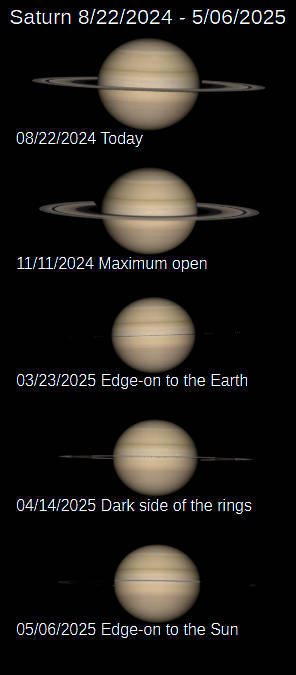
The image shows Saturn and its rings on five dates. The first is today, August 22nd 2024. On this date the rings are a little over three degrees from being edge on to us. They will actually open up a bit for nearly three months. On November 11th they will open up to nearly 6°. On March 23rd next year they will be exactly edge on to us and be invisible. The only sign of their presence will be a very thin shadow the rings cast on the planet. The bad part of this is that early next year Saturn will be too close to the Sun to be easily seen from Earth. That includes the Hubble and James Webb space telescopes. It will appear only 10 degrees west of the Sun on that date. It will increase over the next 44 days to 48 degrees on May 6th, when the rings will be edge on to the Sun. In that period the Earth will be looking at the unlit side of the rings. So the rings will be very dim. Only the light filtering through the rings will be seen, and the B ring which is the brightest normally will be just about completely dark due to the density of ring particles in it. After that the rings will open up for the next 7 1/2 years.
Ephemeris: 09/04/2023 – One more look at Saturn’s Rings
This is Bob Moler with Ephemeris for Labor Day, Monday, September 4th. Today the Sun will be up for 13 hours and 5 minutes, setting at 8:14, and it will rise tomorrow at 7:09. The Moon, 2 days before last quarter, will rise at 10:32 this evening.
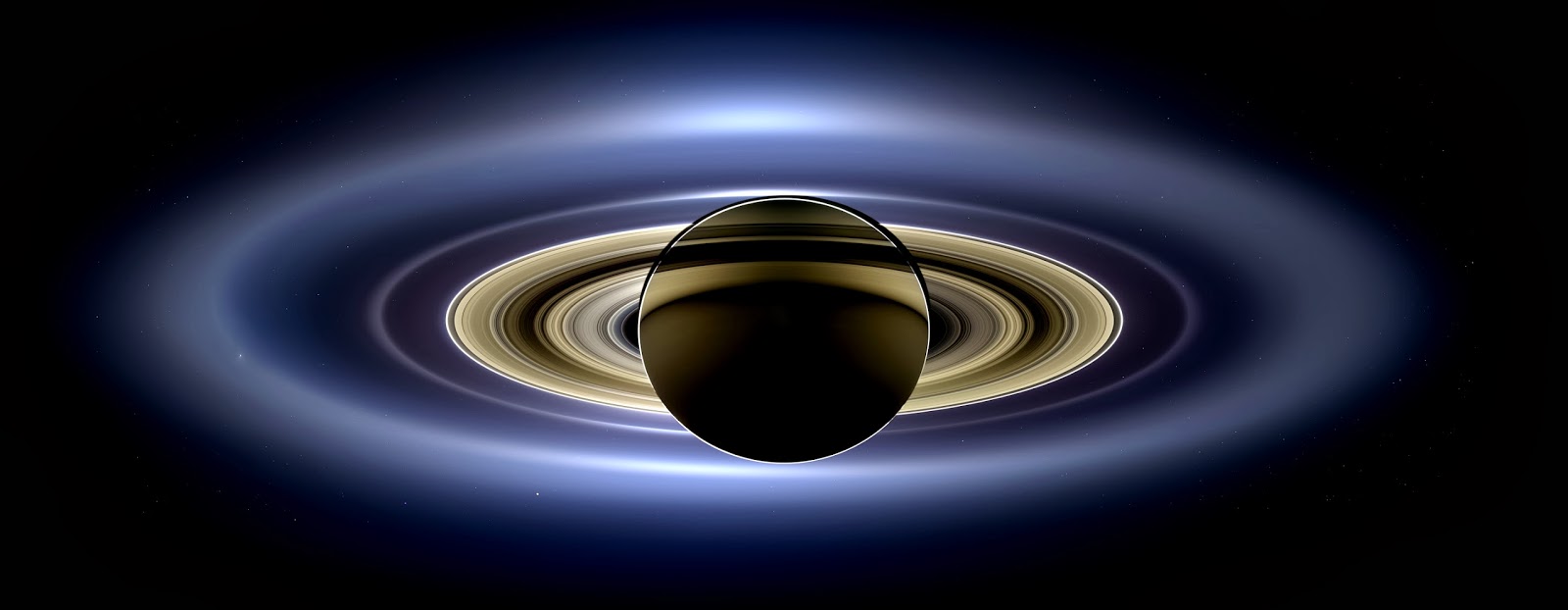
We are going to take one more look at Saturn’s rings, and these are the rings which are not visible from the Earth, but only from spacecraft in the vicinity of Saturn. We have the A, B and C rings which are visible from here Then there’s a D ring inside the C ring. There’s the F ring, a very thin ring which is controlled by a tiny moon called Prometheus, just outside the A ring. Farther out there’s an E ring which is a very diffuse ring, in the orbit of the moon Enceladus, which is an active satellite. It has geysers at the at its South Pole which vent water ice and organic compounds, which form the E ring. Saturn has many more rings and ring arcs in orbit around it, too numerous to mention here.
The astronomical event times given are for the Traverse City/Interlochen area of Michigan (EDT, UT –4 hours). They may be different for your location.
Addendum
Off-topic
08/15/2022 – Ephemeris – Saturn moves into the evening sky
This is Ephemeris for Monday, August 15th. Today the Sun will be up for 14 hours and 3 minutes, setting at 8:48, and it will rise tomorrow at 6:46. The Moon, halfway from full to last quarter, will rise at 10:55 this evening.
Yesterday, Saturn was in opposition to the Sun. I’m not implying an argument here. Opposition is when a planet is opposite the Sun in the sky, so it rises around sunset and sets around sunrise. That means Saturn is the closest it can get to us this year. For the record, that’s 836 million miles (1,345 million kilometers). Saturn will first appear tonight in the southeast when it gets dark enough, say around 9:15 to 9:30 pm. It is in the constellation of Aquarius now. It is moving northeastward in our skies, or it would if it weren’t at opposition, and moving backward or retrograde as the Earth is, in effect, lapping Saturn in our eternal race around the Sun. Saturn’s rings appear to slowly get skinnier as the planet moves to an equinox, where its rings, which orbit its equator, will tilt edgewise to the Sun, and the Earth in 2025.
The astronomical event times given are for the Traverse City/Interlochen area of Michigan (EDT, UT – 4 hours). They may be different for your location.
Addendum
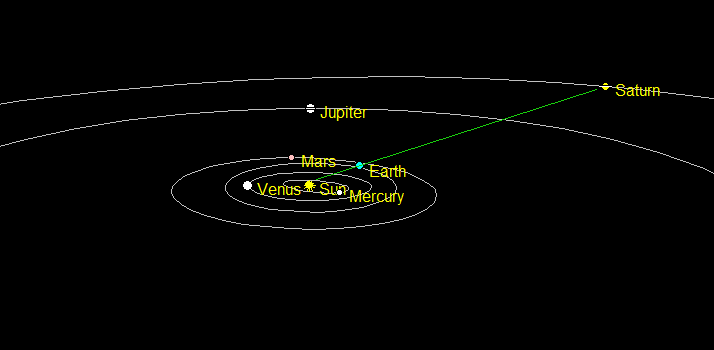
Display of the solar system out to Saturn, with added line showing Saturn’s location opposite the Sun from the Earth. This make the Earth nearly in line from the Sun to Saturn. This is the time that Saturn would be closest to the Earth. Credit: my LookingUp app. I wanted to use NASA’s Eyes, but there were too many interplanetary spacecraft near the Earth. The Earth was crowded out by spacecraft labels.
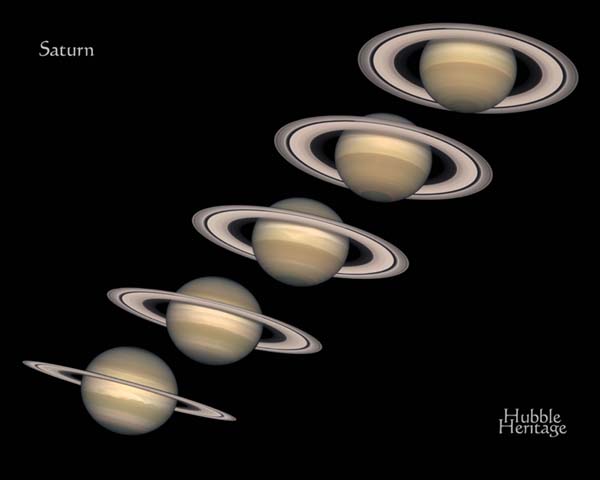
How the appearance of the rings change as Saturn orbits the Sun. Credit: NASA Hubble.
 Bob Moler's Ephemeris Blog