Archive
Ephemeris: 11/13/2025 – Looking at the Pleiades or Seven Sisters
This is Ephemeris for Thursday, November 13th. Today the Sun will be up for 9 hours and 38 minutes, setting at 5:16, and it will rise tomorrow at 7:38. The Moon, 1 day past last quarter, will rise at 1:56 tomorrow morning.
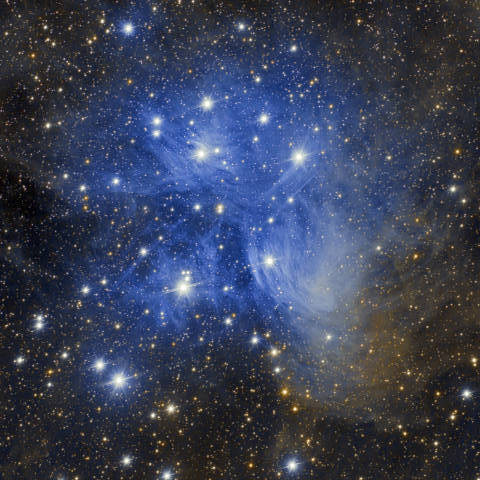
A marvelous member of the autumn skies can be found low in the east around 8 in the evening. It is the famous star cluster called the Pleiades or the Seven Sisters. I might also add the ‘Tiny Dipper’. Many people can spot a tiny dipper shape in its six or seven stars, and mistake it for the Little Dipper. With binoculars, one can see over a hundred stars that appear, along with the dipper shape of the brightest. In photographs, the Pleiades actually illuminate wisps of the dust that surround them. In Greek mythology, the sisters were daughters of the god Atlas and Pleione. The most people can only see is six stars. The reason, according to mythology, is that one of the sisters married a mortal, dimming her star.
The astronomical event times given in this blog are for the Traverse City/Interlochen area of Michigan (Lat 44.7° N, Long 85.7° W; EDT, UT – 4 hours) unless stated otherwise. Times will be different for other locations.
Addendum
Ephemeris: 10/28/2024 – The Pleiades or Seven Sisters and their half sisters
This is Ephemeris for Monday, October 28th. Today the Sun will be up for 10 hours and 20 minutes, setting at 6:36, and it will rise tomorrow at 8:17. The Moon, halfway from last quarter to new, will rise at 5:22 tomorrow morning.
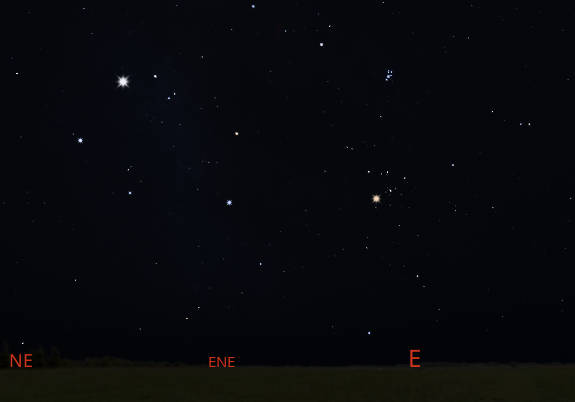
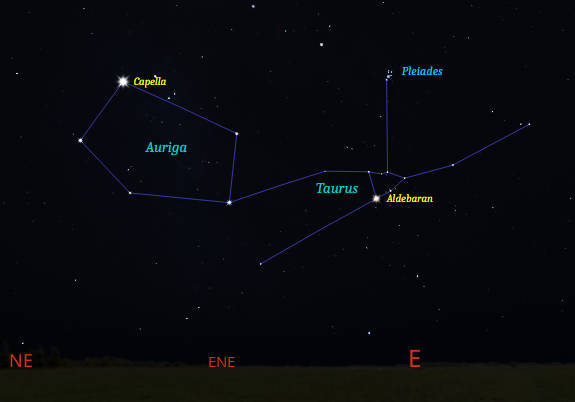
The beautiful star cluster of the Pleiades is seen low in the east northeastern sky after 9:00 PM. It is also known as the Seven Sisters. It has been known as a group of female stars in many cultures. Also, the Ancient Greeks, because they thought that the Pleiades shape looked something like a sail, Also, Pleiades is very close to the Greek name for sail, and that its appearance in the morning sky in early summer heralded the beginning of the summer sailing season on the Mediterranean Sea. According to Greek mythology the Pleiades have half sisters, also seven in number, with the same father, Atlas, but a different mother, called the Hyades which rises about an hour later, and fills out the face of Taurus the bull.
The astronomical event times given are for the Traverse City/Interlochen area of Michigan (EDT, UT – 4 hours). Times will be different for other locations.
Addendum
Ephemeris: 10/25/2024 – Finding the Pleiades or Seven Sisters
This is Ephemeris for Friday, October 25th. Today the Sun will be up for 10 hours and 28 minutes, setting at 6:40, and it will rise tomorrow at 8:13. The Moon, 1 day past last quarter, will rise at 2:09 tomorrow morning.
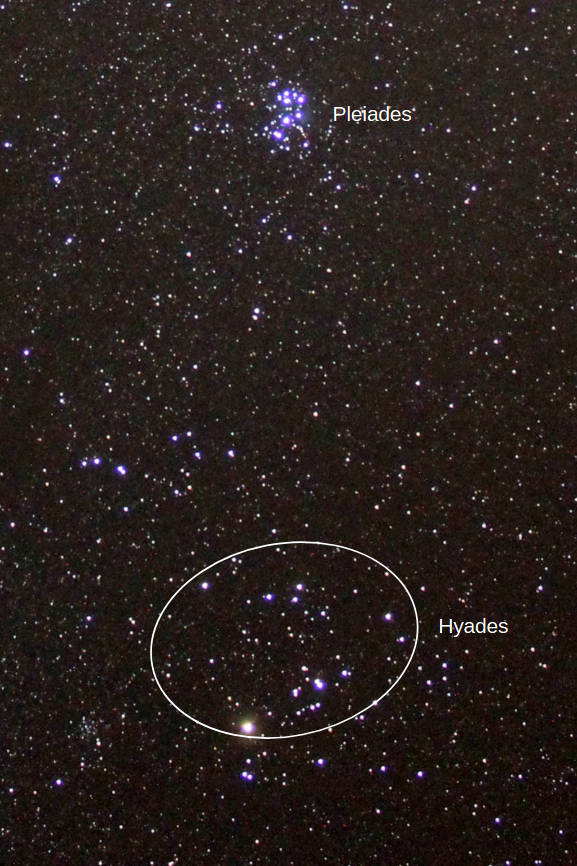
A marvelous member of the autumn skies can be found low in the east northeast after 9 in the evening. It is the famous star cluster called the Pleiades or the Seven Sisters. I might also add the ‘Tiny Dipper’. Many people can spot a tiny dipper shape in its six or seven stars, and mistake it for the Little Dipper. With binoculars, one can see over a hundred stars that appear, along with the dipper shape of the brightest. In photographs, the Pleiades actually contain wisps of the dust they are currently passing through. In Greek mythology, the sisters were daughters of the god Atlas and Pleione. The most people can see is six stars. The reason, according to mythology, is that one of the sisters married a mortal, dimming her star.
The astronomical event times given are for the Traverse City/Interlochen area of Michigan (EDT, UT – 4 hours). Times will be different for other locations.
Addendum
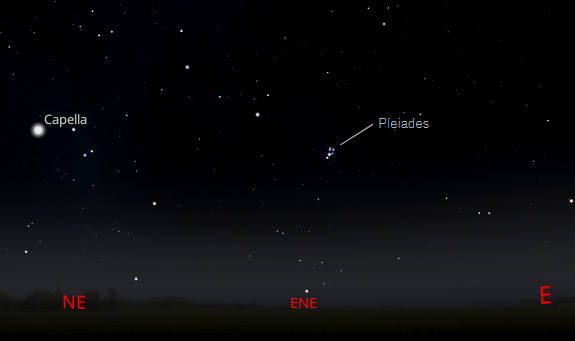
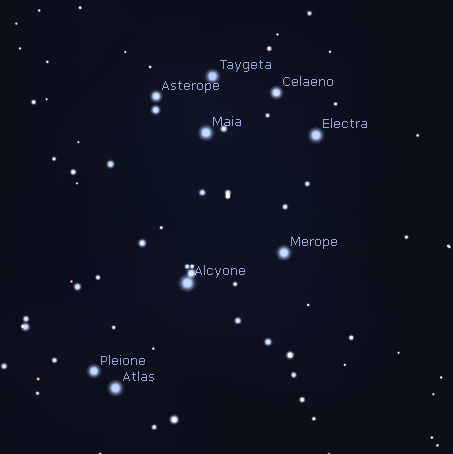
Ephemeris: 11/06/2023 – The Pleiades or Seven Sisters
This is Ephemeris for Monday, November 6th. Today the Sun will be up for 9 hours and 57 minutes, setting at 5:25, and it will rise tomorrow at 7:28. The Moon, 1 day past last quarter, will rise at 1:18 tomorrow morning.
A marvelous member of the autumn skies can be found low in the east after 8 in the evening. It is the famous star cluster called the Pleiades or the Seven Sisters. I might also add the ‘Tiny Dipper’. Many people can spot a tiny dipper shape in its six or seven stars, and mistake it for the Little Dipper. With binoculars, one can see over a hundred stars appear, along with the dipper shape of the brightest. In photographs, the Pleiades actually contain wisps of the dust they are currently passing through. In Greek mythology, the sisters were daughters of the god Atlas and Pleione.
The astronomical event times given are for the Traverse City/Interlochen area of Michigan (EST, UT –5 hours). They may be different for your location.
Addendum
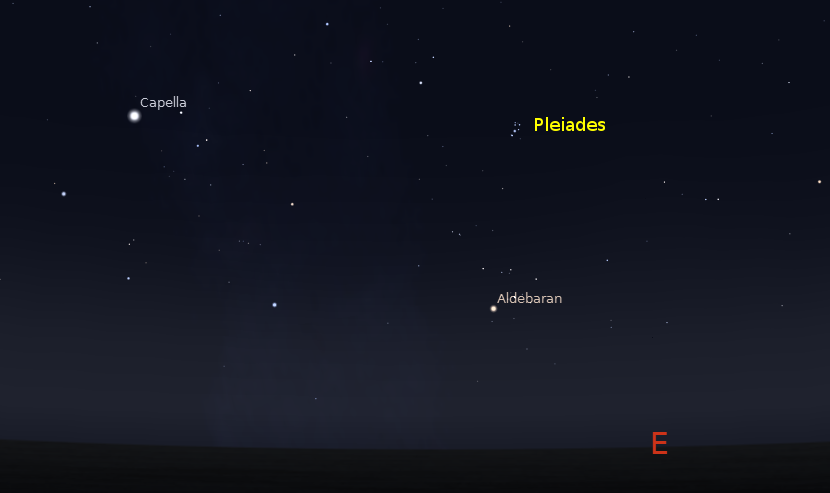
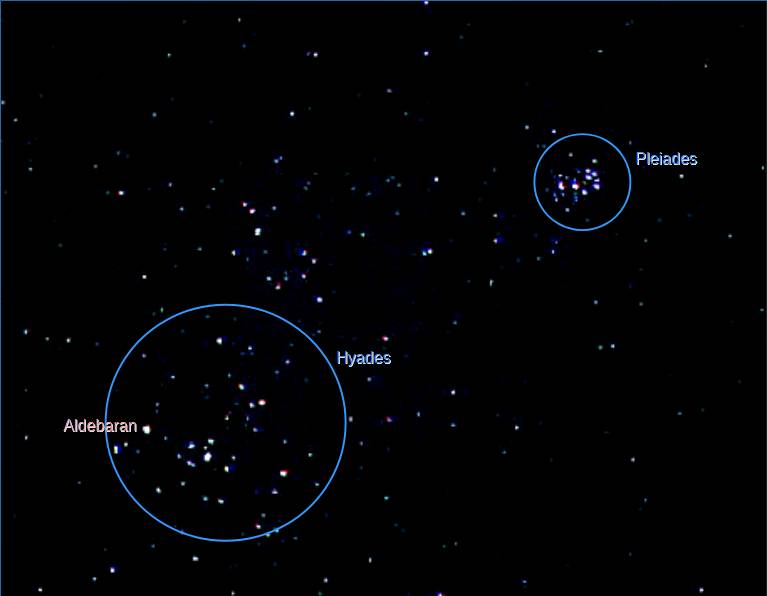
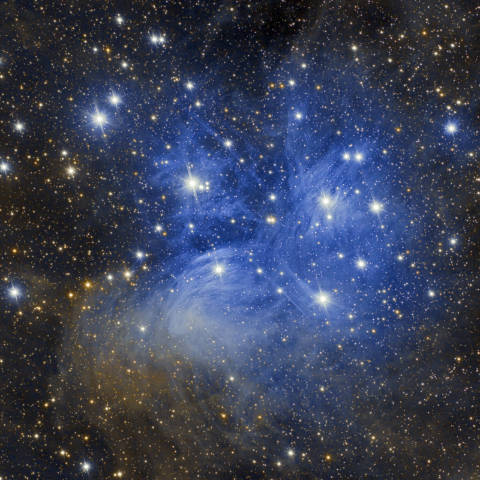
I’ll be coming back to the Pleiades from time to time over the autumn and winter months to cover, especially, the mythology of the Pleiades from different cultures.
01/10/2023 – Ephemeris – The constellation of Orion the hunter, unlucky in love
This is Bob Moler with Ephemeris for Tuesday, January 10th. Today the Sun will be up for 9 hours and 3 minutes, setting at 5:22, and it will rise tomorrow at 8:18. The Moon, halfway from full to last quarter, will rise at 9:01 this evening.
Before the Moon rises tonight, we will have two hours of darkness. Winter’s central constellation, Orion the hunter, doesn’t need the Moon to be absent to see its principal stars. He’s in the southeast before the Moon rises with red Betelgeuse in one shoulder and dimmer Bellatrix on the other, Saiph at one knee and bright blue-white Rigel at the other. Between his shoulders and knees runs his belt of three stars in a line. Above Betelgeuse, he is holding a club aloft and from Bellatrix he holds a lion skin shield to defend himself from the charge of Taurus the bull, above and right of him. I consider him a hard luck hero, with three different stories on how he died. Unlucky in love, he’s consigned to chase the Seven Sisters of the Pleiades throughout eternity.
The astronomical event times given are for the Traverse City/Interlochen area of Michigan (EST, UT –5 hours). They may be different for your location.
Addendum
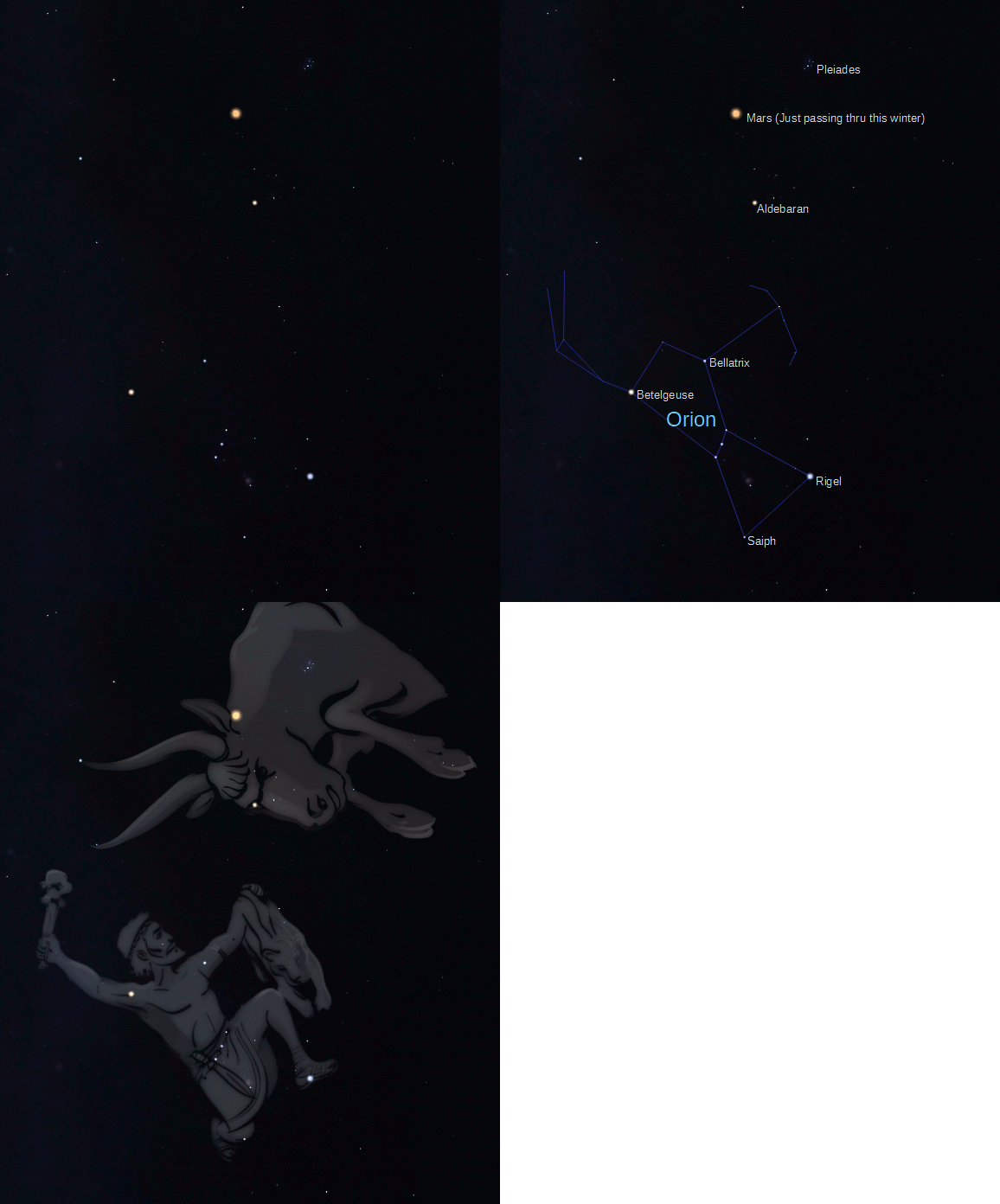
Orion finder animation with Mars. First, showing the unannotated sky looking southeast at Orion. Second, Orion with lines and labels of the stars at the corners of his body, and other bright stars in the view, plus the Pleiades and bright planet Mars, that’s just happening to be passing through this year. Third, the constellation art for Orion and Taurus the bull. Created using Stellarium, LibreOffice Draw and GIMP.
Here are the three stories of how Orion died: One: Orion raped the goddess Artemis, and so she killed him. Two: Orion was betrothed to Artemis, but her twin brother Apollo was jealous and caused her to kill him in a hunting “accident”. Three: Orion was killed by the sting of a scorpion, which is the reason Orion and Scorpius are never in the sky at the same time.
12/15/2022 – Ephemeris – Stories of the Pleiades from many lands
This is Ephemeris for Thursday, December 15th. Today the Sun will be up for 8 hours and 49 minutes, setting at 5:02, and it will rise tomorrow at 8:13. The Moon, 1 day before last quarter, will rise at 12:16 tomorrow morning.
Let’s look at how some ancient cultures saw the Pleiades, the star cluster that is seen high in the eastern sky these evenings. To the Anishinaabe native peoples around here, the Pleiades is the “Hole in the Sky” or the seven stones that are heated for the sweat lodge ceremony. To the Kiowa, these were sister stars that had been whisked into the sky from the top of Devil’s Tower in Wyoming, where they were threatened by a huge bear. In Norse mythology, these were the goddess Freya’s* hens. The name we know them by has rather misty origins. Some think the Greek name is from the mother of the seven sisters, Pleione. The Greek word for sail is similar to Pleiades, and the appearance of the Pleiades in the morning sky saw the best sailing weather in the Mediterranean.
The astronomical event times given are for the Traverse City/Interlochen area of Michigan (EST, UT –5 hours). They may be different for your location.
* Freya is the Norse goddess from which we get the name of the day of the week Friday from. In Latin, the day is named after the goddess Venus.
Addendum
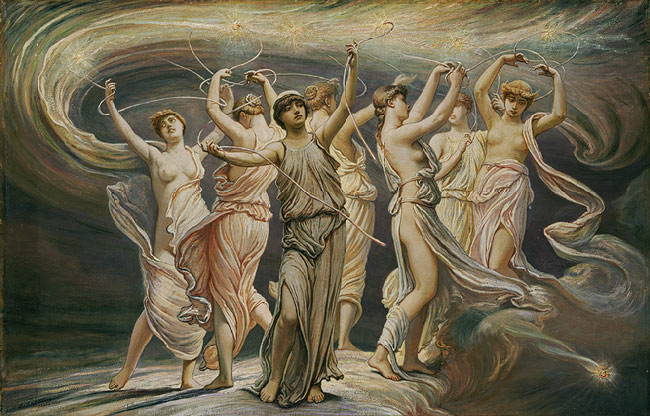
The Greek Pleiades, a painting by Elihu Vedder in the Metropolitan Museum of Art, New York City. Public Domain.

Seven maidens being attacked by a giant bear, having fled to the top of Devil’s Tower in Wyoming. Painting by Herbert Collins, http://www.nps.gov/deto

They are also the Seven Daughters of the Moon and Sun. They loved to dance and play, and when their father, the Moon was low in the sky, would descend to the Earth in a basket to do their thing. On one of their trips to the earth, one of them was captured by a human, and she ended up falling in love with him, and married him. When father Moon found out, he permanently dimmed her star, so now most people now only can spot 6 of the stars. This last bit seems to parallel the Greek story of the lost Pleiad.
11/02/2021 – Ephemeris – Finding the Pleiades or Seven Sisters
This is Ephemeris for Election Day for some, Tuesday, November 2nd. The Sun will rise at 8:22. It’ll be up for 10 hours and 7 minutes, setting at 6:29. The Moon, 2 days before new, will rise at 6:35 tomorrow morning.
A marvelous sight in the autumn skies can be found low in the east after 8 in the evening. It is the famous star cluster called the Pleiades or the Seven Sisters. I might also add the “Tiny Dipper”. Many people can spot a tiny dipper shape in its six or seven stars, and mistake it for the Little Dipper. However, with binoculars, one can see over a hundred stars appear along with the dipper shape of the brightest. In photographs, the Pleiades actually contain wisps of the dust they are passing through. They are a young star cluster, whose age is estimated to be one hundred million years. In Greek mythology, the sisters were daughters of the god Atlas. I’ll be revisiting the Pleiades several times this autumn, and winter, starting on Thursday.
The astronomical event times given are for the Traverse City/Interlochen area of Michigan (EDT, UT – 4 hours). They may be different for your location.
Addendum
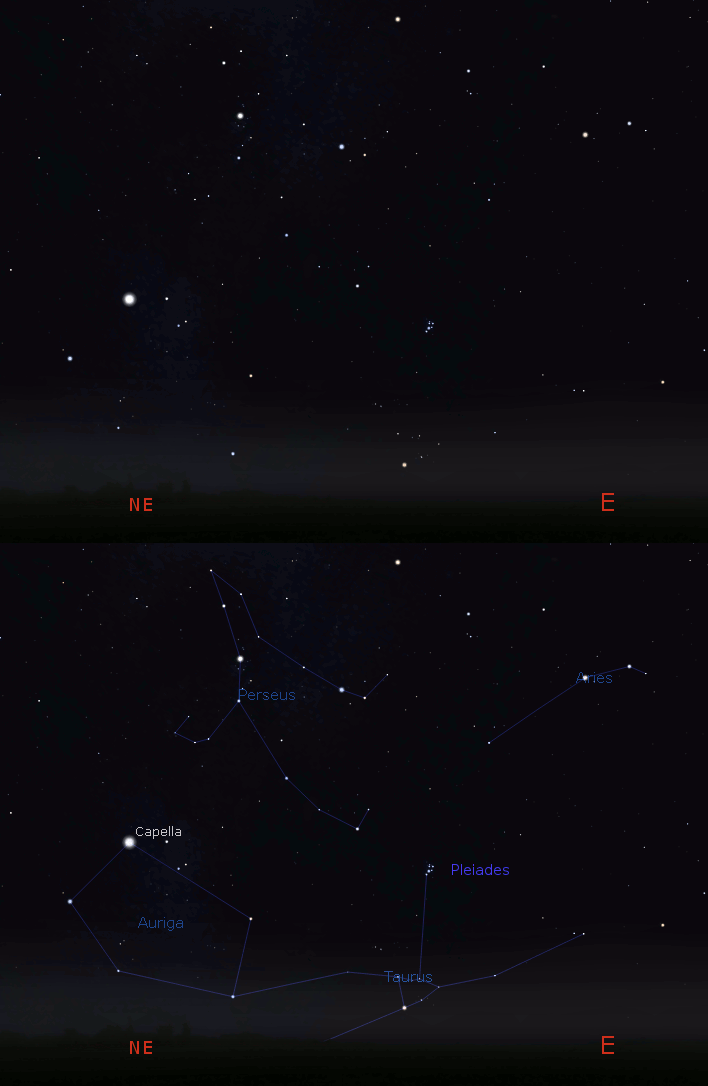
Finding the Pleiades animation for 9 p.m. in late October/early November. Created using Stellarium and GIMP.
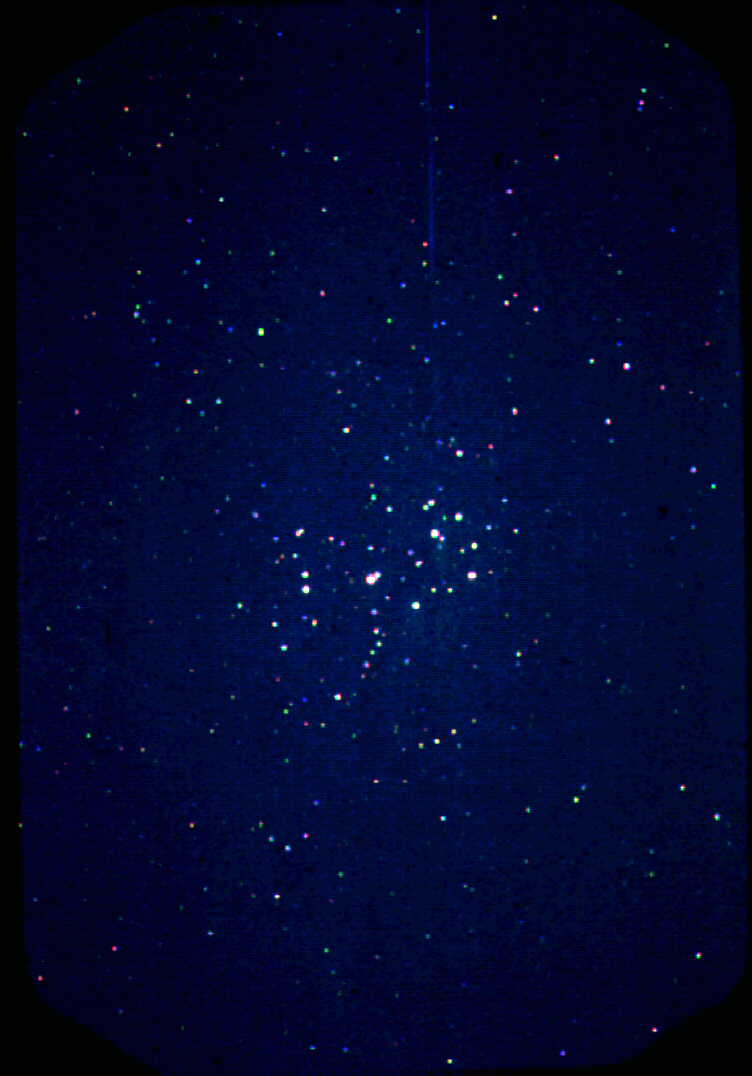
The Pleiades, about what you’d see in binoculars.
11/16/2020 – Ephemeris – How to find the Pleiades or Seven Sisters
This is Ephemeris for Monday, November 16th. Today the Sun will be up for 9 hours and 31 minutes, setting at 5:13, and it will rise tomorrow at 7:43. The Moon, 1 day past new, will set at 6:31 this evening.
A marvelous member of the autumn skies can be found low in the east after 8 in the evening. It is the famous star cluster called the Pleiades or the Seven Sisters. I might also add the ‘Tiny Dipper’. Many people can spot a tiny dipper shape in its six or seven stars, and mistake it for the Little Dipper. When I was nearsighted*, though corrected, I never had been able to see more than a few stars and a bit of fuzz. However, with binoculars, even I could see over a hundred stars appear along with the dipper shape of the brightest. The fuzz I saw was unresolved stars, but in photographs the Pleiades actually contain wisps of the gas and dust they are currently passing through. In Greek mythology the sisters were daughters of the god Atlas. I’ll be revisiting the Pleiades several times this autumn, winter, and as they disappear in the west in evening twilight next spring.
The event times given are for the Traverse City/Interlochen area of Michigan. They may be different for your location.
*My vision was corrected with cataract surgery a few years ago. The Pleiades now have a granular appearance now.
Addendum
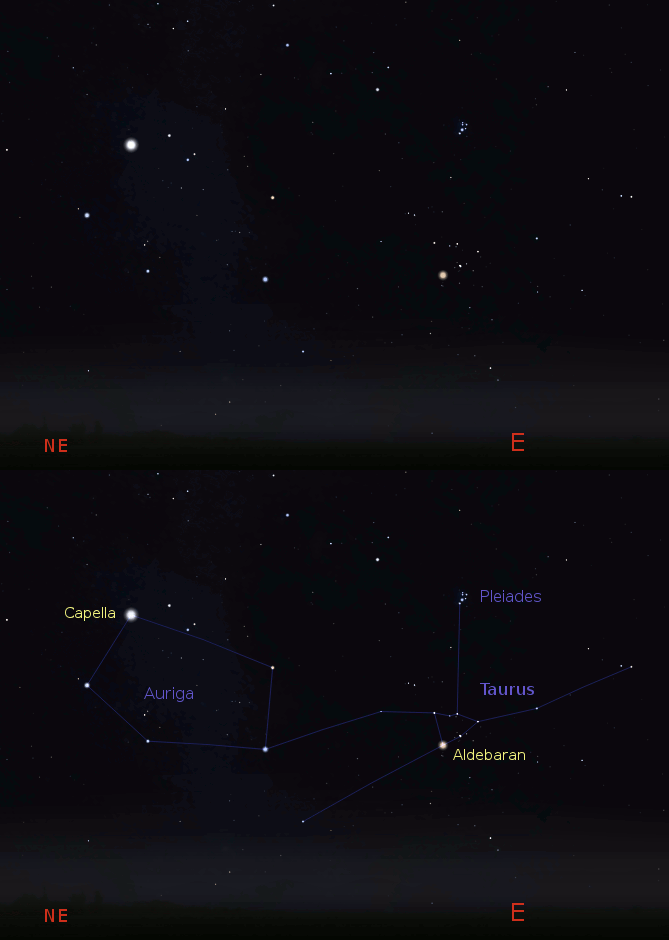
Pleiades finder animation looking east at 8 pm, November 16th. Click on the image to enlarge. Created using Stellarium.
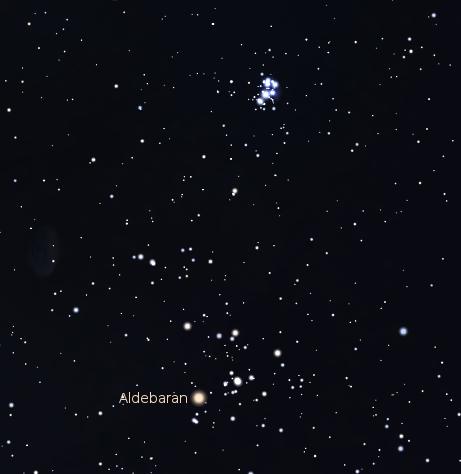
Aldebaran in the ‘V’ shape of the Hyades (The face of Taurus the bull) with the Pleiades above. Created using Stellarium.
The Greek Pleiades a painting by Elihu Vedder in the Metropolitan Museum of Art, New York City. Public Domain.
12/15/2015 – Ephemeris – The Seven Sisters of the Pleiades
Ephemeris for Thursday, December 15th. The Sun will rise at 8:13. It’ll be up for 8 hours and 49 minutes, setting at 5:02. The Moon, 2 days past full, will rise at 7:21 this evening.
While I’ve mentioned the Pleiades with regard to its neighboring stars and constellations several times this autumn I haven’t looked at this beautiful star cluster itself. The Pleiades appears as a group of six or seven stars visible to the naked eye, of over a hundred stars, and is also known as the Seven Sisters. Some also mistake it for the Little Dipper, due to the little bowl shape in the center of the cluster. I call it the “tiny dipper”. The real Little Dipper is now hanging off Polaris in the north. There are a lot of stories about the Pleiades from many different cultures. From the Greek and Roman cultures we get our best known stories of them, that the seven sisters were the daughters of the god Atlas and Pleione. The 9 brightest stars bear the names of the sisters and their parents.
Times are for the Traverse City/Interlochen area of Michigan. They may be different for your location.
Addendum
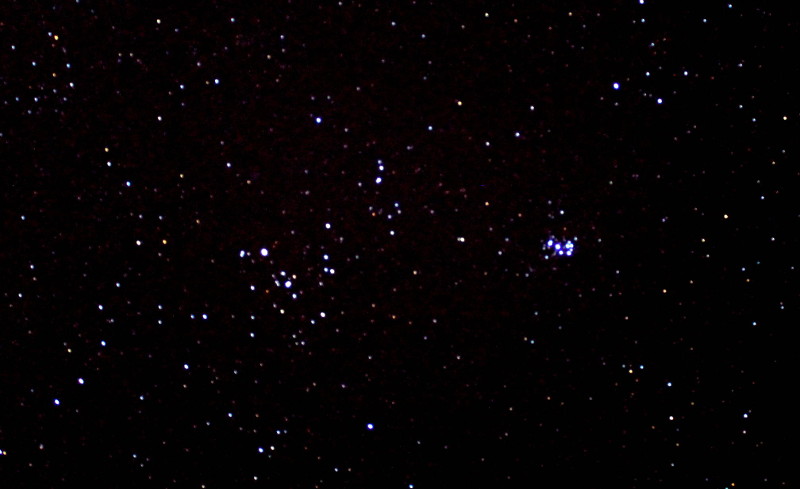
The Pleiades (right) and the Hyades, the face of Taurus the bull (left) in this photograph I took 11:23 p.m. January 4, 2016.
The named stars of the Pleiades. This is also showing more stars than can be seen with the naked eye. This is the number of stars that can be seen in binoculars, which is the best way to observe them. Most telescopes offer too much magnification to fit all the stars in. A thirty power wide angle eyepiece can just fit all the stars in. Created using Stellarium. Note that this view is the orientation of the cluster at 8p.m. tonight.
10/20/2014 – Ephemeris – Looking for the Pleiades or Seven Sisters
Oct 20. This is Bob Moler with Ephemeris for Monday, October 20th. The sun will rise at 8:04. It’ll be up for 10 hours and 45 minutes, setting at 6:49. The moon, 3 days before new, will rise at 5:43 tomorrow morning.
A marvelous member of the autumn skies can be found low in the east northeast after 9 in the evening. It is the famous star cluster called the Pleiades or the Seven Sisters. I might also add the ‘Tiny Dipper’. Many people can spot a tiny dipper shape in its six or seven stars, and mistake it for the Little Dipper. As nearsighted as I am, though corrected, I’ve never been able to see more than a few stars and a bit of fuzz. However with binoculars, even I can see over a hundred stars appear along with the dipper shape of the brightest. The fuzz I saw was unresolved stars, but in photographs the Pleiades actually contain wisps of the gas they are passing through currently. In Greek mythology the sisters were daughters of the god Atlas.
Times are for the Traverse City/Interlochen area of Michigan. They may be different for your location.
Addendum
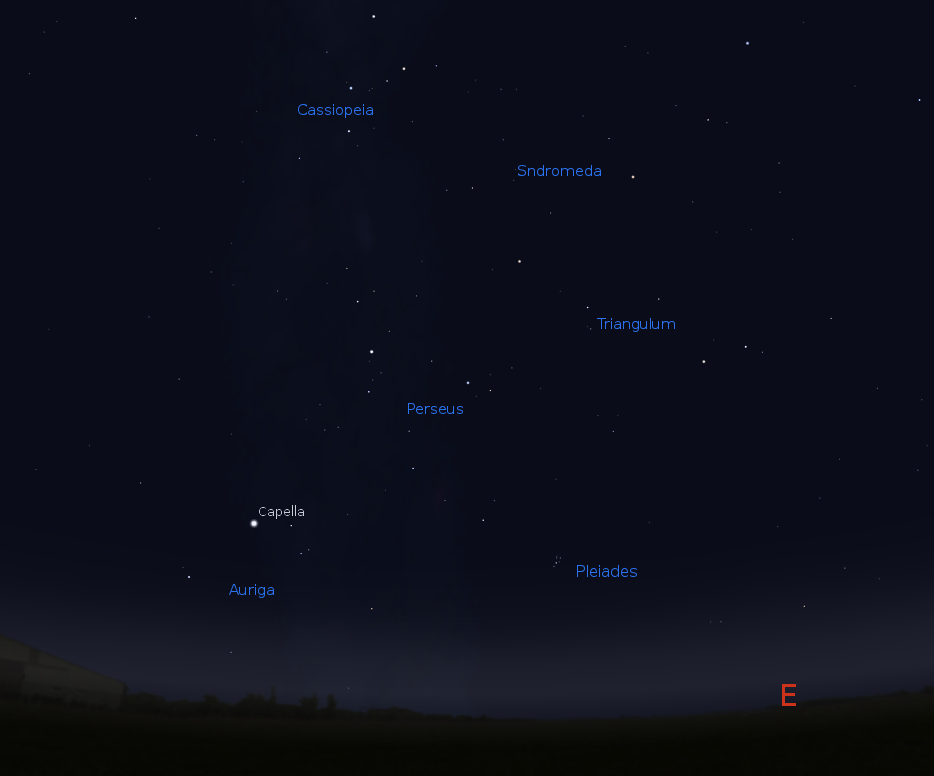
Looking to the east northeast at the Pleiades: 9 p.m.. Created using Stellarium.
The Pleiades, about what you’d see in binoculars.
 Bob Moler's Ephemeris Blog