Archive
01/22/2013 – Ephemeris – Sirius the Dog Star
Ephemeris for Tuesday, January 22nd. The sun will rise at 8:10. It’ll be up for 9 hours and 27 minutes, setting at 5:37. The moon, half way from first quarter to full, will set at 5:23 tomorrow morning.
The brightest star-like object in the evening sky is Jupiter high in the sky now. The second brightest star-like object is Sirius, also known as the Dog Star. It also is the brightest night-time star in our skies period. Tonight at 9 p.m. it’s located low in the southeastern sky. The Dog Star name comes from its position at the heart of the constellation Canis Major, the great dog of Orion the hunter. The three stars of Orion’s belt tilt to the southeast and point to Sirius. The name Sirius means ‘Dazzling One’ or ‘Scorcher’, a reference to its great brilliance and twinkling. Its Egyptian name was Sothis, and its appearance in the dawn skies in late June signaled the flooding of the Nile, and the beginning of the Egyptian agricultural year.
Times are for the Traverse City/Interlochen area of Michigan. They may be different for your location.
Addendum
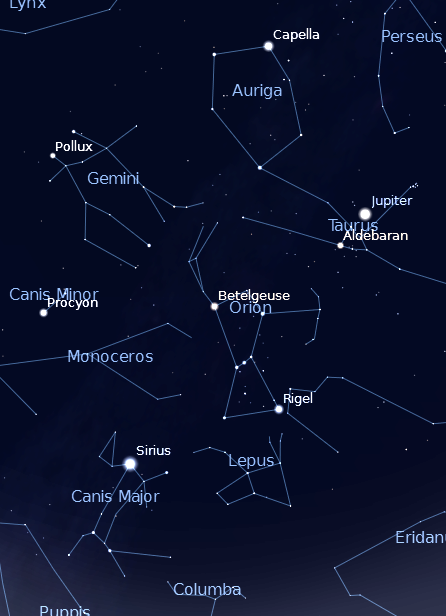
Winter Circle and Jupiter with Sirius at the bottom. Created using Stellarium.
01/11/2013 – Ephemeris – Sirius the Dog Star
Ephemeris for Friday, January 11th. The sun will rise at 8:17. It’ll be up for 9 hours and 6 minutes, setting at 5:23. The moon is new today, and won’t be visible.
The brightest star-like object in the evening sky is Jupiter high in the south around 9 p.m. The second brightest star-like object is Sirius, also known as the Dog Star. It also is the brightest night-time star in our skies period. Tonight at 9 p.m. it’s located low in the south southeastern sky. The Dog Star name comes from its position at the heart of the constellation Canis Major, the great dog of Orion the hunter. The three stars of Orion’s belt tilt to the southeast and point to Sirius. The name Sirius means ‘Dazzling One’, a reference to its great brilliance and twinkling. Its Egyptian name was Sothis, and its appearance in the dawn skies in late June signaled the flooding of the Nile, and the beginning of the Egyptian agricultural year.
Times are for the Traverse City/Interlochen area of Michigan. They may be different for your location.
Addendum
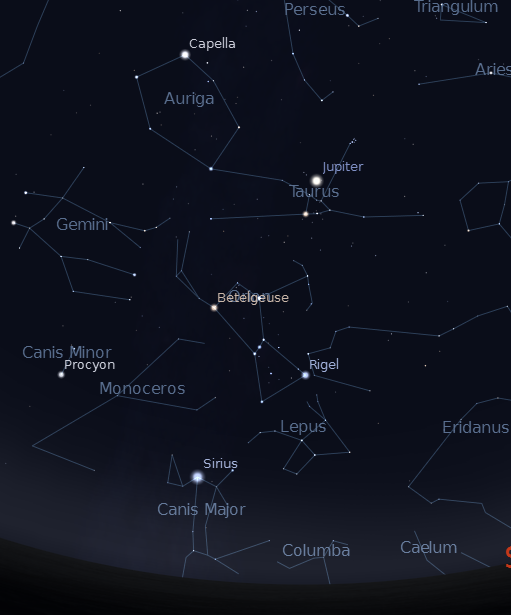
Sirius, Jupiter and the winter stars and constellations at 9 p.m. Created using Stellarium.
02/20/2012 – Ephemeris – The Winter Circle
Ephemeris for President’s Day, Monday, February 20th. The sun will rise at 7:35. It’ll be up for 10 hours and 41 minutes, setting at 6:17. The moon, 1 day before new, will rise at 7:01 tomorrow morning. | The winter skies are blessed with more first magnitude stars than any other season. Six of these stars lie in a large circle centered on the seventh. This circle is up at 9 p.m. Starting high overhead is Capella in Auriga the charioteer. Moving down clockwise is Aldebaran in the face of Taurus the Bull. Then down to Orion’s knee we find Rigel. Down and left is the brightest star of all Sirius the Dog Star in Canis Major, lowest of these stars in the south southeast. Moving up and left is Procyon in Canis Minor, Above Procyon is Pollux in Gemini the twins. All these are centered on Betelgeuse the bright red star in Orion’s shoulder.
* Times are for the Traverse City/Interlochen area of Michigan. They may be different for your location.
Addendum
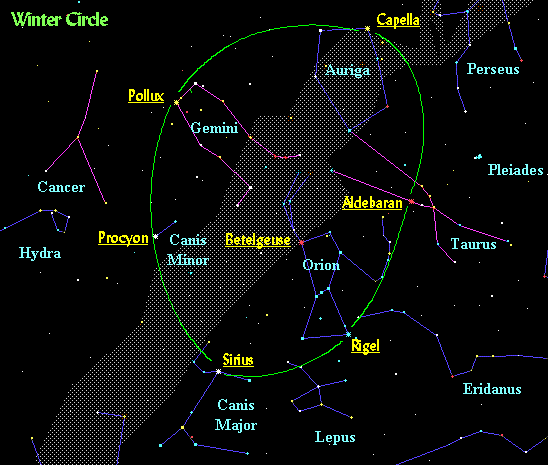
The Winter Circle of 1st magnitude stars
01/30/2012 – Ephemeris – Getting Sirius about color
Ephemeris for Monday, January 30th. The sun will rise at 8:04. It’ll be up for 9 hours and 43 minutes, setting at 5:47. The moon, at first quarter today, will set at 1:51 tomorrow morning.
The bright star shining so bright low in the south southeast at 9 p.m. is Sirius the Dog Star. I talked about it Friday in the context of its constellation Canis Major, Orion’s larger hunting dog. Sirius itself is a remarkable star. It’s name means dazzling one and a look at it in binoculars or a telescope will prove it.. The twinkling effects are due to the earth’s atmosphere, but the bright arc light color is all his. Sirius is a perfect white star. Compare it with the brightest star now overhead Capella which has the same color as our sun. Star colors tell us the temperature of the star surfaces, which run from cool red to hot blue. On our Fahrenheit temperature scale, the sun’s surface is about 10,000 degrees, Sirius is nearly twice that.
* Times, as always are for the Traverse City/Interlochen area of Michigan.
Addendum
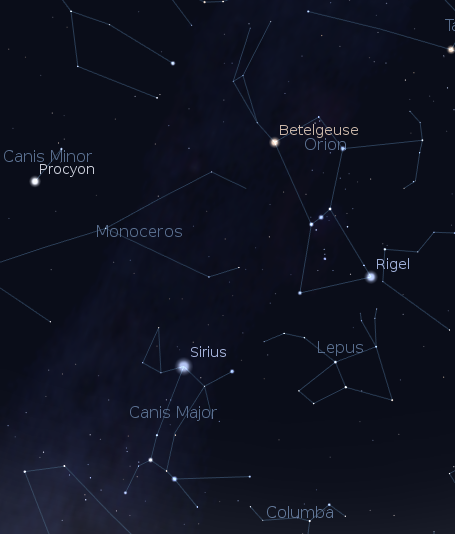
Orion and his Hunting Dogs. Created using Stellarium.
Sirius actually looks blue-white to me. Of course during the day our yellow sun looks white. I think it has to do with out night vision.
12/23/11 – Ephemeris – This year’s Christmas stars
Friday, December 23rd. The sun will rise at 8:17. It’ll be up for 8 hours and 48 minutes, setting at 5:06. The moon, 1 day before new, will rise at 8:04 tomorrow morning.
We have two bright planets and the brightest nighttime star out to be our Christmas stars this year. The planet Venus appears in the southwest in the evening and in seen higher and higher each evening, leading the sun in its slow climb as we move through winter into spring. Jupiter holds forth high in the south, the brightest star-like object once Venus sets. The brightest of all the night-time stars is Sirius, whose name means “Dazzling One” rising higher in the southeast, whiter than any planet with a tinge of blue, especially when seen in binoculars or a telescope.. It is accompanied by the rest of the bright stars of winter, including those of the great constellation Orion the hunter, whose three stars of his belt point down and to the left at Sirius.
* Times, as always are for the Traverse City/Interlochen area of Michigan.
12/20/11 – Ephemeris – Procyon, the “Little Dog Star”
Tuesday, December 20th. The sun will rise at 8:15. It’ll be up for 8 hours and 48 minutes, setting at 5:04. The moon, 3 days past last quarter, will rise at 4:45 tomorrow morning.
Visible low in the east at 9 p.m. appears the star Procyon to its lower left is Sirius the brightest night time star. Procyon is the bright star in the constellation Canis Minor, or lesser dog. I can find only one other star in Canis Minor. Perhaps it’s a hot dog. If Sirius, in Canis major is the Dog Star then Procyon should be the Little Dog Star. However Procyon is an interesting name. It means “Before the dog”, which is an allusion to the fact that Procyon, though east of Sirius actually rises before it. This is due to Procyon’s more northerly position. This effect doesn’t work south of the equator, however. Procyon is a star much like Sirius but farther away. [It’s 11.41 to Sirius’ 8.6 light years away. And like Sirius it even has a small white dwarf star in its system.]
* Times, as always are for the Traverse City/Interlochen area of Michigan. Text in brackets was omitted in the audio program due to time constraints.
Addendum
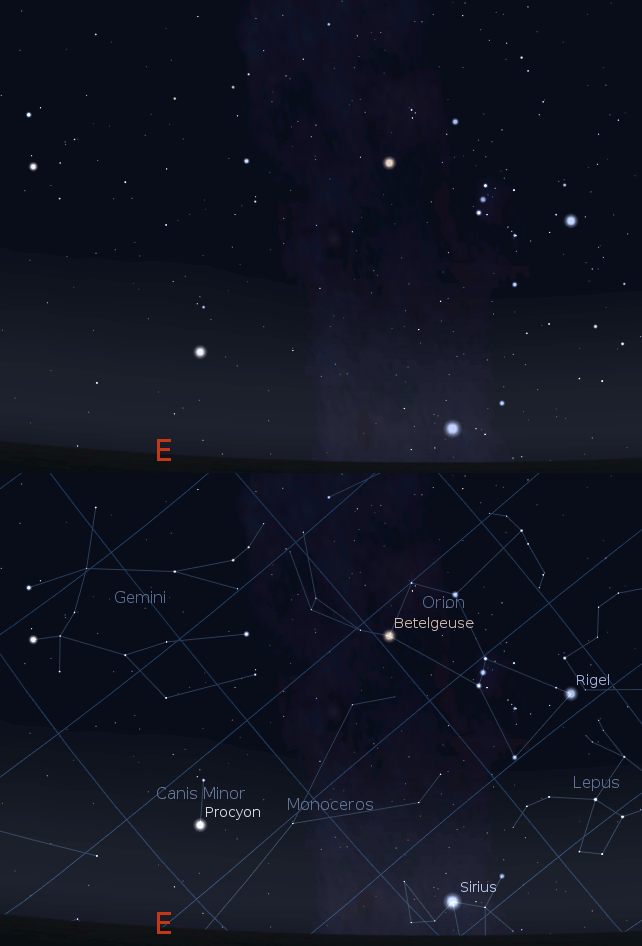
Procyon, Sirius and the stars of winter. Created using Stellarium
The grid lines are right ascension and declination, analogous to longitude and latitude on the earth. Looking eastward the right ascension lined run from the upper left to the lower right. Thus Procyon is definitely farther east than Sirius.
 Bob Moler's Ephemeris Blog