Archive
Ephemeris: 04/08/2025 – A look at Proxima Centauri
This is Ephemeris for Tuesday, April 8th. Today the Sun will be up for 13 hours and 9 minutes, setting at 8:19, and it will rise tomorrow at 7:08. The Moon, halfway from first quarter to full, will set at 5:57 tomorrow morning.
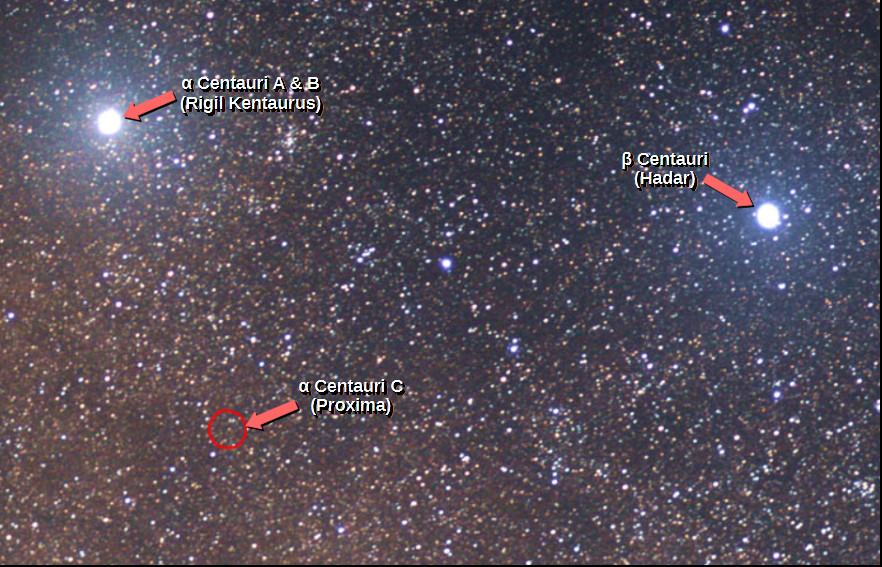
The nearest star to our Sun is a triple star system called Alpha Centauri or Rigil Kentaurus. It is in the skies of the Southern Hemisphere, but visible from the far southern parts of the United States. I’ve seen it from the Florida Keys and also from the latitude of the Big Island of Hawai’i. The closest member of that group this is a star we call Proxima Centauri or just Proxima for short. It is not visible to the naked eye. It is a red dwarf star maybe 12% the Sun’s mass, and at 11th magnitude. Proxima would be tough to spot with a pair of binoculars in a region of the sky which is filled with stars because it’s in the band of the Milky Way. Alpha Centauri, itself, is located near the Southern Cross, the farthest of the two bright stars to the east of it.
The astronomical event times given are for the Traverse City/Interlochen area of Michigan (EDT, UT – 4 hours). Times will be different for other locations.
Addendum
12/25/2014 – Ephemeris – My recollections of spotting the Southern Cross for the first time.
Merry Christmas. This is Ephemeris for Christmas Day, Thursday, December 25th. The sun will rise at 8:17. It’ll be up for 8 hours and 49 minutes, setting at 5:07. The moon, 3 days before first quarter, will set at 9:50 this evening.
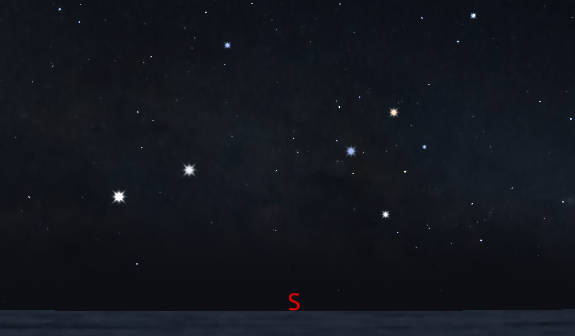
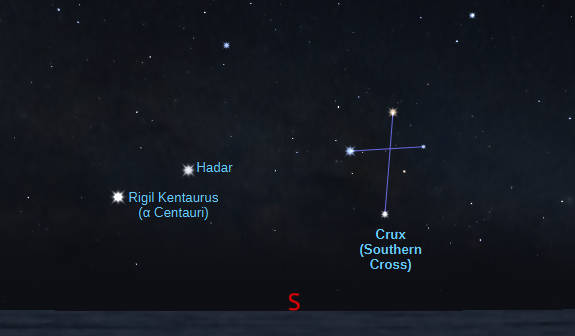
My one and only sighting of the constellation the Southern Cross came two and a half years ago from a cruise ship traveling between the Hawaiian island of Maui and Hilo on the Big Island. I had plotted it out before the trip. Our ship would be traveling in a south-southeasterly direction and at 3 a.m., the Southern Cross would be low above the southern horizon from our latitude which I surmised would be about 20 degrees north. The southern cross would be visible from the bow of the ship. The only really dark location to view it was on Deck 14 with an unobstructed view with some subdued lights behind me. I easily found it, and verified it with the fifth star of the cross. Nearby was Alpha Centauri the closest star to the sun.
Times are for the Traverse City/Interlochen area of Michigan. They may be different for your location.
Addendum

The approximate sky that I saw from the bow of the ship at 3:15 a.m. HST February 14, 2012. The moon was a slight gibbous phase. Recreated using Stellarium.
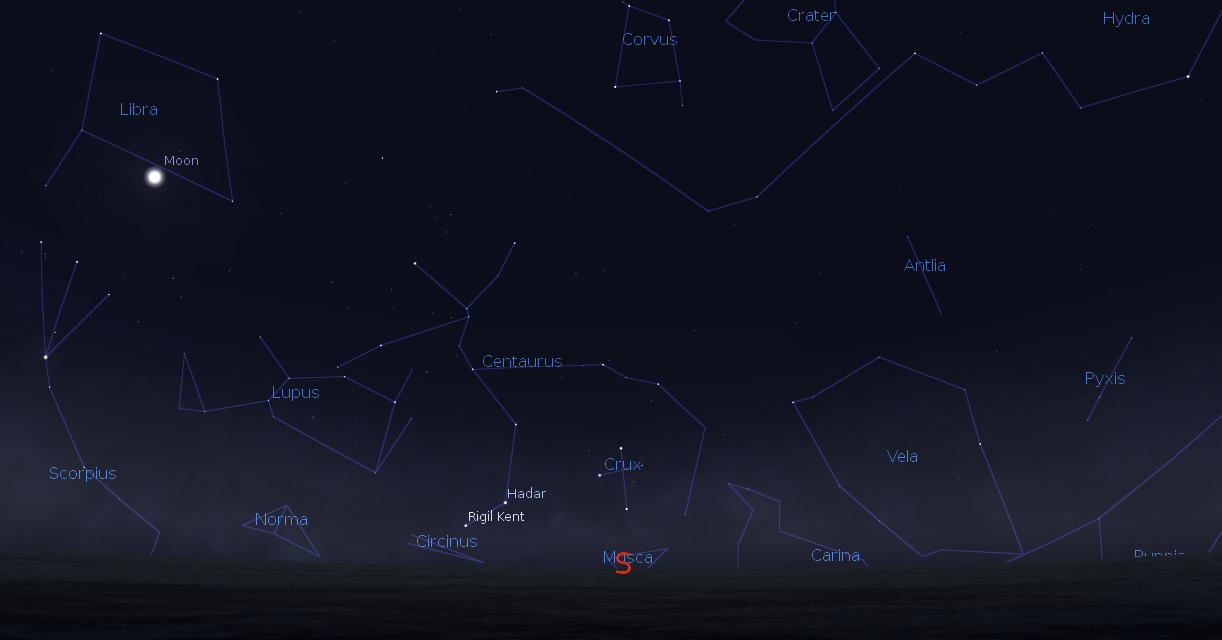
The approximate sky that I saw from the bow of the ship at 3:15 a.m. HST February 14, 2012, annotated. The moon was a slight gibbous phase. Recreated using Stellarium.
Note that the star named Rigil Kent is truncated. It’s Rigil Kentaurus, better known by its catalog name Alpha Centauri. The fifth star of the cross, my check star, is on the right side of the cross, just below the crosspiece. The Southern Cross’s real name is Crux, which simply means cross. The Northern Cross is not an official constellation. It’s part of Cygnus the swan.
I’ve heard folks say the Beta Centauri is Alpha Centauri’s companion star. That is not true. Beta Centauri is Hadar, seen near Alpha in the sky, but is much farther away. There are three stars in the Alpha Centauri system: Alpha Centauri A, Alpha Centauri B, and Proxima Centauri, a telescopic red dwarf, a bit away from the other two. Alpha Centauri A & B are a wide double, visible in a telescope. I saw and photographed them when on Key Largo in April 1986 for Halley’s Comet’s closest approach to the Earth. Note it wasn’t all that close, some 40 million miles, and it had a tail disconnection that week. Bummer.
 Bob Moler's Ephemeris Blog