Archive
05/27/11 – Ephemeris – Spica, some thoughts about its future
Friday, May 27th. Today the sun will be up for 15 hours and 12 minutes, setting at 9:15. The moon, 3 days past last quarter, will rise at 3:27 tomorrow morning. Tomorrow the sun will rise at 6:03.
Yesterday I talked about Spica the bright star to the lower left of Saturn in the evening now. Spica is actually two very massive and hot stars orbiting each other in 4 days. One is 10 times the sun’s mass while the other is 7 times the sun’s mass. The more massive one will run out of hydrogen in its core first and begin to bloat in size. As it does so it will begin to transfer mass to the other star and speed up its evolution. The resulting show should be spectacular when seen at a safe distance. I’m not sure the stars 260 light year distance is safe enough. But we have many millions of years to wait before things get interesting, and that’s fine with me. What seems to be a silent, seemingly changeless sky can hide dramatic happenings.
* Times are for the Traverse City/Interlochen area of Michigan. They may be different for your location.
Addendum
Being only an amateur astronomer the above is rank speculation with no proof that the proposed events will happen. But it’s fun to think about.
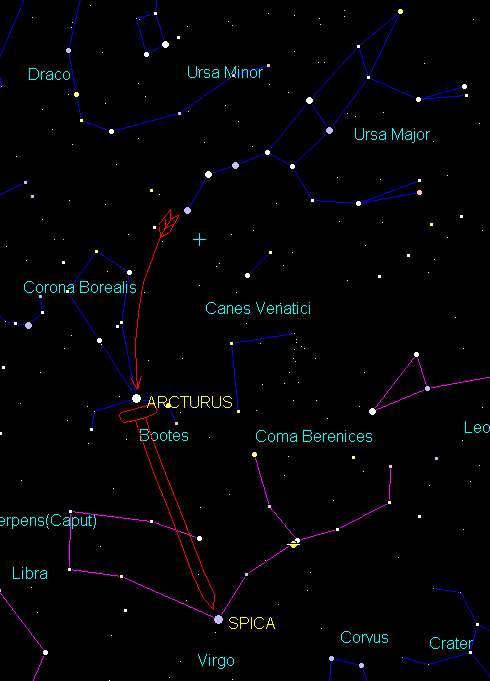
Follow the Spike to Spica, 5/26/2011
05/26/11 – Ephemeris – The bright star Spica
Thursday, May 26th. Today the sun will be up for 15 hours and 10 minutes, setting at 9:14. The moon, 2 days past last quarter, will rise at 3:04 tomorrow morning. Tomorrow the sun will rise at 6:03.
The bright star below and left of the planet Saturn these evenings is the 15th brightest night time star in the sky, called Spica. I’ve found that some pronounce it “Speeka”. Either is correct. It is the stalk of wheat the constellation Virgo is holding. Spica is actually two stars in a tight 4 day orbit of each other. They are both reasonably matched in mass and brightness. Astronomers give it a spectral type B which is a slightly blue star. I found out that once photographing a lunar eclipse near Spica, The star came out very blue. The twin stars of Spica are 260 light years away. I’m glad the stars are young now. They will have a very interesting future as they age and interact in the next few million years.
* Times are for the Traverse City/Interlochen area of Michigan. They may be different for your location.
Addendum
Follow the Spike to Spica, 5/26/2011
Note the unlables Saturn near Spics. The cross near the handle of the Big Dipper ro tail of Ursa major is the zenith at 11 p.m.
 Bob Moler's Ephemeris Blog