Archive
Ephemeris: 08/14/2023 – August is the month to explore the Milky Way
This is Ephemeris for Monday, August 14th. Today the Sun will be up for 14 hours and 6 minutes, setting at 8:50, and it will rise tomorrow at 6:44. The Moon, 2 days before new, will rise at 5:35 tomorrow morning.
Now is the time the summer Milky Way is displayed to its fullest to the southern horizon. We have a week and a half before the Moon begins to encroach on our dark skies after 10 pm. City folk come to our area and are sometimes fooled by the brightness and expanse of the Milky Way and think it’s a cloud. Yes, those are clouds indeed, but they are clouds of stars. Binoculars will begin to show them to be millions of stars, each too faint to be seen individually to the eye, but whose combined glow give the impression of a luminous cloud. Binoculars are the ideal tool to explore the Milky Way. Objects still too fuzzy can be checked out with a telescope to reveal their true nature. The dark nights of August and September are my favorites.
The astronomical event times given are for the Traverse City/Interlochen area of Michigan (EDT, UT –4 hours). They may be different for your location.
Addendum
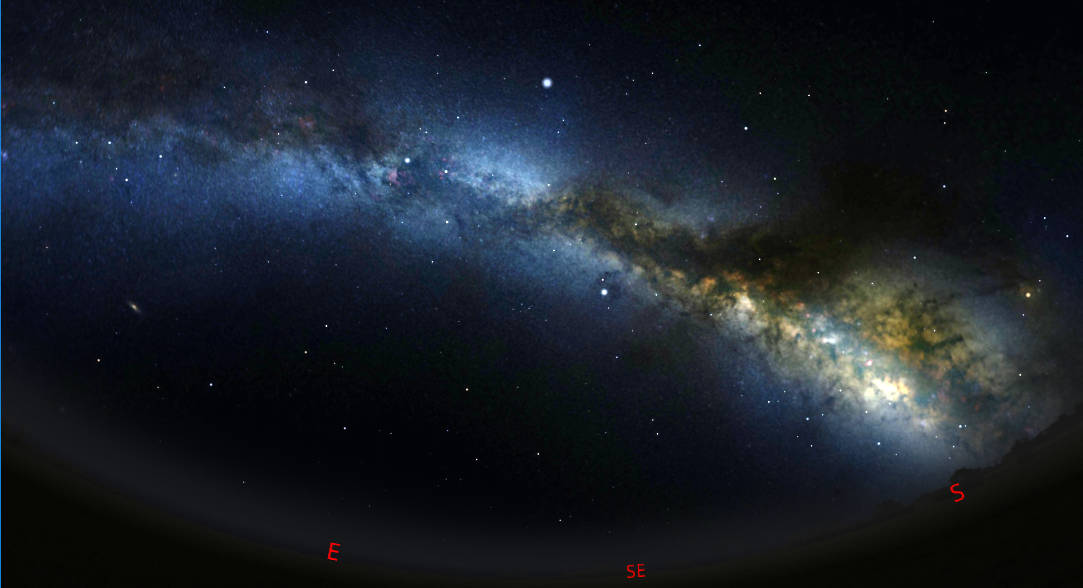
The span of the Milky Way across the summer sky as seen in the free Stellarium app. Specifically August 15th at 10 pm from Northern Michigan. The Milky Way has been set to its maximum brightness to show as much detail as possible. It really isn’t that bright. The horizon is only delineated by the compass points. The dark clouds of the Great Rift are also visible. The Milky Way, in Stellarium, is photo-realistic. The triangle of three bright stars above center is the Summer Triangle, Specifically, clockwise from the top star: Vega, Altair and Deneb. Large images can be truncated on the right. Click or tap on the image to enlarge and display the complete image.
08/22/2022 – Ephemeris – Sleeping Bear Dunes Star Party tonight!
This is Bob Moler with Ephemeris for Monday, August 22nd. Today the Sun will be up for 13 hours and 43 minutes, setting at 8:36, and it will rise tomorrow at 6:54. The Moon, 3 days past last quarter, will rise at 2:43 tomorrow morning.
Weather permitting, a star party will be held tonight at the Sleeping Bear Dunes National Lakeshore at the Dune Climb starting at 8 pm. The star party will be hosted by the park rangers and the Grand Traverse Astronomical Society, who will bring their telescopes to view the heavens, including the planet Saturn and the wonders of the summer Milky Way. The telescopes will be setup in the parking area closest to the dune. While as twilight fades Saturn will be about the only object to view, as it gets darker more and more wonders of the Milky Way will be seen. They include star clusters of both kinds: young open clusters of a few hundred stars sparkling like diamonds and great, ancient globular clusters of hundreds of thousands of stars. Jupiter will rise later in the evening, around 10 pm.
The astronomical event times given are for the Traverse City/Interlochen area of Michigan (EDT, UT – 4 hours). They may be different for your location.
Addendum
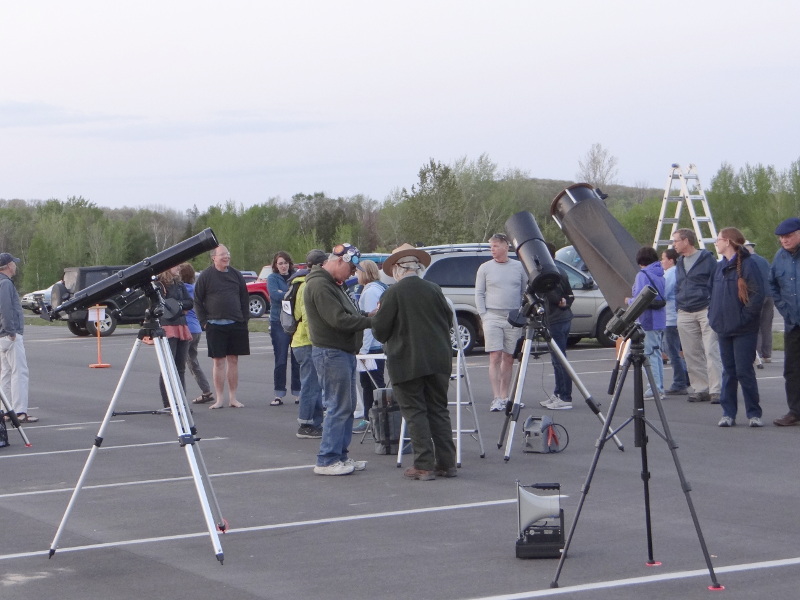
Preparing to start the May star party, 6 years ago at the Dune Climb. A few of the telescopes are visible, including the GTAS 25 inch “Emmettron” telescope at the far right. Credit: Eileen Carlisle.
08/14/2020 – Ephemeris – Seeing the summer Milky Way
This is Bob Moler with Ephemeris for Friday, August 14th. Today the Sun will be up for 14 hours and 4 minutes, setting at 8:49, and it will rise tomorrow at 6:45. The Moon, 3 days past last quarter, will rise at 2:39 tomorrow morning.
Now is the time the summer Milky Way is displayed to its fullest to the southern horizon. We have a week before the Moon begins to encroach on our dark skies after 10 pm. City folk come to our area and are sometimes fooled by the brightness and expanse of the Milky Way and think it’s a cloud. Yes those are clouds indeed, but they are star clouds. Binoculars will begin to show them to be millions of stars, each too faint to be seen individually to the eye, but whose combined glow give the impression of a luminous cloud. Binoculars are the ideal tool to explore the Milky Way. Objects still too fuzzy can be checked out with a telescope to reveal their true nature. The dark nights of August and September are my favorites.
The event times given are for the Traverse City/Interlochen area of Michigan. They may be different for your location.
Addendum
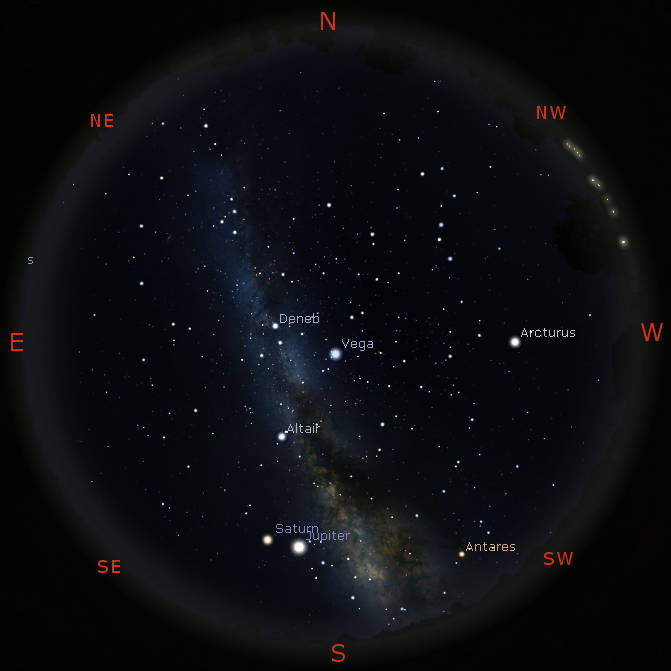
The summer Milky Way spans the sky dome at 11 pm tonight, August 14, 2020. Created using Stellarium.
08/22/2016 – Ephemeris – The glorious summer Milky Way
Ephemeris for Monday, August 22nd. The Sun rises at 6:54. It’ll be up for 13 hours and 42 minutes, setting at 8:36. The Moon, 2 days before last quarter, will rise at 11:11 this evening.
We’ll get a bit of darkness tonight, but it will be the start of about two weeks of the best sky viewing of the year. Now is the time the summer Milky Way is displayed to its fullest to the southern horizon. City folk come to our area and are sometimes fooled by the brightness and expanse of the Milky Way and think it’s clouding up. Yes those are clouds indeed, but they are star clouds. Binoculars will begin to show them to be millions of stars, each too faint to be seen by themselves to the unaided eye, but whose combined glow give the impression of a luminous cloud. Binoculars are the ideal tool to begin to explore the Milky Way. Objects still too fuzzy can be checked out with a telescope to reveal their true nature.
Times are for the Traverse City/Interlochen area of Michigan. They may be different for your location.
Addendum
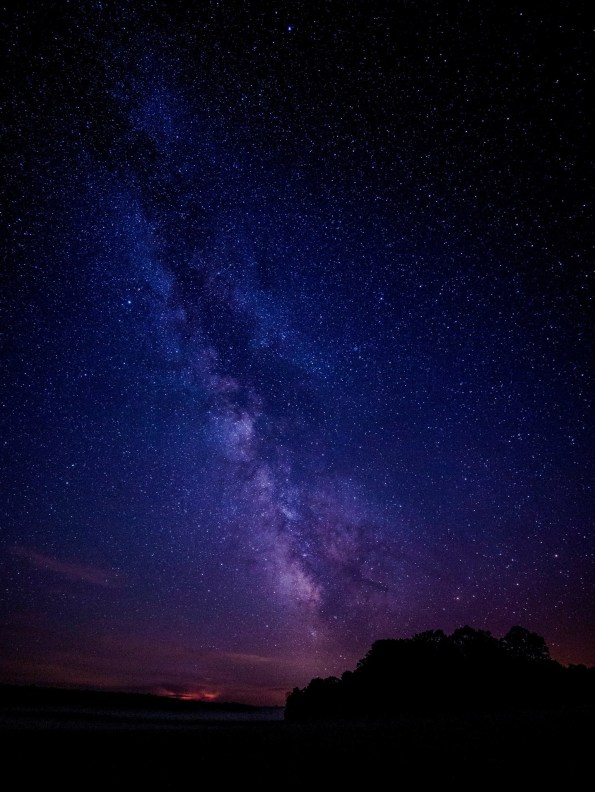
The Milky Way from the Sleeping Bear Dunes last August by Mark Stewart.
Note that this photo shows the Milky Way as brighter and with more stars than you’d see with the naked eye.
 Bob Moler's Ephemeris Blog