Archive
06/16/2014 – Ephemeris – Dates of the earliest sunrise and latest sunset
Ephemeris for Monday, June 16th. Today the sun will be up for 15 hours and 33 minutes, setting at 9:29. The moon, half way from full to last quarter, will rise at 12:11 tomorrow morning. Tomorrow the sun will rise at 5:56.
Yesterday saw the earliest sunrise for the year. My sunrise times will start to show a change on Thursday. The day-to-day change in sunrise times are now a few seconds. The summer solstice, or longest day will be this Saturday, and the latest sunset won’t occur until next week Thursday. The reason these dates don’t coincide has to do with the tilt of the earth’s axis and the earth’s slightly elliptical path around the sun. Actually the disparity between these dates is more pronounced at the winter solstice when the Earth is closer to the sun and moving faster. Yup, the sun is farther away now than it was in December. Actually we’re moving slower now, so summer lasts a few days longer than winter.
Times are for the Traverse City/Interlochen area of Michigan. They may be different for your location.
02/18/2014 – Ephemeris – Gemini and the summer solstice
Ephemeris for Tuesday, February 18th. The sun will rise at 7:38. It’ll be up for 10 hours and 37 minutes, setting at 6:15. The moon, half way from full to last quarter, will rise at 10:19 this evening.
The constellation Gemini lies above and left of Orion in the southern evening sky. Jupiter is now seen against its stars. Gemini is called the twins and its head stars at the upper left of the constellation are Castor and Pollux. Pollux is to the lower left of Castor. Stick figures of the lads can be seen extending to the lower right of these stars. Currently the place in the sky where the sun is on the winter solstice is just to the right of Castor’s big toe. So it would seem that the sun is entering Gemini on the first day of summer, not Cancer as the astrologers would tell you. That solstice point is moving westward at one degree every 71.6 years, a motion called precession. I checked two astronomy programs and that point has now moved into Taurus the bull.
Times are for the Traverse City/Interlochen area of Michigan. They may be different for your location.
Addendum
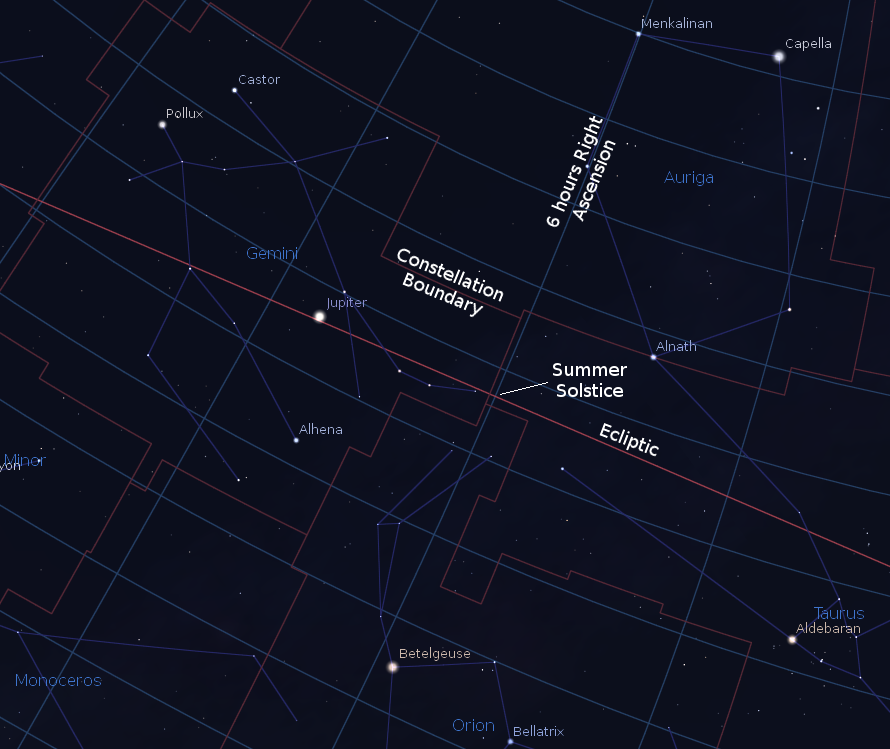
The constellation Gemini and the summer solstice point in the sky. Created using Stellarium.
The summer solstice point in the sky is the intersection of the ecliptic, the suns path in the sky and the 6 hour line of right ascension which is like longitude on the earth. The other blue lines are lines are lines of declination which is like latitude in the sky. Note also that the summer solstice point is the point on the ecliptic closest to the blue declination line which is the 25º north declination line. It’s at approximately 23½º north declination, right over the earth’s 23½º north latitude line also known as the Tropic of Cancer.
Back a couple of thousand of years ago the sun was entering the constellation of Cancer, off our image to the left, on the first day of summer. Since then the summer solstice point has moved westward against the stars at one degree every 71.6 years. This is due to what is called general precession, of the slow wobble of the earth’s axis caused by the pull of the Moon and Sun on the Earth’s equatorial bulge. This torques the earth and causes the 26,000 year wobble, like a spinning top. Since back then the solstice point passed all the way across Gemini and in 1989 entered the territory of Taurus.
06/20/2013 – Ephemeris – Summer starts tomorrow
Ephemeris for Thursday, June 20th. Today the sun will be up for 15 hours and 33 minutes, setting at 9:31. The moon, 3 days before full, will set at 4:15 tomorrow morning. Tomorrow the sun will rise at 5:57.
Summer will arrive overnight at 1:04 a.m. tomorrow morning when the sun will reach its highest point in the northern sky. If you were watching the sun’s shadow of a flag pole at local noon, when the sun is due south, it would be getting shorter every day since the winter solstice back on December 21st. From tomorrow until the next winter solstice that shadow will be getting longer. We are getting the most heat from the sun now due to the length of daylight and the high altitude of the sun most of the day. Because the earth and water takes time to heat up, we are not experiencing our greatest temperatures yet. That will take a month or a month and a half. That’s why solstice just starts summer and is not at the peak of it.
Times are for the Traverse City/Interlochen area of Michigan. They may be different for your location.
Addendum
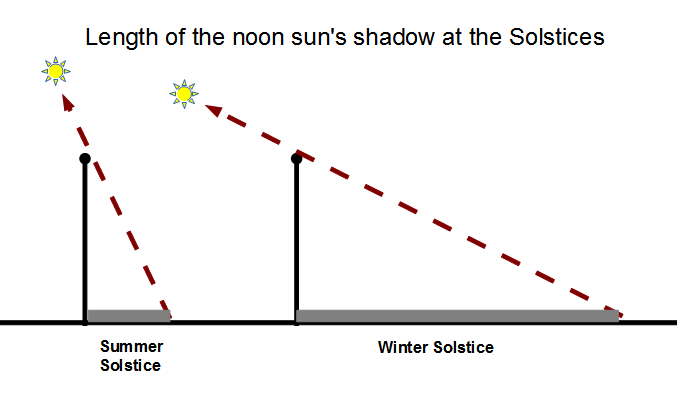
Comparison of shadows between winter and summer solstices. Note the angles are approximate.
06/20/2012 – Ephemeris – Summer begins tonight!
Ephemeris for Wednesday, June 20th. Today the sun will be up for 15 hours and 33 minutes, setting at 9:31. The moon, 1 day past new, will set at 10:12 this evening. Tomorrow the sun will rise at 5:57.
We interrupt our weekly planet report to bring you this important news. At 7: 07 (EDT) this evening summer will begin. That instant of time is called the summer solstice. Solstice means “sun standstill”. That makes today the longest day in terms of daylight hours, though you will notice very little change for the next week or so. We have come to the point in earth’s orbit when the north pole of the earth is tipped its maximum toward the sun so the northern hemisphere will receive the most heat from the sun. The southern hemisphere will experience at that same instant their winter solstice. The earth now is not at its closest to the sun. In fact we’ll be at our farthest from the sun in two weeks.
Times are for the Traverse City/Interlochen area of Michigan. They may be different for your location.
06/21/11 – Ephemeris – Summer solstice is today
Tuesday, June 21st. Today the sun will be up for 15 hours and 33 minutes, setting at 9:31. The moon, 2 days before last quarter, will rise at 12:46 tomorrow morning. Tomorrow the sun will rise at 5:57.
At 1:16 this afternoon the sun will reach its greatest angle north of the celestial equator or 23 ½ degrees. The date and the point in the sky where the sun is at that instant is called the summer solstice, or summer sun standstill. It means the point at which the sun seems poised farthest north before heading southward. This would be most noticeable if you were monitoring the height of the sun at noon or the sun’s rising or setting point day by day as the ancients did. Besides being the day with the longest sunlight we, in the northern hemisphere, are also receiving more intense heat from the sun than any other day of the year. Still hotter weather is in store as the northern hemisphere continues to warm up.
* Times are for the Traverse City/Interlochen area of Michigan. They may be different for your location.
 Bob Moler's Ephemeris Blog