Archive
Ephemeris: 09/04/2025 – Venus, the Morning Star
This is Ephemeris for Thursday, September 4th. Today the Sun will be up for 13 hours and 4 minutes, setting at 8:13, and it will rise tomorrow at 7:10. The Moon, 3 days before full, will set at 4:19 tomorrow morning.
Venus graces our morning sky as the Morning Star. It is seen, this year, along with the planet Jupiter. They are the two brightest planets. The Greek and others of that part of the world, early on, thought the evening and morning appearances of Venus were two different planets. The Mayans of Pre-Columbian Central America were meticulous observers of Venus, as is seen in one of their surviving books, the Dresden Codex. A Venus cycle lasts 584 days, from first appearance in the morning sky, its heliacal rising, through its morning appearance, disappearance behind the Sun, through its evening appearance and disappearance to the next heliacal rising. Astronomers call that it’s synodic period. Five synodic periods equal almost exactly 8 years.
Addendum
Ephemeris: 01/09/2025 – Venus is at its greatest separation from the Sun today
This is Ephemeris for Thursday, January 9th. Today the Sun will be up for 9 hours and 2 minutes, setting at 5:21, and it will rise tomorrow at 8:18. The Moon, 3 days past first quarter, will set at 5:25 tomorrow morning.
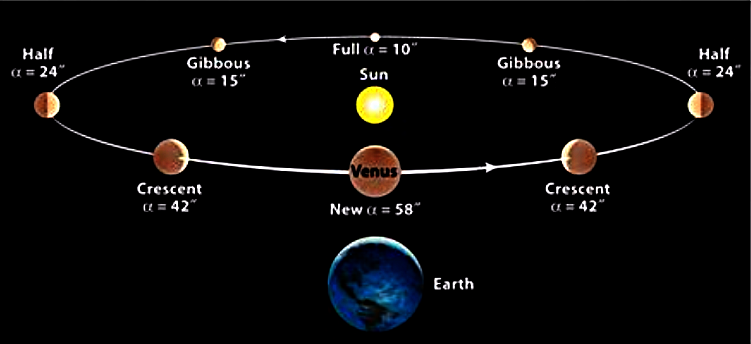
Tonight, Venus will be at its greatest separation from the Sun in the sky at a little bit more than a 47° angle. Venus, being inside the Earth’s orbit, can ever stray far from the Sun. So today it is at its greatest eastern elongation from the Sun. For the rest of winter it will be moving closer to the Sun from our perspective. Crossing between the Earth and the Sun on March 22nd. During this period of time Venus will be a great object for the telescope, as it moves closer to the Earth and gets larger in telescopes and its phase, moving from being like a quarter moon to a very thin crescent near the end of winter. At inferior conjunction with the Sun, Venus will be only 26 million miles away from us, but quite invisible in the Sun’s glare.
The astronomical event times given are for the Traverse City/Interlochen area of Michigan (EST, UT – 5 hours). Times will be different for other locations.
Addendum
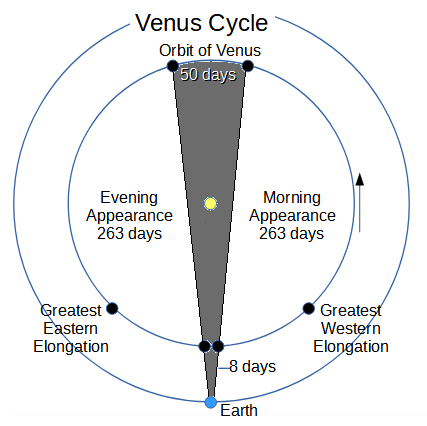
The Mayan civilization of Central America had several calendars. One of them was based on the planet Venus. They discovered that Venus repeated its positions in the sky with respect with the seasonal calendar over a period of eight years, which they called a Venus Sequence. They paid close attention to Venus and discovered it appeared to go around the Sun in the sky in 584 days, which they called a Venus Cycle. We call it Venus’ synodic period, which is the number of days between inferior conjunction, when Venus passes between the Earth and the Sun, then moves through the morning sky, and disappears behind the Sun at superior conjunction, then appears in the evening sky and back to inferior conjunction again. The gray area in the diagram is where Venus is not visible because it’s too close to the sun. However, at our latitude the number of days that Venus is invisible varies with the season. The Mayans, being in the tropics, didn’t have as much variation as we do. The Mayans discovered that Venus completed 5 cycles in almost exactly 8 years.
Today, Venus is at its greatest eastern elongation. On March 22nd Venus will pass inferior conjunction. That is 72 days from today. So it spends most of its time, 7 months, moving from around behind the Sun to the greatest elongation and only a short time, about 2 1/2 months moving from there to inferior conjunction. These 2 1/2 months are the best time to view Venus with a telescope, since Venus will grow in size and become an ever thinning crescent.
Check out my Wednesday posts showing the ever-growing and thinning Venus crescent until March 22nd. Or better yet, see it for yourself with a small telescope.
01/14/2022 – Ephemeris – Mayan civilization and the planet Venus
This is Ephemeris for Friday, January 14th. Today the Sun will be up for 9 hours and 10 minutes, setting at 5:27, and it will rise tomorrow at 8:16. The Moon, 3 days before full, will set at 6:47 tomorrow morning.
The Mayan people of pre-Columbian Central America were diligent observers of the planet Venus. One of their few surviving records is the Dresden Codex. It counts through a long series of Venus’ 584 day cycles. The location of the Mayan cities are a lot closer to the equator than we are, so when Venus disappears as it moves between the Earth and the Sun as it did last weekend, it only disappeared for 8 days. For us, at our latitude, it can be a few days longer. So we should spot it on clear mornings next week in the southeast by 7:15 to 7:30 am. It will appear as a thin crescent in telescopes or even binoculars. Venus will stay in the morning sky until later this year, which will set it up to be a spectacular evening star next year.
The astronomical event times given are for the Traverse City/Interlochen area of Michigan (EST, UT – 5 hours). They may be different for your location.
Addendum
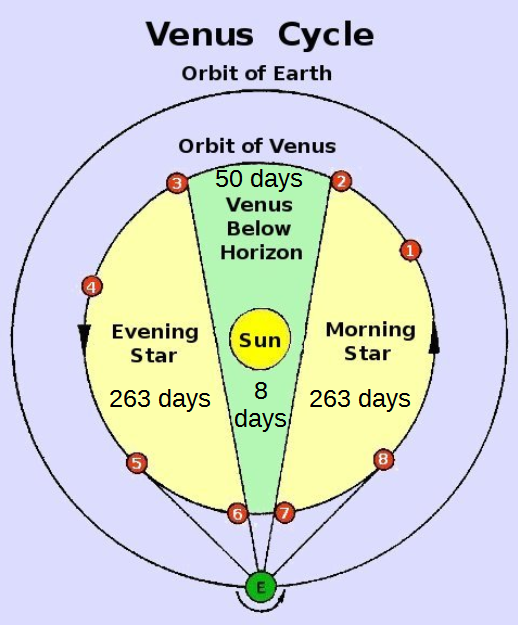
Venus Cycle derived from John P Pratt who had another purpose for the diagram and annotated to include the day number of days in each phase. For my purposes, ignore points 1 and 4. The Mayan cycle starts with 7, the first appearance of Venus during the morning. Points 8 and 5 are the points where Venus is at greatest elongation from the Sun. Credit John P Pratt.
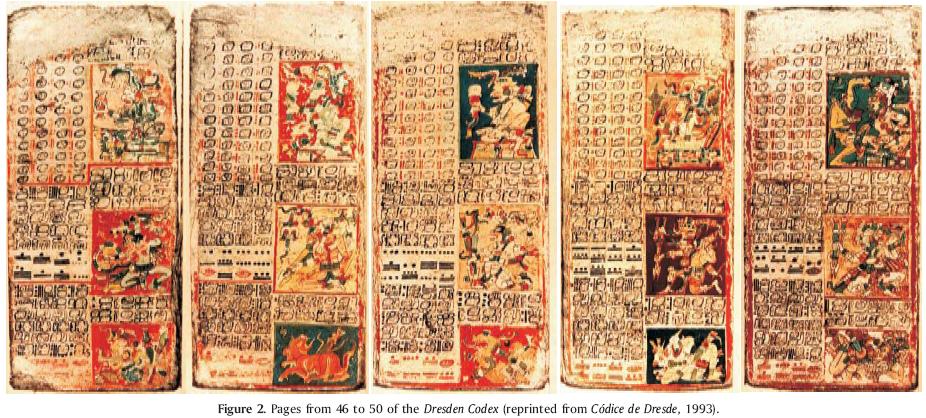
Pages of the Dresden Codex, produced by the Maya tracking Venus’ appearances in the skies over the Yucatán, for 104 years. The Dresden Codex is one of only 4 surviving Mayan Codices.
01/10/2022 – Ephemeris – Venus starts a new cycle in the morning sky
This is Ephemeris for Monday, January 10th. Today the Sun will be up for 9 hours and 3 minutes, setting at 5:22, and it will rise tomorrow at 8:18. The Moon, 1 day past first quarter, will set at 2:36 tomorrow morning.
Two days ago, Venus passed between the Earth and the Sun in an event called an inferior conjunction. Inferior has nothing to due to quality, but denotes the fact that Venus is passing between the Earth and the Sun. The other Venus conjunction is the superior conjunction when Venus passes the Sun on the far side. We should be able to spot Venus rather suddenly in the late 7 to 8 am hour in a few days. Its appearance seems sudden and is sometimes reported as a UFO. It sometimes surprises airport control tower officials, because it may look like an airplane coming in with its landing lights on. But it never lands. In its morning appearance, Venus is sometimes called the Morning Star or Lucifer.
The astronomical event times given are for the Traverse City/Interlochen area of Michigan (EST, UT – 5 hours). They may be different for your location.
Addendum
The Mayans of pre-Columbian Central America were meticulous observers of Venus, as is seen in one of their surviving books, the Dresden Codex. A Venus Cycle lasts 584 days, from first appearance in the morning sky, its heliacal rising, through its morning appearance, disappearance behind the Sun, through its evening appearance and disappearance on front of the Sun to the next heliacal rising. Astronomers call that it’s synodic period. Five Synodic periods equal almost exactly 8 years.
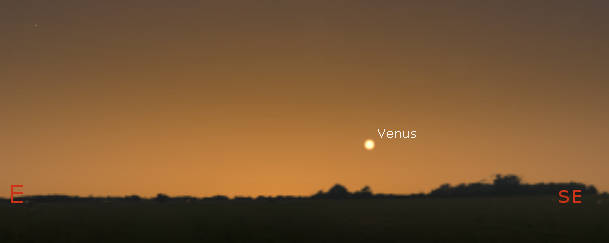
Venus, 9 days after Inferior conjunction, next Monday morning. Venus will be just under 5 degrees above an unobstructed horizon at 7:30 am in northwest lower Michigan. Created using Stellarium.
04/27/2018 – Ephemeris – The Mayan special relationship to Venus
Ephemeris for Arbor Day, Friday, April 27th. The Sun rises at 6:38. It’ll be up for 14 hours and 4 minutes, setting at 8:42. The Moon, 2 days before full, will set at 6:20 tomorrow morning.
The Mayans of Mesoamerica a thousand years ago diligently observed Venus and discovered Venus’ unique cycles that they used to correct their calendars. The first was the Venus Cycle, the period we’d say that Venus passes between the Earth and the Sun to enter the morning sky to the next time it does it. That was 584 days. Its appearance in the morning sky would last 263 days, Then it would disappear near the Sun, actually behind it for 50 days. It would reappear in the evening sky for another 263 days before again disappearing near the Sun, this time for only 8 days. These are the 4 phases of a Venus cycle. Five of these cycles equals almost exactly 8 years, called a sequence. 13 sequences equal 104 years, a Venus Round.
The times given are for the Traverse City/Interlochen area of Michigan. They may be different for your location.
Addendum
Venus Cycle derived from John P Pratt who has another purpose for the diagram and annotated by me to include the number of days in each phase. For my purposes ignore points 1 and 4. The Mayan cycle starts with 7, the first appearance of Venus during the morning. Points 8 and 5 are the points where Venus is at greatest elongation from the Sun. Credit John P Pratt.
 Bob Moler's Ephemeris Blog