Archive
10/28/2020 – Ephemeris – Let’s look for the naked-eye planets for this week
This is Ephemeris for Wednesday, October 28th. Today the Sun will be up for 10 hours and 20 minutes, setting at 6:36, and it will rise tomorrow at 8:17. The Moon, 3 days before full, will set at 6:05 tomorrow morning.
Let’s look for the naked-eye planets for this week. Jupiter and Saturn are both low in the south-southwestern sky at 8 pm. Jupiter is the very bright one. Left and a bit above it will be the somewhat dimmer Saturn. They are closing slowly, so they will cross paths on December 21st and be in the same telescope field that evening. Jupiter will set first tonight at 11:08 with Saturn following at 11:37. Off in the east-southeast at that hour will be Mars. Since the it was closest 22 days ago its distance has increased to 42.0 million miles (67.6 million km) away. Brilliant Venus will rise at 5:12 am in the east as it retreats slowly toward the Sun. We’ll have a big jump backwards in rise and set times next week when standard time returns.
The event times given are for the Traverse City/Interlochen area of Michigan. They may be different for your location.
Addendum
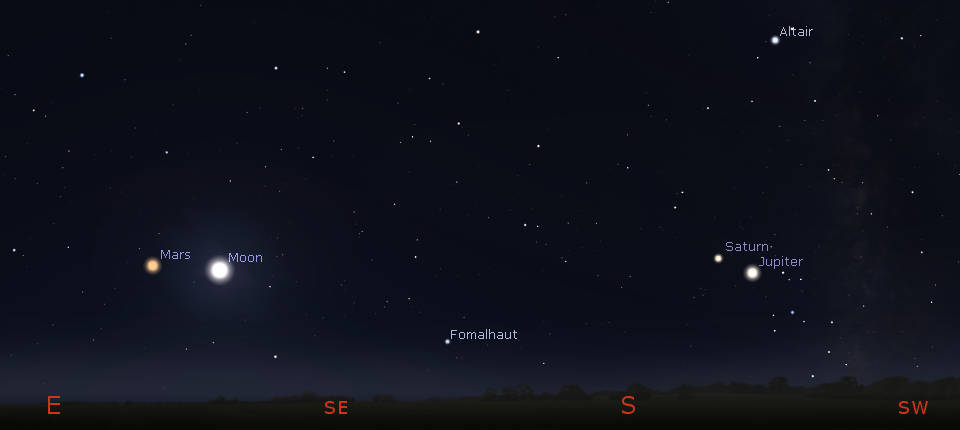
The evening planets and the Moon at 8 pm tonight, October 28, 2020. Click on the image to enlarge. Created using Stellarium.
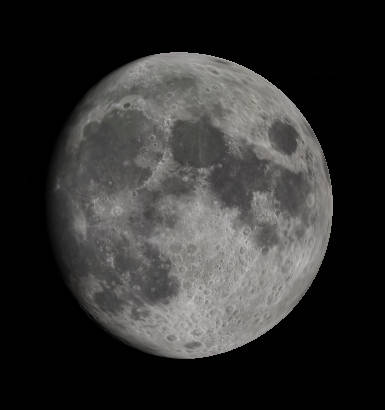
The waxing gibbous Moon tonight October 28, 2020 as it might appear in binoculars or a low power telescope. Created using Stellarium.
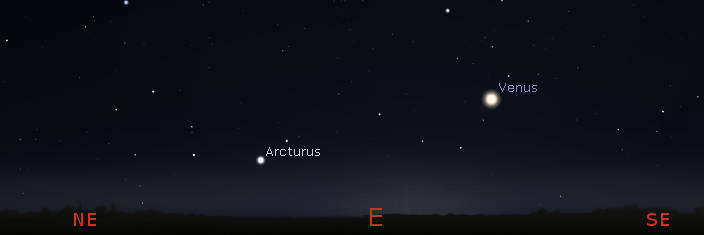
The morning planet Venus visible at 7 am October 29, 2020 with some of the stars of morning. Click on the image to enlarge. Created using Stellarium.
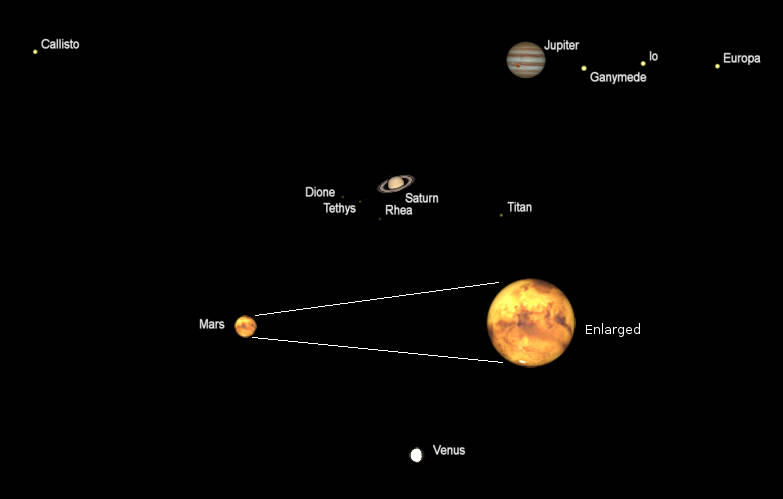
The planets as seen in a telescope (north up) with the same magnification for the night of October 28/29, 2020. Times of the display are: Jupiter and Saturn, 8 pm; Mars, 11 pm; Venus, 7 am. Apparent diameters: Jupiter, 37.26″; Saturn, 16.42″, rings, 38.25″. Mars, 20.27″, and Venus 13.29″. Mars also displays an enlargement showing surface detail. Mars was closest to the Earth this go-a-round on October 6. The ” symbol means seconds of arc (1/3600th of a degree.) Click on the image to enlarge. Created using Cartes du Ciel (Sky Charts).
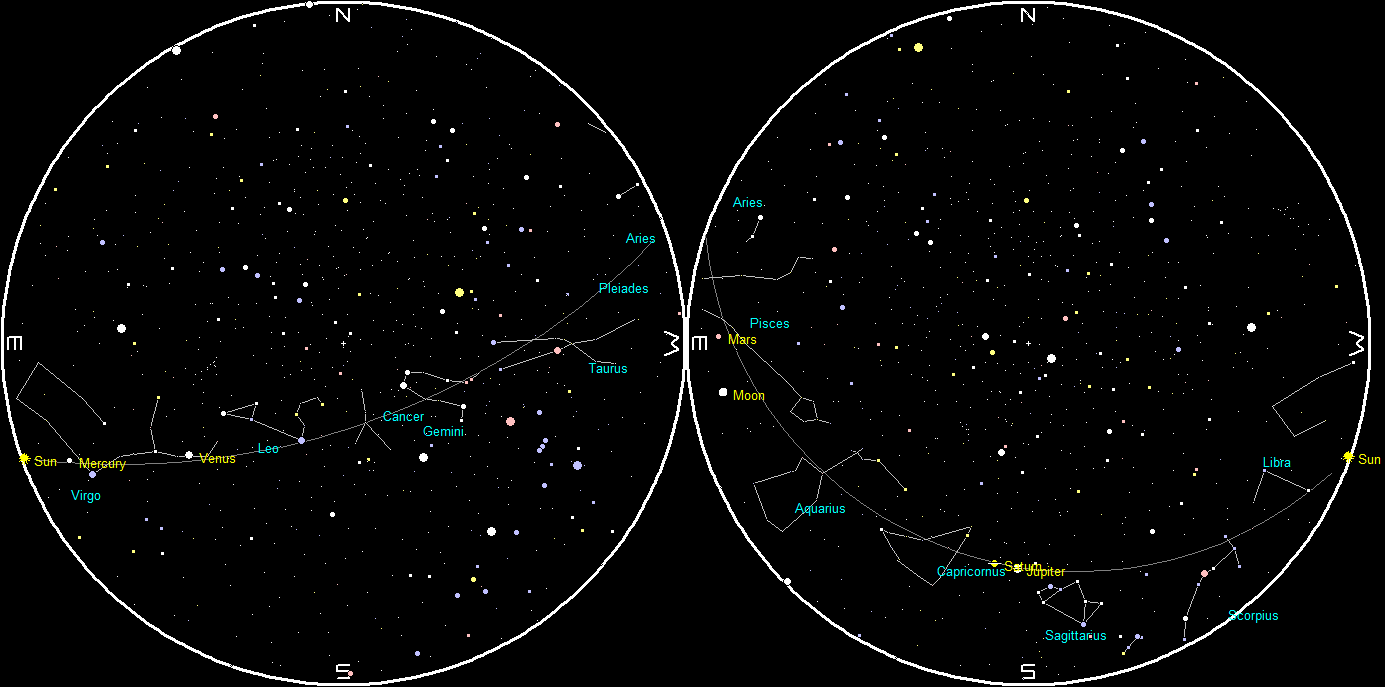
Planets and the Moon at sunset and sunrise of a single night starting with sunset on the right on October 28, 2020. The night ends on the left with sunrise on 29th. Click on the image to enlarge. Created using my LookingUp program.
10/21/2020 – Ephemeris – Let’s look for the naked-eye planets for this week
This is Bob Moler with Ephemeris for Wednesday, October 21st. Today the Sun will be up for 10 hours and 40 minutes, setting at 6:47, and it will rise tomorrow at 8:08. The Moon, 2 days before first quarter, will set at 10:39 this evening.
Let’s look for the naked-eye planets for this week. Jupiter and Saturn are both low in the south-southwestern sky at 9 pm. Jupiter is the very bright one. Left and a bit above it will be the somewhat dimmer Saturn. They are closing slowly, so they will cross paths on December 21st and be in the same telescope field that evening. Jupiter will set first tonight at 11:28 with Saturn following at midnight. Off in the east-southeast at 9 pm will be Mars. Since the it was closest 15 days ago its distance is slowly increasing to 40.1 million miles (64.6 million km) away. Brilliant Venus will rise at 4:55 am in the east as it retreats slowly toward the Sun. It’s brilliant and looks like a tiny featureless gibbous moon in telescopes.
The event times given are for the Traverse City/Interlochen area of Michigan. They may be different for your location.
Addendum
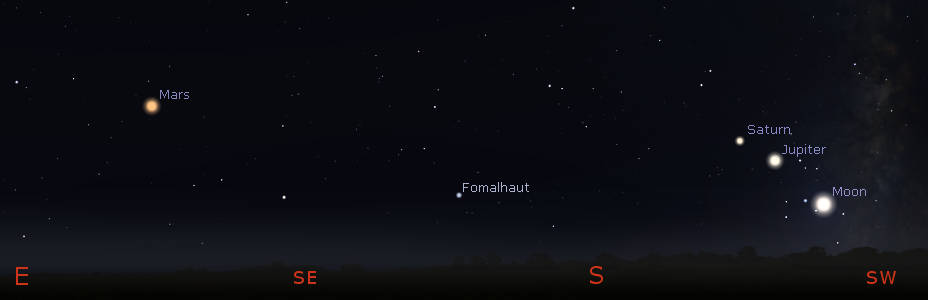
The evening planets and the Moon at 9 pm tonight, October 21, 2020. Click on the image to enlarge. Created using Stellarium.
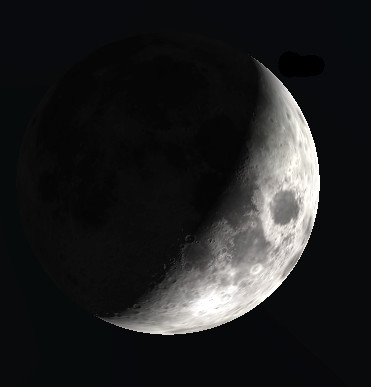
The waxing crescent Moon tonight October 21, 2020 as it might appear in binoculars or a low power telescope. Created using Stellarium.
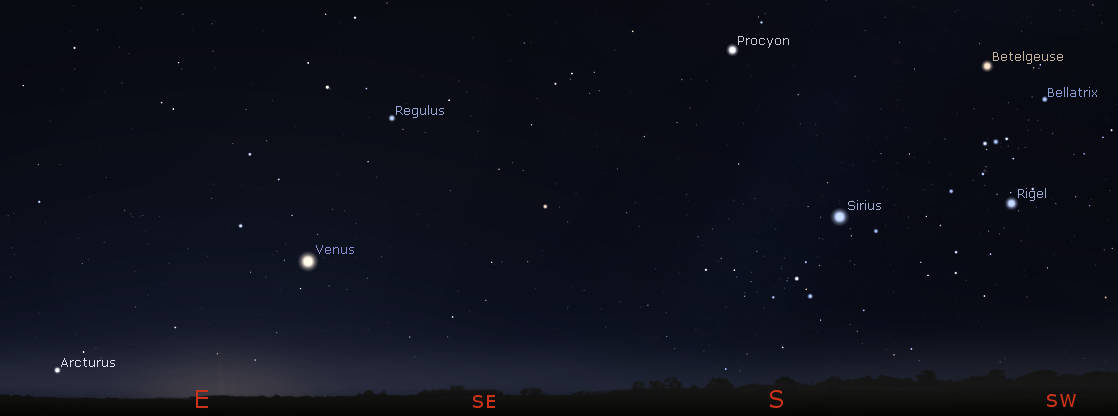
The morning planet Venus visible at 7 am October 22, 2020 with some of the stars of morning. Click on the image to enlarge. Created using Stellarium.
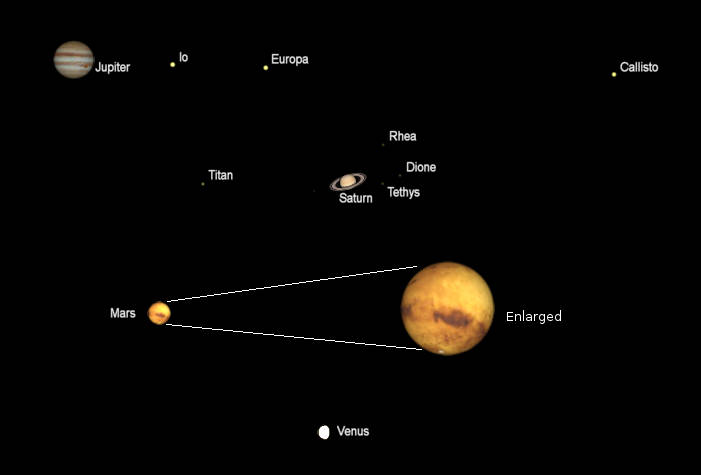
The planets as seen in a telescope (north up) with the same magnification for the night of October 21/22, 2020. Times of the display are: Jupiter and Saturn, 9 pm; Mars, 11 pm; Venus, 7 am. Apparent diameters: Jupiter, 38.01″; Saturn, 16.61″, rings, 38.69″. Mars, 21.57″, and Venus 13.75″. Mars also displays an enlargement showing surface detail. Mars was closest to the Earth this go-a-round on October 6. The ” symbol means seconds of arc (1/3600th of a degree.) Created using Cartes du Ciel (Sky Charts).
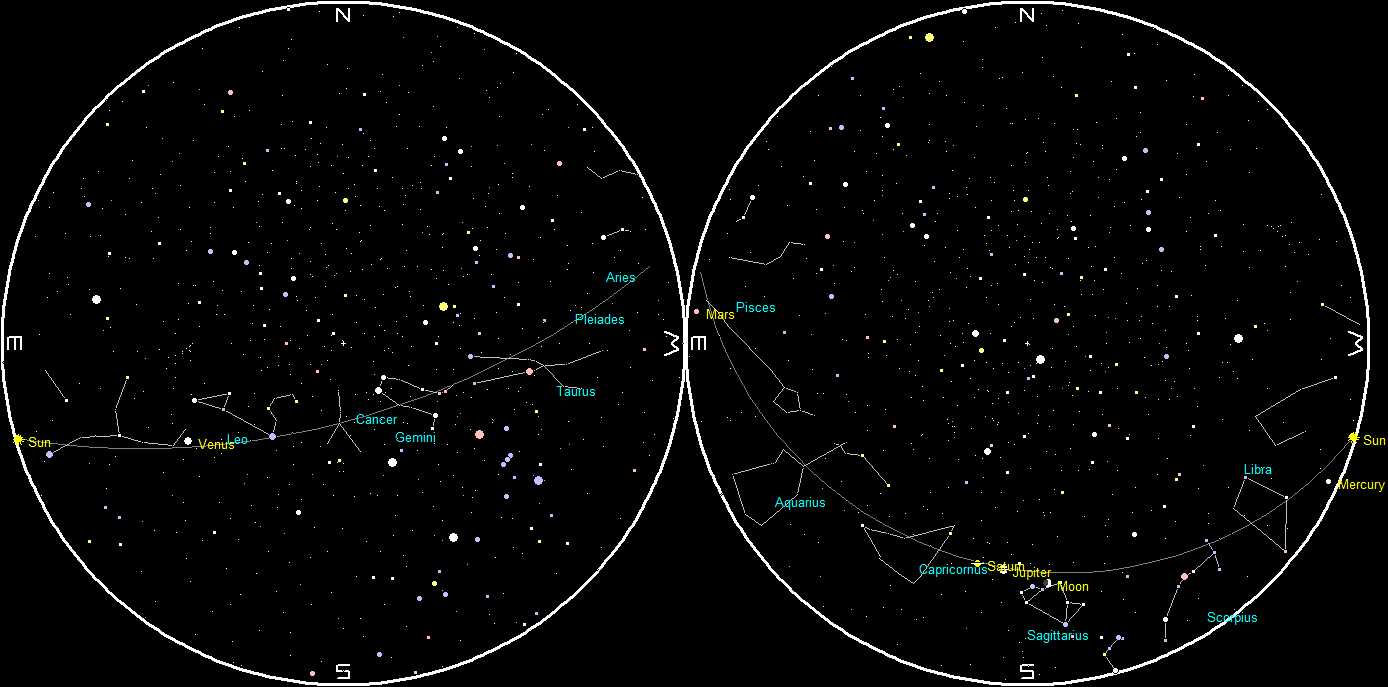
Planets and the Moon at sunset and sunrise of a single night starting with sunset on the right on October 21, 2020. The night ends on the left with sunrise on 22nd. Click on the image to enlarge. Created using my LookingUp program.
10/14/2020 – Ephemeris – Let’s look for the naked-eye planets for this week
This is Bob Moler with Ephemeris for Wednesday, October 14th. Today the Sun will be up for 11 hours and 1 minute, setting at 6:58, and it will rise tomorrow at 7:58. The Moon, 2 days before new, will rise at 6:10 tomorrow morning.
Let’s look for the naked-eye planets for this week. Jupiter and Saturn are both low in the south-southwestern sky at 9 pm. Jupiter is the very bright one. Left and a bit above it will be the somewhat dimmer Saturn. They are closing slowly, so they will cross paths on December 21st and be in the same telescope field that evening. Jupiter will set first tonight at 11:52 with Saturn following at 12:29 am. Off in the east-southeast at 9 pm will be Mars. Since the Earth passed it yesterday its distance is slowly increasing to 38.9 million miles (62.7 million kilometers) away. Brilliant Venus will rise at 4:39 am in the east as it retreats slowly toward the Sun. It’s brilliant and looks like a tiny featureless gibbous moon in telescopes.
The event times given are for the Traverse City/Interlochen area of Michigan. They may be different for your location.
Addendum
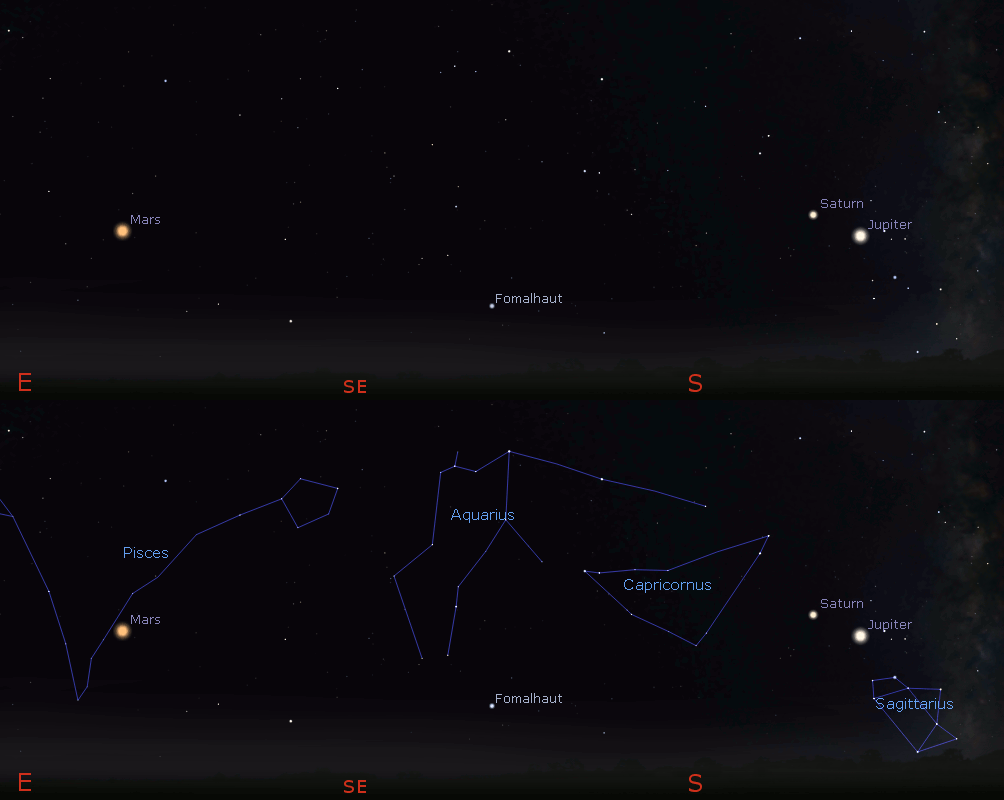
Evening Planets animation showing Jupiter, Saturn and Mars with the constellations of the zodiac for 9 pm October 14, 2020. Click on the image to enlarge. Created using Stellarium.
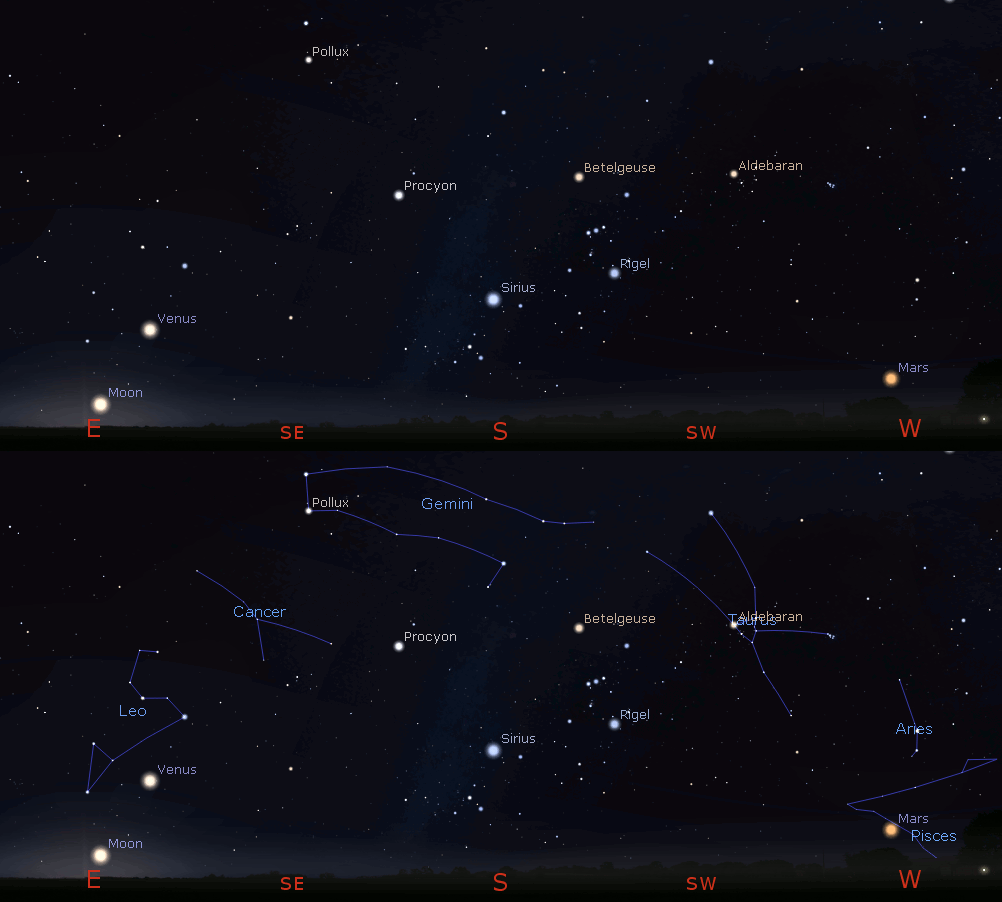
Morning planet animation for 6:45 am tomorrow October 15, 2020. Click on the image to enlarge. Created using Stellarium.
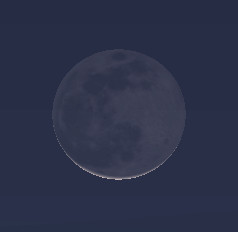
The waning thin crescent Moon about a day and a half from new. as it might be seen in binoculars with earthshine at 6:45 am tomorrow morning October 15, 2020. Created using Stellarium.
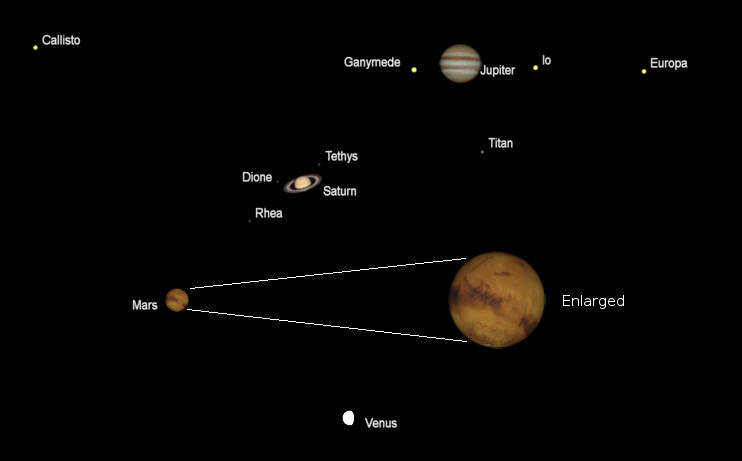
The planets as seen in a telescope (north up) with the same magnification for the night of October 14/15, 2020. Times of the display are: Jupiter and Saturn, 9 pm; Mars, 11 pm; Venus, 7 am. Apparent diameters: Jupiter, 38.82″; Saturn, 16.81″, rings, 39.15″; Mars, 22.27″; and Venus 14.27″. Mars also displays an enlargement showing surface detail. Mars was closest to the Earth this go-a-round on October 6, and at opposition yesterday. The ” symbol means seconds of arc (1/3600th of a degree.) Created using Cartes du Ciel (Sky Charts).
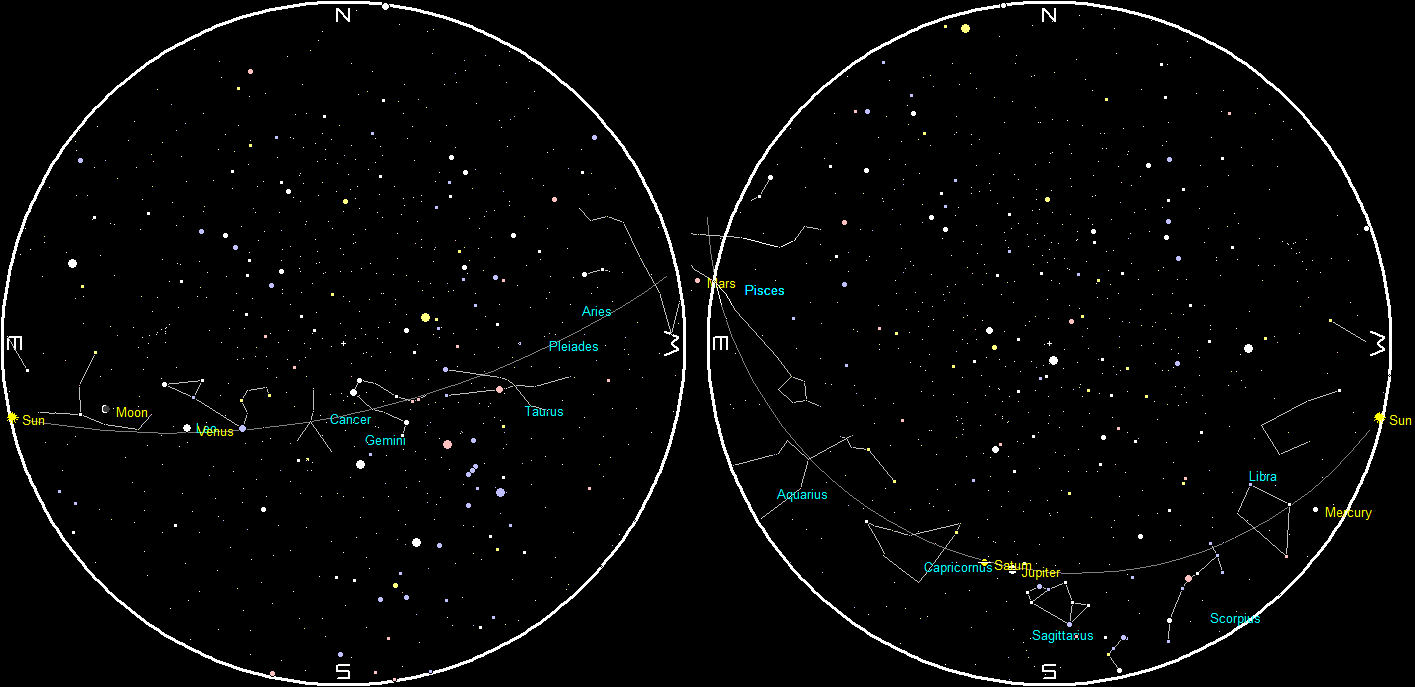
Planets and the Moon at sunset and sunrise of a single night starting with sunset on the right on October 14, 2020. The night ends on the left with sunrise on 15th. Click on the image to enlarge. Mars, near opposition and a bit south of the ecliptic, actually rises after sunset, so I included it in the sunset chart even though it is below the horizon at sunset. Created using my LookingUp program.
10/07/2020 – Ephemeris – Let’s look for the naked-eye planets for this week
This is Ephemeris for Wednesday, October 7th. Today the Sun will be up for 11 hours and 22 minutes, setting at 7:11, and it will rise tomorrow at 7:50. The Moon, 2 days before last quarter, will rise at 10:23 this evening.
Let’s look for the naked-eye planets for this week. Jupiter and Saturn are both low in the southern sky at 9 pm. Jupiter is the very bright one. To the left of it will be the somewhat dimmer Saturn which is just about due south at that hour. They are closing slowly, so they will cross paths on December 21st. Jupiter will set first at 12:23 tomorrow morning with Saturn following at 1 am. Off in the east will be Mars which will rise at 7:33 pm. It’s now down to 38.6 million miles (62.1 million km) away, as the Earth is about to overtake it. Brilliant Venus will rise at 4:24 am as it retreats slowly toward the Sun. It looks like a tiny featureless gibbous moon in telescopes. Its clouds of sulfuric acid are quite featureless in visible light.
The event times given are for the Traverse City/Interlochen area of Michigan. They may be different for your location.
Addendum
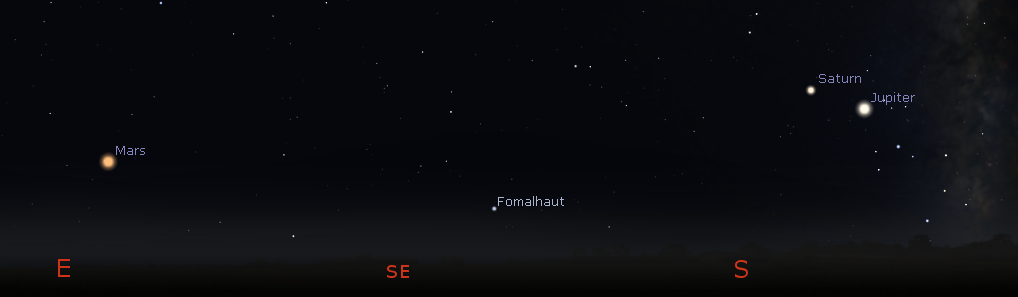
Jupiter, Saturn, and Mars arrayed from south-southwest to east at 9 pm tonight October 7, 2020. Click on the image to enlarge. Created using Stellarium.
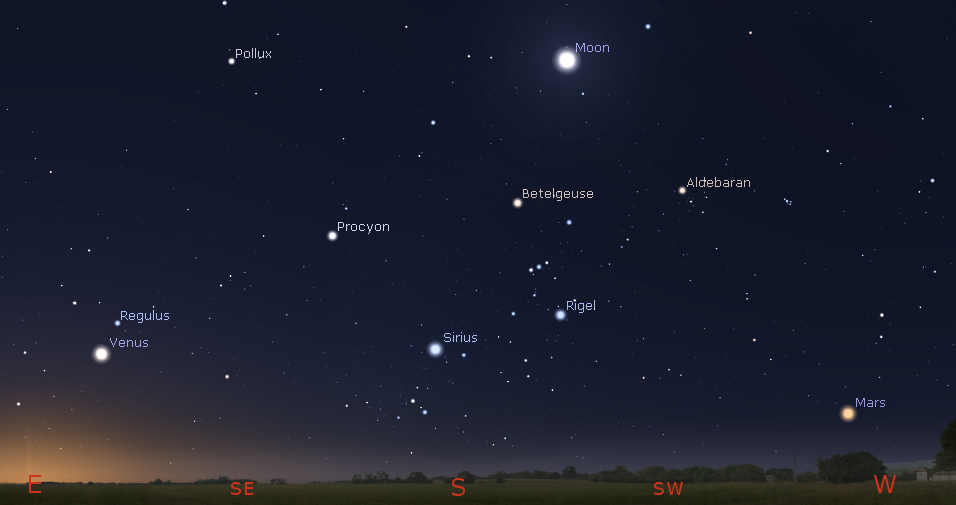
Venus, the Moon and Mars among the stars of winter but at 7 am October 8, 2020. Click on the image to enlarge. Created using Stellarium.
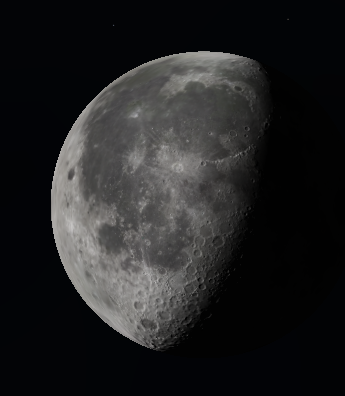
The waning gibbous Moon as it might be seen in binoculars at 7 am tomorrow October 8, 2020. Created using Stellarium.
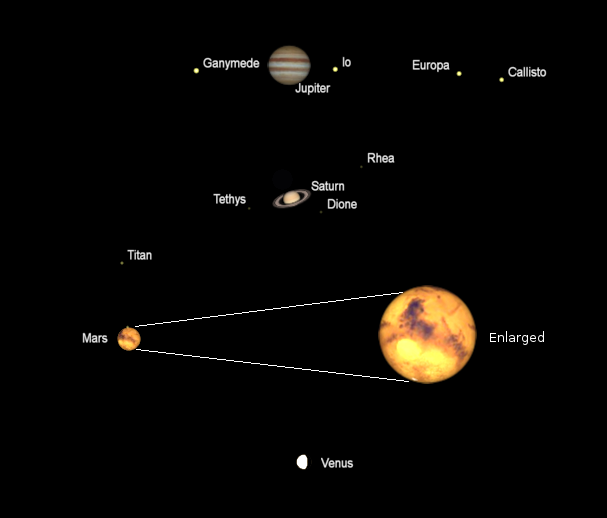
The planets as seen in a telescope (north up) with the same magnification for the night of October 7/8, 2020. Times of the display are: Jupiter and Saturn, 9 pm; small Mars, 9 pm; enlarged Mars, 11 pm, Venus, 7 am. Apparent diameters: Jupiter, 39.64″; Saturn, 17.00″, rings, 39.60″. Mars, 22.56″, and Venus 14.86″. Mars also displays an enlargement showing surface detail. On the Mars enlargement the large dark feature to the upper left of center is Syrtis Major, and the bright area below it is the Hellas Basin. Mars was closest to the Earth this go-a-round on October 6. The ” symbol means seconds of arc (1/3600th of a degree.) Created using Cartes du Ciel (Sky Charts).
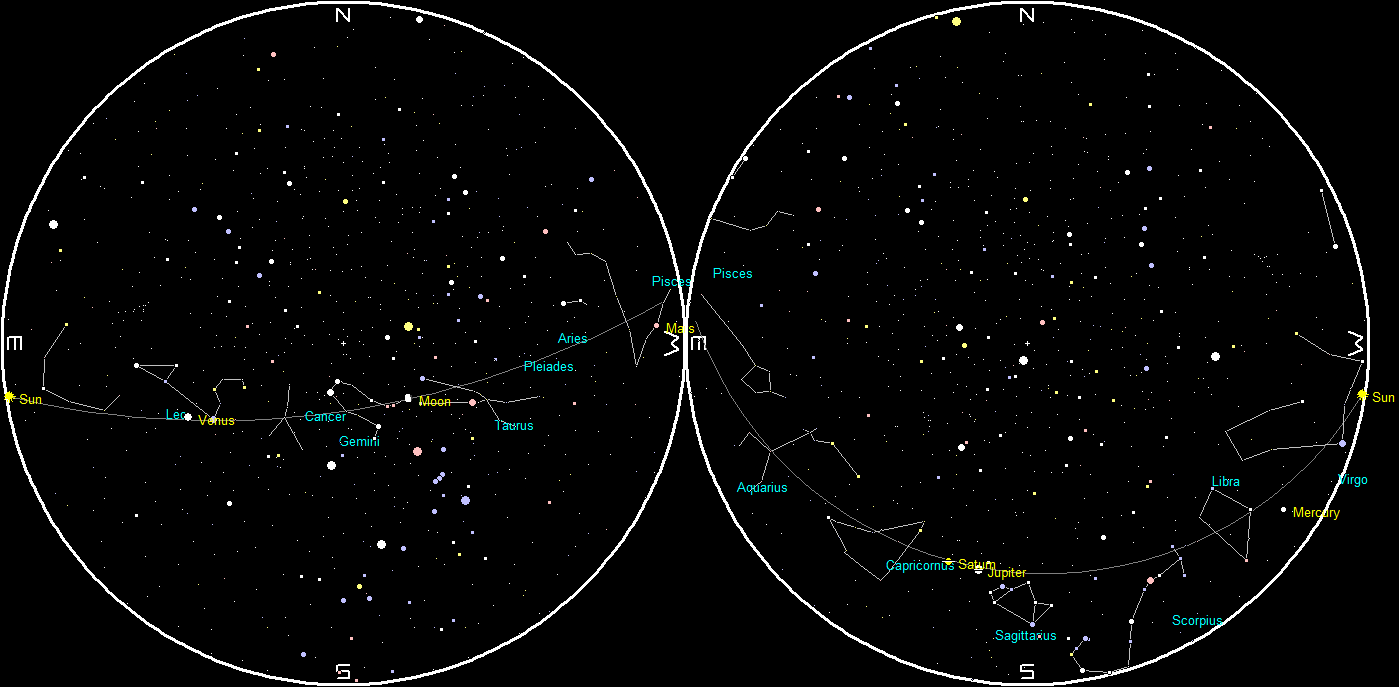
Planets and the Moon at sunset and sunrise of a single night starting with sunset on the right on October 7, 2020. The night ends on the left with sunrise on 8th. Click on the image to enlarge. Created using my LookingUp program.
09/29/2020 – Ephemeris – Let’s look for the naked-eye planets for this week
This is Ephemeris for Wednesday, September 30th. Today the Sun will be up for 11 hours and 43 minutes, setting at 7:24, and it will rise tomorrow at 7:41. The Moon, 1 day before full, will set at 7:11 tomorrow morning.
Let’s look for the naked-eye planets for this week. Jupiter and Saturn are both low in the southern sky at 9 pm. Jupiter is the very bright one. To the left of it will be the somewhat dimmer Saturn which is just about due south at that hour. They are now seemly to close a tiny bit, and they will cross paths on December 21st. Jupiter will set first at 12:48 tomorrow morning with Saturn following at 1:27 am. The next planet visible will be Mars which will rise at 8:12 pm. It’s now down to 38.8 million miles (62.5 million km) away, as the Earth very slowly overtook it by 1.0 million miles (1.5 million km) last week as the Mars will be at its closest in 7 days. Brilliant Venus will rise at 4:07 am as it retreats slowly toward the Sun.
The event times given are for the Traverse City/Interlochen area of Michigan. They may be different for your location.
Addendum
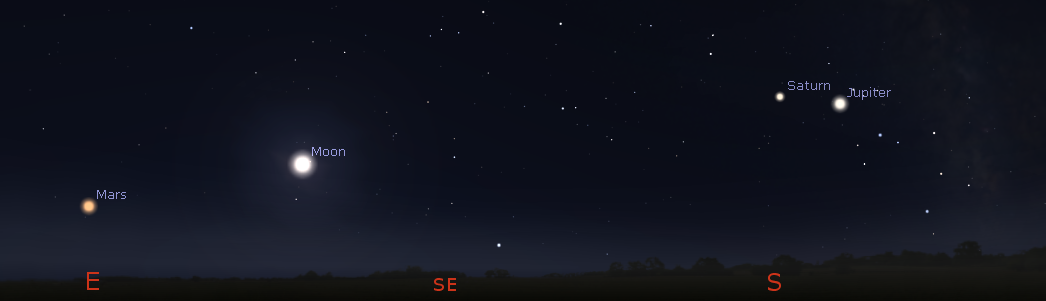
Jupiter, Saturn, the Moon and Mars arrayed from south-southwest to east at 9 pm tonight September 30, 2020. Click on the image to enlarge. Created using Stellarium.
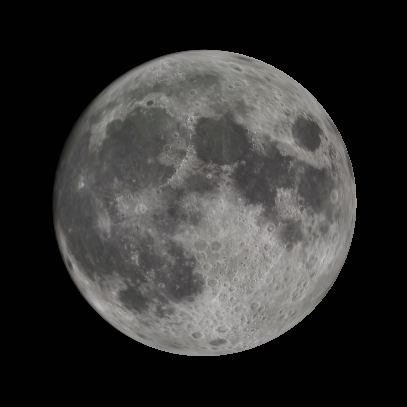
The Moon as it might appear in binoculars or a small telescope tonight at 9 pm, September 30, 2020. Created using Stellarium.
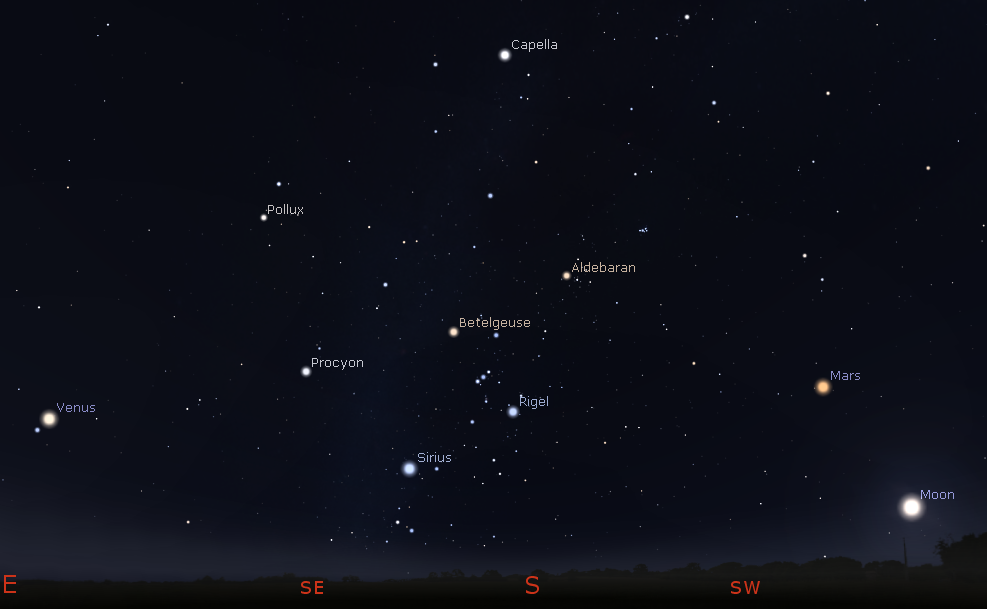
Venus, Mars, the Moon and the stars of winter but at 6 am October 1, 2020. The bright star under Venus is Regulus in Leo the lion. Click on the image to enlarge. Created using Stellarium.
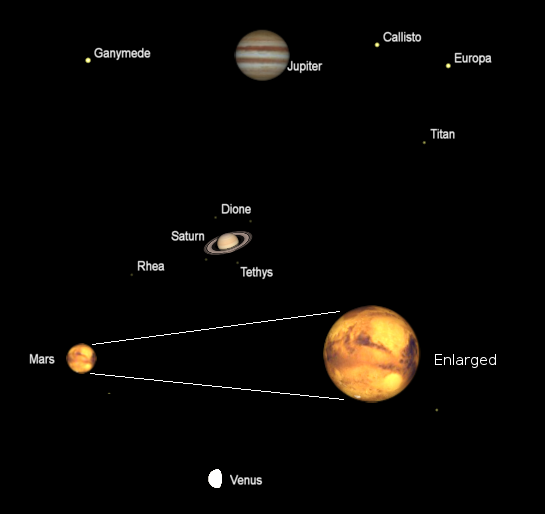
The planets as seen in a telescope (north up) with the same magnification for the night of September 30/October 1, 2020. Times of the display are: Jupiter and Saturn, 9 pm; Mars, Midnight; Venus, 6 am. Apparent diameters: Jupiter, 40.53″; Saturn, 17.20″, rings, 40.07″. Mars, 22.45″, and Venus 15.52″. Jupiter’s moon Io is behind the planet and will reappear at 12:02 am. Mars also displays an enlargement showing surface detail. Mars will be closest to the Earth this go-a-round on October 6. The ” symbol means seconds of arc (1/3600th of a degree.) Created using Cartes du Ciel (Sky Charts).
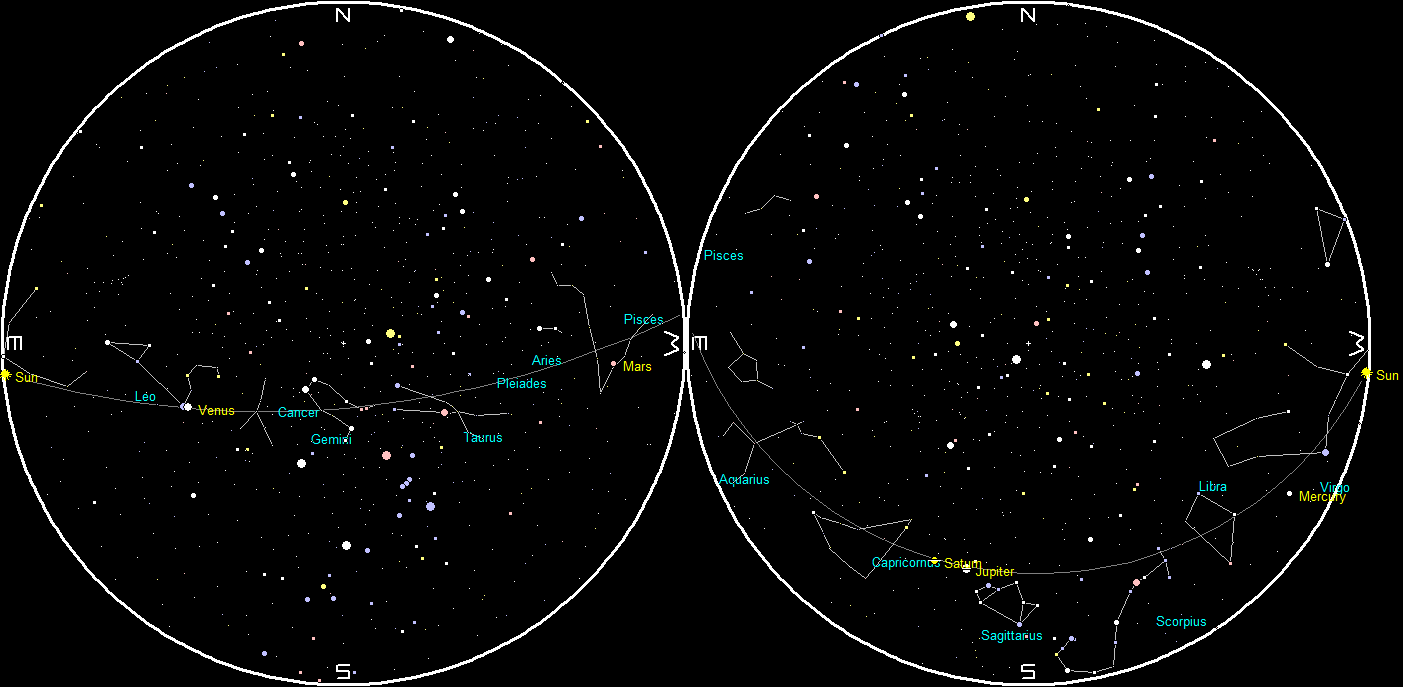
Planets and the Moon at sunset and sunrise of a single night starting with sunset on the right on September 30, 2020. The night ends on the left with sunrise on October 1st. Click on the image to enlarge. Created using my LookingUp program.
09/23/2020 – Ephemeris – Let’s look at a the naked-eye planets for this week
This is Ephemeris for Wednesday, September 23rd. Today the Sun will be up for 12 hours and 5 minutes, setting at 7:37, and it will rise tomorrow at 7:32. The Moon, at first quarter today, will set at 11:53 this evening.
Let’s look at a the naked-eye planets for this week. Jupiter and Saturn are both low in the southern sky at 9 pm. Jupiter is the very bright one. To the left of it will be the somewhat dimmer Saturn. They are now seemly to close a tiny bit since Jupiter is resuming its eastward motion, and they will cross paths in December. Jupiter will set first at 1:11 tomorrow morning with Saturn following at 1:51. The next planet visible will be Mars which will rise at 8:44 pm. Its now down to 39.8 million miles (64.0 million km) away, as the Earth very slowly overtook it by 1.5 million miles (2.6 million km) last week as the Earth is moving nearly abreast of it. Brilliant Venus will rise at 3:53 am as it retreats toward the Sun.
The event times given are for the Traverse City/Interlochen area of Michigan. They may be different for your location.
Addendum
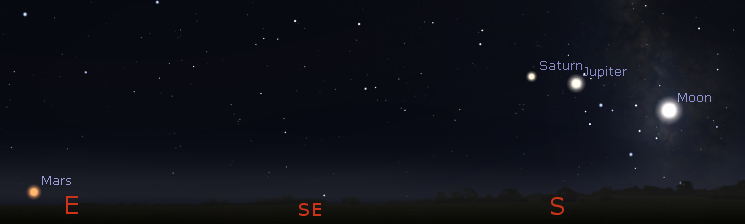
The planets visible at 9 pm or about an hour and a half after sunset tonight September 23, 2020. Click on the image to enlarge. Created using Stellarium and GIMP.
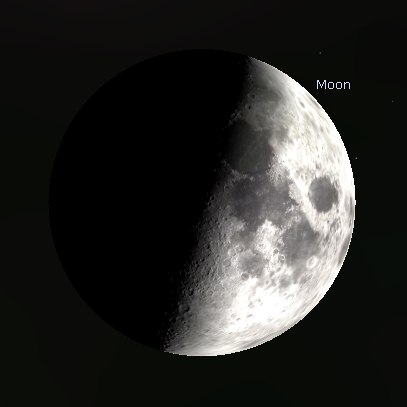
The first quarter Moon tonight as it might appear in binoculars or a low power telescope. Created using Stellarium.
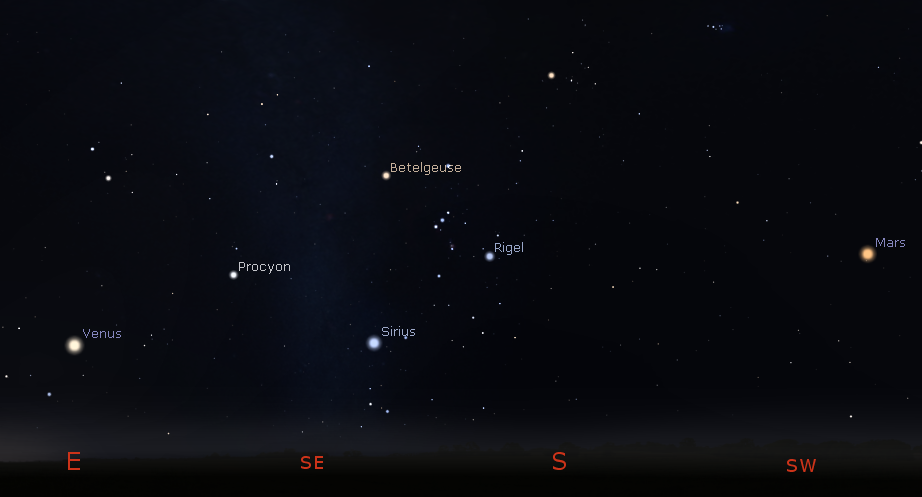
Mars, and Venus and the morning stars at 6 am or an hour and a half before sunrise tomorrow morning September 24, 2020. Click on the image to enlarge. Created using Stellarium and GIMP.
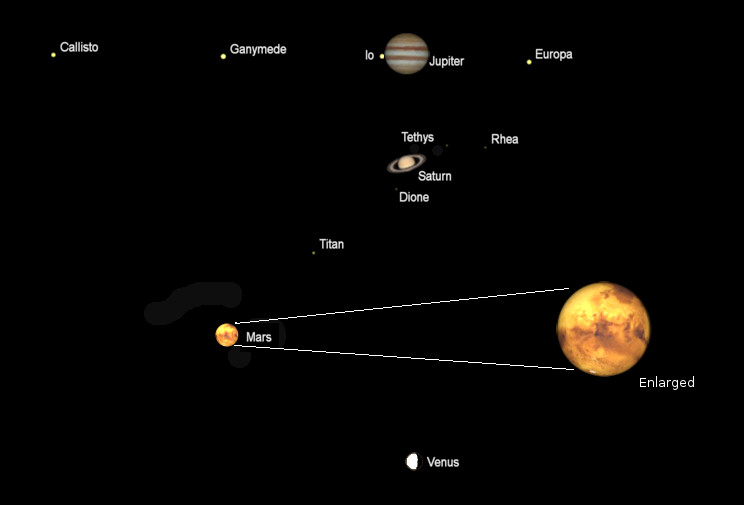
The planets as seen in a telescope (north up) with the same magnification for the night of September 23/24, 2020. Times of the display are: Jupiter and Saturn, 9 pm; Mars, Midnight; Venus, 6 am. Apparent diameters: Jupiter, 41.42″; Saturn, 17.40″, rings, 40.52″. Mars, 21.96″, and Venus 16.25″. Mars also displays an enlargement showing surface detail. Mars will be closest to the Earth this go-a-round on October 6. The ” symbol means seconds of arc (1/3600th of a degree.) Created using Cartes du Ciel (Sky Charts).
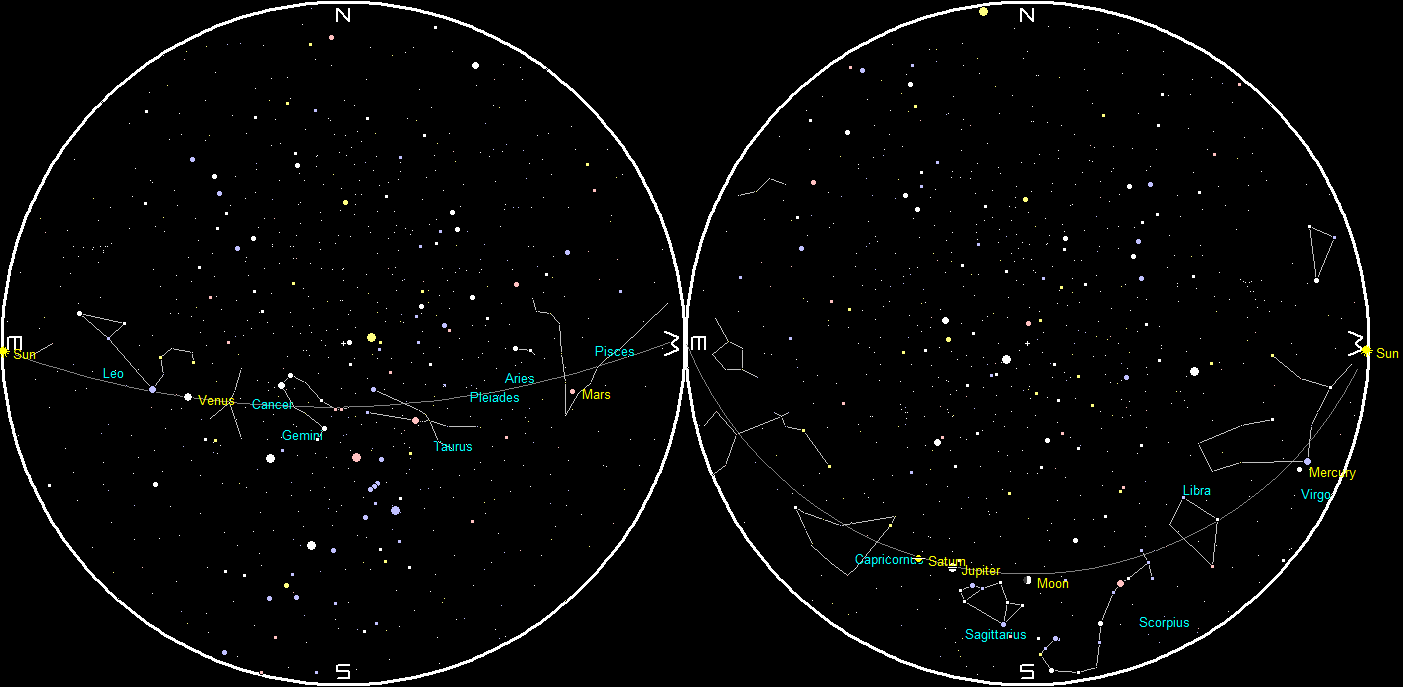
Planets and the Moon at sunset and sunrise of a single night starting with sunset on the right on September 23, 2020. The night ends on the left with sunrise on the 24th. Click on the image to enlarge. Created using my LookingUp program.
09/16/2020 – Ephemeris – Let’s look at a the naked-eye planets for this week. Plus thoughts on phosphine in Venus’ atmosphere
This is Ephemeris for Wednesday, September 16th. Today the Sun will be up for 12 hours and 27 minutes, setting at 7:50, and it will rise tomorrow at 7:24. The Moon, 1 day before new, will rise at 7:20 tomorrow morning.
Let’s look at a the naked-eye planets for this week. Jupiter and Saturn are both low in the southern sky at 10 pm. Jupiter is the very bright one. To the left of it will be the somewhat dimmer Saturn. They are now seemly to close a tiny bit since Jupiter is resuming its eastward motion, and they will cross paths in December. Jupiter will set first at 1:37 tomorrow morning with Saturn following at 2:19. The next planet visible will be Mars which will rise at 9:15 pm. Its now down to 41.3 million miles (66.6 million kilometers) away, as the Earth slowly overtakes it at the rate of about 2.1 million miles (3.1 million kilometers) the last week as the Earth begins to pull abreast of it. Brilliant Venus will rise at 3:42 am as it retreats toward the Sun.
The event times given are for the Traverse City/Interlochen area of Michigan. They may be different for your location.
Addendum
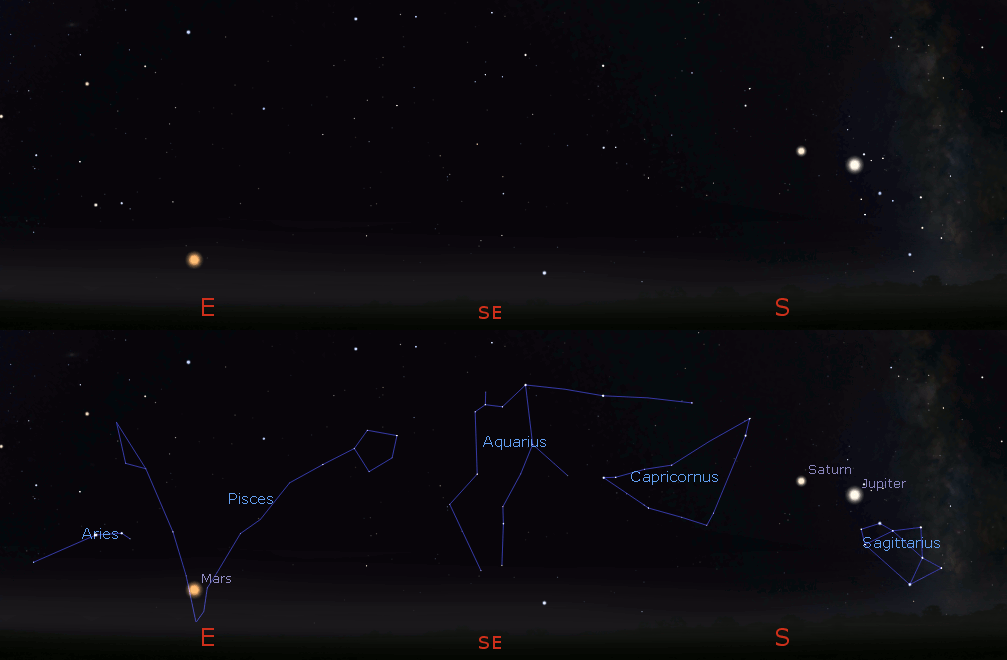
Planets visible at 10 pm or about 2 hours after sunset with the zodiacal constellations tonight September 16, 2020. Click on the image to enlarge. Created using Stellarium and GIMP.
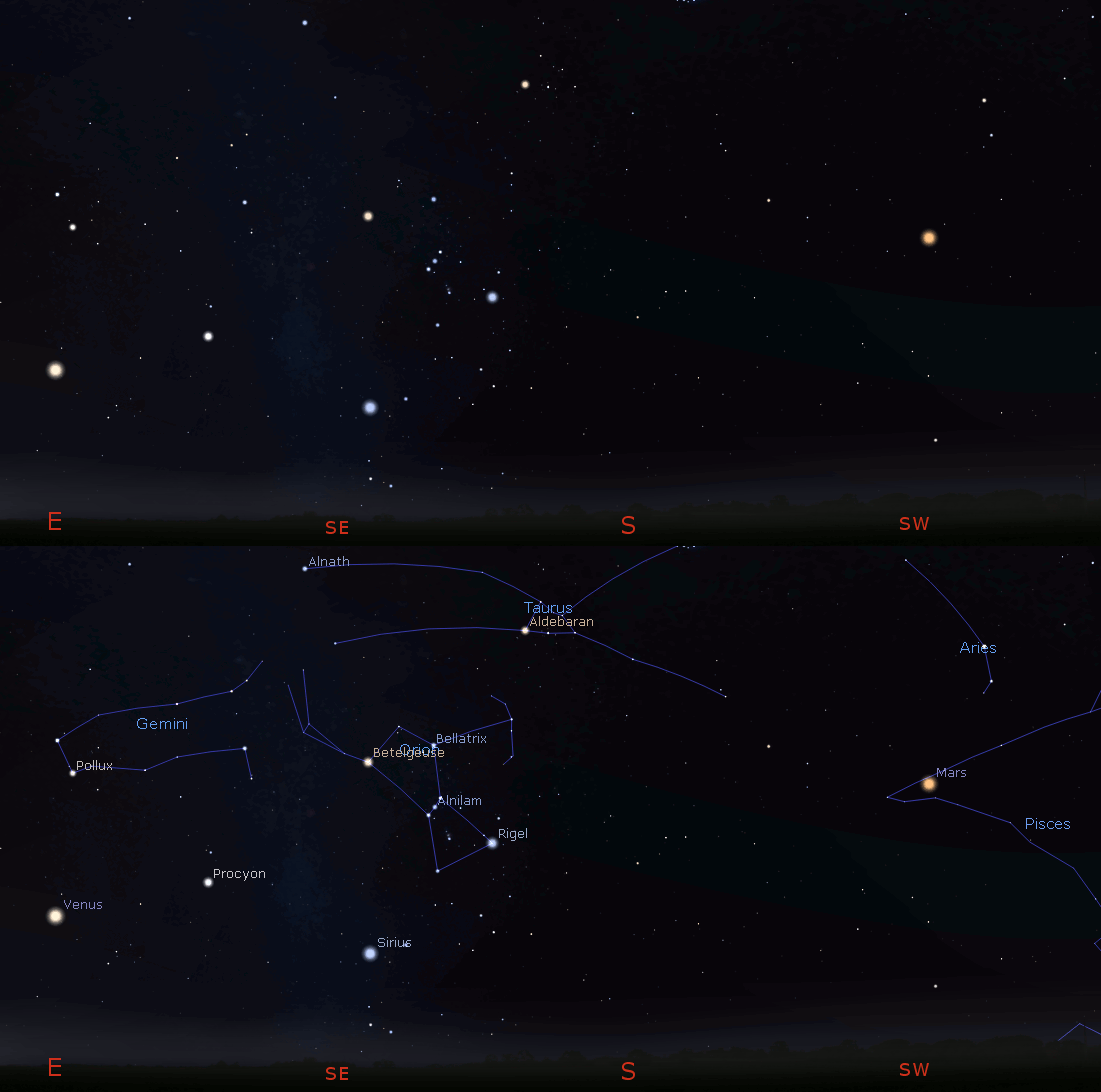
Mars, Venus and the zodiacal constellations and Orion at 6 am or an hour and a half before sunrise tomorrow morning September 17, 2020. Click on the image to enlarge. Created using Stellarium and GIMP.
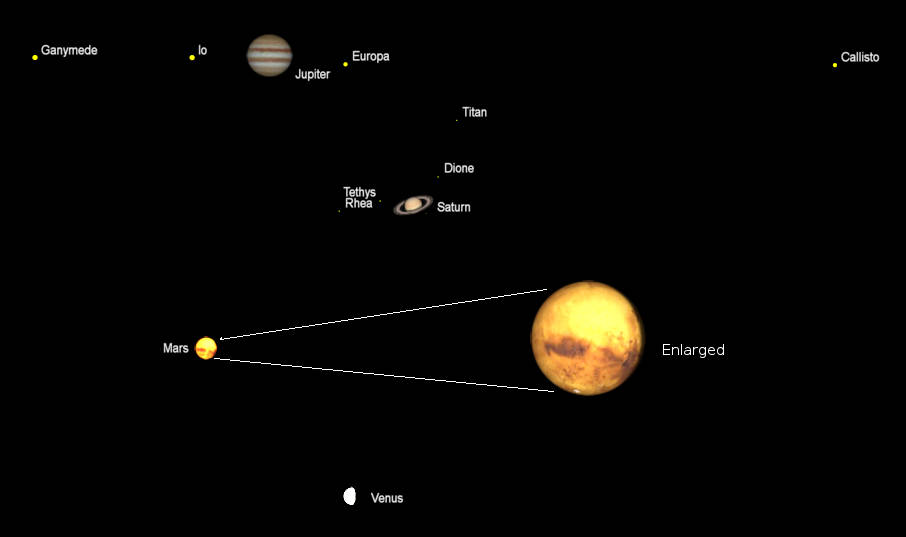
The planets as seen in a telescope (north up) with the same magnification for the night of September 16/17, 2020. Times of the display are: Jupiter and Saturn, 10 pm; Mars, Midnight; Venus, 6 am. Apparent diameters: Jupiter, 42.31″; Saturn, 17.59″, rings, 40.96″. Mars, 21.24″, and Venus 17.09″. Mars also displays an enlargement showing surface detail. The ” symbol means seconds of arc (1/3600th of a degree.) Created using Cartes du Ciel (Sky Charts).
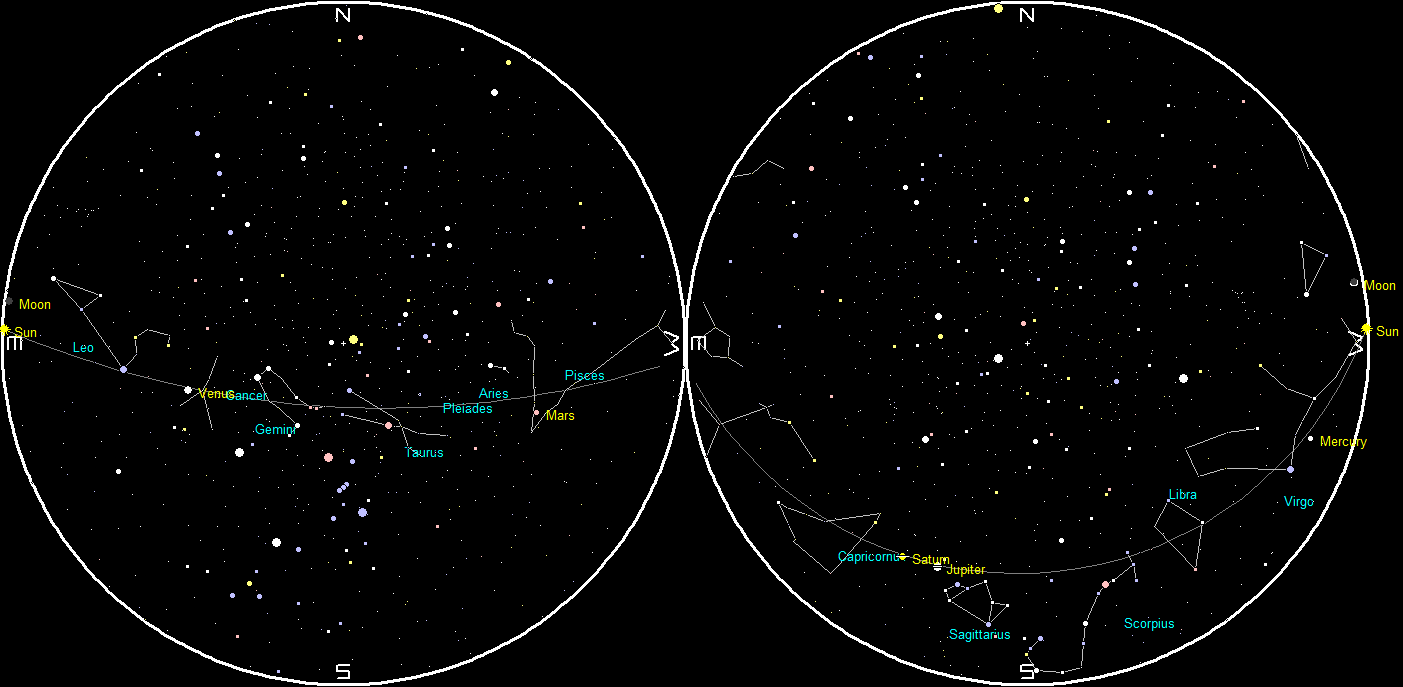
Planets and the Moon at sunset and sunrise of a single night starting with sunset on the right on September 16, 2020. The night ends on the left with sunrise on the 17th. Click on the image to enlarge. Created using my LookingUp program.
Breaking planet news
Yesterday there were a rash of posts on social media and other sources to the effect “Is there life on Venus?” This was due to an article released in Nature Astronomy that the compound phosphine was discovered in the Venusian atmosphere. Phosphine (PH3) on the Earth, at least, is mostly produced by life processes. I’m still absorbing all of this so check out articles by Dr. Phil Plait (The Bad Astronomer) and Steven Novella (Skeptic’s Guide to the Universe) for less technical takes on the discovery.
Venus is the subject of two of the four proposed discovery program missions that NASA announced this past June. one of them DAVINCI+ will be looking at the atmospheric chemistry and might get a boost and some tweaks due to the phosphine discovery. DAVINCI+ will drop through the atmosphere. The best mission for this would be a balloon floating in the Venusian atmosphere above the sulfuric acid clouds. The Russians did it in 1986. Anyway any mission to Venus is many years away.
I’ll have more for the Ephemeris program itself when I know more.
09/09/2020 – Ephemeris – Let’s look at a the naked-eye planets for this week
This is Bob Moler with Ephemeris for Wednesday, September 9th. Today the Sun will be up for 12 hours and 48 minutes, setting at 8:03, and it will rise tomorrow at 7:16. The Moon, 1 day before last quarter, will rise at 11:48 this evening.
Let’s look at a the naked-eye planets for this week. Jupiter and Saturn are both low in the southern sky at 10 pm. Jupiter is the very bright one. To the left of it will be the somewhat dimmer Saturn. They seem to be separating a teeny bit due to the Earth’s motion now, but they will cross paths in December. Both planets will be up until the morning hours with Jupiter setting first at 2:05 tomorrow morning and Saturn following at 2:47 am. The next planet visible will be Mars which will rise at 9:44 pm. Its now down to 43.3 million miles (69.7 million km) away, as the Earth slowly overtakes it at the rate of about 2.3 million miles (3.8 million km) a week as the Earth begins to pull abreast of it. Brilliant Venus will rise at 3:30 am as it retreats toward the Sun.
The event times given are for the Traverse City/Interlochen area of Michigan. They may be different for your location.
Addendum
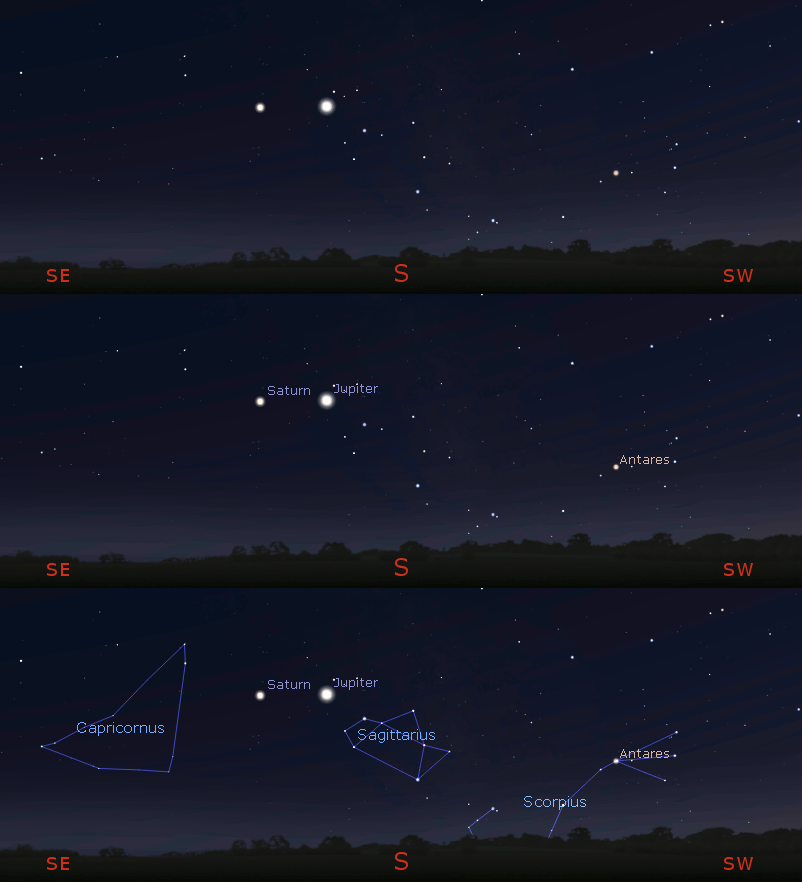
Jupiter and Saturn with the zodiacal constellations at 9 pm tonight September 9, 2020. Click on the image to enlarge. Created using Stellarium and GIMP.
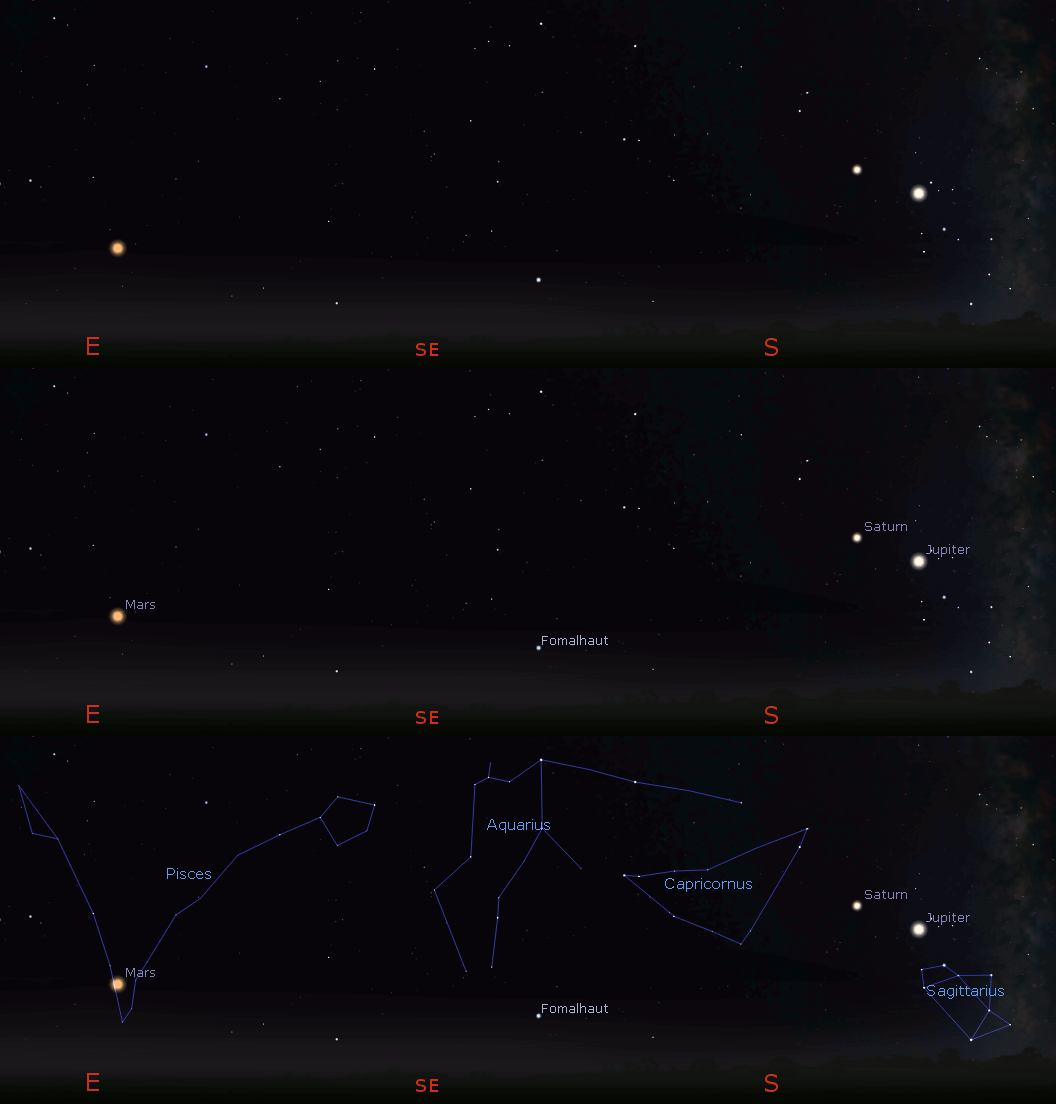
Jupiter, Saturn and Mars with the zodiacal constellations at 11 pm tonight September 9, 2020. Click on the image to enlarge. Created using Stellarium and GIMP.
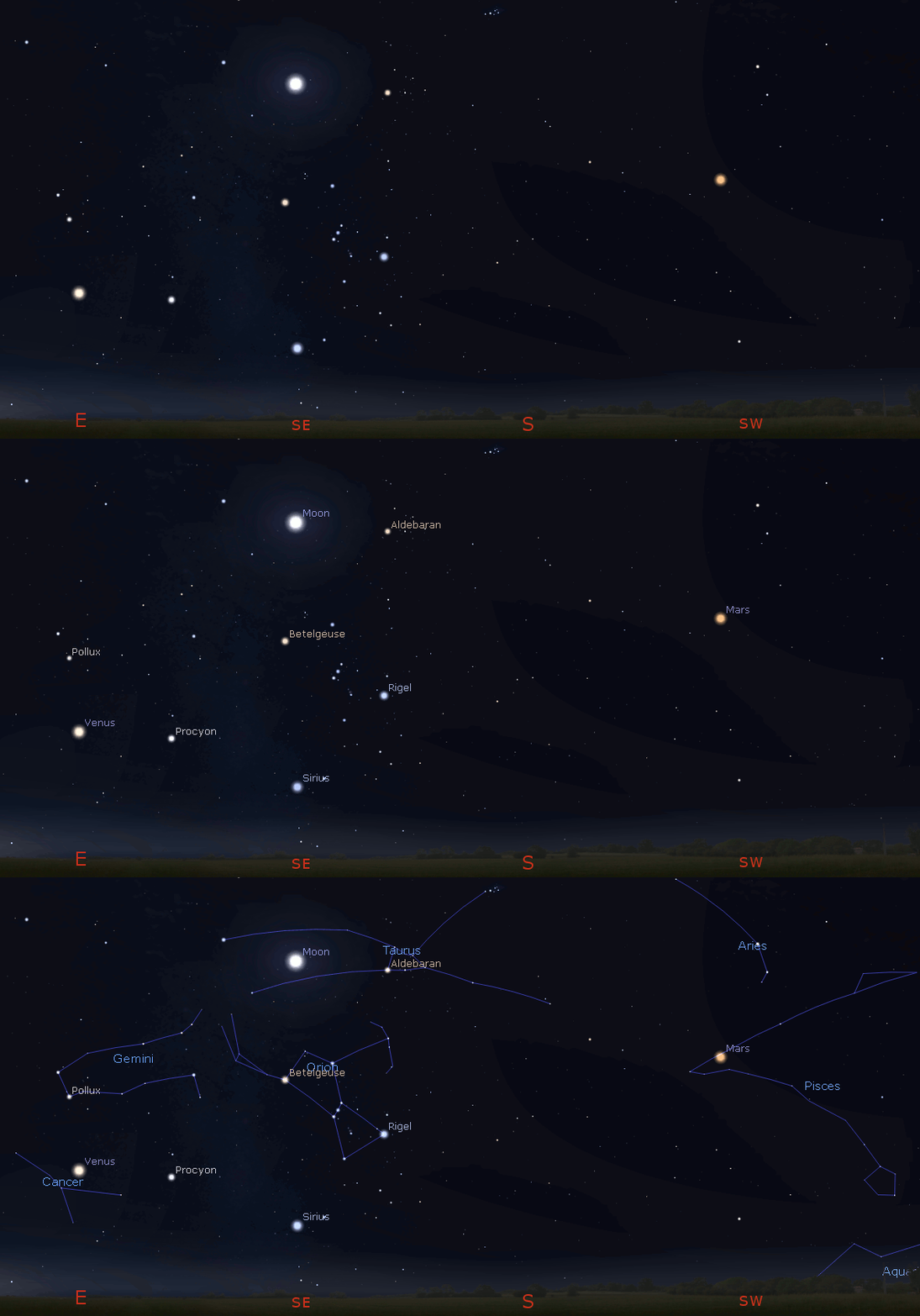
Mars, the Moon, Venus and the zodiacal constellations and Orion at 6 am tomorrow morning September 10, 2020. Click on the image to enlarge. Created using Stellarium and GIMP.
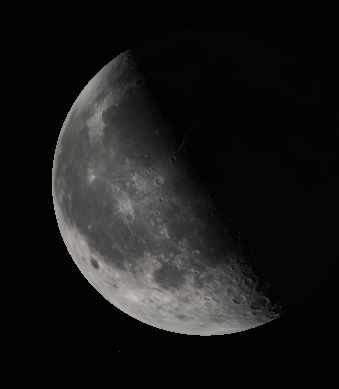
The last quarter Moon as it might be seen in binoculars at 6 am tomorrow September 10, 2020. Created using Stellarium.
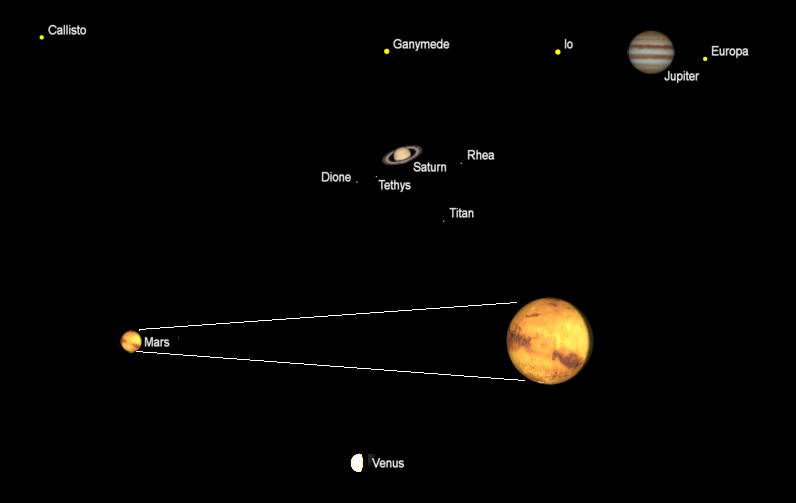
The planets as seen in a telescope (north up) with the same magnification for the night of September 9/10, 2020. Times of the display are: Jupiter and Saturn, 9 pm; Mars, Midnight; Venus, 6 am. Apparent diameters: Jupiter, 43.21″; Saturn, 17.77″, rings, 41.39″. Mars, 20.26″, and Venus 18.04″. Mars also displays an enlargement showing surface detail. The ” symbol means seconds of arc (1/3600th of a degree.) Created using Cartes du Ciel (Sky Charts).
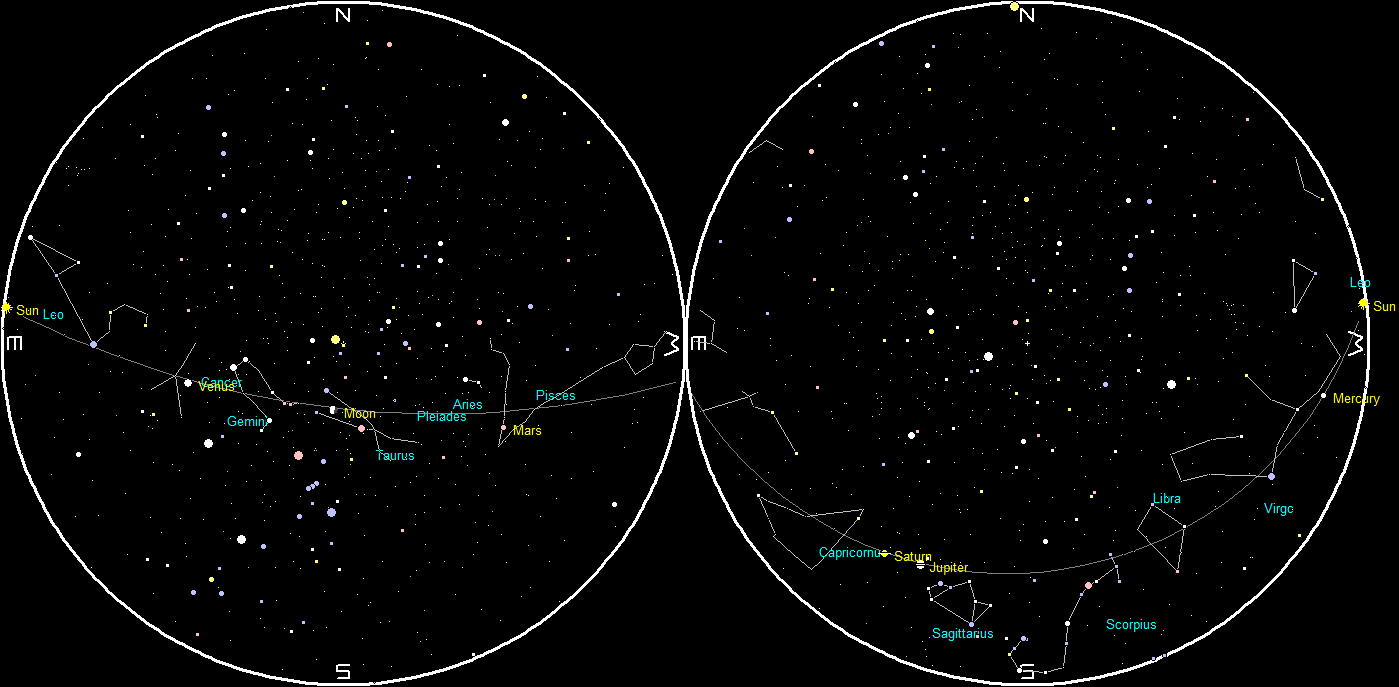
Planets and the Moon at sunset and sunrise of a single night starting with sunset on the right on September 9, 2020. The night ends on the left with sunrise on the 10th. Click on the image to enlarge. Created using my LookingUp program.
09/02/2020 – Ephemeris – Let’s look at a the naked-eye planets for this week
This is Ephemeris for Wednesday, September 2nd. Today the Sun will be up for 13 hours and 9 minutes, setting at 8:16, and it will rise tomorrow at 7:08. The Moon, at full today, will rise at 8:58 this evening.
Let’s look at a the naked-eye planets for this week. Jupiter and Saturn are both low in the south-southeastern sky at 10 pm. Jupiter is the very bright one. To the left of it will be Saturn. They now seem to be separating a bit due to the Earth’s motion now, but they will cross paths in December. Both planets will be up until the morning hours with Jupiter setting first at 2:33 tomorrow morning and Saturn following at 3:16 am. The next planet visible will be Mars which will rise at 10:11 pm. Its now down to 45.6 million miles (73.5 million kilometers) away, as the Earth slowly overtakes it at the rate of about 2.7 million miles (4.3 million kilometers) a week as the Earth begins to pull abreast of it. Brilliant Venus will rise at 3:14 am.
The event times given are for the Traverse City/Interlochen area of Michigan. They may be different for your location.
Addendum
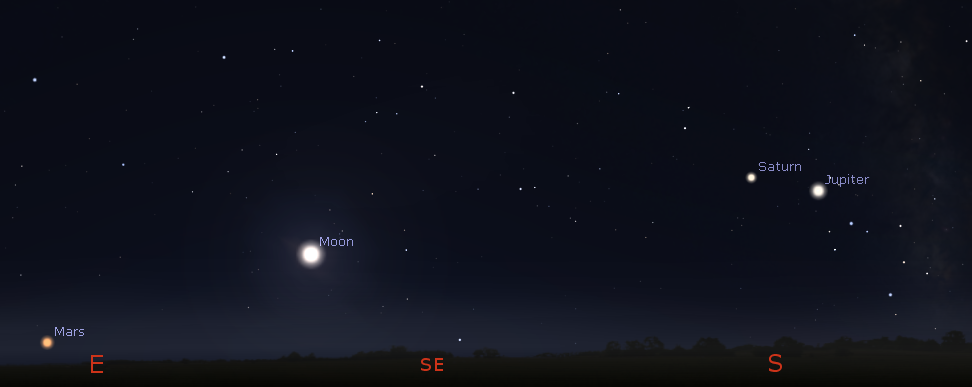
Planets and the Moon in the evening at 10:30 tonight, September 2, 2020. Click on the image to enlarge. Created using Stellarium.
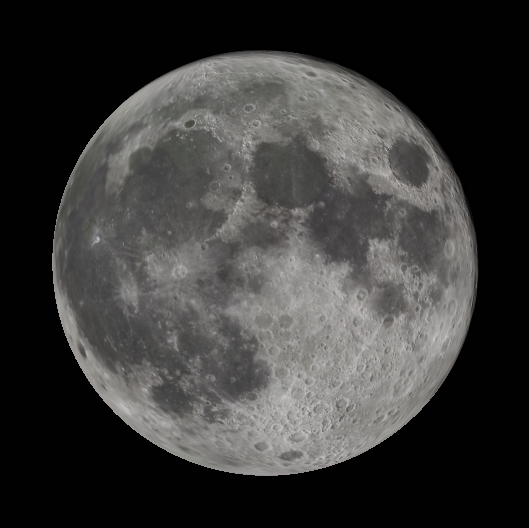
The full Moon tonight September 2, 2020 as it might appear at 10 pm in a low power telescope. Created using Stellarium.
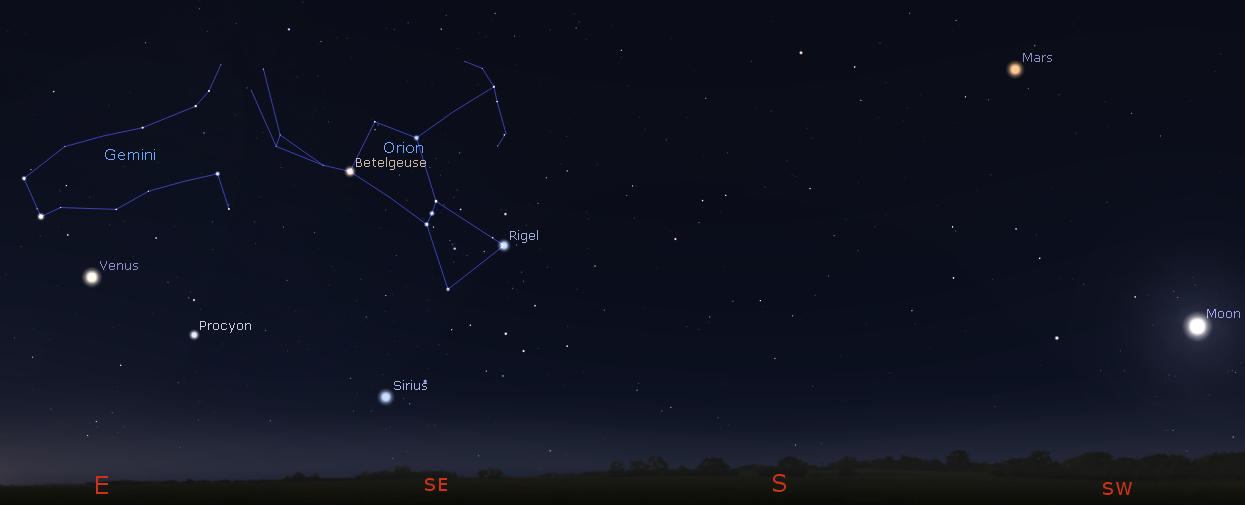
Planets and the Moon in the morning tomorrow, September 3, 2020. Click on the image to enlarge. Created using Stellarium.
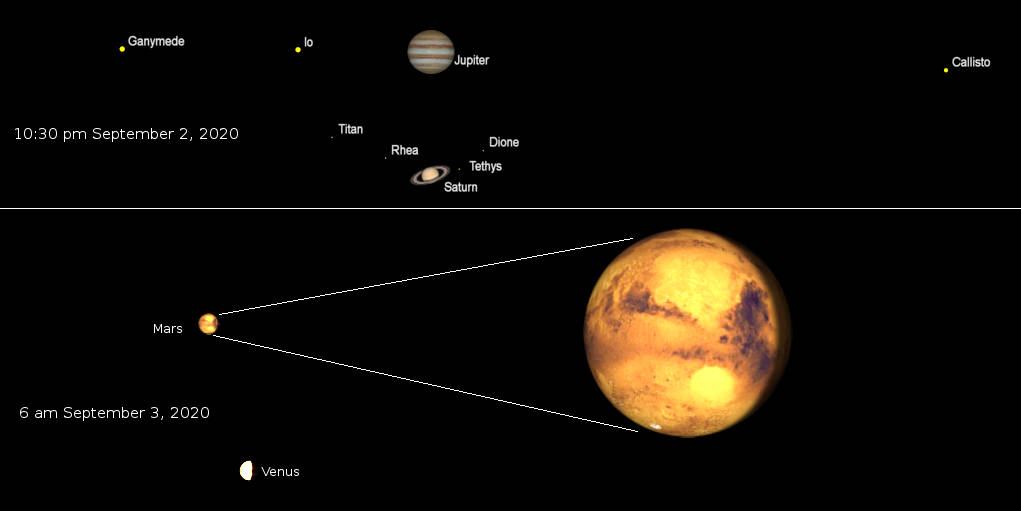
The planets as seen in a telescope (north up) with the same magnification Apparent diameters: Jupiter, 44.07″; Saturn, 17.93″, rings, 41.77″. Mars, 19.26″, and Venus 19.12″. At 6 am. Mars also displays an enlargement showing surface detail. The ” symbol means seconds of arc (1/3600th of a degree.) Created using Cartes du Ciel (Sky Charts).
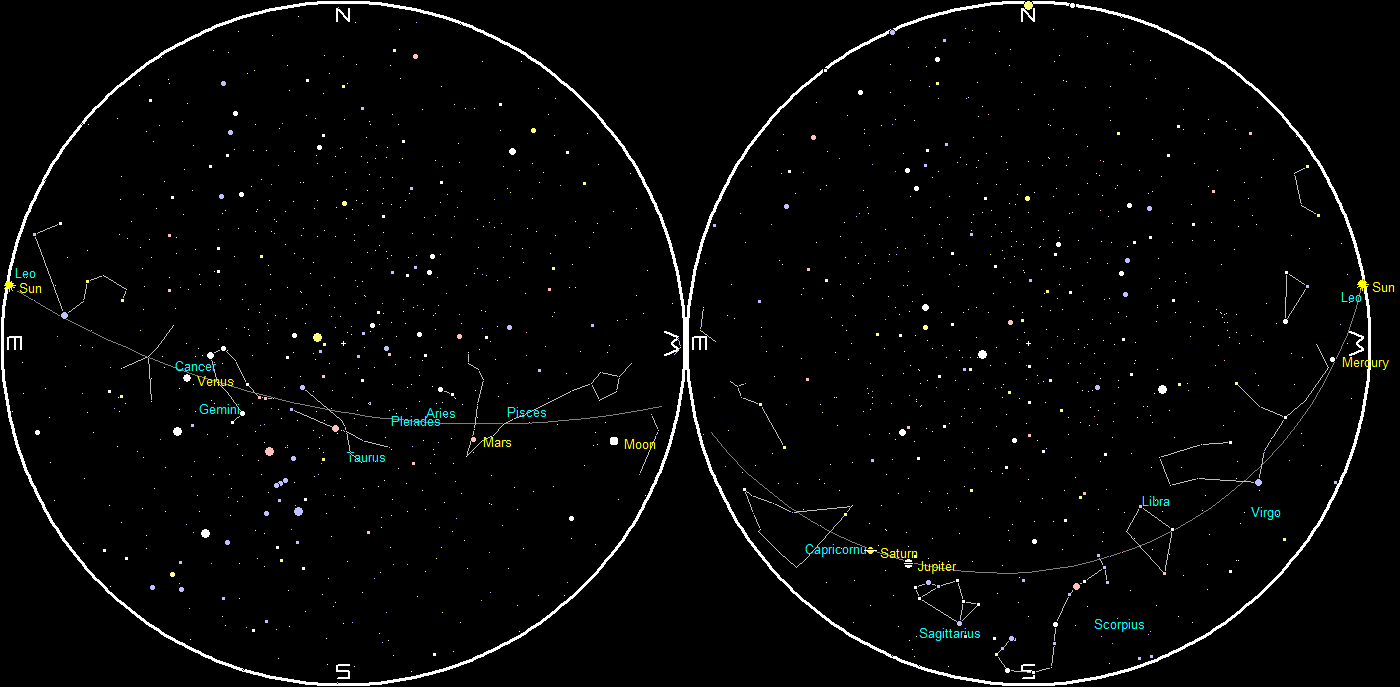
Planets and the Moon at sunset and sunrise of a single night starting with sunset on the right on September 2, 2020. The night ends on the left with sunrise on the 3rd. Click on the image to enlarge. Created using my LookingUp program.
08/26/2020 – Ephemeris – Let’s look at a the naked-eye planets for this week
This is Ephemeris for Wednesday, August 26th. Today the Sun will be up for 13 hours and 30 minutes, setting at 8:29, and it will rise tomorrow at 6:59. The Moon, 1 day past first quarter, will set at 1:09 tomorrow morning.
Let’s look at a the naked-eye planets for this week. Jupiter and Saturn are both low in the south-southeastern sky at 10 pm. Jupiter is the very bright one. To the left of it will be Saturn. They now seem to be separating a bit due to the Earth’s motion now, but they will cross paths in December. Both planets will be up most of the night with Jupiter setting first at 3:02 tomorrow morning and Saturn following at 3:45 am. The next planet visible will be Mars which will
rise at 10:36 pm. Its now down to 48.3 million miles (77.8 million kilometers) away, as the Earth slowly overtakes it at the rate of about 3.0 million miles (4.8 million kilometers) a week. Brilliant Venus will rise at 3:14 am and is moving ahead of the Earth in its orbit.
The event times given are for the Traverse City/Interlochen area of Michigan. They may be different for your location.
Addendum
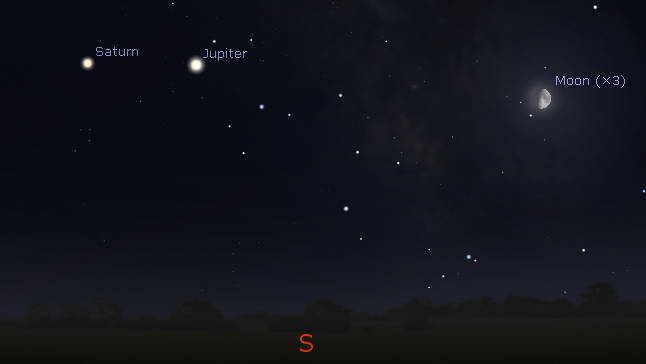
Jupiter, Saturn and the Moon at 10 pm August 26, 2020. Note that the Moon is enlarged 3 times to show its phase. Click on the image to enlarge. Created using Stellarium.
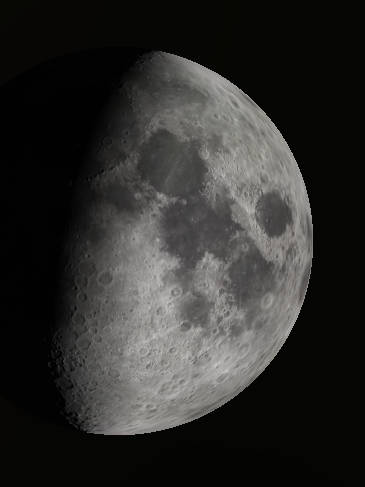
The gibbous Moon as it might be seen tonight at 10 pm August 26, 2020. Created using Stellarium.
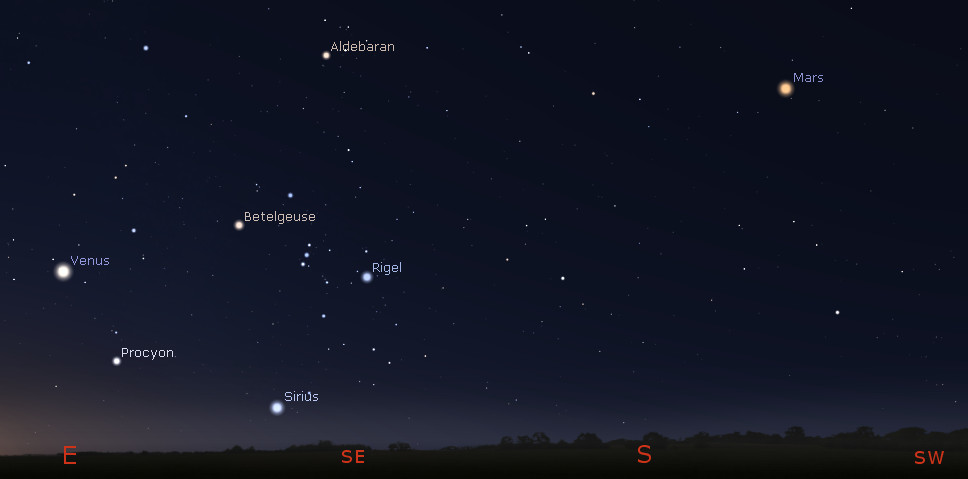
Venus and Mars at 6 am tomorrow morning August 27, 2020. Click on the image to enlarge. Created using Stellarium.
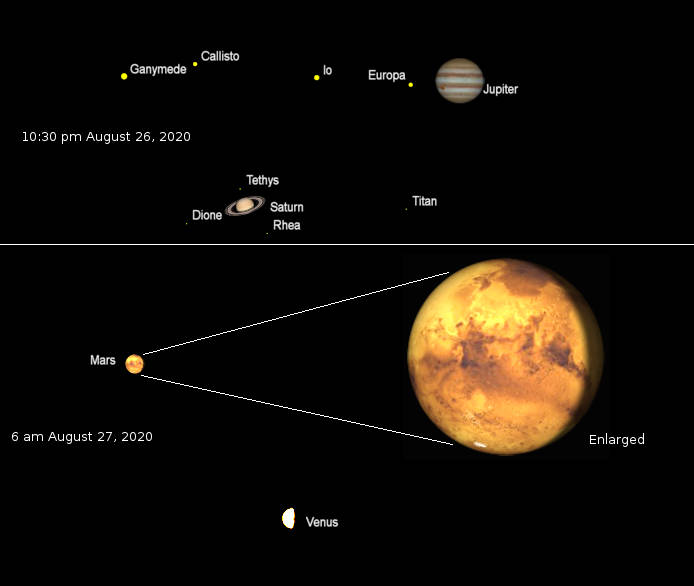
The planets as seen in a telescope (north up) with the same magnification Apparent diameters: Jupiter, 44.89″; Saturn, 18.08″, rings, 42.12″. Mars, 18.21″, and Venus 20.37″. At 6 am. Mars also displays an enlargement showing surface detail. The ” symbol means seconds of arc (1/3600th of a degree.) Created using Cartes du Ciel (Sky Charts).
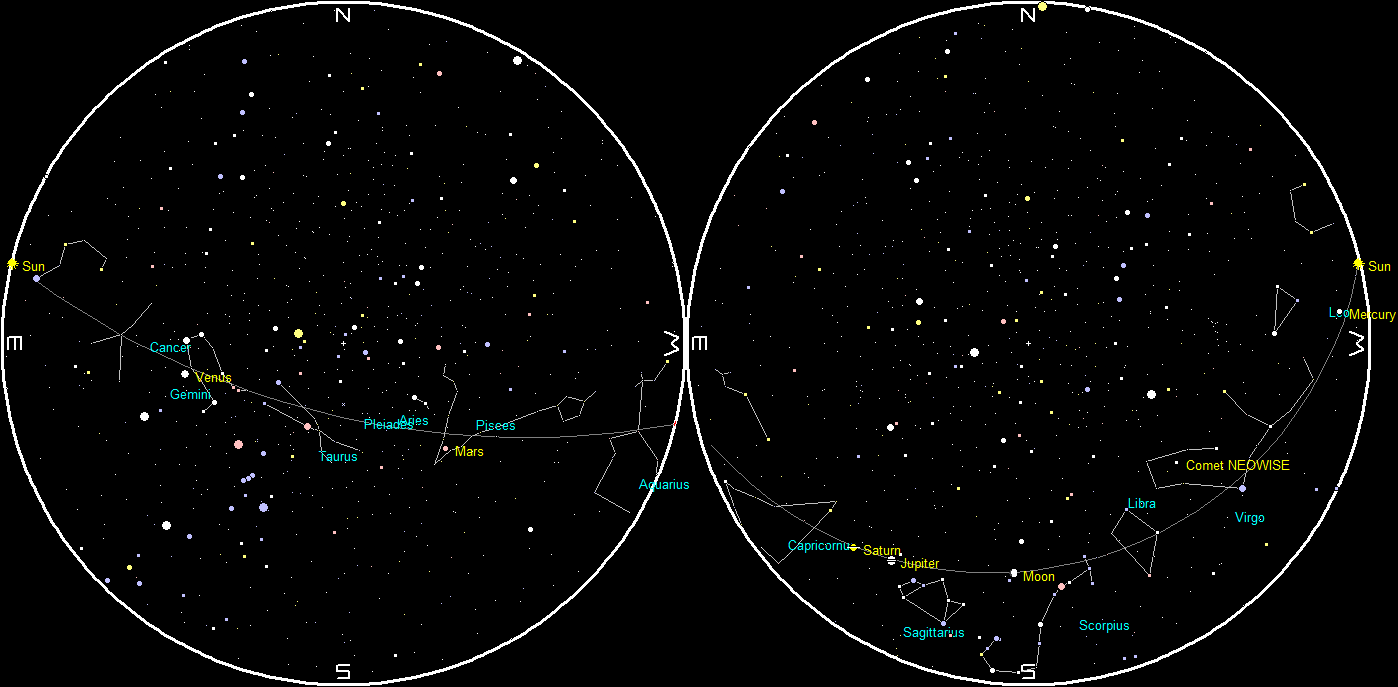
Planets and the Moon at sunset and sunrise of a single night starting with sunset on the right on August 26, 2020. The night ends on the left with sunrise on the 27th. Comet NEOWISE is now 8th magnitude, almost too faint for binoculars. Click on the image to enlarge. Created using my LookingUp program.
 Bob Moler's Ephemeris Blog