Archive
09/03/2015 – Ephemeris – Jewels in the shield
Ephemeris for Thursday, September 3rd. The Sun will rise at 7:07. It’ll be up for 13 hours and 9 minutes, setting at 8:16. The Moon, 2 days before last quarter, will rise at 11:26 this evening.
The teapot pattern of stars that is the constellation of Sagittarius lies at the southern end of the Milky Way this evening. It appears that the Milky Way is steam rising from the spout. The area above Sagittarius in the brightest part of the Milky Way is the dim constellation of Scutum the shield. Don’t bother looking for the stars that make up the constellation; what’s important is the star clouds of the Milky Way. Scan this area with binoculars or small telescope for star clusters and nebulae or clouds of gas. In binoculars both clusters and nebulae will appear fuzzy, but a small telescope will tell most of them apart. Even if you’ve never been able to find anything in your telescope, you’ll find something here.
Times are for the Traverse City/Interlochen area of Michigan. They may be different for your location.
Addendum
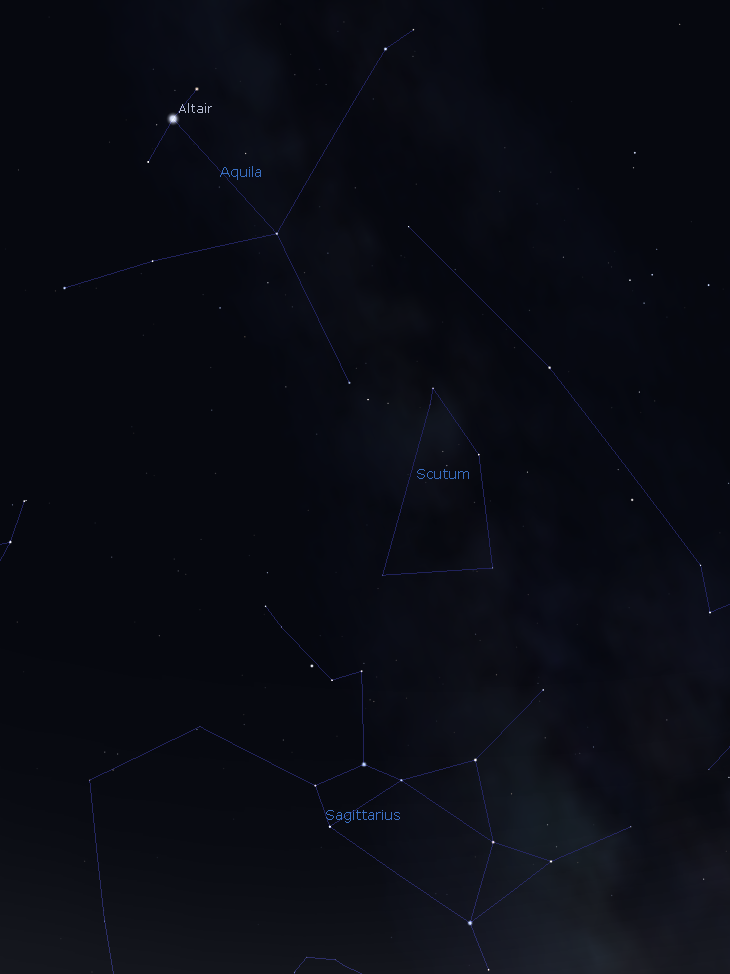
Scutum between Sagittarius below and Aquila above at 10 p.m. September 3, 2015. Created using Stellarium.
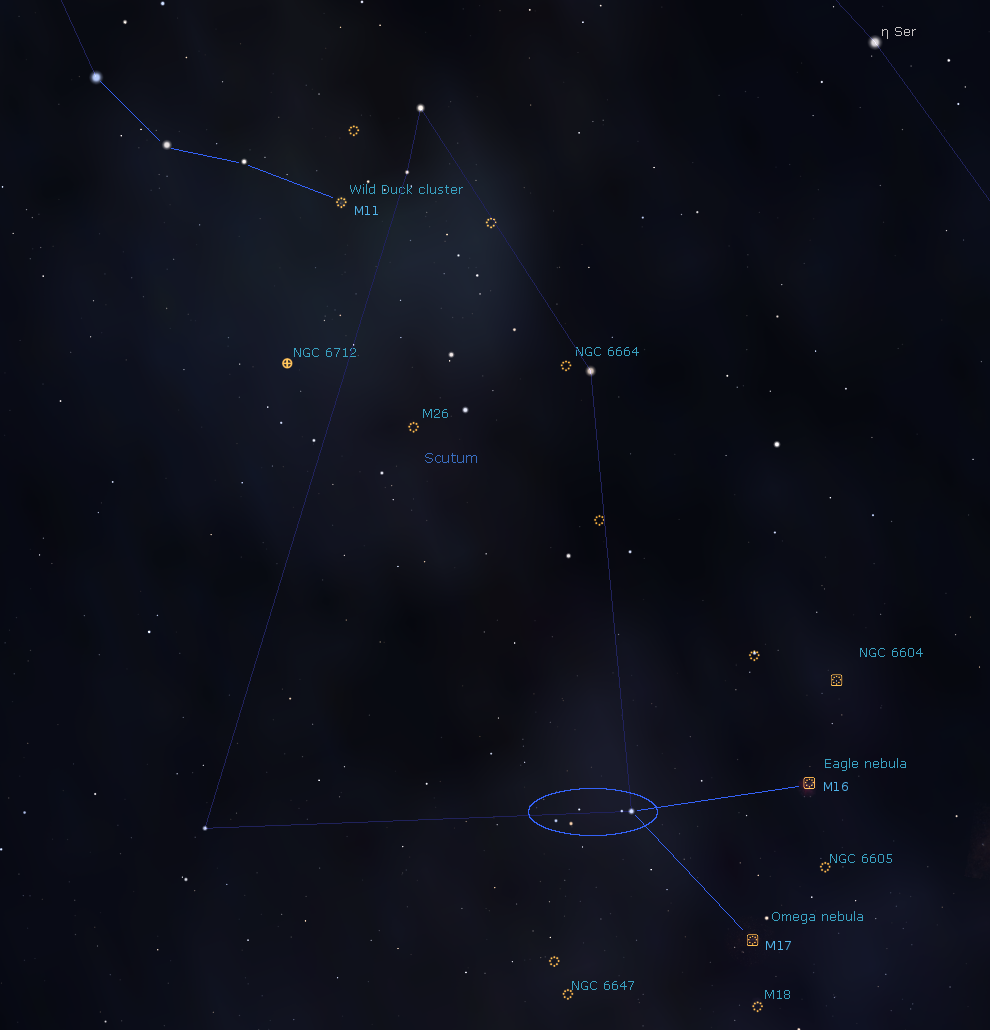
How to find the three brightest deep sky wonders around Scutum by star hopping. Created using Stellarium, annotated by myself.
Star hopping is a method to find objects from familiar star patterns. At the top my method to find M11, the wild duck cluster is to locate the three stars at the tail of Aquila the Eagle and follow them to M11. M11 takes a little bigger telescope to resolve. I remember having trouble resolving it is a 5″ telescope. It looks like a triangular cluster with all the stars of the same dimness except one brighter one.
At the bottom of Scutum, I locate that distinctive 5 star group circled. Directly west is M16, the Eagle Nebula and star cluster. The star cluster is easy to spot, the nebula is hard. The Hubble space telescope made the nebula famous in the 1990’s as the Pillars of Creation.
Below and west is M17, the Omega Nebula, or the Swan Nebula. To me it looks like a swan swimming or a check mark of nebulosity. The associated star cluster is much less noticeable.
Happy star hopping.
08/06/2015 – Ephemeris – There’s an eagle in the stars
Ephemeris for Thursday, August 6th. The Sun rises at 6:34. It’ll be up for 14 hours and 27 minutes, setting at 9:02. The Moon, at last quarter today, will rise at 12:46 tomorrow morning.
The southernmost star in the Summer Triangle of three bright stars is Altair, high in the south-southeast in the evening. It’s in the head of the constellation Aquila the Eagle. Altair is flanked by two stars, the eagle’s shoulders, and farther out are the wing tips. Other stars to the lower right are in its body and a last three in its tail. Near the tail binoculars will show a fuzzy spot that telescopes show as a compact star cluster, sometimes called the Wild Duck Cluster for its nearly triangular shape. Aquila is flying northeastward through the Milky Way, where it is split in two by a cloud of gas and dust. According to mythology the Trojan boy Ganymede was taken to heaven at the behest of the god Zeus by this eagle.
Times are for the Traverse City/Interlochen area of Michigan. They may be different for your location.
Addendum
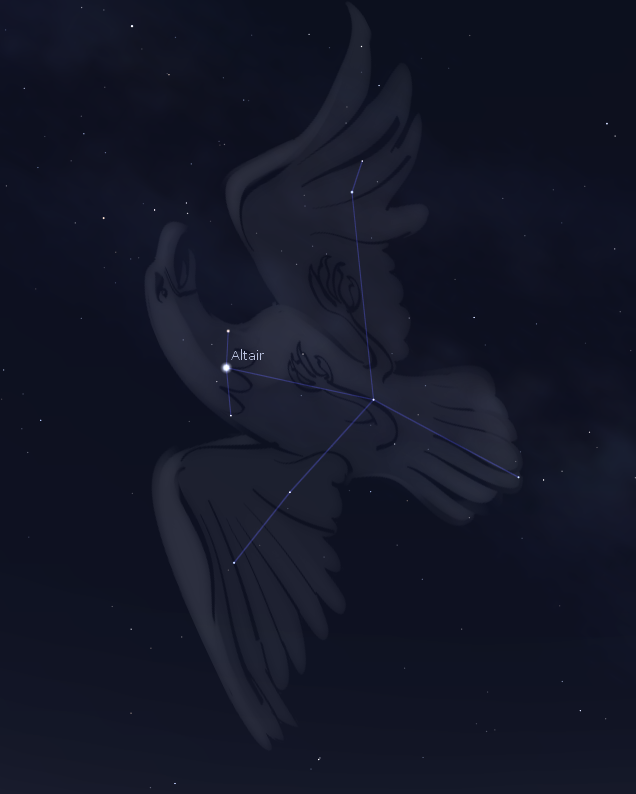
Aquila the Eagle in the southeastern sky. Created using Stellarium.
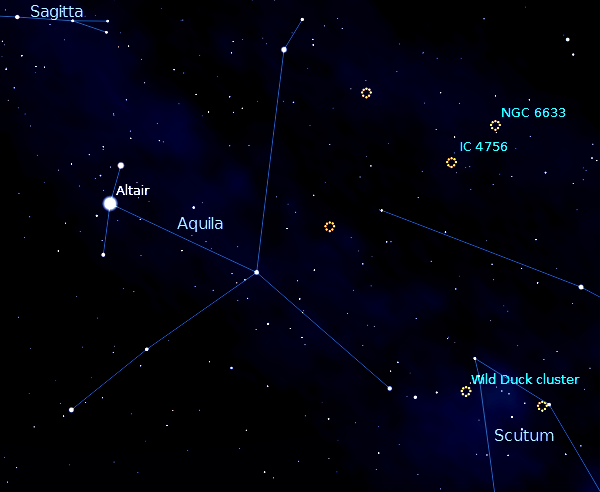
Finder chart for M11, the Wild Duck Cluster, Created using Stellarium.
08/02/11 – Ephemeris – The constellation of Aquila the eagle
Note: this is a repeat due to Internet problems for the July 25th program with one alteration.
Tuesday, August 2nd. The sun rises at 6:29. It’ll be up for 14 hours and 37 minutes, setting at 9:06. The moon, 3 days past new, will set at 10:19 this evening.
The southernmost star in the Summer Triangle of three bright stars is Altair, high in the south southeast in the evening. It’s in the head of the constellation Aquila the Eagle. Altair is flanked by two stars, the eagle’s shoulders, and farther out are the wing tips. Other stars to the lower right are in its body and a last three in its tail. Near the tail binoculars will show a fuzzy spot that telescopes show as a compact star cluster, sometimes called the Wild Duck Cluster for its nearly triangular shape. Aquila is flying northeastward through the Milky Way, where it is split in two by a cloud of gas and dust, the edges of which can be seen in binoculars. According to mythology the Trojan boy Ganymede was taken to heaven at the behest of the god Zeus by this eagle.
* Times are for the Traverse City/Interlochen area of Michigan. They may be different for your location.
Addendum
Finder chart for M11, the Wild Duck Cluster, Created using Stellarium.
 Bob Moler's Ephemeris Blog