Archive
Ephemeris: 03/07/2024 – There’s a unicorn in there somewhere
This is Bob Moler with Ephemeris for Thursday, March 7th. Today the Sun will be up for 11 hours and 30 minutes, setting at 6:39, and it will rise tomorrow at 7:06. The Moon, 3 days before new, will rise at 6:35 tomorrow morning.
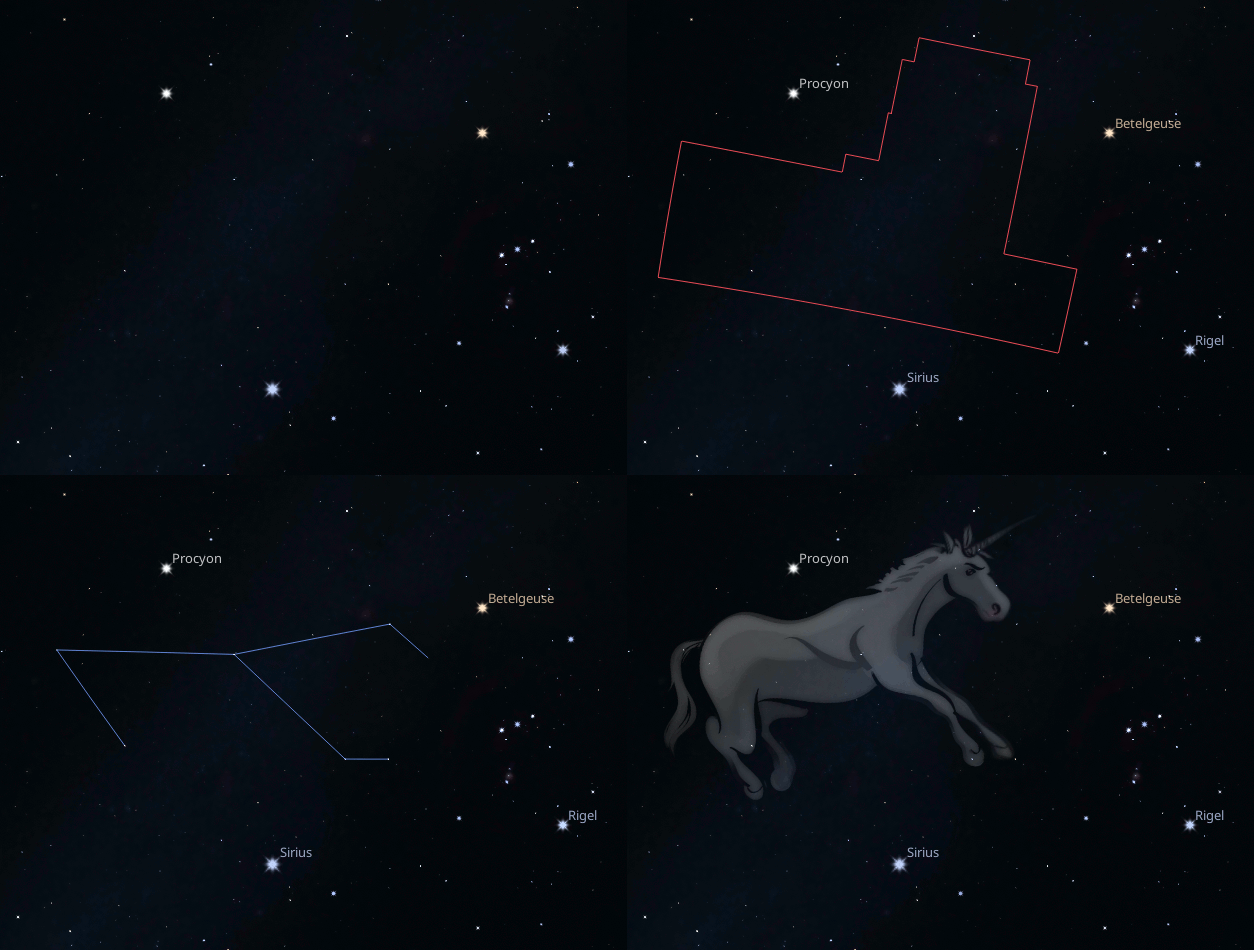
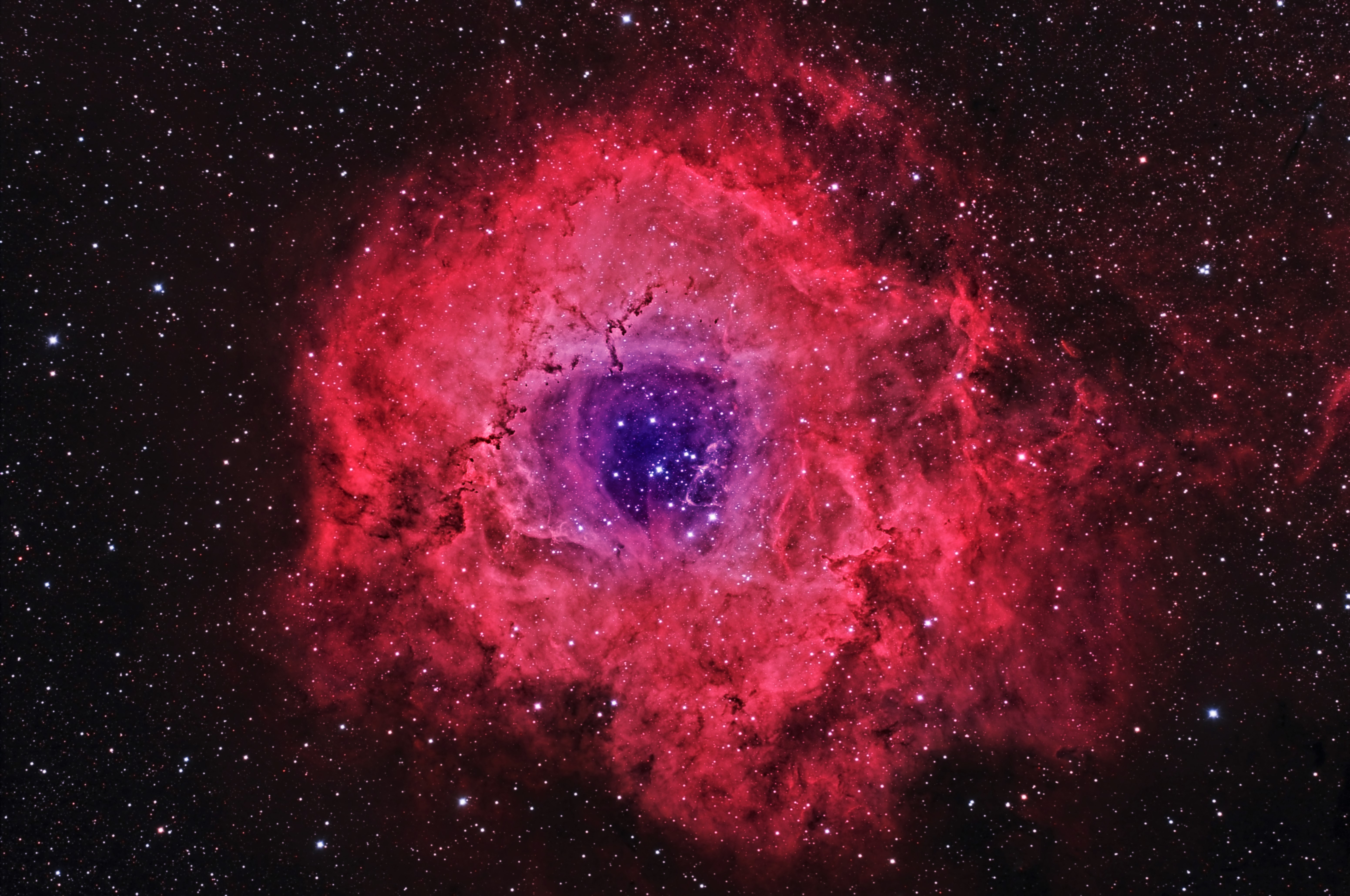
The constellation of Monoceros the unicorn is located in an area of sky to the left of Orion so it’s in the south at 8 pm, inside the Winter Triangle of stars, Betelgeuse in Orion; Sirius in the Great Dog, Canis Major; and Procyon in Canis Minor. If you don’t see anything there, it’s OK. Nobody sees real unicorns any more anyway. Are there any real unicorns? Anyway, there’s a great number of nebulae here in the Milky Way that runs through it, which unfortunately are too faint to be seen with amateur telescopes. However, it is a gold mine for amateur astronomers who are also astrophotographers using time exposures to record the faint nebulae here, including the famous Rosette Nebula!
The astronomical event times given are for the Traverse City/Interlochen area of Michigan (EST, UT –5 hours). They may be different for your location.
Addendum
02/22/2022 – Ephemeris – The Winter Triangle
This is Ephemeris for Tuesday, February 22nd. Today the Sun will be up for 10 hours and 49 minutes, setting at 6:21, and it will rise tomorrow at 7:30. The Moon, 1 day before last quarter, will rise at 1:26 tomorrow morning.
I’ve talked about the Winter Circle of bright stars already this winter, but some other astronomers talk about the Winter Triangle. The stars involved are Betelgeuse in the hunter Orion, Sirius in Canis Major, Orion’s large hunting dog, and Procyon in Canis Minor, his other small hunting dog. These three stars enclose a rather blank piece of sky with the faint Milky Way running through it and the almost invisible constellation of Monoceros the unicorn. The Summer Triangle has three bright stars with no other close competition. The Winter Triangle has four other bright stars near it. Any three of these would make a nice triangle. One of these constellations, Canis Minor, is tiny with Procyon and one other star. It makes me think of a dachshund, or maybe, if I’m hungry, a hot dog.
The astronomical event times given are for the Traverse City/Interlochen area of Michigan (EST, UT -5 hours). They may be different for your location.
Addendum
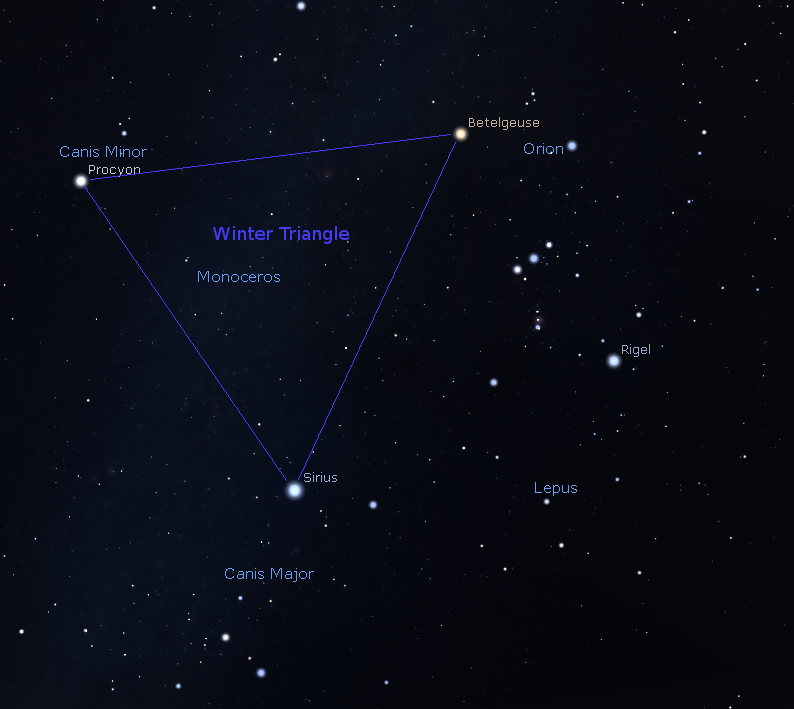
The Winter Triangle. It encloses a pretty blank space where Monoceros the unicorn lies. Created using Stellarium with my annotations for the Winter Triangle.
02/11/2021 – Ephemeris – The Winter Triangle
This is Ephemeris for Thursday, February 11th. Today the Sun will be up for 10 hours and 17 minutes, setting at 6:06, and it will rise tomorrow at 7:47. The Moon is new today, and won’t be visible.
I usually talk about the Winter Circle of bright stars, but some other astronomers talk about the Winter Triangle. The stars involved are Betelgeuse in the hunter Orion, Sirius in Canis Major, Orion’s large hunting dog, and Procyon in Canis Minor, his other small hunting dog. These three stars enclose a rather blank piece of sky with the faint Milky Way running through it and the almost invisible constellation of Monoceros the unicorn. The Summer Triangle has three bright stars with no other close competition. The Winter Triangle has four other bright stars near it. Any three of these would make a nice triangle. One of these constellations Canis Minor is tiny, with Procyon and one other star. It makes me think of a dachshund, or maybe, if I’m hungry, a hot dog.
The event times given are for the Traverse City/Interlochen area of Michigan. They may be different for your location.
Addendum
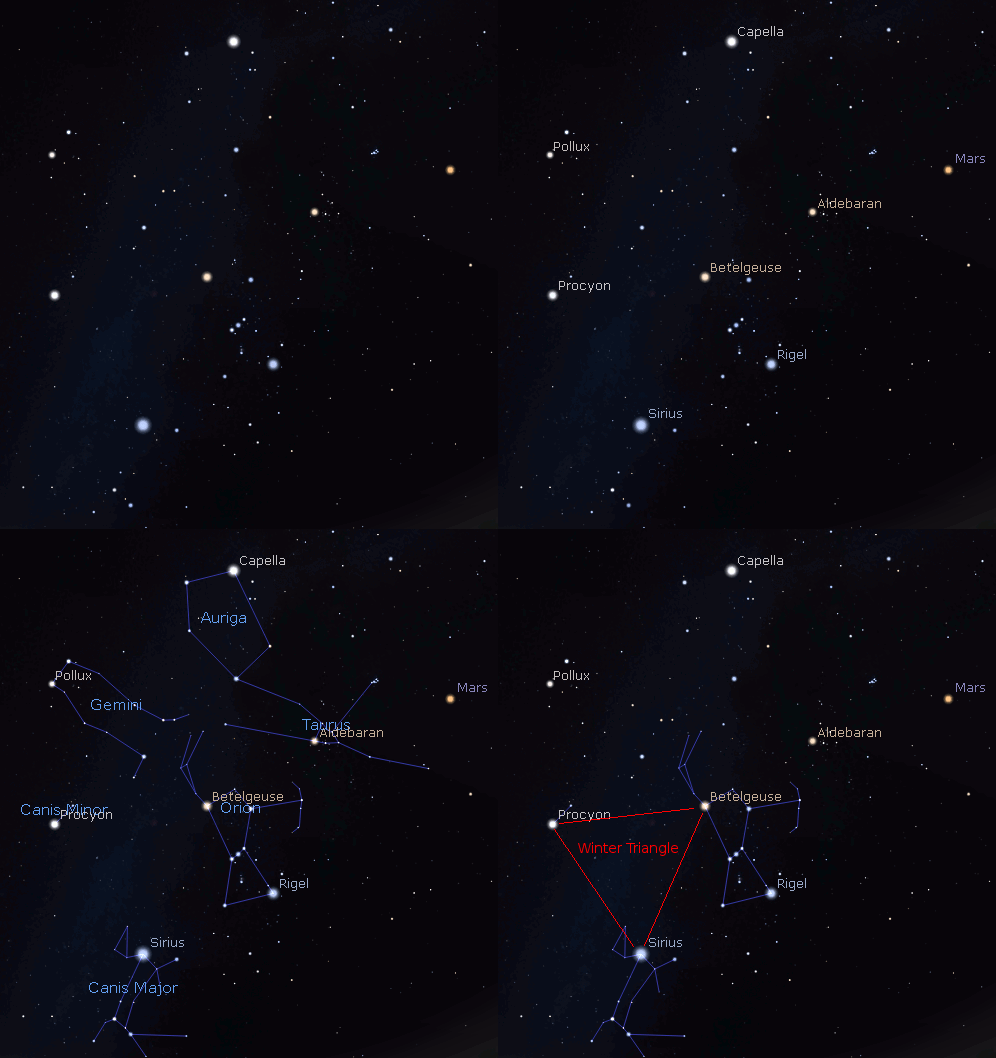
Winter Triangle finder animation. It shows the star field, named first magnitude stars, then their constellations, then the Winter Triangle and constellations of the three stars. Click on the image to enlarge. Created using Stellarium and GIMP.
02/20/2020 – Ephemeris – The Winter Triangle
Ephemeris for Thursday, February 20th. Today the Sun will be up for 10 hours and 41 minutes, setting at 6:17, and it will rise tomorrow at 7:34. The Moon, 3 days before new, will rise at 6:53 tomorrow morning.
I usually talk about the Winter Circle of bright stars, but some other astronomers talk about the Winter Triangle. The stars involved are Betelgeuse in the hunter Orion, Sirius in Canis Major, Orion’s large hunting dog, and Procyon in Canis Minor, his other small hunting dog. These three stars enclose a rather blank piece of sky with the faint Milky Way running through it and the equally invisible constellation of Monoceros the unicorn. The Summer Triangle has three bright stars with no other close competition. The Winter Triangle has 4 other bright stars near it. Any three of these would make a nice triangle. One of these stars, Betelgeuse has been the news recently because it is dimming to an unprecedented degree.
The times given are for the Traverse City/Interlochen area of Michigan. They may be different for your location.
Addendum
The Winter Triangle. It enclose a pretty blank space where Monoceros the unicorn lies. Created using Stellarium with my annotations for the Winter Triangle. By the way, Betelgeuse is currently only as bright as Bellatrix, the star next to the “n” in Orion.
02/12/2016 – Ephemeris – A circle of bright stars in winter
Ephemeris for Friday, February 12th. The Sun will rise at 7:48. It’ll be up for 10 hours and 18 minutes, setting at 6:06. The Moon, 3 days before first quarter, will set at 11:19 this evening.
The winter skies are blessed with more first magnitude stars than any other season. With the moon out these stars will stand out even more, as dimmer stars are suppressed. Six of these stars lie in a large circle centered on the seventh, the Winter Circle.
This circle is up at 9 p.m. Starting high nearly overhead is Capella in Auriga the charioteer. Moving clockwise down to the south, we come to Aldebaran in the face of Taurus the Bull. Then down to Orion’s knee we find Rigel. Down and left is the brightest star of all Sirius in Canis Major Orion’s large hunting dog, lowest of these stars in the southeast. Moving up and left there is Procyon in Canis Minor, Above is Pollux in Gemini the twins. All are centered on Betelgeuse the bright red star in Orion’s shoulder.
Times are for the Traverse City/Interlochen area of Michigan. They may be different for your location.
Addendum
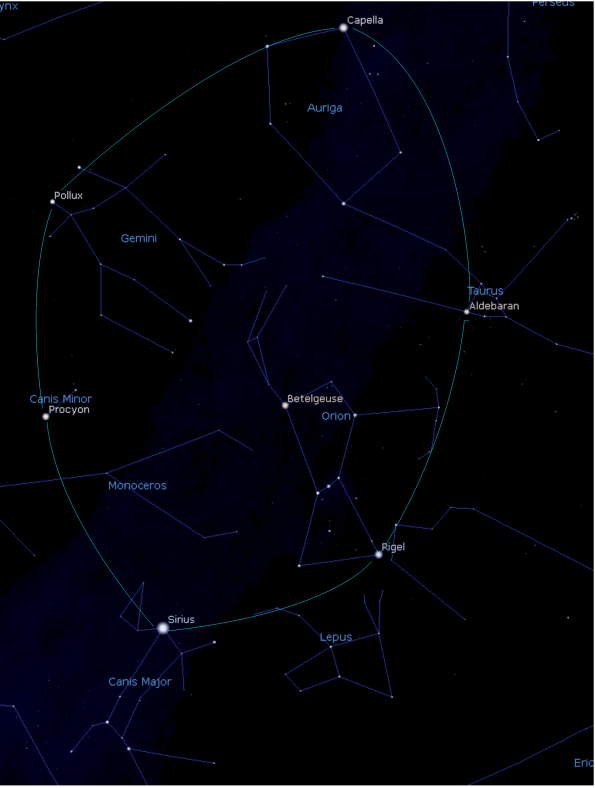
The bright stars of winter arrayed in a circle. Created using Stellarium.
Some also see a Winter Triangle consisting of the stars Betelgeuse, Sirius and Procyon.
 Bob Moler's Ephemeris Blog