Archive
10/15/10 – Ephemeris – GTAS Weekend Events
Friday, October 15th. The sun will rise at 7:57. It’ll be up for 11 hours and 1 minute, setting at 6:58. The moon, 1 day past first quarter, will set at 1:35 tomorrow morning.
There’s an event to be held this Sunday evening at the Sleeping Bear Dunes National Lake Shore. It’s sponsored by Families United in Nature. They’ve invited the Grand Traverse Astronomical Society to participate. If it’s good weather it will be held at stop #3 of the Pierce Stocking Scenic Drive from 6 to 8 p.m. Since it won’t get too dark observing will include the sun, moon and the planet Jupiter. If inclement weather it will be held at the park headquarters in Empire. On Thursday the 21st there will be a celebration of the park’s 40th anniversary. We’ll be there again at the same locations though the end time will be at 9 p.m. giving us darker skies. Details of the society’s outreach program can be found at www.gtastro.org.
10/14/10 – Ephemeris – The star Capella
Thursday, October 14th. The sun will rise at 7:56. It’ll be up for 11 hours and 3 minutes, setting at 6:59. The moon, at first quarter today, will set at 12:32 tomorrow morning.
A bright star called Capella has slowly been rising in the northeastern sky in the evenings for the past few months. At 9 p.m. now it is low in the north northeast far below the letter “W” shaped constellation of Cassiopeia. This winter Capella will be overhead the highest of winter’s seven brilliant first magnitude stars. Capella never quite sets for anyone north of Ludington. Due to its brightness, and being the closest first magnitude star to the pole, Capella appears to move slowly as the earth rotates, and spends summer and autumn evenings close to the horizon, and has in years past elicited a few phone calls and other queries about that ‘bright object in the northeast’. Capella belongs to the pentagonal constellation of Auriga the Charioteer.
Astronomy Cruise – Day 1
October 1st.
I got up about 6 a.m. and got on deck. Orion was shining in the south, with the nearly last quarter moon high above. Fellow passenger Chris, who is another amateur astronomer from Dayton, Ohio was also up drinking in the winter sky preview.
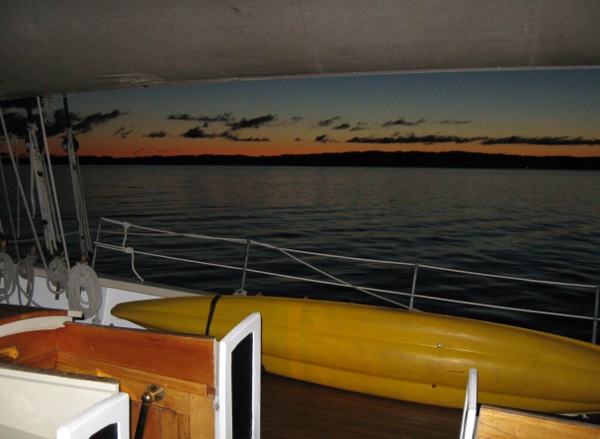
Daybreak from the deck of the Manitou at 6:56 a.m.
The twilight showed a line of clouds just above the eastern horizon. It looked like the day was going to be great for sailing. At 7 a.m. Brent of the galley crew brought out coffee and scones.
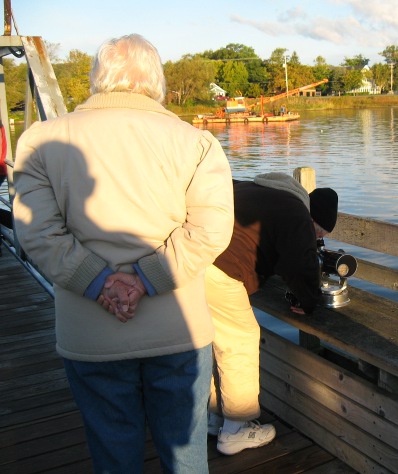
A passenger looking at the sun through the Questar
Not knowing how long it was going to be brfore we sailed, I brought out the Questar with it’s solar filter and set it up on a bench on the dock. There was one good sunspot visible.
8 a.m. was breakfast. All 20 plus passengers squeezed into the galley. Chief cook Lulu fed us some wonderful meals during the trip, including this breakfast.
Captain Dave came aboard before breakfast and after breakfast gave us our morning briefing. We would cast off at 10 a.m. so some of us could go ashore to get some last minute items.
We had a deck crew of 4 headed by Cheyenne who was also a certified captain. She captained by earlier 2 hour cruise Labor Day weekend that I was on. Also in the crew were Neil, who grew up in Suttons Bay, Matt who really looked like a old fashoned deck hand with his beard, and Ann a crewman from a prior year who volunteered for the cruise.
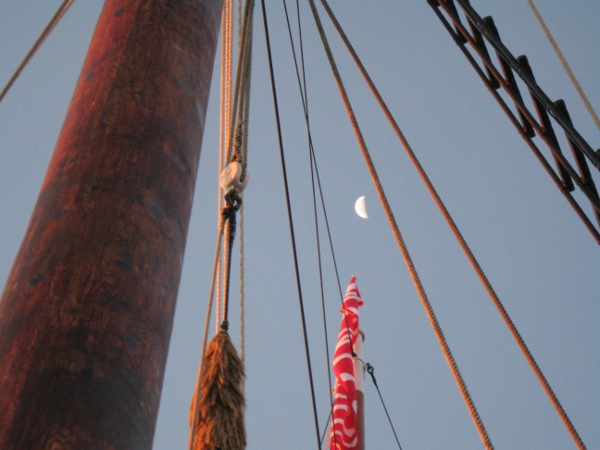
The moon through the rigging
Besides 6 sails, the Manitou has a diesel engine and we motored away from the dock. After a bit Captain Dave headed the Manitou into the wind to begin the process of raising the sails. The crew got at least 6 of us passengers lined on either side of the deck forward of the main mast to raise the mainsail. The Manitou is a gaff-rigged schooner in that its main and fore sails are trapezoidal in shape being stretched between the boom on the bottom and the gaff at the top. The port line raised the throat of the gaff next to the mast, while the line on the starboard side raised the peak of the gaff. I was on the port side when the time cane our side shouted to the captain “Ready on the throat!” The other side shouted “Ready on the peak!” At the signal we hauled away. As we were raising more and more canvas the task grew harder. Near the end we end we gave some mighty pulls with commands of 2-6-Heave.
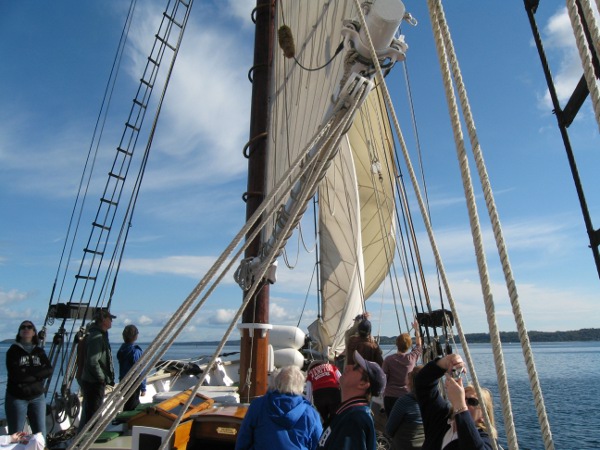
The crew unfurls the staysails
The foresail was easier taking only three on a side and pulling vertically. The crew then unfurled the three stay sails attached between the foremast and the bowsprit.
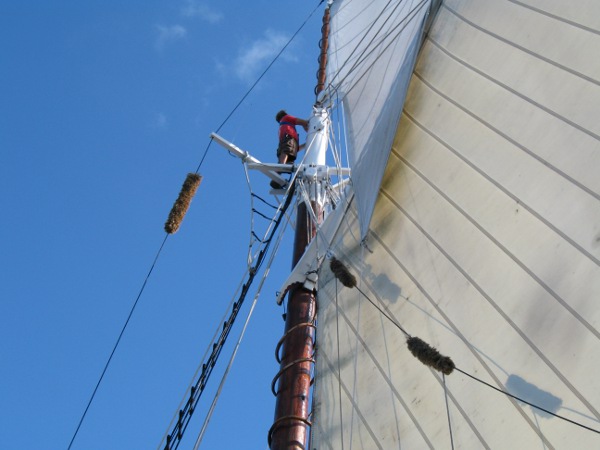
Matt unfurls the topsail
Last to go up was the topsail. Matt climbed up to set that sail.

The Manitou under full sail (From the Traverse Tall Ship Co. Website)
We headed northward from the southwest shore of the west arm of Grand Traverse bay under a light westerly breeze. That breeze died just as we tacked to the west to clear the shoals off Power Island. The map below shows it as Marion Island. I recall that it was even named Ford Island being once owned by Henry Ford, but I can’t find anything on the Internet about it.
Captain Dave resorted to starting the diesel engine to make up some time. The wind came up in the early afternoon, but this time from the north which put Omena and Northport out of range for the day. Also it was becoming overcast. Lulu fixed us lunch including French onion soup. It was delicious!
We tacked back and forth in West Bay (the west arm of the Grand Traverse Bay) in order to clear the Old Mission Light and so to enter East Bay and head south with the wind to anchor in Old Mission Harbor. Along the way we saw rain showers in the distance. I may be wrong but I’d say they were lake effect showers from the cold air blowing over the warm waters of Lake Michigan.
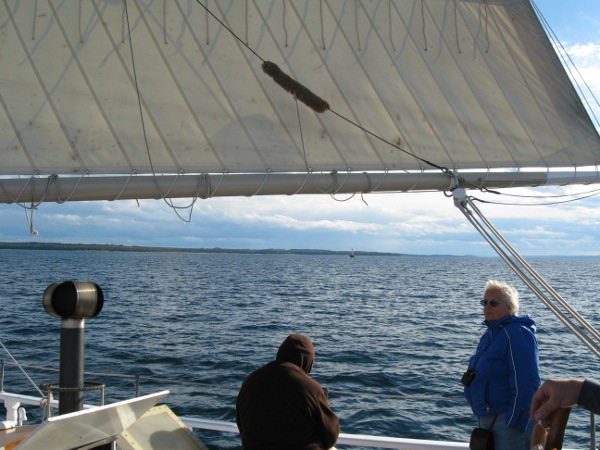
We're passing Old Mission Light to enter East Bay
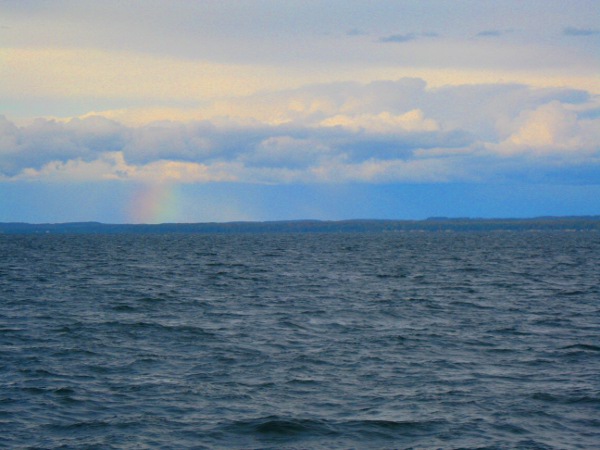
Rainbow spotted in the late afternoon
Toward the end of our sail that day we saw a rainbow in the distance. It was truncated because it was in the distance and the clouds were low. After we anchored in Old Mission Bay we had dinner and the Zodiac boat was lowered from the davits at the stern of the Manitou to let those who wanted to go ashore.
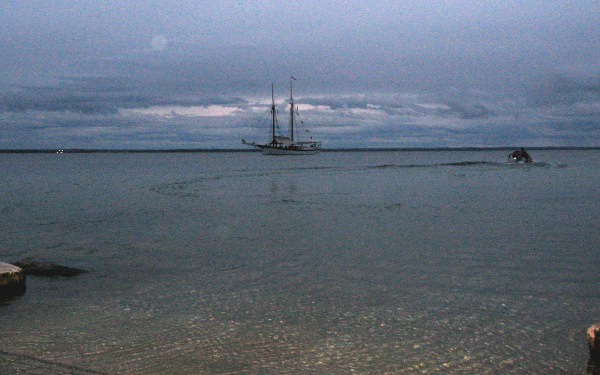
The Manitou in Old Mission Harbor with the Zodiac returning for more passengers
Old Mission was actually the oldest continuous settlement in the Grand Traverse Bay area, even older than Traverse City. It was founded in 1839 by the Rev. Dougherty who started a mission there to convert the local Native Americans. Some of headed to the Old Mission General Store for ice cream. That place is all decked out as a depression era store. It is run by a cranky old guy who forbids the taking of photographs inside. But the Moomers ice cream was worth the visit. After this we headed back to the dock in the dark, and our warm beds aboard the Manitou..
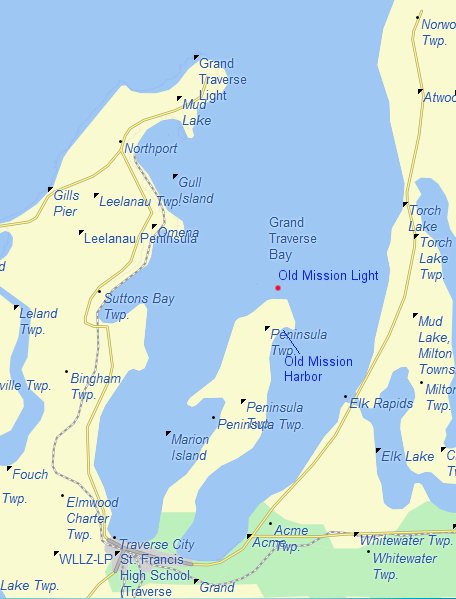
Map of Grand Traverse Bay from Wiki Mini Atlas
10/13/10 – Ephemeris – Planets for this week
Wednesday, October 13th. The sun will rise at 7:55. It’ll be up for 11 hours and 6 minutes, setting at 7:01. The moon, 1 day before first quarter, will set at 11:28 this evening.
Lets take a look at the bright planets for this week. Venus and Mars are very low and pretty much lost in the evening twilight. Venus is the brightest. It’s 29.3 million miles away and slowly approaching, and appears as a thin crescent, if you can find it. It will set at 7:15 p.m. Mars, though appearing farther from the sun, is too dim to be spotted in the bright twilight. The planet Jupiter is up at sunset and will move due south at 11:58 p.m.. It is very bright in the southeastern sky, and the brightest starlight object in the sky. It’s located in Pisces this year and will set at 5:47 a.m. Comet Hartley 2 may be just visible in binoculars as a fuzzy spot near the northern tip of the constellation Perseus closest to the W shape of Cassiopeia in the northeast.
10/12/10 – Ephemeris – The Pleiades or Seven Sisters
Tuesday, October 12th. The sun will rise at 7:53. It’ll be up for 11 hours and 9 minutes, setting at 7:03. The moon, 2 days before first quarter, will set at 10:26 this evening.
A marvelous member of the autumn skies can be found low in the east northeast after 9 in the evening. It is the famous star cluster called the Pleiades or the Seven Sisters. I might also add the ‘Tiny Dipper’. Many people can spot a tiny dipper shape in its six or seven stars, and mistake it for the Little Dipper. As nearsighted as I am, though corrected, I’ve never been able to see more than a few stars and a bit of fuzz. However with binoculars, even I can see over a hundred stars appear along with the dipper shape of the brightest. The fuzz I saw was unresolved stars, but in photographs the Pleiades actually contains wisps of the gas they are passing through currently. They were born from a hundred million years ago. In Greek mythology the sisters were daughters of the god Atlas.
10/11/10 – Ephemeris – The constellation Pegasus
Monday, October 11th. The sun will rise at 7:52. It’ll be up for 11 hours and 12 minutes, setting at 7:04. The moon, 3 days before first quarter, will set at 9:29 this evening.
Rising ever higher in the east at as it gets dark around 9 p.m. can be found one of the great autumn constellations: Pegasus the flying horse of Greek myth. Its most visible feature is a large square of four stars, now standing on one corner. This feature, called the Great Square of Pegasus, represents the front part of the horse’s body. The horse is quite aerobatic, because it is seen flying upside down. Remembering that fact, the neck and head is a bent line of stars emanating from the right corner star of the square. Its front legs can be seen in a gallop extending to the upper right from the top star of the square. From the left star extend, not hind legs but the constellation of Andromeda, a fascinating constellation in its own right.
10/08/10 – Ephemeris – Local World Space Week event
Friday, October 8th. The sun will rise at 7:48. It’ll be up for 11 hours and 21 minutes, setting at 7:10. The moon, 1 day past new, will set at 7:16 this evening.
This is World Space Week which was celebrated last year by a star party at the White House. This year the Grand Traverse Astronomical Society will join societies, planetariums, and observatories around the world. The local society’s contribution is a star party tonight near the Open Space on the bay front in Traverse City. The grassy expanse where the old light and power generators stood appears dark enough for our purposes. Society members will be out tonight from about 8 p,.m. If it’s clear. If not we’ll postpone it to Saturday night. The giant planet Jupiter will be the featured attraction. This is a new venue for the society so we’ll test just how dark it is. For more information go to worldspaceweek.org. Dress warmly, Clear nights are cold this time of year.
Times are for the Grand Traverse Area of Northern Michigan, USA.
Astronomy Cruise – Day 0
Late last year I was privileged enough to be asked by Captain Dave owner of the tall ship Manitou and the Traverse Tall Ship Company, based in Traverse City, to be the astronomer on their annual astronomy cruise. After the three times a day two hour cruises of the summer months they have three or four day “Windjammer” cruises after Labor Day. The astronomy cruise was scheduled for October 1-4 this year, and happened to be the last cruise of the season.
The Manitou is a 114 foot replica of a 19th century cargo schooner like those that sailed the lakes back then. It can accommodate 24 passengers on multi-day cruises, 62 on short day cruises.
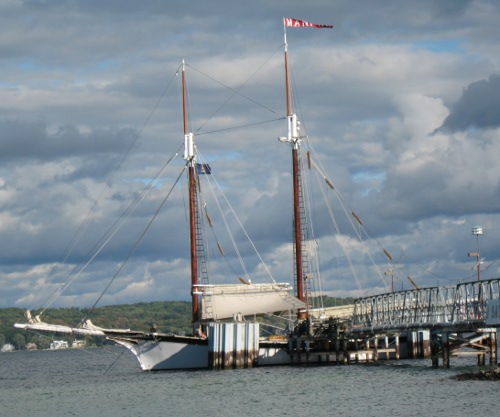
The schooner Manitou at its dock in Traverse City
Boarding was on the afternoon before to get things stowed, and I had a lot to stow: 8″ Celestron SCT telescope, tripod, other telescope parts, christened “bag of bricks” by the crew, 2 battery packs, a Questar telescope on loan from the Leelanau School, and my traveling bag. I had a cabin to myself, so the tripod slept in the upper bunk.
After heading ashore with another passenger to get some takeout burgers and having a quick supper I set up my telescope, because the sky was clear.
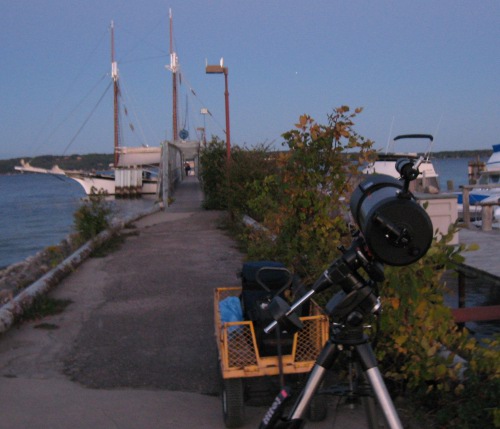
My telescope aimed at the rising Jupiter, just visible.
Only tonight and Sunday night were forecast to be clear, so I wasn’t going to waste even this first night in port to observe the sky. Among other things I did spot comet Hartley 2. The south was affected by an unshielded sodium light on a dock south of us. Overhead and to the north were good and dark.
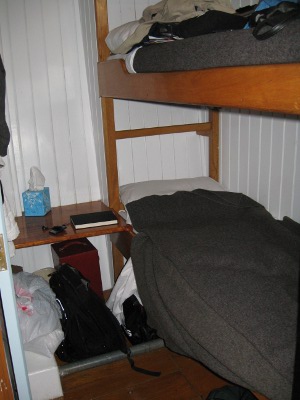
The bunk in my quarters (Not the first night)
After tearing down the telescope, I settled in to my cabin and a very comfortable, but narrow bed for a fitful sleep. I always have trouble sleeping the first night in a new place. The rest of the nights I went to sleep right away and slept soundly. My MP3 player and ear buds silenced the fellow snoring on the other side of the wall. The bed being unmade in the photo is my fault. I didn’t keep my cabin exactly ship shape.
Tomorrow is going to be a big day as we head out into the Grand Traverse Bay.
10/07/10 – Ephemeris – The star Fomalhaut
Thursday, October 7th. The sun will rise at 7:47. It’ll be up for 11 hours and 24 minutes, setting at 7:12. The moon is new today, and won’t be visible.
There’s a bright star that appears for only seven and a half hours a night on autumn evenings. It’s appearance, low in the south, is a clear indication of the autumn season. At 9 p.m. tonight it’s low in the southeast. The star’s name is Fomalhaut, which means fish’s mouth. That fits because it’s in the constellation of Piscis Austrinus, the southern fish. At our latitude it’s the fish that got away, because Fomalhaut appears to be quite alone. The dimness of the constellation’s other stars and location close to the horizon make the fainter stars hard to spot. They would be overhead in Australia. The earth’s thick atmosphere near the horizon reduces the stars brightness by a factor of two or more, so Fomalhaut appears to keep a lonely vigil in the south.
Times are for the Grand Traverse Area of Northern Michigan, USA.
10/06/10 – Ephemeris – The planets this week
Wednesday, October 6th. The sun will rise at 7:46. It’ll be up for 11 hours and 27 minutes, setting at 7:13. The moon, 1 day before new, will rise at 7:42 tomorrow morning.
Lets take a look at the bright planets for this week. Venus and Mars are very low in the twilight. Venus is the brightest. It’s 32.1 million miles away and slowly approaching, and appears as a thin crescent. If you can find it. It will set at 7:41 p.m. Mars, though appearing farther from the sun, is too dim to be spotted in the bright twilight. The planet Jupiter is up at sunset and will move due south at 12:29 a.m.. It is very bright in the southeastern sky, and the brightest starlight object in the sky. It’s located in Pisces this year and will set at 6:19 a.m. Comet Hartley 2 may be just visible in binoculars as a fuzzy spot just right of the bottom of the W shape of the constellation Cassiopeia in the evening now.
Times are for the Grand Traverse Area of Northern Michigan, USA.
 Bob Moler's Ephemeris Blog