Archive
Smile! – Comet Tempel 1 gets its retakes
Wow! I was tipped off by Emily Lackdawalla‘s Planetary Society Blog. She found the image of the Deep Impact site. I pulled the image from the JPL site, enlarged it, tweaked the brightness levels, and sharpened it a bit.
I got the impact site wrong, since it hadn’t been pointed out yet. I thought it was that bright spot, definitely not visible in the 2005 images. In perusing the press conference images several hours later I saw the real impact. A low crater that blends with the color and terrain around it. It goes to show how fast the dust liberated by the comet’s out gassing covers the surface of the comet. I’d bet it we ever pass the comet next time around the fresh impact would be covered too.
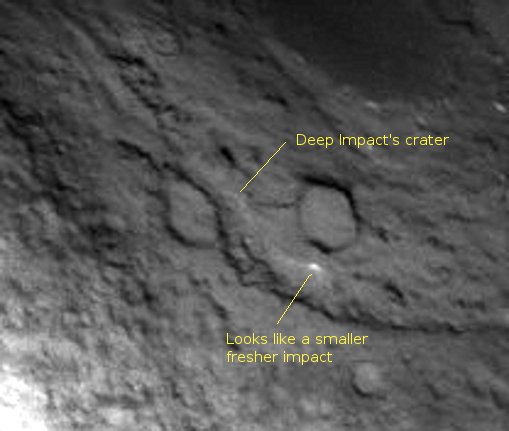
Impact crater on Comet Tempel 1. Credit: NASA/JPL-Caltech/Cornell. Image enhanced and annotated by Bob Moler
02/15/11 – Ephemeris – Kepler discoveres lots of planets
Tuesday, February 15th. The sun will rise at 7:43. It’ll be up for 10 hours and 27 minutes, setting at 6:10. The moon, 3 days before full, will set at 6:20 tomorrow morning.
Two weeks ago NASA announced the discovery of a possible 12 hundred and 35 planets around other stars discovered by the Kepler spacecraft mission, which has been staring at a single patch of the Milky Way for nearly two years. It found 5 earth-like planets in the habitable zones of their stars. It’s finding planets by their passage in front of their stars, something astronomers call transits. A very useful technique but only a few percent of star systems are so perfectly oriented to our line of sight to produce these transits. Most of these finds have to be verified by the Doppler wobble method of the planet’s effects of the motion of the star itself. Kepler even found a six planet system all orbiting within a few million miles of their star.
* Times are for the Traverse City/Interlochen area of Michigan. They may be different for your location.
02/14/11 – Ephemeris – Stardust-NExT reaches Comet Tempel 1 tonight
St Valentine’s Day, Monday, February 14th. The sun will rise at 7:44. It’ll be up for 10 hours and 24 minutes, setting at 6:09. The moon, 3 days past first quarter, will set at 5:41 tomorrow morning.
About 11:40 this evening the Stardust spacecraft will pass about 120 miles from comet Tempel 1’s nucleus. It’s happening over 200 million miles away, near Mars’ distance from the sun. The spacecraft will take 72 pictures as it speeds past the comet at over 24,000 miles an hour. By tomorrow morning many of the photographs should be available on the Internet and TV. On Tempel 1’s last approach to Mars’ orbit it was struck bu a big chunk of copper when the Deep Impact spacecraft’s impactor struck the comet’s nucleus. That was July 4th, 2005. This time the Stardust-NExT mission is interested in changes in the comet that have occurred over the orbit, and it’s looking for the crater left by Deep Impact.
* Times are for the Traverse City/Interlochen area of Michigan. They may be different for your location.
02/11/11 – Ephemeris – The moon will appear near the Pleiades tonight
Friday, February 11th. The sun will rise at 7:48. It’ll be up for 10 hours and 16 minutes, setting at 6:05. The moon, at first quarter today, will set at 3:05 tomorrow morning.
Today the moon will pass below the Pleiades or Seven Sisters star cluster. It does this once a month, but maybe tonight the moon won’t be too bright to completely drown them out. The Pleiades is a relatively nearby star cluster about 440 light years away. It is easily visible to the unaided eye, but not with the bright moon nearby. Binoculars will help bring out the cluster, which may show many more stars. On the moon two of the great features for small telescopes are visible, the wide flat floored crater Plato and the Straight Wall. Plato is visible at the upper part of the moon, while the Straight Wall is below center on the moon as a thin black line. It’s hard to spot for the first time. It is nearly a sheer fault 67 miles long and 900 feet high with a slope of 30 to 40 degrees.
* Times are for the Traverse City/Interlochen area of Michigan. They may be different for your location.
Extra
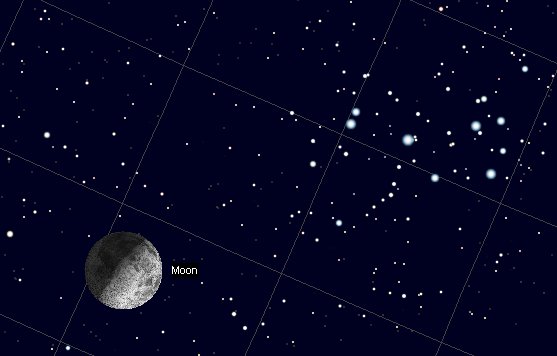
The Moon near the Pleiades, February 11, 2011 9 p.m. EST. Created using Cartes du Ciel (Sky Charts)
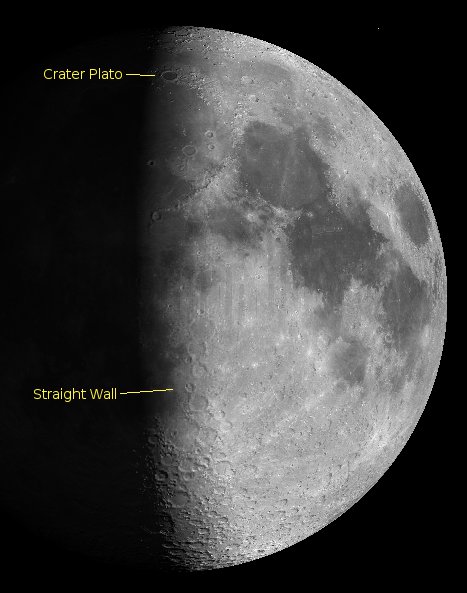
Lunar crater Plato and the fault Straight Wall
This is not a photograph! Image created using Virtual Moon Atlas by Christian Legrand and Patrick Chevalley. A free program. http://www.ap-i.net/avl/en/start.
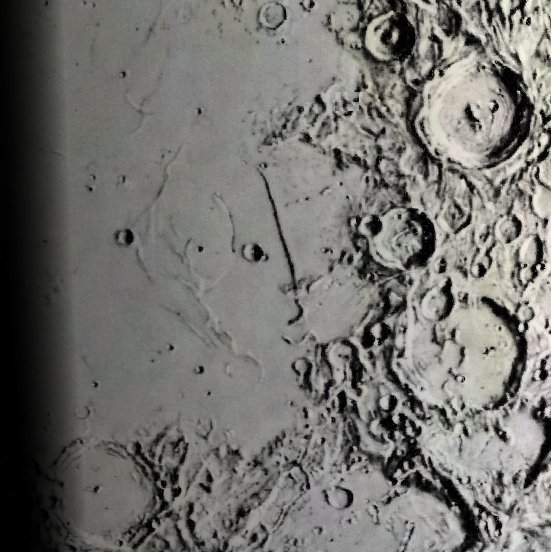
Closeup of the Straight Wall
Image also created using Virtual Moon Atlas.
02/10/11 – Ephemeris – The moon near first quarter
Thursday, February 10th. The sun will rise at 7:50. It’ll be up for 10 hours and 13 minutes, setting at 6:03. The moon, 1 day before first quarter, will set at 2:04 tomorrow morning.
The moon is just about first quarter. When it’s out tonight it will be less than 6 hours from the actual moment of first quarter, that is when the moon is at a 90 degree angle from the sun. In a small telescope a neat straight feature will be visible. It is near the northern part of the moon, which is up to the unaided eye or binoculars and usually on the lower part of the moon when viewed in an astronomical telescope. The straight feature is the Alpine Valley which cuts through the lunar Alps. Mountain ranges on the moon are named for earthly mountains, though lunar mountains are usually the rims of lunar seas, which are really large craters. The Alpine valley is 79 miles long and 7 miles wide. It appears to be a fault line.
* Times are for the Traverse City/Interlochen area of Michigan. They may be different for your location.
Extra
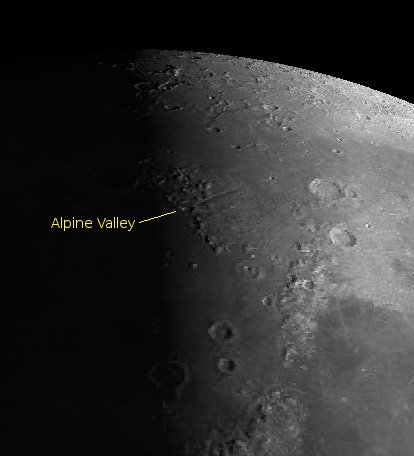
Alpine Valley on the moon
This is not a photograph! Image created using Virtual Moon Atlas by Christian Legrand and Patrick Chevalley. A free program. http://www.ap-i.net/avl/en/start.
02/09/11 – Ephemeris – The bright planets for this week
Wednesday, February 9th. The sun will rise at 7:51. It’ll be up for 10 hours and 10 minutes, setting at 6:02. The moon, 2 days before first quarter, will set at 1:01 tomorrow morning.
Lets take a look at the bright planets for this week. The planet Jupiter is up in the west southwestern sky in the early evening. It is a spectacular sight in a telescope with its four satellites, shifting their positions from night to night, and the cloud bands running in the directions of the satellites. Jupiter is the brightest star-like object in the evening. It’s located left the Circlet in Pisces now and will set at 9:43 p.m. The ringed planet Saturn will rise at 10:44 p.m. in the east southeast and will move due south at 4:29 a.m. Venus is brilliant in the morning sky and will rise at 5:18 a.m. in the east southeast. Mercury is now too close to the direction of the sun to be seen, as is Mars which is now in the morning sky. It’ll be a few months before it’s visible in the morning.
* Times are for the Traverse City/Interlochen area of Michigan. They may be different for your location.
02/08/11 – Ephemeris – The lunar crater Theophilus
Tuesday, February 8th. The sun will rise at 7:52. It’ll be up for 10 hours and 8 minutes, setting at 6:00. The moon, 3 days before first quarter, will set at 11:58 this evening.
The 5 day old crescent moon reveals to a small telescope, a trio of large craters on the edge of the moon’s terminator or sunrise line. The best of these is on top Theophilus, a perfectly circular 61 mile diameter crater with a prominent central peak. It’s a little late for it tonight but sometimes when the terminator is crossing the crater, the floor is dark and the central peak catches the morning sunlight. Theophilus is a couple of hundred miles south of the Apollo 11 landing site in the Sea of Tranquility, That sea will be completely in sunlight tomorrow night. The moon is a great celestial object to view with that new telescope. It’d big and bright, and relatively easy to find in the telescope. When trying to find an object in the sky always use the lowest power.
* Times are for the Traverse City/Interlochen area of Michigan. They may be different for your location.
02/07/11 – Ephemeris – The moon appears near Jupiter
Monday, February 7th. The sun will rise at 7:54. It’ll be up for 10 hours and 5 minutes, setting at 5:59. The moon, 4 days before first quarter, will set at 10:56 this evening.
The waxing crescent moon will appear near Jupiter in the evening with Jupiter below the moon. Jupiter is slowly leaving the evening sky, setting earlier by about a half an hour a week, while the sun is setting later by 10 minutes a week. These are the last few weeks to get a good view of Jupiter in a telescope before it sinks too close to the horizon for good views. The more of the earth’s atmosphere we have to look through near the horizon the fuzzier Jupiter looks. The moon is coming on and will brighten over the next week and a half. In binoculars the dark spot on the right edge of the moon is the Sea of Crises. In telescopes usually, about this time, a lone mountain peak at one of the moon’s poles catches the sunlight off the cusp of the crescent.
* Times are for the Traverse City/Interlochen area of Michigan. They may be different for your location.
02/04/11 – Ephemeris – Local astronomy events
Friday, February 4th. The sun will rise at 7:58. It’ll be up for 9 hours and 57 minutes, setting at 5:55. The moon, 2 days past new, will set at 7:53 this evening.
A star Bowl quiz will be held this evening between the NMC astronomy club and the Grand Traverse Astronomical Society at this evening’s meeting of the society at 8 p.m. at Northwestern Michigan College’s Rogers Observatory. The NMC folks are really smart being in or freshly out of professor Dobek’s astronomy class. We’re going to lose so bad. Come in and watch the carnage annd learn sone cool astronomy facts.. Tomorrow night the groups bury the hatchet and will both host a public viewing night starting at 8 p.m. On tap will be the planet Jupiter early, and the Great Orion Nebula, a place where stars are even now forming.. The observatory is located south of Traverse City on Birmley road between Garfield and Keystone roads.
* Times are for the Traverse City/Interlochen area of Michigan. They may be different for your location.
02/03/11 – Ephemeris – Spring constellations rising
Thursday, February 3rd. The sun will rise at 7:59. It’ll be up for 9 hours and 54 minutes, setting at 5:53. The moon, 1 day past new, will set at 6:51 this evening.
With winter half over, I’m looking forward to spring. The night sky gives us a tantalizing look at some of the spring constellations. Looking to the northeast is the Big Dipper standing on the tip of the handle. However it’s not an official constellation, but the hind ed of Ursa Major, the Great Bear, which is. While the Big Dipper never sets, being close to the north pole of the sky, and the bear mostly is, it is highest in the sky on spring evenings. A line through the bowl of the dipper to the right will arrive at another spring constellation, Leo the lion, rising in the east. Leo has a backward question mark for his head and mane, with the bright star Regulus at the base. Below left is a triangle of stars, his hind end. Check each clear night as Leo rises higher and higher.
* Times are for the Traverse City/Interlochen area of Michigan. They may be different for your location.
 Bob Moler's Ephemeris Blog