Archive
MESSENGER’s in orbit of Mercury!
Just like clockwork! I’m looking for a year of new discoveries about this nearest planet to the sun.
They’re tweeting at http://www.twitter.com/messenger2011.
MESSENGER’s web site is at http://messenger.jhuapl.edu/.
NASA’s MESSENGER page is at http://www.nasa.gov/mission_pages/messenger/main/.
03/17/11 – Ephemeris – MESSENGER spacecraft arrives at Mercury tonight
Ephemeris for St. Patrick’s Day, Thursday, March 17th. The sun will rise at 7:51. It’ll be up for 11 hours and 59 minutes, setting at 7:50. The moon, 2 days before full, will set at 6:48 tomorrow morning.
This evening the MESSENGER Spacecraft will fire its main engine for 15 minutes to put itself in orbit of the planet Mercury. The rocket firing will be at 8:45 this evening. Due to light time delays caused by Mercury being 97 million miles away, we won’t know if the rocket fired until 8:54. While its high gain antenna won’t be pointed at earth, we should get a signal from its omni- directional antenna. We did get a signal from Cassini with its orbital insertion of Saturn in 2004, and that was nearly a billion miles away. I don’t know if NASA TV’s covering the insertion live, but Johns Hopkins Applied Physics Laboratory is having a live webcast. Google “messenger mercury live orbital insertion” It was the first hit. I’ll have the address on the blog. http://messenger.jhuapl.edu/mer_orbit.html
* Times are for the Traverse City/Interlochen area of Michigan. They may be different for your location.
03/16/11 – Ephemeris – The bright planets this week
Ephemeris for Wednesday, March 16th. The sun will rise at 7:53. It’ll be up for 11 hours and 56 minutes, setting at 7:49. The moon, 3 days before full, will set at 6:19 tomorrow morning.
It’s Wednesday and time again to take a look at the whereabouts of the bright planets for this week. If the weather cooperates tonight we might get a glimpse of Mercury just above Jupiter low in the west shortly after sunset. Jupiter is the brighter of the two and will set first at 9:07, with Mercury following at 9:18. The best time to view them will be about 8:30 or so. The ringed planet Saturn will rise at 9:17 p.m. in the east southeast and will move due south at 3:05 a.m. In telescopes Saturn shows its rings which are a year and a half along their seven and a half year opening. Venus is brilliant in the morning sky and will rise at 6:27 a.m. in the east southeast. It is really a beautiful sight in the morning twilight.
* Times are for the Traverse City/Interlochen area of Michigan. They may be different for your location.
Addendum
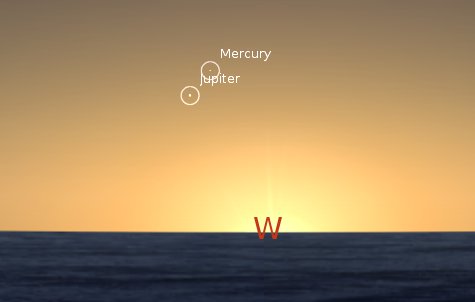
Jupiter-Mercury Conjunction March 16, 2011. Created using Stellaruim.
03/15/11 – Ephemeris – The Lunar Highlands
Ephemeris for Tuesday, March 15th. The sun will rise at 7:55. It’ll be up for 11 hours and 52 minutes, setting at 7:48. The moon, half way from first quarter to full, will set at 5:48 tomorrow morning.
The south part of the moon that can be seen tonight appears brighter than the darker areas that we call seas, that make up the face of the man in the moon. These and other bright areas are called the lunar highlands, and are the most primitive surface of the moon. Here the landscape is saturated with craters. In binoculars the crater Tycho with its rays are just beginning to become prominent. These rays, are thought to be small craterlets caused by the ejecta from the creation of Tycho which occurred perhaps less than 1.1 billion years ago. This makes Tycho a relatively fresh crater in the moon’s nearly 4.5 billion year history. A telescope will reveal more, including the large crater Clavius with its arc of smaller craters within.
* Times are for the Traverse City/Interlochen area of Michigan. They may be different for your location.
03/14/11 – Ephemeris – The Lunar Jura Mountains
Ephemeris for Monday, March 14th. The sun will rise at 7:57. It’ll be up for 11 hours and 49 minutes, setting at 7:46. The moon, 3 days past first quarter, will set at 5:13 tomorrow morning.
On the moon tonight the gibbous phase and the terminator on the left side of the moon is revealing a large semi circular mountain range called the Jura Mountains that encloses a flat lava plain that looks like a bay in the margin of the Sea of Showers or Mare Imbrium. It is easily visible in binoculars this evening when the sunrise line is crossing the bay. The Jura Mountains will appear as a hook out of the upper left edge of the moon. That’s about the coolest sight that’s visible on the moon that can be seen with binoculars. It’s especially striking if seen in a small telescope. I’ve added these programs to my web log or blog and I can add images to illustrate what I’m talking about, as I did today. The blog’s address is bobmoler.wordpress.com.
* Times are for the Traverse City/Interlochen area of Michigan. They may be different for your location.
Addendum
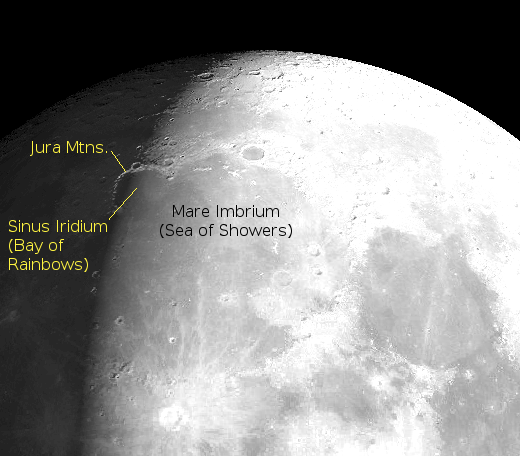
The Jura Mountains sticking up into morning daylight. Created from the Virtual Moon Atlas.
What we used to know about Mercury
On Thursday evening, 8:45 p.m. March 17 EDT (12:45 a.m. March 18 UTC) the MESSENGER spacecraft will complete the second of NASA’s 2011 planetary trifecta when it will, if all goes well, fire its rocket engine to drop into orbit of the tiny planet Mercury. We’ve had six quick peeks at Mercury so far. Three by the Mariner 10 spacecraft in the 1970’s which looked at the same half of the planet due to Mercury’s unique rotational period. And three more by MESSENGER as it used Mercury to put on the breaks, so it would be going slow enough this time, so it’s rocket engine could drop it into polar orbit of the planet.
At first blush, Mercury looks like the moon. But it’s not. The moon is light, being made up, apparently, of mostly the crustal materials expelled by the earth and another Mars sized body. So it has a relatively small core. Mercury, on the other hand has a large core, and is the second densest planet at 5.43 grams per cubic centimeter. It’s only beaten out by the earth’s 5.52 g/cm3.
We’re going to learn a lot more about Mercury in the next year or so as MESSENGER maps Mercury and the complex interaction between it and the solar wind and magnetic field coming from the sun. Lets look back at the early history of our knowledge of Mercury.
It seems the that early Greeks noticed this elusive planet. They saw it in the morning sometimes, and then they saw it in the evening. At first they thought it was two separate planets that they gave the name Hermes in the evening and Apollo in the morning before they figured out that it was the same planet. The name Mercury we know the planet by today is the Roman equivalent of Hermes.
Another revelation came later. In my youth Mercury was thought to be in tidal lock with the sun, like our moon is to the earth. The rather poor markings found on the planet seen low in the sky at dusk and dawn seemed to bear that out an 88 day rotation to match its 88 day revolution of the sun. It wasn’t until 1965 that radar observations proved that the rotation was 2/3 of 88 days. Every 2 orbits of the sun Mercury rotates 3 times. It seems that the best times to spot Mercury are when it’s in the same part of its orbit, but basically every other return to that spot. Funny thing. The northern hemisphere’s best views of Mercury are for its eastern elongation on spring evenings and western elongations on autumn mornings. In effect we’re viewing Mercury at the same point in its orbit, when it is near its perihelion, when it is closest to the sun. The southern hemispheric observers get to see more favorable views of Mercury, when it’s farthest from the sun.
As we’ve found with all the planets that we’ve gotten a close look at, the generalities of our long-standing ignorance is brushed away. Each planet is its own unique place in the sun.
Taken from my March, 2011 article in the Stellar Sentinel,the newsletter of the Grand Traverse Astronomical Society.
Here is the MESSENGER web page. This mission is run for NASA by the Johns Hopkins Applied Physics Laboratory.

MESSENGER’s First Look at Mercury’s Previously Unseen Side
Credit: NASA/Johns Hopkins University Applied Physics Laboratory/Carnegie Institution of Washington
03/11/11 – Ephemeris – Time change again
Friday, March 11th. The sun will rise at 7:02. It’ll be up for 11 hours and 40 minutes, setting at 6:43. The moon, 1 day before first quarter, will set at 1:52 tomorrow morning.
This weekend we go back to Eastern Daylight Saving Time. It may be a boon to most folks, lengthening the evening daylight hours, but around here it makes stargazing difficult by pushing it to the late night hours, especially in June or July. In the old days noon was when the sun was due south in the sky. Railroad schedules were the impetus for the creation of standard time zones, one hour wide. Thanks to politics Michigan is in the eastern time zone, rather than the closer central time zone. We’re about 43 minutes behind Philadelphia, the eastern time meridian. With the imposition of daylight time, it pushes our time meridian 15 degrees of longitude farther east, out into the Atlantic Ocean. So late winter, or spring, forward Sunday morning.
* Times are for the Traverse City/Interlochen area of Michigan. They may be different for your location.
03/10/11 – Ephemeris – The moon will appear near the Pleiades tonight
Thursday, March 10th. The sun will rise at 7:04. It’ll be up for 11 hours and 37 minutes, setting at 6:41. The moon, 2 days before first quarter, will set at 12:54 tomorrow morning.
The fat crescent moon tonight will be near the Pleiades or Seven Sisters star cluster. The Pleiades can be seen above the moon. They will make a very beautiful sight in binoculars. They will be closest together near 2 in the morning. Some years the moon will even pass in front of the stars of the Pleiades. On the moon itself tonight, in binoculars, we can see the dark lunar seas of Crises, Fertility, Nectar, and Tranquility. With a telescope the crater Theophilus is visible near the terminator, the sunrise line a bit below center of the moon. It is a perfect circular crater with a central peak. The best crater visible now. That will change as the moons phase becomes fuller. It will appear washed out and indistinct. The moon needs shadows to delineate its features.
* Times are for the Traverse City/Interlochen area of Michigan. They may be different for your location.
Blog addendum:
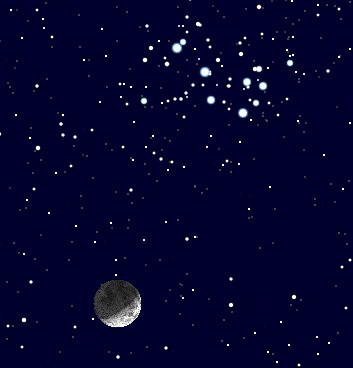
Pleiades and the moon 03/10/11, created using Cartes du Ciel.
Here’s a closer look at the moon courtesy of Virtual Moon Atlas.
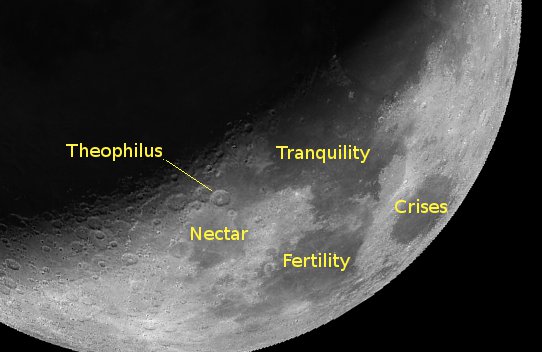
Young moon with the crater Theophilus and four seas. From Virtual Moon Atlas
03/09/11 – Ephemeris – Where are the bright planets this week?
Ash Wednesday March 9th. The sun will rise at 7:06. It’ll be up for 11 hours and 34 minutes, setting at 6:40. The moon, 3 days before first quarter, will set at 11:53 this evening.
It’s Wednesday and time again to take a look at the whereabouts of the bright planets for this week. Mercury is marginally visible low in the west in twilight setting at 7:37. The planet Jupiter is low in the western sky in the early evening twilight. It will set at 8:25 p.m. The ringed planet Saturn will rise at 8:47 p.m. in the east southeast and will move due south at 2:34 a.m. In telescopes Saturn shows its rings which are a year and a half along their seven and a half year opening. Also visible in a telescope is Saturn’s moon Titan. Wait a couple of hours after Saturn rises for the clearest images. Venus is brilliant in the morning sky and will rise at 5:29 a.m. in the east southeast. It is really a beautiful sight in the morning twilight.
* Times are for the Traverse City/Interlochen area of Michigan. They may be different for your location.
A preview of the coming northern lights season*
Here’s a link to the mlive.com web site for an article on how great northern Michigan is to view the Northern Lights or Aurora Borealis. Here’s the link to Best northern lights viewing in Michigan by Kim Schneider.
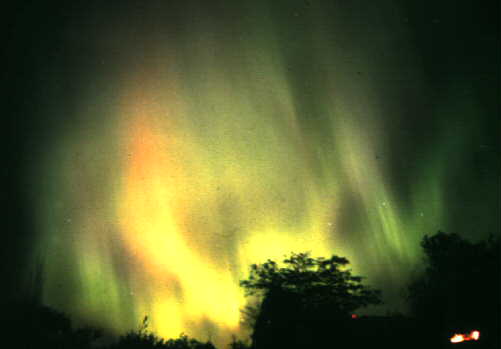
An auroral display. Credit Bob Moler.
* The “aurora season” or “northern lights season” coincides with the coming solar or sunspot peak which is expected to occur in 2013, and last several years.
Tip o’the dew cap to Pat Stinson.
 Bob Moler's Ephemeris Blog