Archive
03/08/11 – Ephemeris – The lunar sea of Crises
Fat Tuesday, March 8th. The sun will rise at 7:08. It’ll be up for 11 hours and 31 minutes, setting at 6:39. The moon, half way from new to first quarter, will set at 10:51 this evening.
The one feature that is prominent on the crescent moon tonight will be the dark sea Mare Crisium or sea of Crises. It appears easily in binoculars. It, as all the lunar seas, are really a large crater that was created about 3.85 billion years ago by an asteroid strike. It appears foreshortened because it’s near the moon’s limb. If you watched the proximity of Mare Crisium to the edge of the moon over time, you’d notice that sometimes it’s closer to the edge than at other times. The moon has a constant rotation, but its orbit isn’t circular, so the moon appears to rock back and forth slowly, and nods a bit too. The effect is called libration, and allows us to see 60% of the moon from earth.
* Times are for the Traverse City/Interlochen area of Michigan. They may be different for your location.
Blog Addendum:
Below is an image from Virtual Moon Atlas pointing out Mare Crisium, the Sea of Crises. VMA is a free program. See the links for free programs on this blog.
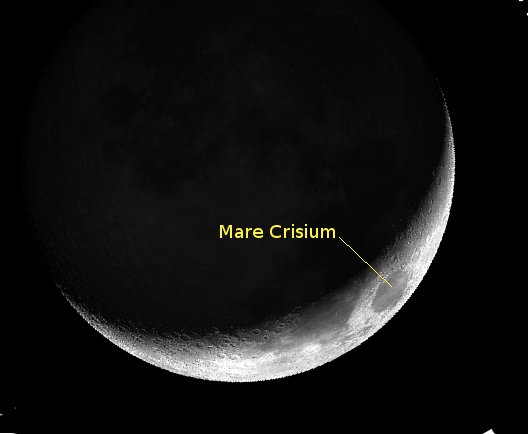
Mare Crisium via Virtual Moon Atlas
03/07/11 – Ephemeris – Earthshine
Monday, March 7th. The sun will rise at 7:09. It’ll be up for 11 hours and 28 minutes, setting at 6:37. The moon, 3 days past new, will set at 9:49 this evening.
The moon tonight will appear as a thin sliver, with not much visible on the thin illuminated portion. However if as you look at the moon tonight you have the funny feeling that the whole moon is visible, you are right. It’s easily confirmed with a pair of binoculars or a small telescope. What is illuminating the dark part of the moon is earthshine. The earth is big and bright in the moon’s sky, and nearly full from its vantage point. The effect used to be called by the term “Old moon in the new moon’s arms”. The effect was first explained by Leonardo DaVinci some 500 years ago. The effect will disappear in a few days as the moon gets brighter and the earth less so in the moon’s sky. Earthshine will appear again when the moon appears as a waning crescent in the morning.
* Times are for the Traverse City/Interlochen area of Michigan. They may be different for your location.
Update:
Earthshine is notoriously hard to photograph. Here’s one of mine from 1991. Part of a planetary conjunction picture with a short focal length telephoto lens. I’ve cropped out the planets. The sunlit side of the moon is vastly overexposed causing the blooming in the photograph.
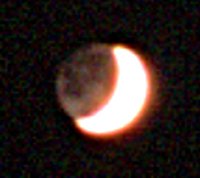
Earthshine on the crescent moon
Phil Plait has a great video of the STS133 Launch
From Phil Plait’s Bad Astronomy blog comes a great Video taken from several cameras on the solid rocket boosters (SRBs). The greatest sight for me was to see from the aft cameras the shuttle orbiter and the fuel tank depart after the SRB’s were jettisoned. Here’s a screen cap from the left aft SRB camera. Check out the entire video. There’s only one or two launches left.
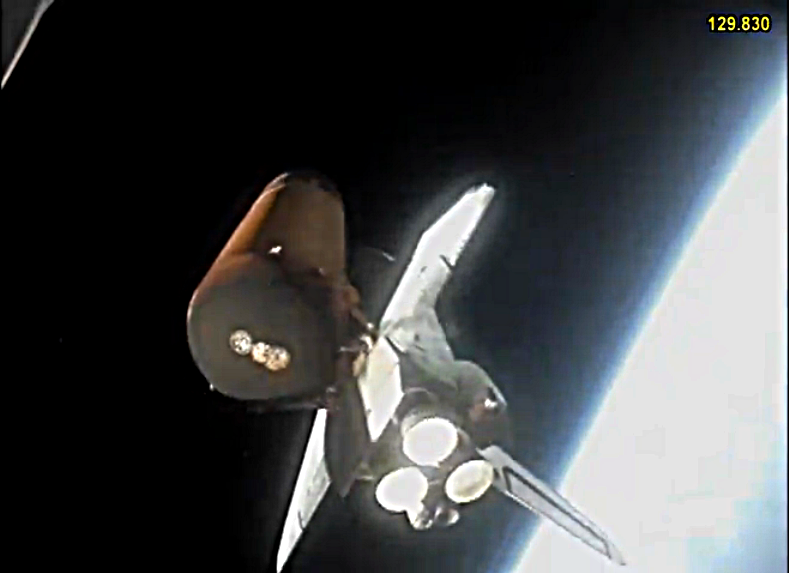
STS133 orbiter and fuel tank leaving the booster behind
Image credit NASA.
03/04/11 – Ephemeris – Local astronomy events in Traverse City
Friday, March 4th. The sun will rise at 7:15. It’ll be up for 11 hours and 18 minutes, setting at 6:33. The moon is new today, and won’t be visible.
A look at the forgotten planets Uranus and Neptune will be given by Chris Snyder of the Northwestern Michigan College Astronomical Association at this evening’s meeting of the Grand Traverse Astronomical Society at 8 p.m. at Northwestern Michigan College’s Rogers Observatory. These two planets were last closely studied by the Voyager 2 spacecraft in the 1980’s, though the Hubble space telescope and other telescopes have been keeping tabs on them. Tomorrow night both groups will host a public viewing night starting at 8 p.m. On tap will be the planet Jupiter early, and the Great Orion Nebula, a place where stars are even now forming, and a look at the rising planet Saturn later on. The observatory is located south of Traverse City on Birmley road between Garfield and Keystone roads.
* Times are for the Traverse City/Interlochen area of Michigan. They may be different for your location.
03/03/11 – Ephemeris – The constellation Cancer
Thursday, March 3rd. The sun will rise at 7:16. It’ll be up for 11 hours and 15 minutes, setting at 6:32. The moon, 1 day before new, will rise at 6:46 tomorrow morning.
At 9 this evening, the faint constellation, and member of the Zodiac, Cancer the crab will be located in the south southeast half way between the bright stars Castor and Pollux of the constellation Gemini, high in the south and the bright star Regulus in Leo the lion in the east. Cancer is very dim, looking like an upside-down Y. In the center of Cancer is a fuzzy spot to the unaided eye. In binoculars or a low power telescope this fuzzy spot becomes a cluster of stars. It is the Beehive cluster. At 577 light years away, it is one of the closest star clusters, but more distant than the Pleiades and Hyades the face of Taurus the bull. Of the three the Pleiades is the youngest at 100 million years The Beehive is 7 times older.
* Times are for the Traverse City/Interlochen area of Michigan. They may be different for your location.
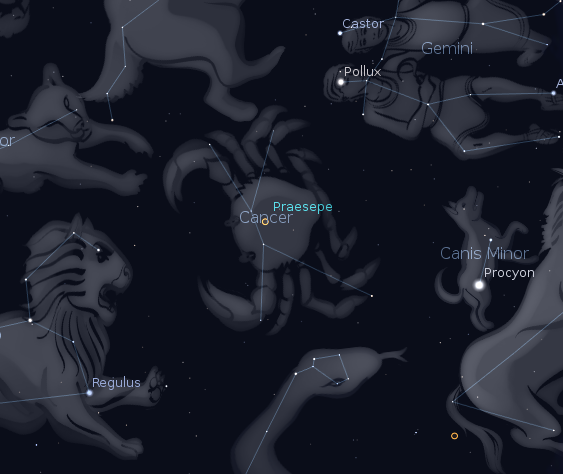
Cancer rising in the southeast
Created using Stellarium. Constellation art by Johan Meuris.
Praecepe is the old name for the Beehive star cluster possibly before the invention of the telescope. Praecepe means “Manger”. Below is the Beehive as seen in binoculars.
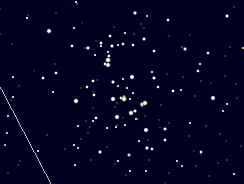
The Beehive star cluster (M44) as it would appear in binoculars.
Chart created using Cartes du Ciel.
03/02/11 – Ephemeris – The bright planets this week
Wednesday, March 2nd. The sun will rise at 7:18. It’ll be up for 11 hours and 12 minutes, setting at 6:31. The moon, 2 days before new, will rise at 6:25 tomorrow morning.
It’s Wednesday and time again to take a look at the whereabouts of the bright planets for this week. The planet Jupiter is low in the western sky in the early evening twilight. It will set at 8:44 p.m. The ringed planet Saturn will rise at 9:17 p.m. in the east southeast and will move due south at 3:03 a.m. In telescopes Saturn shows its rings which are a year and a half along their seven and a half year opening. Also visible in a telescope is Saturn’s moon Titan. Wait a couple of hours after Saturn rises for the clearest images. Venus is brilliant in the morning sky and will rise at 5:30 a.m. in the east southeast. It is really a beautiful sight in the morning twilight. Mercury is now too close to the direction of the sun to be seen, as is Mars which is now in the morning sky.
* Times are for the Traverse City/Interlochen area of Michigan. They may be different for your location.
03/01/11 – Ephemeris – The constellation Puppis
Tuesday, March 1st. The sun will rise at 7:20. It’ll be up for 11 hours and 9 minutes, setting at 6:29. The moon, 3 days before new, will rise at 6:01 tomorrow morning.
Located south and east of Canis Major, the great hunting dog of Orion and it brilliant star Sirius in the south is a dim constellation of Puppis, the poop deck of the old constellation Argo Navis, the constellation that depicts the ship Jason and the Argonauts used in their search for the Golden Fleece. This huge constellation has been subdivided. Only Puppis and Pyxis the ship’s compass are visible from Michigan. The rest of the ship are Carina the keel, and Vela the sail require traveling south at least to the southern United States. Three other constellations also related to this expedition are Gemini with Castor, who died on the expedition and Pollux. Hercules was also aboard and was the physician of the constellation Ophiuchus.
* Times are for the Traverse City/Interlochen area of Michigan. They may be different for your location.
Update:
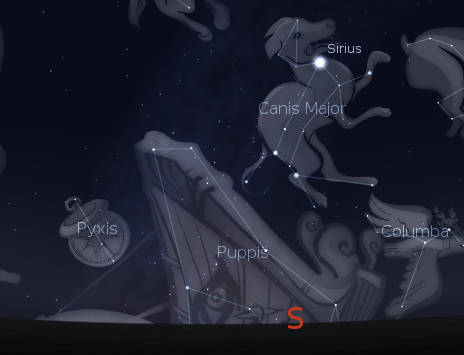
The constellation Puppis the poop deck of the good ship Argo
Above, Puppis from northern Michigan.
Below, the entire ship Argo, the old constellation Argo Navis. It contains the modern constellations Puppis, the poop deck, Pyxis the compass, Vela the sail, and Carina the keel.
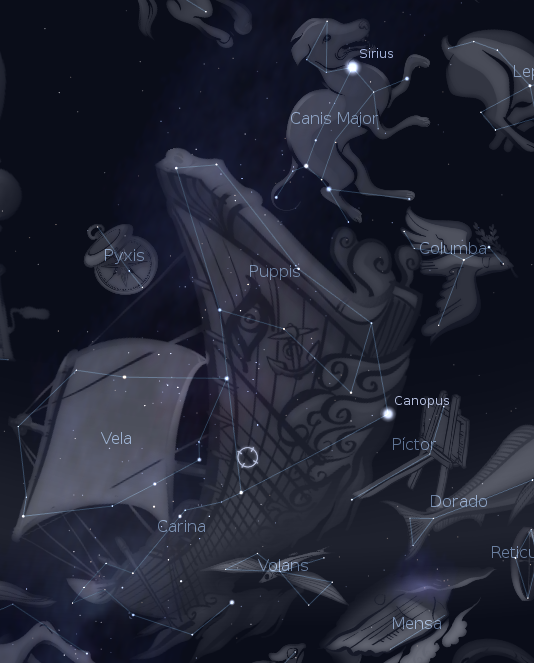
The old constellation Argo Navis
These images were created using Stellarium. Constellation art by Johan Meuris.
 Bob Moler's Ephemeris Blog