Archive
09/16/11 – Ephemeris – Astronomical observing events this weekend in northern Michigan
Friday, September 16th. The sun will rise at 7:22. It’ll be up for 12 hours and 29 minutes, setting at 7:51. The moon, half way from full to last quarter, will rise at 9:27 this evening.
This evening the Grand Traverse Astronomical Society will host a viewing night at Northwestern Michigan College’s Rogers Observatory starting at 9 p.m. The featured objects of the evening will be the planet Jupiter and the moon. Jupiter is the largest planet and has 65 satellites, of which the four discovered by Galileo are large enough to be easily seen. Three of these are larger than our moon. The observatory is located south of Traverse City, on Birmley Road between Garfield and Keystone roads. Also this weekend, tomorrow members of the society will bring their telescopes to the Leland Heritage Celebration to safely view the sun, which has recently become vary active. Times for this event are 10 a.m to 3 p.m.
* Times are for the Traverse City/Interlochen area of Michigan. They may be different for your location.
09/15/11 – Ephemeris – The waning gibbous moon tonight
Thursday, September 15th. The sun will rise at 7:21. It’ll be up for 12 hours and 32 minutes, setting at 7:53. The moon, 3 days past full, will rise at 8:56 this evening.
I don’t usually talk about the moon after it becomes full, but because of the harvest moon effect its still rises early. The moon’s phase is now a waning gibbous, with the sunset line now crossing the moon from right to left. Visible are the dark seas including to the upper right the scallop shell shaped Sea of Serenity. In telescopes at its right edge will be the crater Posidonus a flat crater, 58 miles in diameter, with low walls with an inner partial crater ring within. Larger telescopes may be able to see cracks or rilles in its floor. The sea south of Serenity is Tranquility where Apollo 11 landed and by tomorrow night the sun will nearly have set there as well as having encroached on Serenity
* Times are for the Traverse City/Interlochen area of Michigan. They may be different for your location.
Addendum
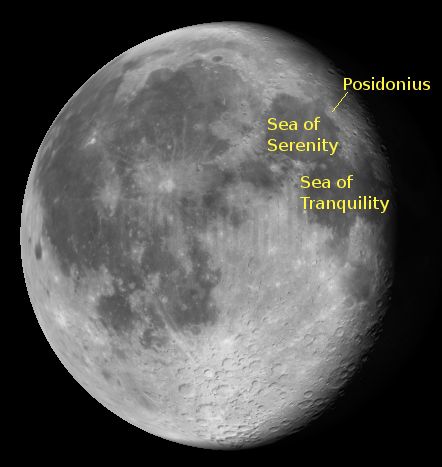
The moon 9/15/11 10 p.m. Created using Virtual Moon Atlas.
09/14/11 – Ephemeris – The bright planets visible this week
Wednesday, September 14th. The sun will rise at 7:19. It’ll be up for 12 hours and 35 minutes, setting at 7:55. The moon, 2 days past full, will rise at 8:29 this evening.
It’s Wednesday and time again to take a look at the whereabouts of the bright planets. The planet Venus is rather close to the sun in the evening setting 23 minutes after the sun and not really visible. The ringed planet Saturn is not really visible in the west in evening twilight. It will set 45 minutes after the sun. Jupiter is now the prominent planet of the evening sky after it rises at 9:41 p.m. in the east northeast and is seen against the stars of the constellation Aries now. It will be accompanied by its 4 brightest moons. Mars will rise at 2:31 a.m also in the east northeast and is now between the constellation Gemini and Cancer. Mercury is briefly visible now from about half an hour after its rising in the east at 6:17 until about 7 a.m.
* Times are for the Traverse City/Interlochen area of Michigan. They may be different for your location.
09/13/11 – Ephemeris – Supernova in the Pinwheel Galaxy
Tuesday, September 13th. The sun will rise at 7:18. It’ll be up for 12 hours and 38 minutes, setting at 7:57. The moon, 1 day past full, will rise at 8:05 this evening.
There is currently a supernova in a galaxy near the handle of the Big Dipper. The bright moon is interfering with its visibility in telescopes. It’s in a galaxy called M101 or the Pinwheel galaxy, a difficult to spot galaxy between and above the two end stars of the handle of the Big Dipper. The galaxy is 21 million light years away, relatively close as galaxies go. It is being intensely studied because it is of a type, 1a, that is used for distance measurements of far more distance galaxies. This kind of Supernova is thought to be the destruction of a white dwarf star in a close binary relation with a more massive star and is drawing matter off the larger star. When the dwarf reaches 1.38 times the sun’s mass… Kablooey! Astronomers are trying to see if that’s true for this star.
* Times are for the Traverse City/Interlochen area of Michigan. They may be different for your location.
09/12/11 – Ephemeris – Harvest Moon tonight
Monday, September 12th. The sun will rise at 7:17. It’ll be up for 12 hours and 41 minutes, setting at 7:59. The moon, at full today, will rise at 7:43 this evening.
Today’s full moon is the famous Harvest Moon, the nearest full moon to the autumnal equinox. This is a time of the full and waning gibbous moons in the next few days rising in twilight. In the old days before electric lights it helped farmers by effectively lengthening the hours of light to gather in the crops. The moon on average rises 50 minutes later each night. The interval between tonight’s moonrise and tomorrow’s will be 22 minutes. The interval between Tuesday and Wednesday will be 24 minutes, between Wednesday and Thursday, 27 minutes. The instant of full moon today is actually past, at 5:26 this morning. The fact that the rising moon appears orange has nothing to do with the Harvest Moon. Like the sun, it’s always orange or red near the horizon.
* Times are for the Traverse City/Interlochen area of Michigan. They may be different for your location.
09/09/11 – Ephemeris – Star party Saturday September 10th, 2011 at the Sleeping Bear Dunes
Friday, September 9th. The sun will rise at 7:14. It’ll be up for 12 hours and 50 minutes, setting at 8:04. The moon, 3 days before full, will set at 5:32 tomorrow morning.
Tomorrow is the Grand Traverse Astronomical Society’s 4th star party of 2011 at the Sleeping Bear Dunes National Lakeshore. This time we’ll be at the Dune Climb. The bottom, not the top, in or near the parking lot. We’ll have the bright moon early. We’ll be also looking at binary stars, star clusters and the Ring Nebula. Toward the end of the evening Jupiter will be high enough to view. The event will be canceled if it’s too cloudy. There will be another star party, this one to celebrate the Lakeshore’s 41st anniversary in October, so stay tuned for that one. So far we’ve had no outright cancellations, but two of the nights were hampered by clouds. Our one absolutely clear night cleared just after sunset, and after an earlier rain shower.
* Times are for the Traverse City/Interlochen area of Michigan. They may be different for your location.
09/08/11 – Ephemeris – The moon tonight
Thursday, September 8th. The sun will rise at 7:12. It’ll be up for 12 hours and 53 minutes, setting at 8:06. The moon, half way from first quarter to full, will set at 4:28 tomorrow morning.
The moon tonight is very bright, so looking at it with a telescope can be almost painful. There are moon filters sold at telescope stores for standard sized eyepieces that will alleviate that problem. Remember it’s daytime on the moon and the sunlight is as strong on the moon as it is on the earth. Concentrate the telescope on the left edge of the moon, the sunrise line where the shadows are. The bright crater Aristarchus is just coming into sunlight now on the upper left. It’s the brightest spot on the moon when the moon is full. The Crater Gassendi to the lower left is a ringed plain with low walls and a flat floor that has a rille or crack in it. Another distinctive crater is Schiller lower to the south and distinctively elongated.
* Times are for the Traverse City/Interlochen area of Michigan. They may be different for your location.
Addendum
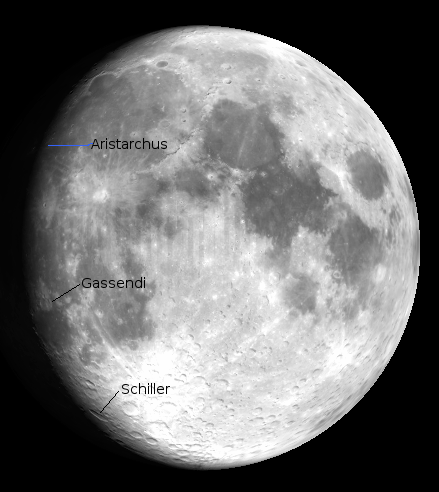
The moon with craters Aristarchus, Gassendi and Schiller. Image from Virtual Moon Atlas.
Closeup of the crater Gassendi
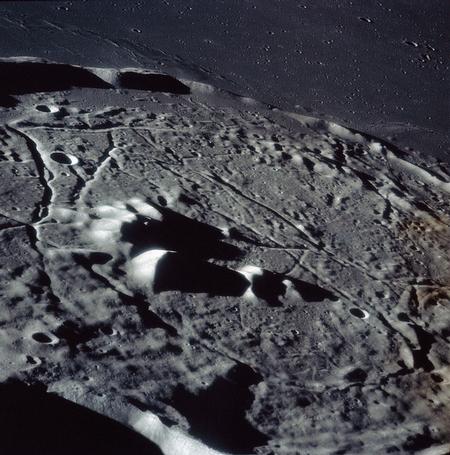
The crater Gassendi from Apollo 16 - NASA
09/07/11 – Ephemeris – The bright planets visible this week
Wednesday, September 7th. The sun will rise at 7:11. It’ll be up for 12 hours and 56 minutes, setting at 8:08. The moon, 3 days past first quarter, will set at 3:23 tomorrow morning.
It’s Wednesday and time again to take a look at the whereabouts of the bright planets. The ringed planet Saturn will be barely visible in the west southwest in evening twilight. It’s near the bright star Spica to its left. Spica has a blue tinge, while Saturn is yellowish. It will set at 9:25 p.m. Because we are seeing Saturn in evening twilight now its image is being deteriorated by the earth’s atmosphere being low in the sky. Jupiter will rise at 10:10 p.m. in the east northeast and is seen against the stars of the constellation Aries now. Mars will rise at 2:36 a.m also in the east northeast and is now passing through the constellation Gemini the twins. Mercury is briefly visible now from about half an hour after its rising in the east at 5:43 until about 20 minutes before sunrise.
* Times are for the Traverse City/Interlochen area of Michigan. They may be different for your location.
09/06/11 – Ephemeris – Comet Elenin self-destructs
Tuesday, September 6th. The sun will rise at 7:10. It’ll be up for 12 hours and 59 minutes, setting at 8:10. The moon, 2 days past first quarter, will set at 2:17 tomorrow morning.
When Comet Elenin was discovered by Russian astronomer Leonid Elenin using a remotely controlled telescope in New Mexico on December 10th of last year, it was hoped that it would become a bright comet in our skies next month. It would pass between the earth and the sun this month and move ahead of the earth to be briefly a bright comet in the morning sky. Last week astronomers from the southern hemisphere saw its nucleus suddenly elongate and the comet dropped in brightness. It appears that the small solid part of the comet is breaking up. Comets do this on occasion. About 10 years ago or so one of the many Comet Linears simply exploded sending out hundreds of pieces of its nucleus, which evaporated and disappeared.
* Times are for the Traverse City/Interlochen area of Michigan. They may be different for your location.
09/05/11 – Ephemeris – Mercury is visible in the morning
Labor Day, Monday, September 5th. The sun will rise at 7:09. It’ll be up for 13 hours and 2 minutes, setting at 8:12. The moon, 1 day past first quarter, will set at 1:13 tomorrow morning.
The planet Mercury is now very low in the eastern sky before sunrise. This tiny planet was at its greatest apparent distance from the sun yesterday. Astronomers call it greatest elongation and its separation from the sun was an 18 degree angle. Mercury will be very close to the east northeast horizon in the 6:30 a.m. twilight. Once found, you can probably follow it for the next 20 minutes or so. Mercury will be visible for the next week of so. The cool thing is that it will become brighter. It’s illuminated by the sun, and as it moves away from us around the sun its phase or illuminated portion from our vantage point becomes larger. Currently Mercury is being studied up close by the MESSENGER spacecraft now orbiting it.
* Times are for the Traverse City/Interlochen area of Michigan. They may be different for your location.
Addendum
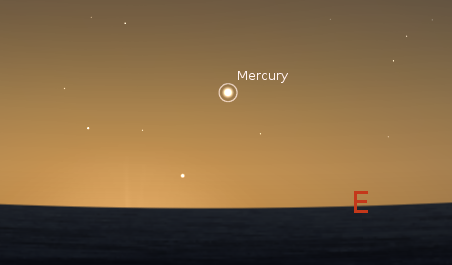
Mercury in the morning in early September 2011. Chrat created using Stellarium.
 Bob Moler's Ephemeris Blog