Archive
08/17/2012 – Ephemeris – The constellation Aquila the eagle
Ephemeris for Friday, August 17th. The sun rises at 6:47. It’ll be up for 13 hours and 56 minutes, setting at 8:43. The moon is new today, and won’t be visible.
Aquila the eagle is a constellation that lies in the Milky Way. It’s in the southeastern sky as it gets dark. Its brightest star, Altair is one of the stars of the Summer Triangle, a group of three bright stars seen now in the eastern sky in the evening. Altair, in the head of the eagle, is flanked by two slightly dimmer stars, the shoulders of the eagle. The eagle is flying northeastward through the Milky Way. Its wings are seen in the wing tip stars. A curved group of stars to the lower right of Altair is its tail. Within Aquila the Milky Way shows many dark clouds as part of the Great Rift that splits it here. The other summer bird is Cygnus the swan, which I talked about earlier this year, above and left of Aquila, flying in the opposite direction.
Times are for the Traverse City/Interlochen area of Michigan. They may be different for your location.
Addendum
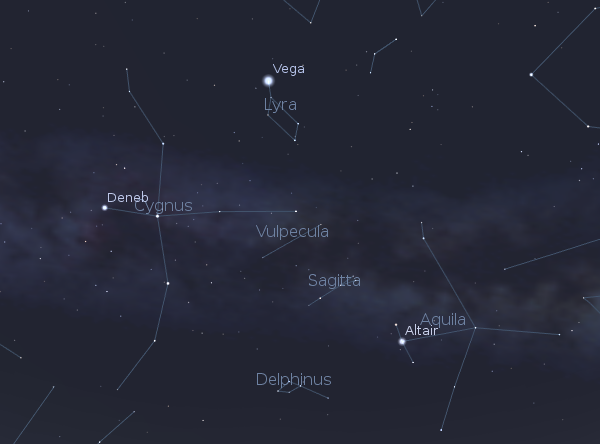
The constellations Lyra, Cygnus and Aquila. Created using Stellarium.
08/16/2012 – Ephemeris – The constellation of Scutum
Ephemeris for Thursday, August 16th. The sun rises at 6:46. It’ll be up for 13 hours and 58 minutes, setting at 8:45. The moon, 1 day before new, will rise at 6:53 tomorrow morning. | In the evening sky, in the south after it gets dark can be seen part of the Milky Way. There is actually a constellation here located between Sagittarius the archer, which really looks like a teapot, below and Aquila the eagle above. It’s Scutum the shield of John Sobieski the Polish king who stopped the advance of the Turks at Kalenberg in 1683. Scutum is the only official constellation I know of which is related to a real person. The Polish half of me is very proud. However the stars here are so dim and embedded in the glow of the Milky Way as to be nearly impossible to discern. Scutum lies in one of the richest portions of the Milky Way, wonderful to scan with binoculars and telescopes for star clusters and nebulae or clouds of dust and gas.
Times are for the Traverse City/Interlochen area of Michigan. They may be different for your location.
Addendum
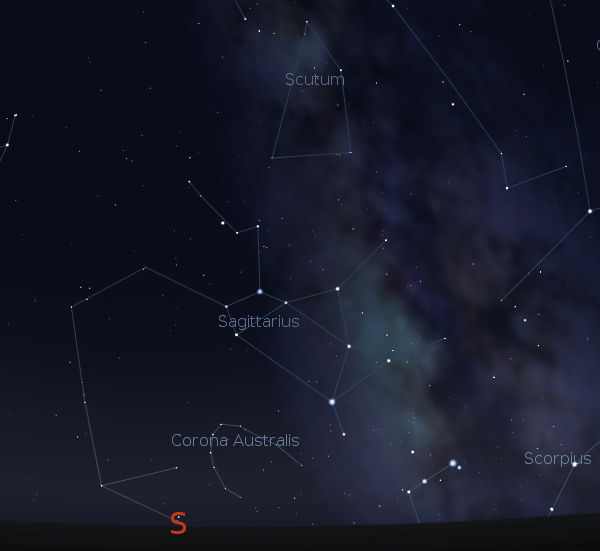
The constellations Sagittarius and Scutum. Created using Stellarium.
08/15/2012 – Ephemeris – Where are the bright planets this week
Ephemeris for Wednesday, August 15th. The sun rises at 6:45. It’ll be up for 14 hours and 1 minute, setting at 8:47. The moon, 2 days before new, will rise at 5:45 tomorrow morning.
Let’s see what’s happening with the bright planets for this week. Mars Saturn and the star Spica make a bright skinny triangle in the west southwest after sunset. Mars is in the middle between Saturn on the top and Spica. They are located in the constellation Virgo the virgin. Mars will be setting in the west at 10:59 p.m. Saturn will set at 11:12. The triangle is going to fatten up over the next week as Mars heads eastward. The morning sky features the two brightest planets: Jupiter, which will rise at 1:12 a.m. in the east northeast and Venus, which will rise at 3:08 also in the east northeast. The bright star Aldebaran in Taurus the bull will appear just to the lower right of Jupiter tomorrow morning, but Venus will be at greatest elongation from the sun.
Times are for the Traverse City/Interlochen area of Michigan. They may be different for your location.
Addendum
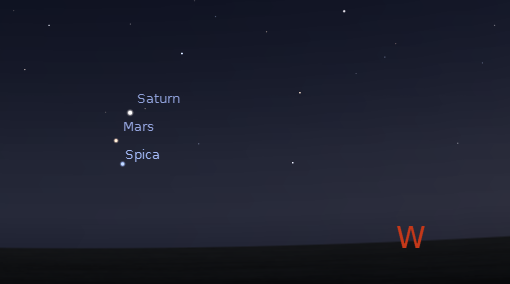
Looking west at 10 p.m. on August 15, 2012. Created using Stellarium.
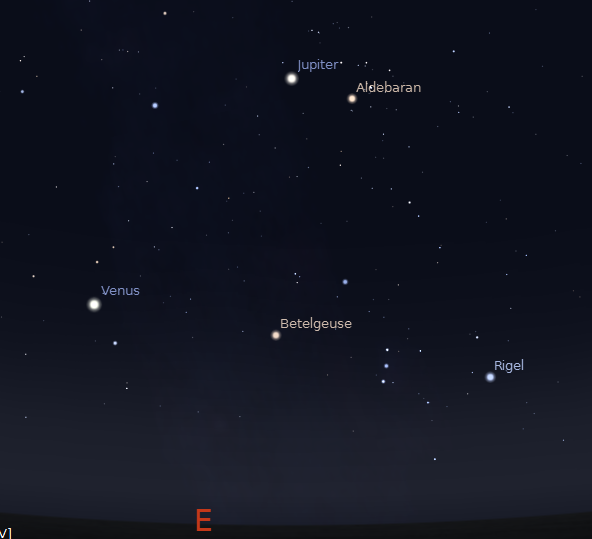
Looking east at 5 a.m. August 16, 2012. Created using Stellarium.
08/14/2012 – Ephemeris – The asterism of the Teapot (Sagittarius)
Ephemeris for Tuesday, August 14th. The sun rises at 6:44. It’ll be up for 14 hours and 4 minutes, setting at 8:48. The moon, 3 days before new, will rise at 4:40 tomorrow morning. | If the ancient Greeks had teapots the constellation we call Sagittarius might have been Teapotius or something. It’s low in the south at 11 p.m. with the Milky Way rising like steam from its spout. Sagittarius is supposed to be a centaur with a bow and arrow. However to us the dearth of centaurs around outside of Harry Potter movies, and lots of teapots, and that great children’s song that perfectly describes the Sagittarius teapot that’s what we imagine. So the teapot is an asterism, like the Big Dipper, not one of the official constellations. A pair of binoculars is all you need to spot many fuzzy objects in and around Sagittarius. Pay special attention to that steam of the Milky way above the teapot’s spout for many fuzzy objects.
Times are for the Traverse City/Interlochen area of Michigan. They may be different for your location.
Addendum
The constellations Sagittarius and Scutum. Created using Stellarium.
08/13/2012 – Ephemeris – Saturn, Mars and Spica line up
Ephemeris for Monday, August 13th. The sun rises at 6:43. It’ll be up for 14 hours and 7 minutes, setting at 8:50. The moon, half way from last quarter to new, will rise at 3:38 tomorrow morning.
This evening the triangle of the planets Mars and Saturn plus the star Spica has momentarily disappeared. They are, this evening only, practically in a straight line. Mars has moved to be between Saturn and Spica. The reason Mars moves so fast and Saturn has been hanging around Spica all year is that Mars is closer to the sun, so it moves faster. It takes a bit less than two or our years to orbit the sun. Saturn takes nearly 30 years to do the same. Saturn averages 9.5 times the earth’s distance from the sun. While Mars averages one and a half times the earth’s distance. Mars will hang on in the western sky for a few more months, getting dimmer as it moves around behind the sun. Saturn and Spica will soon be lost in twilight.
Times are for the Traverse City/Interlochen area of Michigan. They may be different for your location.
Addendum
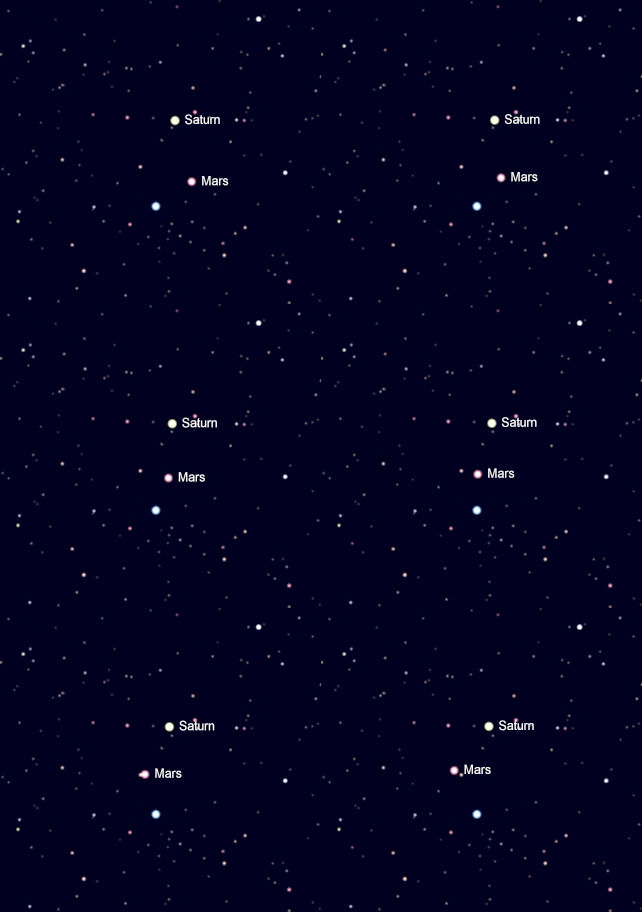
The trio of Mars, Saturn and the star Spica from August 11th through the 18th. Created using Cartes du Ciel (Sky Charts)
08/10/2012 – Ephemeris – Weekend Meteor Watches
Ephemeris for Friday, August 10th. The sun rises at 6:39. It’ll be up for 14 hours and 15 minutes, setting at 8:54. The moon, 1 day past last quarter, will rise at 1:04 tomorrow morning.
There are two events this weekend to view the heavens and the Perseid meteor showers. First, part of the Port Oneida Fair the Grand Traverse Astronomical Society will work with the rangers of the Sleeping Bear Dunes National Lakeshore to hold a star party and meteor watch at Thoreson Farm on South Thoreson Road of M22, a couple miles north of Glen Arbor. That will start at 9 p.m. It will be about 10:30 when it’ll be dark enough spot the meteors. Sunday evening there’s a Meteors and S’mores event at the Leelanau State Park, at the tip of the Leelanau Peninsula. That event starts at 10:30 p.m. The society will participate there also. The moon won’t interfere with the meteor shower It’s been banished into the morning sky.
Times are for the Traverse City/Interlochen area of Michigan. They may be different for your location.
08/09/2012 – Ephemeris – Viewing the Perseid meteor shower
Ephemeris for Thursday, August 9th. The sun rises at 6:38. It’ll be up for 14 hours and 17 minutes, setting at 8:56. The moon, at last quarter today, will rise at 12:24 tomorrow morning.
Lets take a look at what will happen this weekend with the Perseid meteor shower. We seem to have two meteoroid streams intercepting the earths. The earth will pass through the classic stream Saturday night, Sunday morning. The earth is expected to pass through a second stream Sunday Night, Monday morning. In the early evening the meteors are fewer, but the trails will be longer. The meteors will seem to come from the constellation of Perseus which lies below the W shaped constellation of Cassiopeia in the northeast. At two or three in the morning will see the greatest numbers of meteors, up to 60 meteors an hour. Tomorrow I’ll tell you about two events and places to go to join others in viewing the shower.
Times are for the Traverse City/Interlochen area of Michigan. They may be different for your location.
Addendum
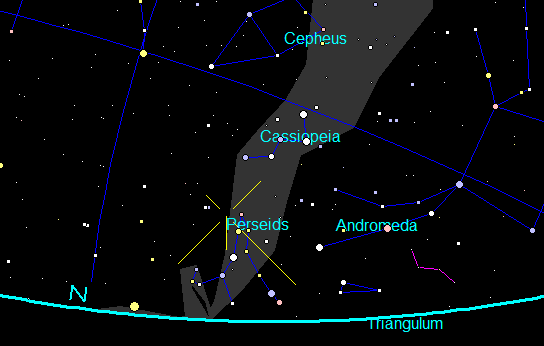
Perseid radiant at 10:30 p.m.
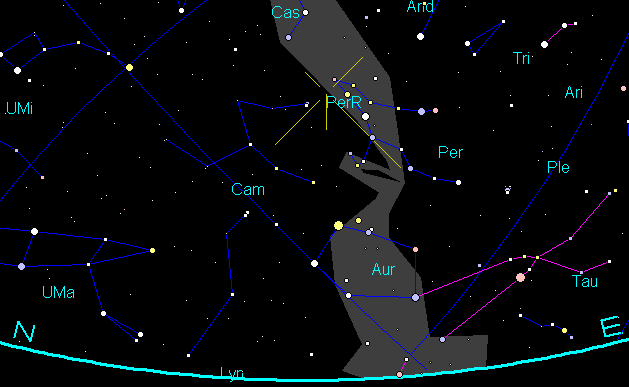
Perseid Meteor Shower radiant after midnight
08/08/2012 – Ephemeris – Where are the bright planets this week?
Ephemeris for Wednesday, August 8th. The sun rises at 6:37. It’ll be up for 14 hours and 20 minutes, setting at 8:57. The moon, 1 day before last quarter, will rise at 11:50 this evening.
Let’s see what’s happening with the bright planets for this week. Mars Saturn and the star Spica make a bright triangle in the west southwest after sunset. Mars is on the lower right and Saturn is the topmost of the three. They are located in the constellation Virgo the virgin. Mars will be setting in the west at 11:17 p.m. Saturn will set at 11:39. Next Monday Mars will pass between Saturn and Spica. The morning sky features the two brightest planets: Jupiter, which will rise at 1:32 in the east northeast and Venus, which will rise at 3:09 also in the east northeast. The bright star Aldebaran in Taurus the bull will appear just to the lower right of Jupiter tomorrow morning, but Venus will have dropped farther below Jupiter, as it stays near the sun.
Times are for the Traverse City/Interlochen area of Michigan. They may be different for your location.
Addendum
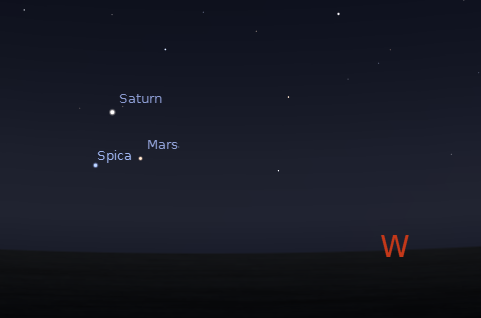
Looking west at 10:30 p.m. on August 8, 2012. Created using Stellarium.
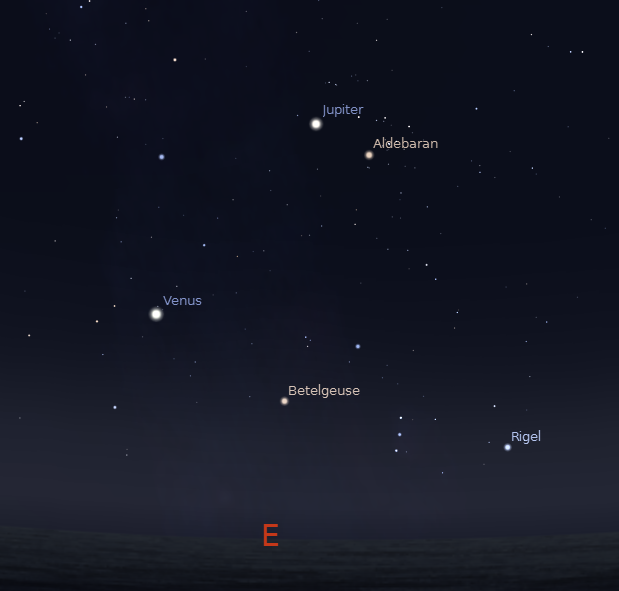
Looking eastward at 5 a.m. on August 9, 2012. Orion is also rising along with Jupiter and Venus. Created using Stellarium.
The trio of Mars, Saturn and the star Spica from August 11th through the 18th. Created using Cartes du Ciel (Sky Charts)
08/07/2012 – Ephemeris – the comet responsible for the Perseid meteor shower
Ephemeris for Tuesday, August 7th. The sun rises at 6:36. It’ll be up for 14 hours and 22 minutes, setting at 8:59. The moon, 2 days before last quarter, will rise at 11:20 this evening.
The Perseid meteor shower is so named because the meteors seem to come from the direction of the constellation of Perseus which starts in the evening low in the northeast and rotates up throughout the night higher and higher. The comet responsible is Comet Swift-Tuttle, discovered in 1862 by Lewis Swift and Horace Tuttle. The comet has a 130 year orbit and returned in 1992. It’s orbit intersects ours at a 113 degree angle, which is why the radiant point is so far north. The Perseids have been recorded for 2,000 years so the comet has been around much longer than that. It’s nucleus is 17 miles in diameter, about twice that of Halley’s Comet. While Comet Swift-Tuttle won’t be back this century, we can see bits of it tonight.
Times are for the Traverse City/Interlochen area of Michigan. They may be different for your location.
08/06/2012 – Ephemeris – The Perseid Meteor Shower this weekend
Aug 6. This is Bob Moler with Ephemeris for Monday, August 6th. The sun rises at 6:35. It’ll be up for 14 hours and 25 minutes, setting at 9:00. The moon, 3 days before last quarter, will rise at 10:52 this evening.
Saturday night through Sunday morning will be the period of the maximum number of meteors in the Perseid meteor shower. There are many meteor showers but a few very active ones. Of these the Perseids are the most famous. Meteor showers occur the same dates during the year because meteoroid streams are debris left near the orbits of comets. If a comet passes near the earth’s orbit the debris it sheds when close to the sun will end up in orbits similar to the comet and when the earth passes the spot we experience a meteor shower. Thus in late July through mid August we pass through the meteoroid stream of debris of Comet Swift-Tuttle, whose sand to pea sized particles hit the atmosphere at 40 miles per second providing us a celestial show.
Times are for the Traverse City/Interlochen area of Michigan. They may be different for your location.
 Bob Moler's Ephemeris Blog