Archive
02/28/2013 – Ephemeris – Previewing March Skies
Ephemeris for Thursday, February 28th. The sun will rise at 7:21. It’ll be up for 11 hours and 8 minutes, setting at 6:29. The moon, 3 days past full, will rise at 10:06 this evening.
Let’s preview the month of March which begins tomorrow. This month the increase in daylight hours is at its greatest, with Spring 3 weeks away. Daylight hours will increase from 11 hours and 11 minutes tomorrow to 12 hours and 44 minutes on the 31st. Along with that the altitude of the sun at noon will increase from 38 degrees today to 49 ½ degrees at month’s end. Local noon, by the way for Interlochen and Traverse City is about 12:50 p.m, which is mainly due to the fact that our standard time meridian happens to run through Philadelphia. That’s before daylight time starts next week. The big astronomical event this month be the appearance of Comet PanSTARRS in the evening. Spring starts on the 20th.
Times are for the Traverse City/Interlochen area of Michigan. They may be different for your location.
Addendum
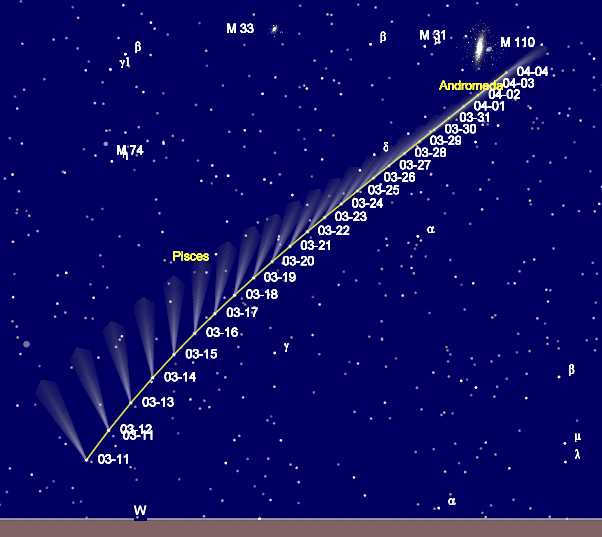
Comet PanSTARRS path in the March evening sky. Created using Cartes duCiel.
Cartesn duCiel doesn’t do twilight. The comet will be in twilight through out March.
02/27/2013 – Ephemeris – Where are the bright planets this week?
Ephemeris for Wednesday, February 27th. The sun will rise at 7:22. It’ll be up for 11 hours and 5 minutes, setting at 6:27. The moon, 2 days past full, will rise at 8:56 this evening.
It’s time to check out the planets for this week. Jupiter is located in the constellation of Taurus and moves from the high south to the southwest during the evening. It will transit or pass due south near sunset, and will itself set at 2:07 a.m. Jupiter is a wonderful sight in telescopes with its cloud bands and its moons which change positions each night. Saturn will be the next planet to rise at 11:39 p.m. in the east southeast. It’s located in eastern Virgo. Saturn will pass due south at 4:49 a.m. Saturn is the most beautiful of planets when seen in a telescope with its fabulous rings, now opened wide.. One’s first impression is how small it is. It is the second largest planet, but it’s almost 900 million miles away.
Times are for the Traverse City/Interlochen area of Michigan. They may be different for your location.
Addendum
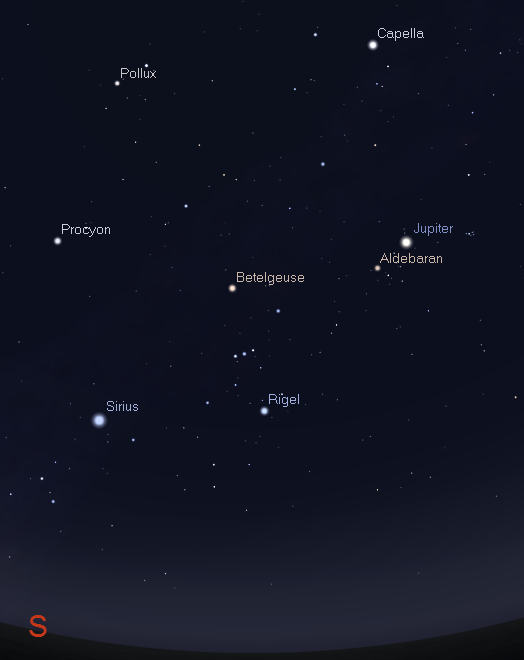
Jupiter and the winter stars in the south southwest at 9 p.m. on February 27, 2013. Created using Stellarium.
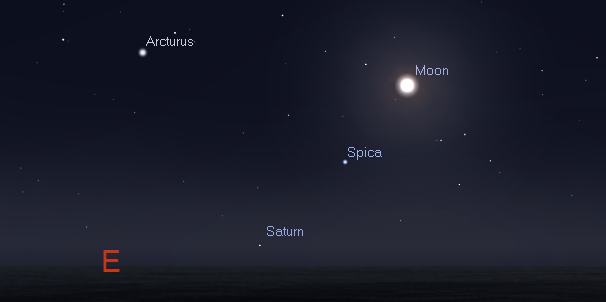
Saturn rising at midnight (0h) February 28, 2013. Created using Stellarium.
02/26/2013 – Ephemeris – Light: Is it particles or waves, or is it both?
Ephemeris for Tuesday, February 26th. The sun will rise at 7:24. It’ll be up for 11 hours and 2 minutes, setting at 6:26. The moon, 1 day past full, will rise at 7:47 this evening.
Yesterday I talked about light in terms of waves and wavelengths. Light has a dual identity because I also acts like particles. They’re called photons. The shorter the wavelength the more energy the photon has. Light’s wave property explains how light is bent when it passes through a lens, and why stars in telescopes have diffraction rings and spikes. However CCD cameras and other light detection devices work because light also is particles. Some are sensitive enough to count photons one at a time. What’s even crazier is that particles like electrons also behave like waves. This is quantum mechanics, the physics of the nano world. Astrophysicists, what professional astronomers really are, work with the micro and the macro universe.
Times are for the Traverse City/Interlochen area of Michigan. They may be different for your location.
Addendum
The proof of the pudding, quantum pudding that is, is the famous double slit experiment. There’s a nice animated video on YouTube featuring “Dr. Quantum” to blow your mind about electrons acting like waves. Click here.
02/25/2013 – Ephemeris – Electromagnetic spectrum
Ephemeris for Monday, February 25th. The sun will rise at 7:26. It’ll be up for 10 hours and 58 minutes, setting at 6:25. The moon, at full today, will rise at 6:40 this evening.
With the moon so bright I’ve been talking about light our last couple of programs. When I talk about light I’m talking about electromagnetic radiation, its whole spectrum, not the single octave of frequencies that we perceive as visible light. On the long end is radio waves, like those you are hearing me now by, microwaves of radar and those microwave ovens. Then there’s infrared we sense as heat on our skin, and then visible light. Shorter wavelengths and higher frequencies we have ultraviolet, x-rays and finally gamma rays. The final three are harmful to us and our atmosphere generally protects us from it. Astronomers have learned to observe the universe in all those wavelengths. And found a universe that is quite amazing and dangerous.
Times are for the Traverse City/Interlochen area of Michigan. They may be different for your location.
Addendum
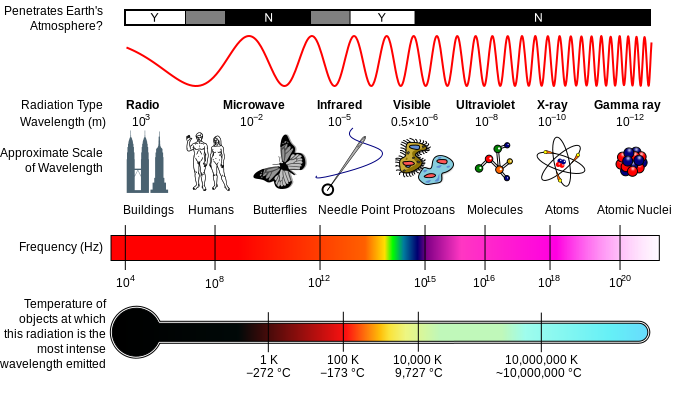
Electromagnetic Spectrum. Credit: Inductiveload, NASA.
02/22/2013 – Ephemeris – Speed of light: hinderance and help
Ephemeris for Friday, February 22nd. The sun will rise at 7:31. It’ll be up for 10 hours and 49 minutes, setting at 6:21. The moon, 3 days before full, will set at 5:55 tomorrow morning.
Yesterday I talked about the invariability of the speed of light in a vacuum. This would seem to put interstellar travel on the list of things that can’t be done. Apparently General Relativity has ways of getting around. I’ll leave that to smarter people to explain. But one cool thing about the speed of light is that it allows us to see into the distant past. The farther the object is away the farther back in time we can see it. With the Hubble Space Telescope in its Deep Field images of galaxies can see back to within perhaps a billion years of the Big Bang, at least for a few galaxies. The James Webb space telescope to be launched later this decade will explore, among other things more deeply into this unknown time to see how these galaxies formed.
Times are for the Traverse City/Interlochen area of Michigan. They may be different for your location.
02/21/2013 – Ephemeris – Speed of light
Ephemeris for Thursday, February 21st. The sun will rise at 7:32. It’ll be up for 10 hours and 46 minutes, setting at 6:19. The moon, half way from first quarter to full, will set at 5:21 tomorrow morning.
The speed of light at 186,000 miles a second or 300,000 kilometers a second. It is the ultimate speed limit in the universe. nothing with mass can match is speed. But particles without mass, like photons, travel at that speed in a vacuum naturally. That speed of light in a vacuum was a constant was postulated by Albert Einstein and was the central part of his Special Theory of Relativity published in 1905. In physics the lower case letter c represents the speed of light in a vacuum. And its figures in Einsteins most famous equation, which actually wasn’t part of special relativity: e=mc2. The equation that changed the world for good or ill. Science itself is nether good nor bad. It’s how that knowledge is applied.
Times are for the Traverse City/Interlochen area of Michigan. They may be different for your location.
02/20/2013 – Ephemeris – Where are the bright planets this week?
Ephemeris for Wednesday, February 20th. The sun will rise at 7:34. It’ll be up for 10 hours and 43 minutes, setting at 6:18. The moon, 3 days past first quarter, will set at 4:43 tomorrow morning.
Let’s check out the planets for this week. Mercury can still be seen low in the west southwest. It will set at 7:50. This is a good apparition of Mercury for us in the northern hemisphere. Binoculars will help you locate it low in the sky. Jupiter is located in the constellation of Taurus and moves from the high south to the southwest during the evening. It will transit or pass due south at 6:59 p.m, and will set at 2:31 a.m. Jupiter is a wonderful sight in telescopes with its cloud bands and its moons which change positions each night. Saturn will be the next planet to rise at 12:07 a.m. in the east southeast. It’s located in eastern Virgo. Saturn will pass due south at 5:17 a.m. It will rise before midnight in a couple of days.
Times are for the Traverse City/Interlochen area of Michigan. They may be different for your location.
Addendum
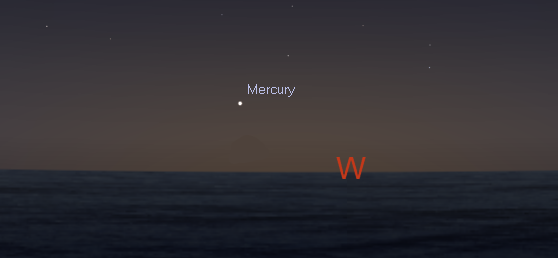
Mercury low on the western horizon at 7:15 p.m. on February 20, 2013. Created using Stellarium 0.12.0.
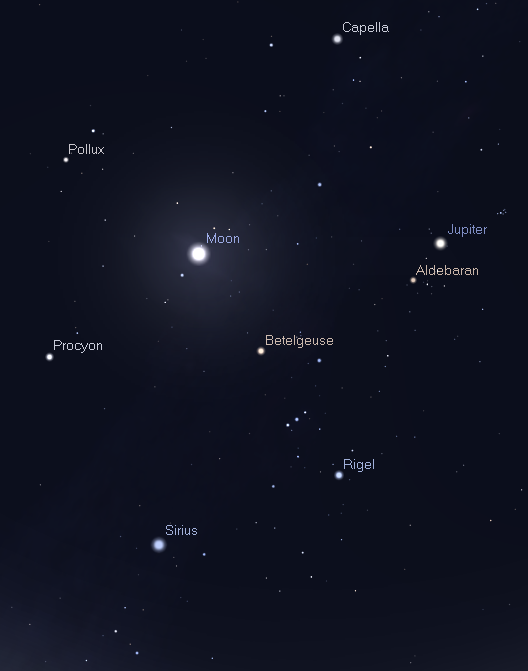
Jupiter and the stars of winter at 9 p.m. on February 20, 2013. Created using Stellarium 0.12.0
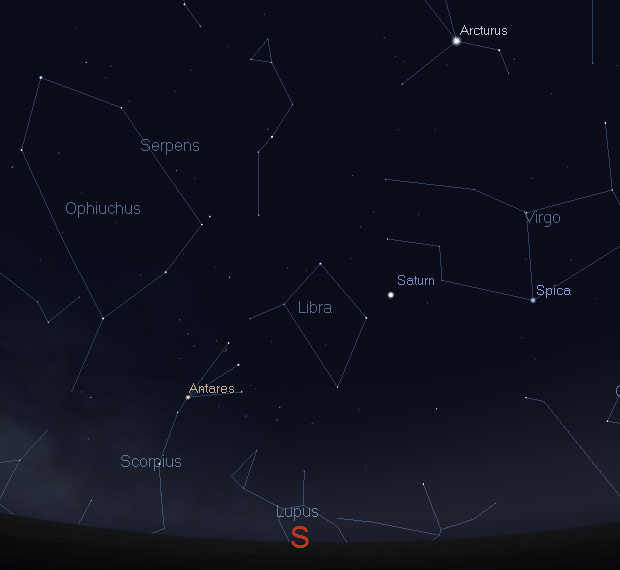
Saturn and the coming stars of late spring and early summer at 6 a.m. on February 21, 2013. Created using Stellarium 0.12.0.
02/19/2013 – Ephemeris – A hit and a miss
Ephemeris for Tuesday, February 19th. The sun will rise at 7:36. It’ll be up for 10 hours and 41 minutes, setting at 6:17. The moon, 2 days past first quarter, will set at 4:01 tomorrow morning.
Last Friday we had what I’d call a hit and a miss. The miss was the close passage of asteroid 2012 DA14 a rock maybe half the size of a football field. We’ll know better once radar observation of the asteroid are processed. Up to then the size was calculated by its brightness and its supposed reflectance or albedo. That last is the biggest variable. The asteroid was traveling at a slight angle to the earth’s orbit and a bit slower than the earth. It was crossing the earth’s orbit heading slightly northward, what astronomers call ascending node. That’s why the asteroid appeared heading north from our point of view. The meteoroid that exploded over Russia I think had a slight southerly trajectory. We’ll find out when the orbit is reconstructed.
Times are for the Traverse City/Interlochen area of Michigan. They may be different for your location.
Addendum
The Bad Astronomer Phil Plait has the story of the Russian Meteor with lots of videos.
http://www.slate.com/blogs/bad_astronomy/2013/02/15/breaking_huge_meteor_explodes_over_russia.html
The Planetary Society Blog has more information including a Webcast available at:
http://www.planetary.org/blogs/mat-kaplan/20130218-2012-da14-planetcast-on-demand.html
02/18/2013 – Ephemeris – The moon appears near Jupiter tonight
Ephemeris for President’s Day, Monday, February 18th. The sun will rise at 7:37. It’ll be up for 10 hours and 38 minutes, setting at 6:15. The moon, 1 day past first quarter, will set at 3:15 tomorrow morning.
The moon will point to Jupiter tonight. The planet will be a ways to the west or right of the moon. Actually the moon was closer to Jupiter last night. It’s closest apparent approach is about now this morning. But they’re below the horizon now. My younger granddaughter Bea has made Jupiter her favorite planet because of its red spot. The Great Red Spot on Jupiter has been seen off and on ever its was discovered by a series of astronomers. It would fade for many years only to reappear again. In fact it never went away. Right now this high pressure system is more a light pastel pink. Back in the 1950’s, and 1960’s I found it hard to ignore in the smallest of telescopes. Now it takes bigger telescopes to spot.
Times are for the Traverse City/Interlochen area of Michigan. They may be different for your location.
Addendum
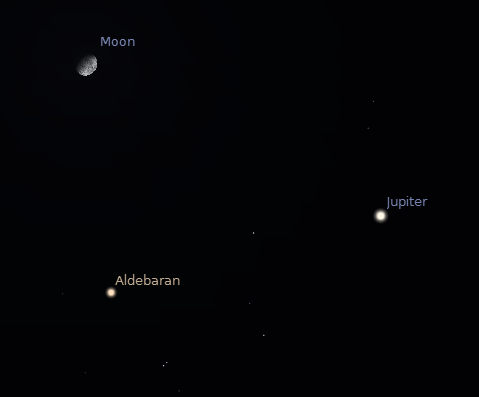
Jupiter and the moon at 9 p.m. on February 18, 2013. Created using Stellarium.
02/15/2013 – Ephemeris – Old grumpy astronomer to asteroid 2012 DA14: “Get off my lawn”!
Ephemeris for Friday, February 15th. The sun will rise at 7:42. It’ll be up for 10 hours and 29 minutes, setting at 6:11. The moon, 2 days before first quarter, will set at 12:29 tomorrow morning.
The asteroid 2012 DA14 will zip inside the ring of geosynchronous communication and weather satellites this afternoon around 2:30. We’re on the wrong side of the earth to see it. But many astronomers with optical and radio telescopes will be watching. The asteroid, perhaps half the size of a football field in diameter will whiz by 18,000 miles above the earth’s surface and from our point of view will appear to move from south to north. The asteroid was found by Spanish amateur astronomers in a program to refine the orbits of other near earth objects. They use mostly their own funds and whatever they receive in donations. The asteroid was discovered with a CCD camera that they received with a grant from the Planetary Society.
Times are for the Traverse City/Interlochen area of Michigan. They may be different for your location.
Addendum
The Bad Astronomer, Phil Plait, has a lot to say about today’s close encounter.
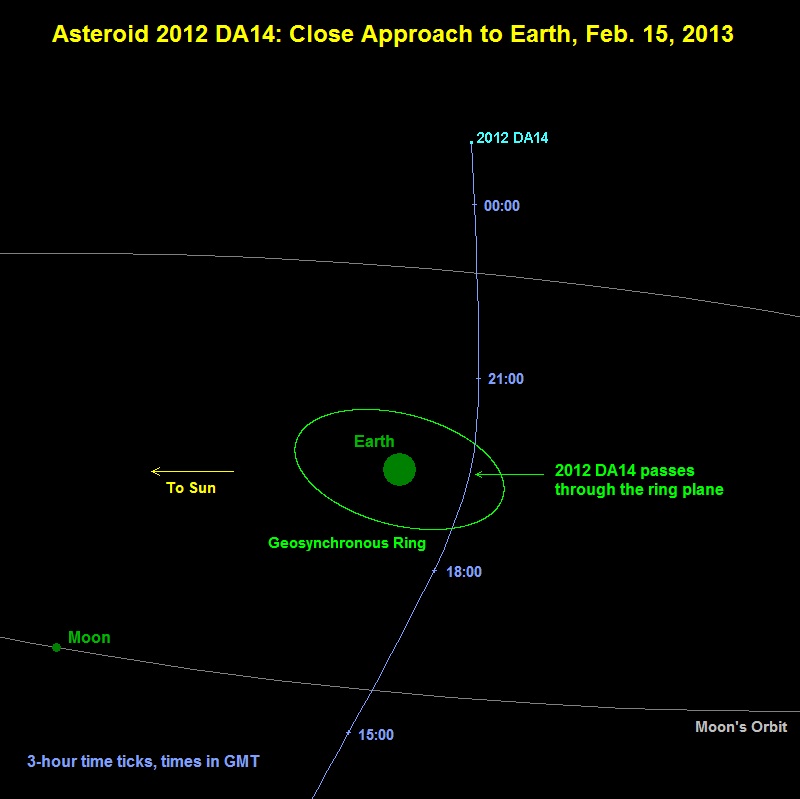
The orbit of asteroid 2012 DA14 as it passes the earth on February 15, 2013. Credit NASA.
As it passes the earth the asteroid 2012 DA14 will appear to travel just about directly south to north. This because we are orbiting the sun too. Until the encounter the asteroid has a slightly slower orbit of the sun. The encounter will cause the orbital period of the asteroid to shorten. The asteroid will cross this point in the solar system again, and someday the asteroid and the earth will cross each other’s path again on or around February 15th in a distant year.
 Bob Moler's Ephemeris Blog