Archive
04/16/2013 – Ephemeris – The moon’s strange orbit
Ephemeris for Tuesday, April 16th. The sun rises at 6:56. It’ll be up for 13 hours and 32 minutes, setting at 8:28. The moon, 2 days before first quarter, will set at 2:13 tomorrow morning.
The fat crescent moon appears high in the sky. It appears in a part of the sky where the sun will be in early July. The moon follows a path nearly in the plane of the earth’s orbit , but a bit tilted from it by an angle of 5 degrees. This is unusual. Most planet’s major satellites orbit their primary in it’s equatorial plane, like our geostationary communication satellites, though none them orbit in one of their planet’s days. The moon orbits the earth, but due to its great distance of 60 earth radii, or 240 thousand miles also is very much gravitationally affected by the sun. Apparently one of its effects was to pull the moon close to the the earth’s orbital plane. If you like eclipses this is a good thing. It makes eclipses much more frequent than if the moon orbited over the earth’s equator.
Times are for the Traverse City/Interlochen area of Michigan. They may be different for your location.
Addendum

The true scale of the earth-moon system. From Traipse.com
04/15/2013 – Ephemeris – The Big Dipper and the Fisher
Ephemeris for Tax deadline day* Monday, April 15th. The sun rises at 6:57. It’ll be up for 13 hours and 29 minutes, setting at 8:27. The moon, 3 days before first quarter, will set at 1:32 tomorrow morning.
The Big Dipper is nearly overhead in the evening now. The Big Dipper is not a constellation but part of the Great Bear for most peoples, and is enshrined by the International Astronomical Union as Ursa Major. To some of the Anishinabek peoples native to our region the stars of the Big Dipper belonged to a small weasel like animal call the Fisher. In a story I can’t relate here Fisher brought summer to the earth, and for his trouble was killed by an arrow to his only vulnerable spot, his tail. The Great Spirit would not let Fisher fall to earth, but placed him in the sky. His rising in the northeast signals the coming of spring, and when his bloody tail brushes the horizon in autumn his blood paints the autumn leaves red.
Times are for the Traverse City/Interlochen area of Michigan. They may be different for your location.
Addendum
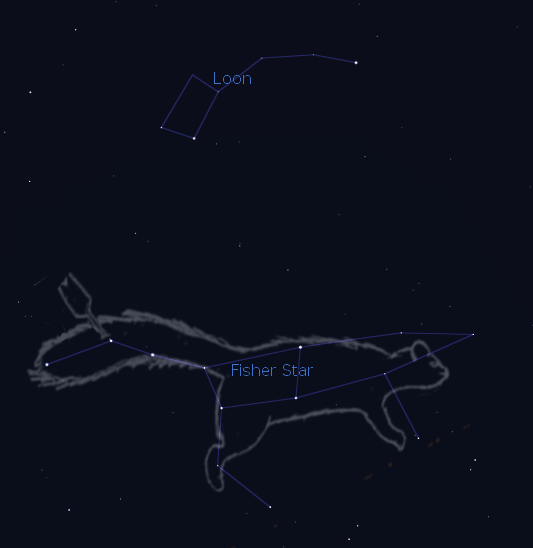
The Fisher or Fisher Star as seen Overhead and the Big Dipper. Created using Stellarium and some other help.
04/12/2013 – Ephemeris – Yuri’s Night
Ephemeris for Friday, April 12th. The sun will rise at 7:03. It’ll be up for 13 hours and 20 minutes, setting at 8:23. The moon, 2 days past new, will set at 11:00 this evening.
A special celebration has been sneaking into my consciousness: Yuri’s Night. It is celebrated in many places around the world, including at NASA. The closest celebration to us is in Ann Arbor. It is the anniversary of Yuri Gargarin’s, and mankind’s first orbital flight around the earth in 1961. These are all in the nature of parties, talks and the like celebrating the beginning of humankind’s first steps into space. Gargarin never flew in space again and tragically died in 1968 when his jet crashed.
NASA has released a series of ebooks about the Soviet space program written by Boris Chertok, one of the rocket designers. It’s in four volumes Rockets and People. I skipped to the 4th, the Moon Race and their heart breaking development of the N1 moon rocket that never really worked.
Times are for the Traverse City/Interlochen area of Michigan. They may be different for your location.
Addendum

Link to NASA’s page to download Rockets and People.
04/11/2013 – Ephemeris – The Big Dipper and Ursa Major the Great Bear
Ephemeris for Thursday, April 11th. The sun will rise at 7:04. It’ll be up for 13 hours and 17 minutes, setting at 8:22. The moon, 1 day past new, will set at 10:01 this evening.
The Big Dipper is now nearly overhead in the northeast at 10 p.m. The seven bright stars are second to Orion in the west as the seven brightest stars in a constellation. If you looked up a list of constellations, you’d find that the Big Dipper isn’t there. Ursa Major or the Great Bear is the constellation of which the Big Dipper is a part. The seven bright stars of the dipper is the rump and long tail of this constellation. The rest of the bear, including his head and legs are delineated by dimmer stars. An anatomical problem is its long tail, which was drawn in by the ancients of the old world. Many Native Americans, also saw a bear in the stars here, but the handle of the dipper became three hunters following the bear.
Times are for the Traverse City/Interlochen area of Michigan. They may be different for your location.
Addendum
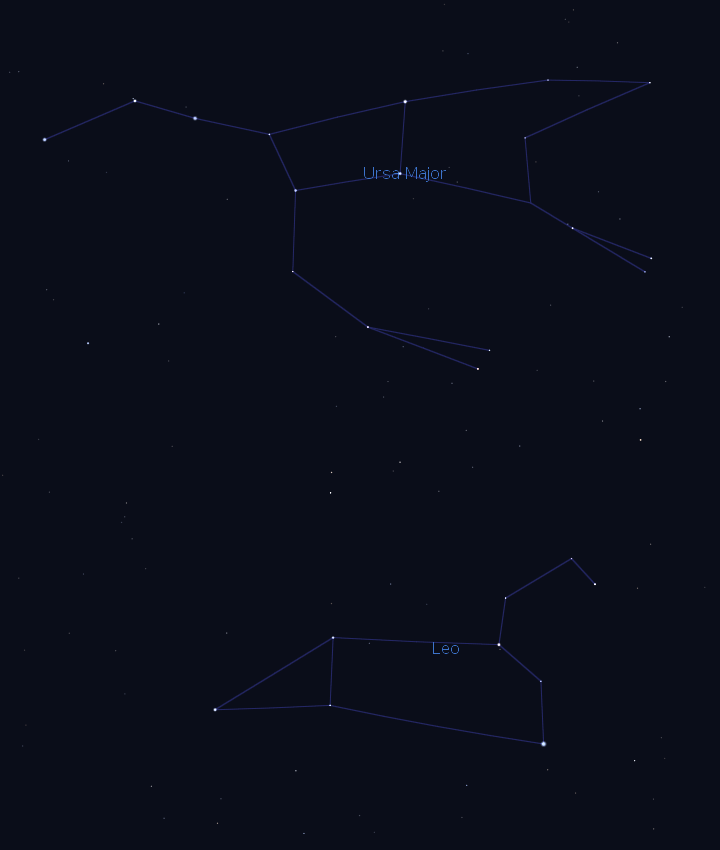
The Big Dipper part of Ursa Major with Leo right below in spill range. This is for 10 p.m. on April 11, 2013. Created using Stellarium.
04/10/2013 – Ephemeris – Where are Comet PanSTARRS and the two bright planets thia week?
Ephemeris for Wednesday, April 10th. The sun will rise at 7:06. It’ll be up for 13 hours and 14 minutes, setting at 8:21. The moon is new today, and won’t be visible.
It’s time to check out a comet and the two remaining bright planets for this week. Comet PanSTARRS is in the northwest in the evening, moving away from the sun and us, and getting a little higher in the sky as it moves northward. The comet will no longer set though it is best seen in the evening and mornings just after the end of evening twilight and before morning twilight. The comet is now down to near 6th magnitude, strictly a binocular object. Jupiter is located in the constellation of Taurus and is in the west during the evening. It will set at 12:51 a.m. The other bright planet Saturn will rise at 9:43 p.m. in the east southeast. It’s located in eastern Virgo. It will pass due south at 2:56 a.m. Both planets are wonderful sights in telescopes. Saturn has those wonderful rings.
Times are for the Traverse City/Interlochen area of Michigan. They may be different for your location.
Addendum
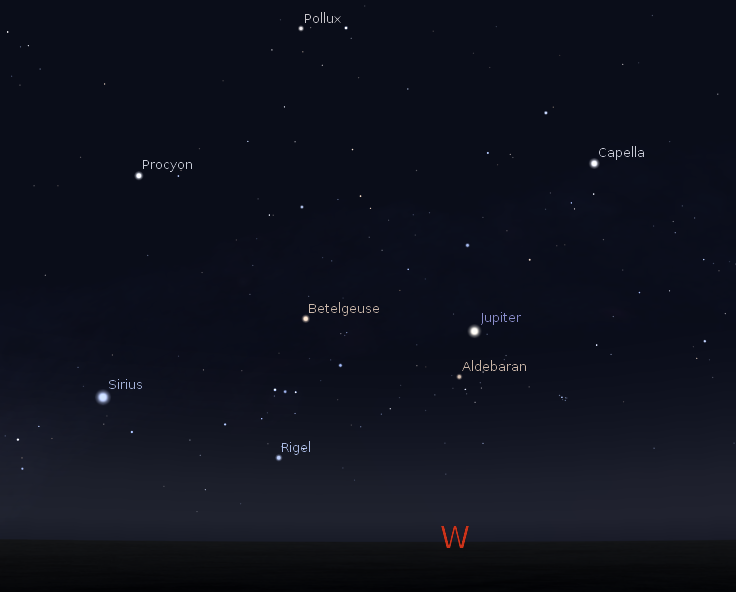
Jupiter and the setting winter stars at 10 p.m. on April 10, 2013. Created using Stellarium.
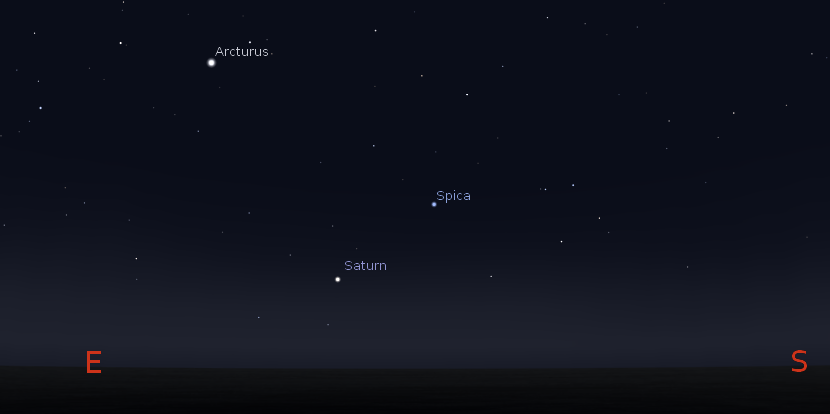
Saturn rising with bright stars of spring at 11 p.m. April 10, 2013. Created using Stellarium.
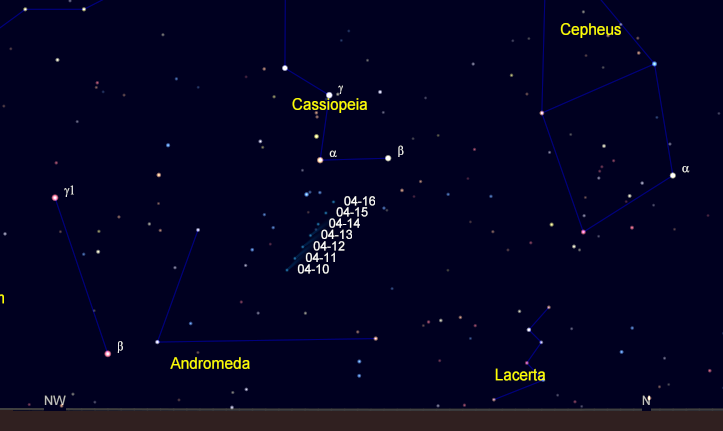
Comet PanSTARRS at the end of twilight at 10 p.m. for the seven days starting April 10, 2013. Created using Cartes du Ciel.
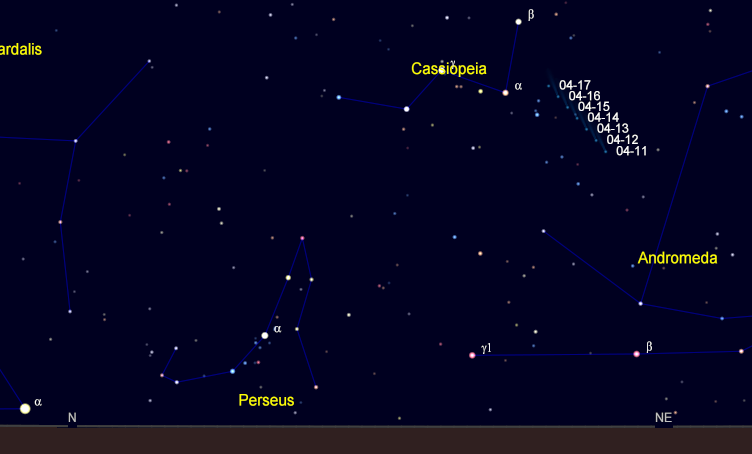
Comet PanSTARRS at the beginning of twilight 5:20 a.m. for the dates listed. Created using Cartes du Ciel.
04/09/2013 – Ephemeris – Hydra the water snake
Ephemeris for Tuesday, April 9th. The sun will rise at 7:08. It’ll be up for 13 hours and 11 minutes, setting at 8:20. The moon, 1 day before new, will rise at 7:01 tomorrow morning.
In the southwest to southeastern sky at 11 p.m. can be found the constellation of Hydra the water snake. Unlike the monster of the same name this Hydra has but one head, which is its most distinctive part. After 10 p.m. look to the south to southwest. The head of Hydra is located below a line from the constellation Leo the Lion in the south and Gemini high in the west southwest. Hydra’s head is a small but distinctive group of 6 stars that make a drooping loop to the right. The rest of Hydra wends its way just above the southern horizon ending under Virgo below the star Spica and ends near Saturn. To astronomers constellations have distinct boundaries like congressional districts, and Hydra is one long Gerrymander*.
Times are for the Traverse City/Interlochen area of Michigan. They may be different for your location.
Addendum
* Gerrymander – A method of drawing Congressional Districts of supposed equal population so that it benefits the party in power at the time. Names after Governor Gerry of Massachusetts in 1812 when one of the districts he drew looked like a salamander. I checked Wikipedia and we ain’t the only ones. Actually Hydra is quite linear, being a snake. It is the longest constellation. Actually Eridanus and Draco are more crooked.
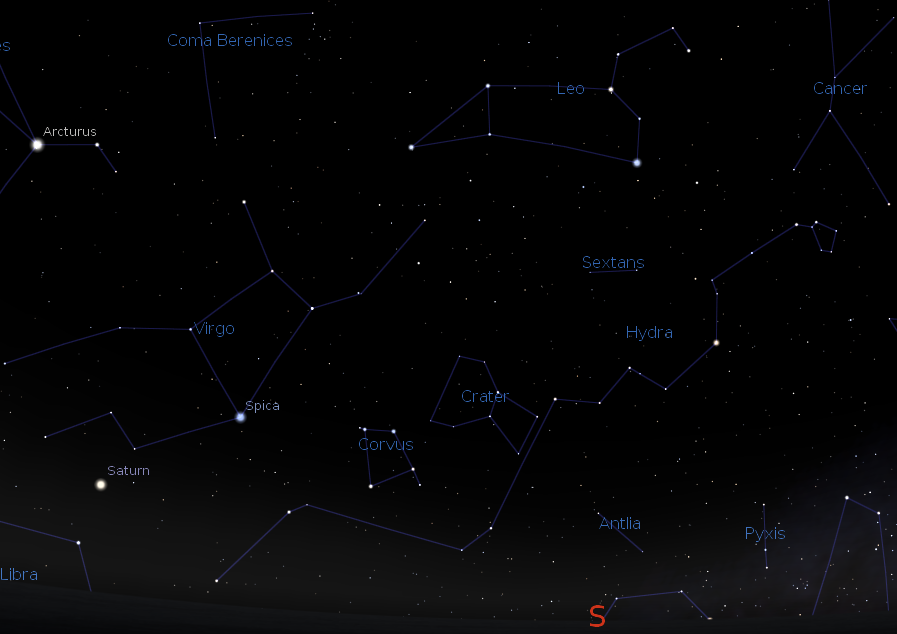
Hydra the water snake seen at 11 p.m. on April 9, 2013. Created using Stellarium.
Below are the official boundaries of Hydra and the nearby constellations.
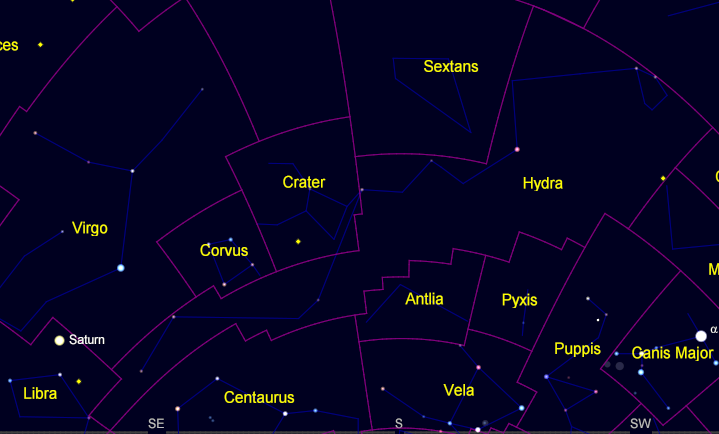
Hydra boundaries according to the International Astronomical Union. Created using Cartes du Ciel.
04/08/2013 – Ephemeris – The constellation Leo the lion
Ephemeris for Monday, April 8th. The sun will rise at 7:10. It’ll be up for 13 hours and 8 minutes, setting at 8:18. The moon, 2 days before new, will rise at 6:32 tomorrow morning.
Besides the advancing sunset times and warming temperatures, there’s another sign that spring is here. That’s the appearance of the constellation Leo the lion high in the southeast in the evening. The front of this beast is a backward question mark of stars with the bright star Regulus as the dot at the bottom. That’s his head, mane and chest. His haunches are a triangle of stars to the left, This year the planet Saturn is to the left of the Regulus. A way to find Leo is to remember that cat’s aren’t supposed to like water. Find the Big Dipper high in the northeast and imagine drilling a hole in the bottom of the bowl. The water will fall on Leo’s back. Also you’ll notice the stars of spring to the east are more sparse than those of winter to the west.
Times are for the Traverse City/Interlochen area of Michigan. They may be different for your location.
Addendum
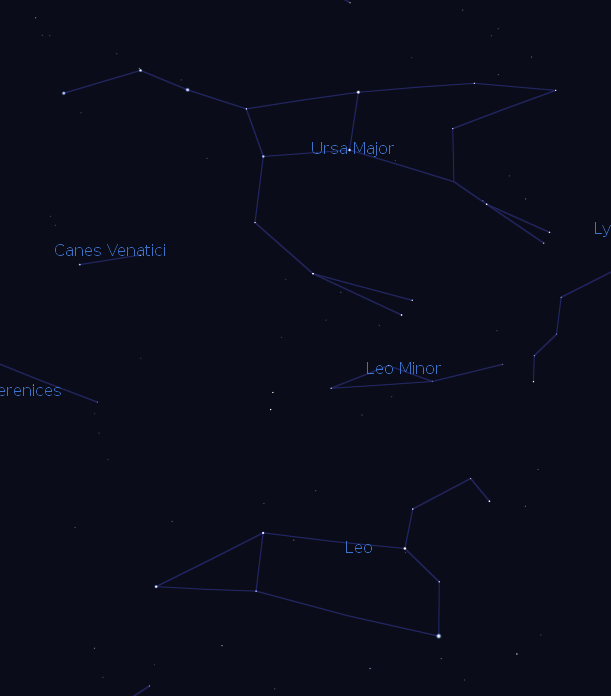
Leo and Ursa Major (Big Dipper) for 10 pm on April 8, 2013. Created using Stellarium.
04/05/2013 – Ephemeris – Astronomy meeting and a star party tonight.
Ephemeris for Friday, April 5th. The sun will rise at 7:15. It’ll be up for 12 hours and 59 minutes, setting at 8:15. The moon, 2 days past last quarter, will rise at 5:06 tomorrow morning.
Trixie and Kevin Pickard will preset a program this evening entitled Heavenly Signs at this evening’s meeting of the Grand Traverse Astronomical Society at Northwestern Michigan College’s Rogers Observatory starting at 8 p.m. Trixie has been one of our members since she was in high school. Her main interest has been the manned space program. But I am assured that this topic is not about that. Starting at 9 p.m. Is our March star party at the observatory. Highlights, if its clear will be the planet Jupiter and the wonders of the winter sky including the Great Orion Nebula. Towards the end of the evening Saturn will rise. It will be rather low in the sky and fuzzy. But it is Saturn after all. All are welcome.
Times are for the Traverse City/Interlochen area of Michigan. They may be different for your location.
04/04/2013 – Ephemeris – Can you spot Zodiacal Light?
Ephemeris for Thursday, April 4th. The sun will rise at 7:17. It’ll be up for 12 hours and 56 minutes, setting at 8:14. The moon, 1 day past last quarter, will rise at 4:34 tomorrow morning.
After you try to spot Jupiter tonight, or hang around outside at the end of astronomical twilight, about 10 p.m. look to the west at Taurus the bull and Gemini. Then broaden your gaze. There will be a very faint triangular glow with broad base at the horizon leaning a bit to the left, with its apex near Jupiter and the V of the face of Taurus the bull and the bright star Aldebaran to the right of Orion. This glow is called Zodiacal Light, caused by the reflected sunlight off a cloud of dust located in the plane of the solar system. Most of the large bodies of the solar system orbit the sun in a single plane. The one exception to this are comets, which orbit at all angles to the sun. Zodiacal Light is best seen on spring evenings and autumn mornings.
Addendum
It seems the only good photographs of zodiacal light I get is when there’s a comet in that direction. It happened a year before with Comet Hyakutake. The images here were taken later in the month when the Hyades and the Pleiades were lower in the sky.
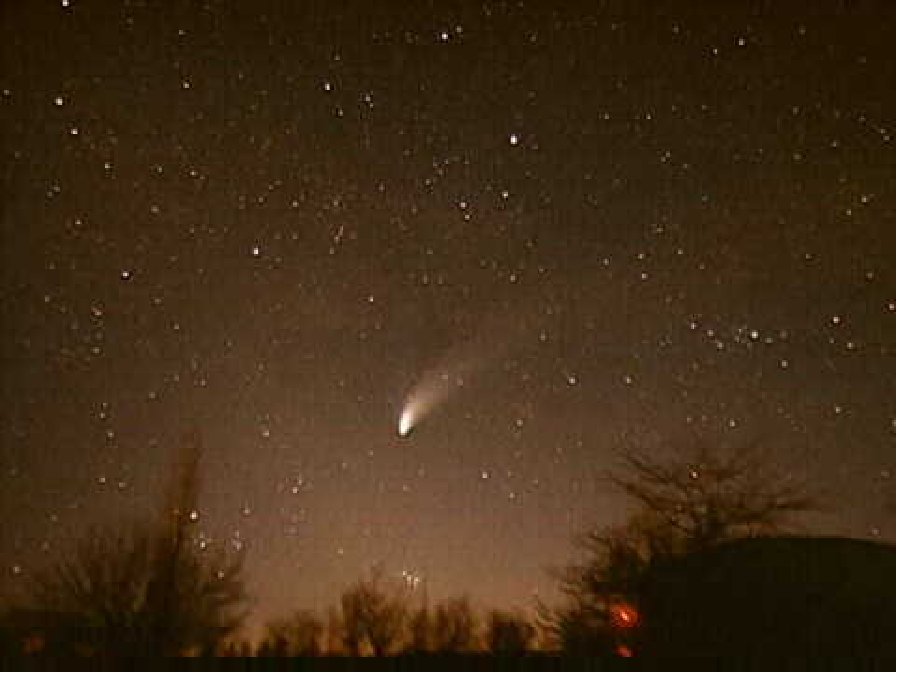
Zodiacal Light and Comet Hale-Bopp April 1997. My image.
Here’s a black and white image with enhanced contrast.
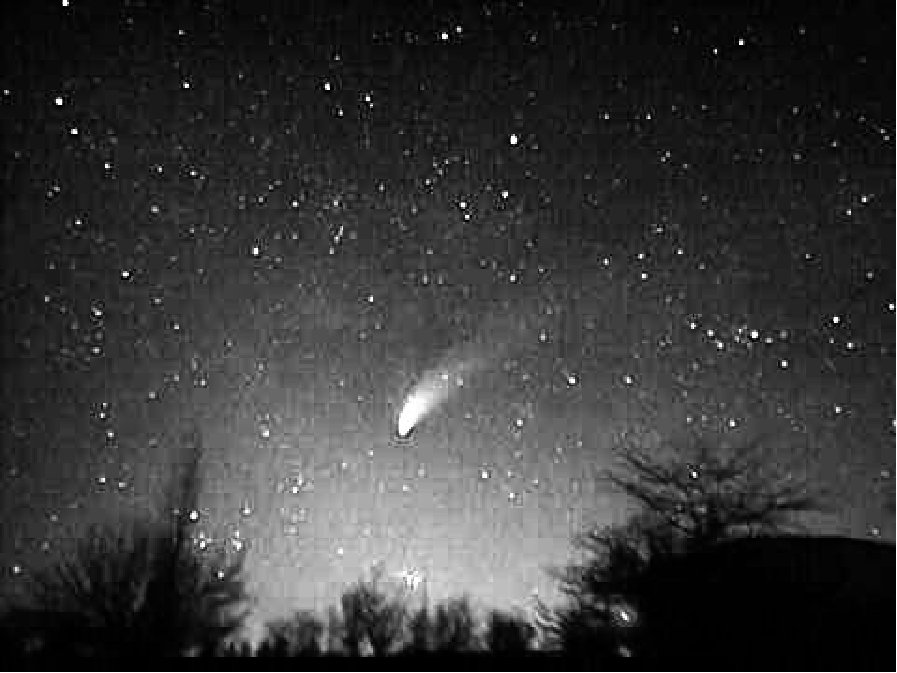
Zodiacal Light and Comet Hale-Bopp April 1997. Enhanced contrast.
04/03/2013 – Ephemeris – Where are Comet PanSTARRS and the bright planets this week?
Ephemeris for Wednesday, April 3rd. The sun will rise at 7:19. It’ll be up for 12 hours and 53 minutes, setting at 8:12. The moon, at last quarter today, will rise at 3:57 tomorrow morning.
It’s time to check out a comet and the two remaining bright planets for this week. Comet PanSTARRS is in the northwest, moving away from the sun, and getting a little higher in the sky as it moves northward rather than eastward. The comet will set at 11:22 p.m. The comet is now down to near 5th magnitude, strictly a binocular object. It’s also visible in the morning, rising at 3:04 a.m. Jupiter is located in the constellation of Taurus and is in the west during the evening. It will set at 1:16 a.m. The other bright planet Saturn will rise at 10:13 p.m. in the east southeast. It’s located in eastern Virgo. It will pass due south at 3:26 a.m. Both planets are wonderful sights in telescopes. Saturn is the most beautiful of planets with its rings.
Times are for the Traverse City/Interlochen area of Michigan. They may be different for your location.
Addendum
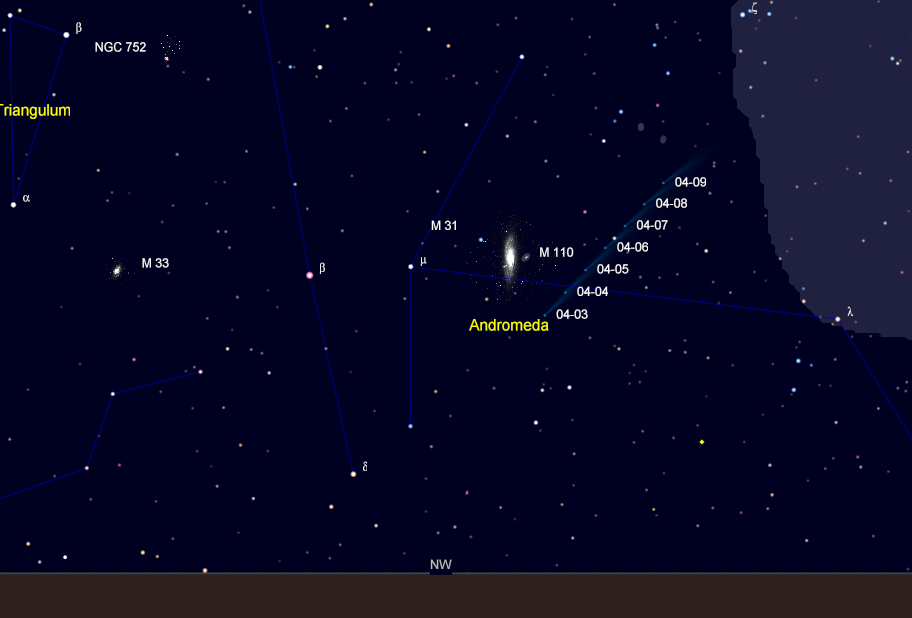
Comet PanSTARRS at 9:30 p.m. for the period April 3 through 9, 2013. Created using Cartes du Ciel.
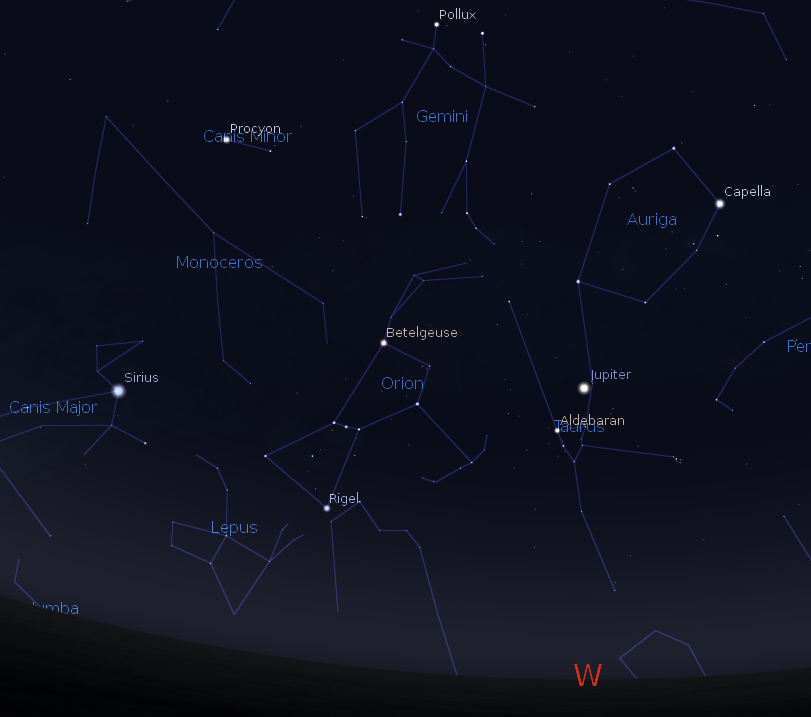
Jupiter with the setting constellations of winter at 10 p.m. on April 3, 2013. Created using Stellarium.
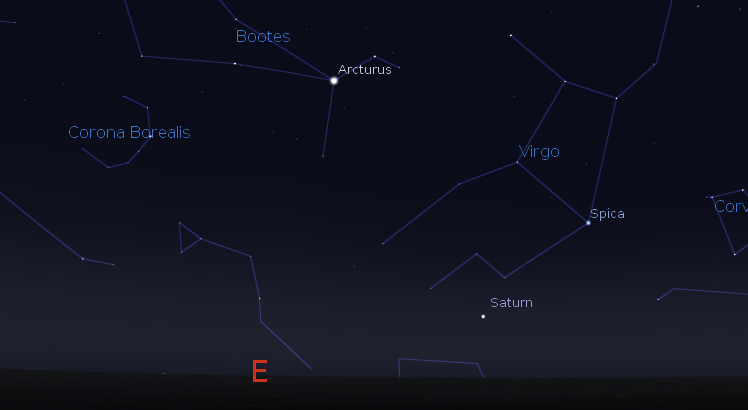
Saturn rising at 11:30 p.m. on April 3, 2013. Created using Stellarium.
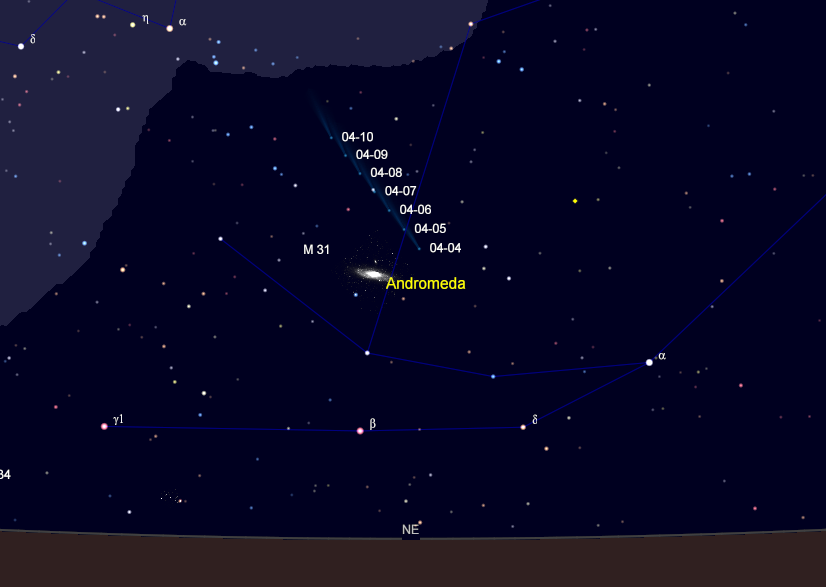
Comet PanSTARRS in the morning at 5:45 for the period April 4 through 10, 2013. Created using Cartes du Ciel.
 Bob Moler's Ephemeris Blog