Archive
05/06/2013 – Ephemeris – The Constellation Leo the Lion and its meaning to the ancients
Ephemeris for Monday, May 6th. The sun rises at 6:25. It’ll be up for 14 hours and 28 minutes, setting at 8:53. The moon, 3 days before new, will rise at 5:03 tomorrow morning.
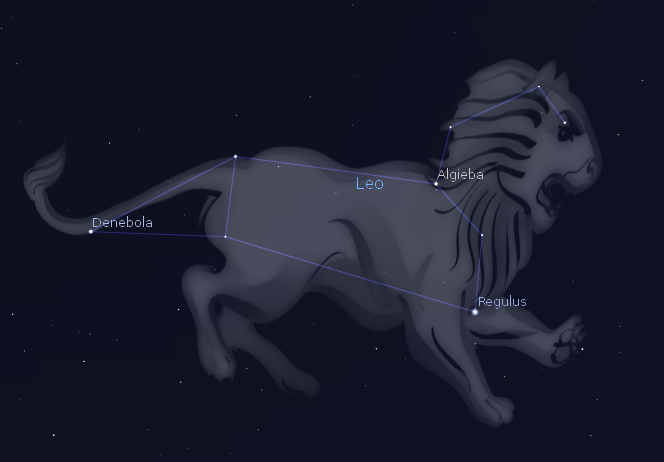
Leo the lion’s image as displayed by Stellarium for May 6, at 10 p.m. due south.
The constellation of Leo the lion is seen in the south at 10:30 p.m. Regulus lies at the bottom of a backwards question mark of stars that are his head and mane. This backwards question mark is also known as the asterism or informal constellation of the Sickle. To the left of the Sickle is a triangle of stars that are his haunches. As the lion is the king of beasts it is fitting that its brightest star Regulus means “Little King Star”. It was thought in ancient Egypt that the heat of summer, when the sun was in Leo drove the lions to drink the waters of the Nile. The lion was also the symbol of the Israelite tribe of Judah, from Jacob’s prophesy in Genesis, and as such may have played a part in the origin of the Star of Bethlehem.
Times are for the Traverse City/Interlochen area of Michigan. They may be different for your location.
05/03/2013 – Ephemeris – Explore the sun and the stars tonight
Ephemeris for Friday, May 3rd. The sun rises at 6:29. It’ll be up for 14 hours and 20 minutes, setting at 8:49. The moon, 1 day past last quarter, will rise at 3:39 tomorrow morning.
Yours truly will present a talk about the sun and its effects on the earth at this evening’s meeting of the Grand Traverse Astronomical Society at Northwestern Michigan College’s Rogers Observatory starting at 8 p.m. This is a talk that is prepared to be given to the Friendly Garden Club later this month. It explores how the sun gets its energy and it emphases the life-giving radiation we receive from the sun and how plants, especially use it to create our green oxygenated world. Starting at 9 p.m. Is our first of our star parties for May at the observatory. Highlights, if its clear will be the planets Jupiter and Saturn, plus some of the bright wonders of the spring skies and maybe a star cluster or two. All are welcome.
Times are for the Traverse City/Interlochen area of Michigan. They may be different for your location.
05/02/2013 – Ephemeris – The Eta Aquarid meteors will reach peak this weekend
Ephemeris for Thursday, May 2nd. The sun rises at 6:30. It’ll be up for 14 hours and 17 minutes, setting at 8:48. The moon, at last quarter today, will rise at 3:09 tomorrow morning.
Monday morning will see the expected peak of the Eta Aquarid meteor shower. The meteors will seem to come from the southeast. This shower has a very long peak and can be seen tomorrow morning. This shower’s claim to fame is that the meteoroids that produce this shower are bits shed by Halley’s Comet. The orbits of Halley’s comet and the earth nearly intersect at two points. The inbound Halley’s comet crosses the earth’s orbit where the earth is on October 20th., when we have the Orionid meteor shower. The comet’s orbit then passes between the orbits of Venus and Mercury then crosses the earth’s orbit again near where the earth is on May 6th. The shower has 12 year fluctuations of peak numbers, probably caused by Jupiter.
Times are for the Traverse City/Interlochen area of Michigan. They may be different for your location.
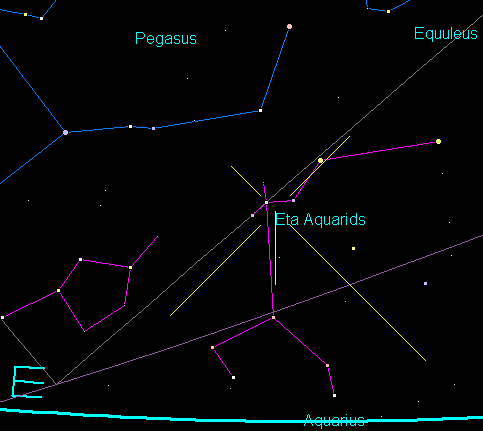
Eta Aquarid radiant
05/01/2013 – Ephemeris – Where are the bright planets this week?
Ephemeris for Wednesday, May 1st. The sun rises at 6:32. It’ll be up for 14 hours and 15 minutes, setting at 8:47. The moon, 1 day before last quarter, will rise at 2:35 tomorrow morning.
It’s time to check out the two remaining bright planets for this week. Jupiter is located in the constellation of Taurus, above the V shape of stars, the face of the bull and is in the west during the evening. It will set at 11:49 p. m. In the west northwest. Jupiter is still high enough as it gets dark to get a very good view of its cloud bands and satellites. The four moons that Galileo found are easy targets for small telescopes or even sharp eyed binocular observers. The other bright planet Saturn will be low in the east southeast when it gets dark in the evening. It’s located in eastern Virgo, but us moving back a bit toward the bright star Spica to its right. Saturn will move past due south at 1:28 a.m. An event called transiting the meridian.
Times are for the Traverse City/Interlochen area of Michigan. They may be different for your location.
Addendum
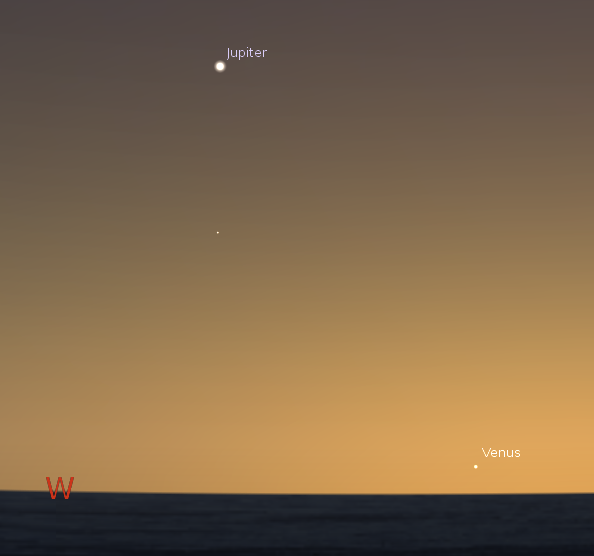
I’m including Venus in this image at 9:20 p.m., May 1, 2013. I’ll start talking about it on the program next week. Created using Stellarium.
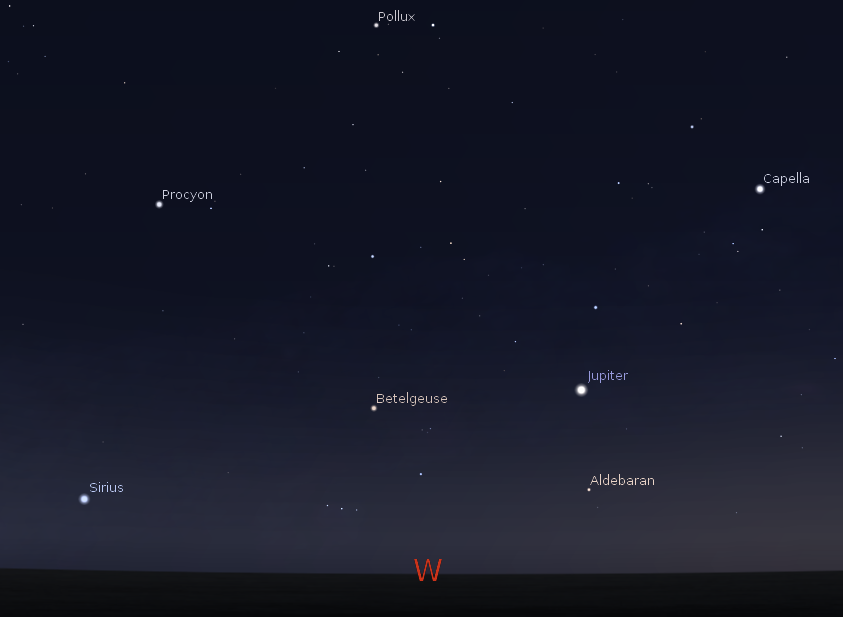
Jupiter and the setting stars of winter at 10 p.m. on may 1, 2013. Created using Stellarium.
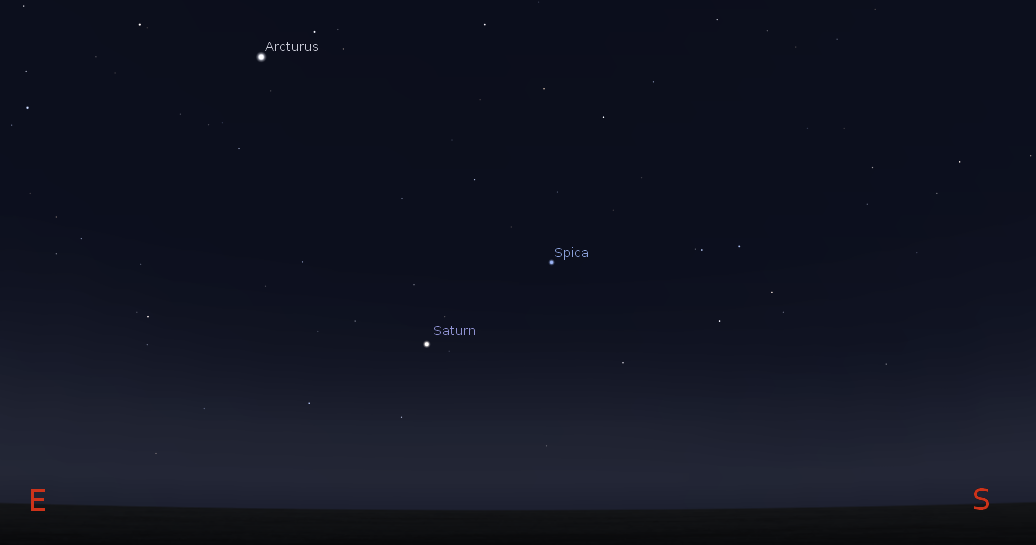
Saturn is seen low in the southeast at 10 p.m. on May 1, 2013. Created using Stellarium.
 Bob Moler's Ephemeris Blog