Archive
11/15/2013 – Ephemeris – New information on the Chelyabinsk meteor
Ephemeris for Friday, November 15th. The sun will rise at 7:39. It’ll be up for 9 hours and 34 minutes, setting at 5:14. The moon, 2 days before full, will set at 6:34 tomorrow morning.
Articles in Nature and Science bring some precision to the Chelyabinsk meteor of February 15th. Its orbit is very close to a known but unnamed asteroid 86039 discovered in 1999, and may be a piece broken off from it. The meteorite retrieved from the nearby lake broke when it was attempted to be weighed. It turns out that a security camera recorded the splash as the large piece hit the lake and broke through the ice. The fragility of the meteorite testifies as to why it exploded in the atmosphere. The meteor was recorded from satellites, infra-sound recorders from the International Test Ban Treaty Organization, and a host of dashboard cams. The blast, depending on who did the measuring could have been up to 600 kilotons. (The bomb that was dropped on Hiroshima had a yield of 16 kilotons).
Times are for the Traverse City/Interlochen area of Michigan. They may be different for your location.
Addendum

Caption: Witness photo of 2013 Russian meteor event made from Chelyabinsk Drama Theater. Photo by Nikita Plekhanov.
11/14/2013 – Comet ISON has an outburst
Last night Comet ISON suddenly brightened and may be bright enough to be visible to the naked eye.. The comet is now within the orbit of Venus and falling with increasing velocity toward the sun for its November 28th perihelion.
Here’s a link to Universe Today‘s post with lots of photos.
EarthSky also has an entry for it: with a finder chart for naked eye viewing of the comet in twilight.
Here’s SpaceWeather.com‘s entry for today.
This may bode well for the comet’s brightness after perihelion, if the comet’s nucleus holds together or stays in big enough pieces. The next week may tell.
11/14/2013 – Ephemeris – An asteroid with 6 tails.
Ephemeris for Thursday, November 14th. The sun will rise at 7:38. It’ll be up for 9 hours and 37 minutes, setting at 5:15. The moon, 3 days before full, will set at 5:31 tomorrow morning.
Ready for something weird in the sky? Back in August the Pan-STARRS telescope on Mount Haleakala in Hawaii discovered an asteroid with 6 tails. This was confirmed in September by the Hubble Telescope. The tails weren’t directed away from the sun like cometary tails, bur were set off in a range of directions from the asteroid. This was a main belt asteroid orbiting the sun between Mars and Jupiter. It may be that the asteroid was in a collision some time ago which sent it spinning rapidly, so the speed of rotation at its equator is at or above the asteroid’s escape velocity, and dust migrating to the equator is flung off to make the tails. Looks like the hunt for near earth asteroids is picking up some interesting objects.
Times are for the Traverse City/Interlochen area of Michigan. They may be different for your location.
Addendum
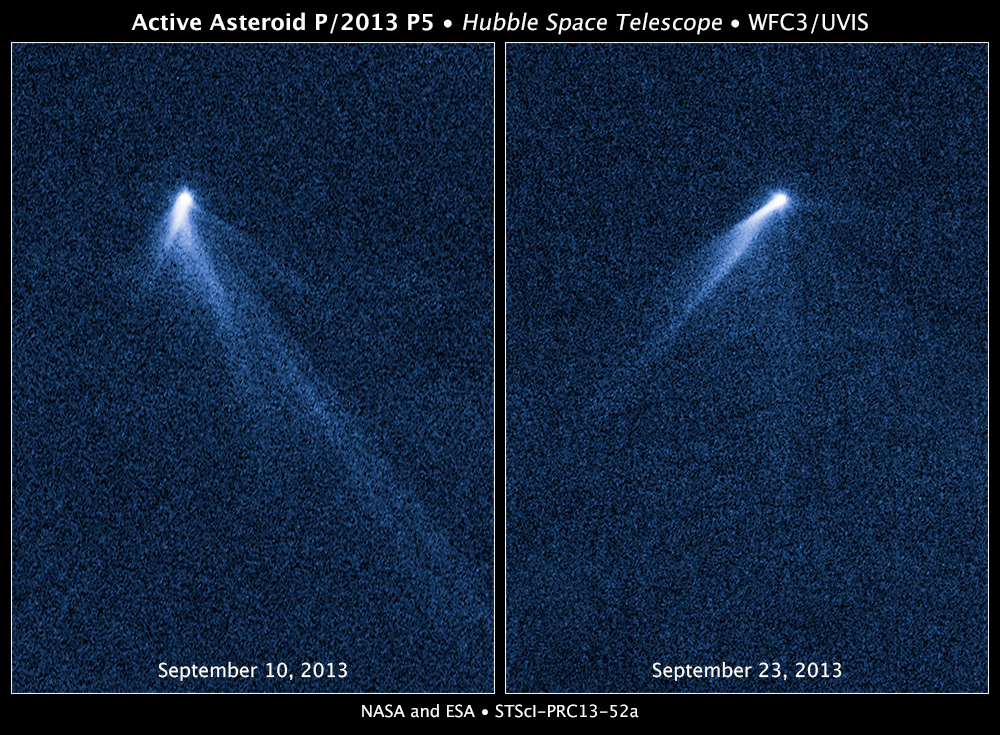
Hubble Space Telescope images of Asteroid P/2013 P5. Hat tip to Universe Today.
11/13/2013 – Ephemeris – Where are the bright planets and comets out this week?
Ephemeris for Wednesday, November 13th. The sun will rise at 7:36. It’ll be up for 9 hours and 39 minutes, setting at 5:16. The moon, 3 days past first quarter, will set at 4:26 tomorrow morning.
Let’s see where the bright planets are this week. Venus is brilliant in the west southwest after sunset. It will set at 7:49 p.m. The giant planet Jupiter will rise at 8:59 p.m. in the east northeast. It’s cruising against the stars of Gemini now. It will pass due south at 4:36 a.m. Mars will rise at 1:55 a.m. also in the east northeast. Reddish Mars is nearly two widths of a fist held at arm’s length below and left of the bright star Regulus in Leo now. Comet ISON is approaching the bright star Spica and will pass it Monday morning. ISON has been hanging around magnitude 8, about half as bright as current predictions, but probably visible in small telescopes. Comet ISON will rise about 4:16 a.m. and be visible until around 6:15 a.m.
Times are for the Traverse City/Interlochen area of Michigan. They may be different for your location.
Addendum
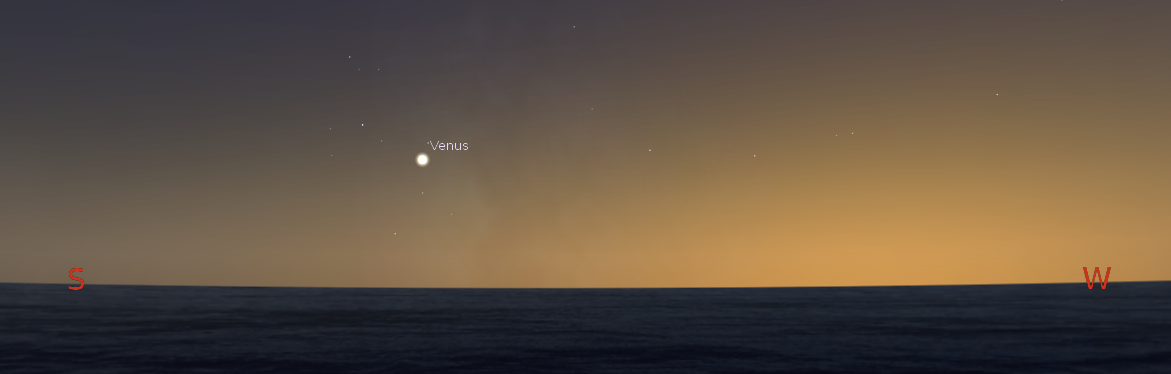
Venus low in the southwest at 6 p.m. on November 13, 2013. Created using Stellarium.
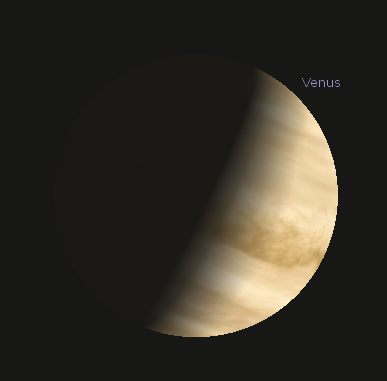
Venus through the telescope. (Note the bands are only visible in UV, not visible light). Created using Stellarium.
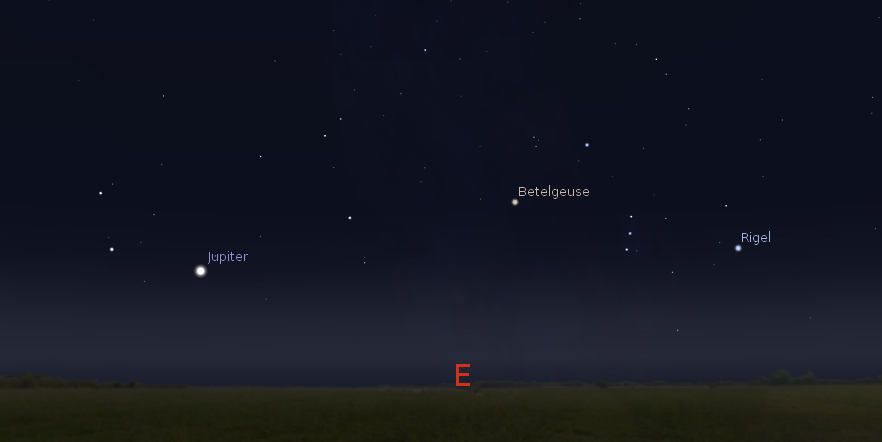
Jupiter rising at 10 p.m. with some of the winter stars. Created using Stellarium.
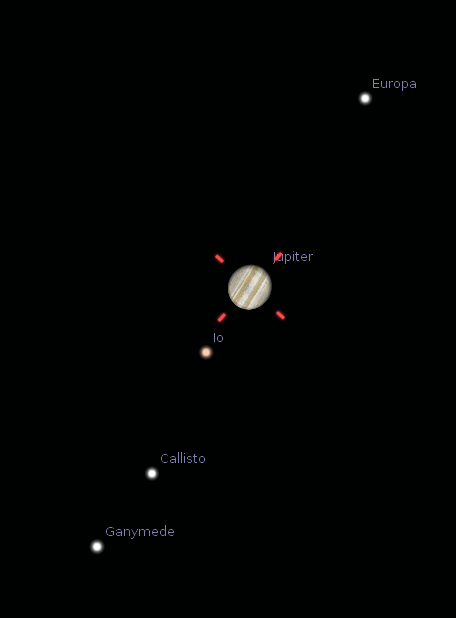
Telescopic Jupiter and its moons at 11 p.m. Created using Stellarium.
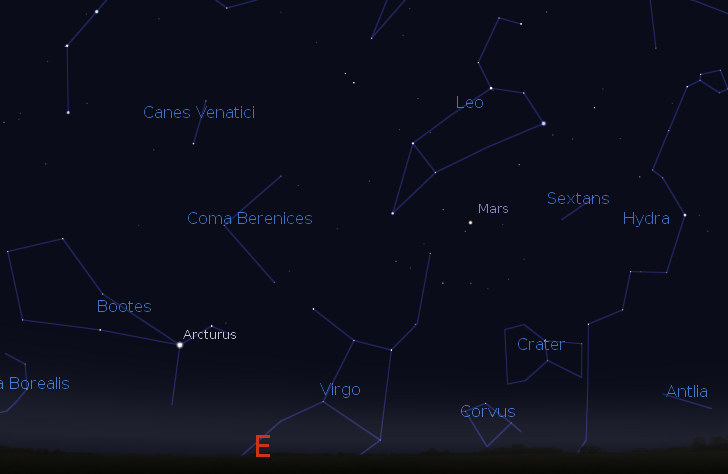
Mars and the spring constellations at 5:30 a.m. November 14, 2013. Created using Stellarium.
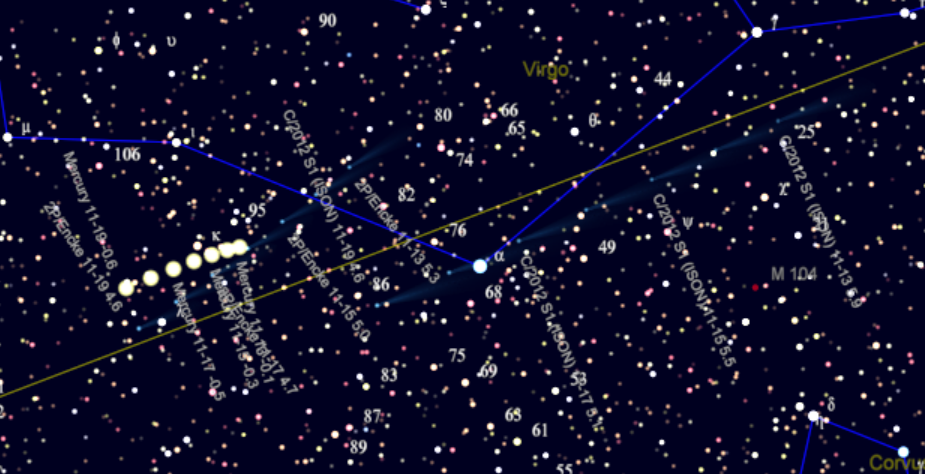
This is a busy chart with Comets ISON and Encke and Mercury for the period November 13th through 19th of November 2013 at 6 a.m. Created using Carts du Ciel.
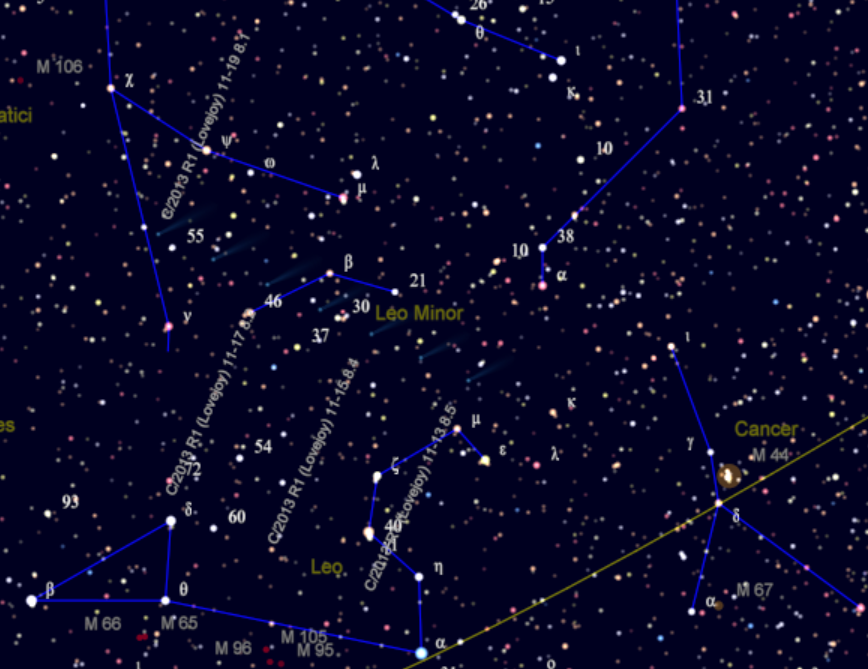
Comet Lovejoy and the constellation Leo for November 13th through 19th, 2013 at 6 a.m. Created using Cartes du Ciel.
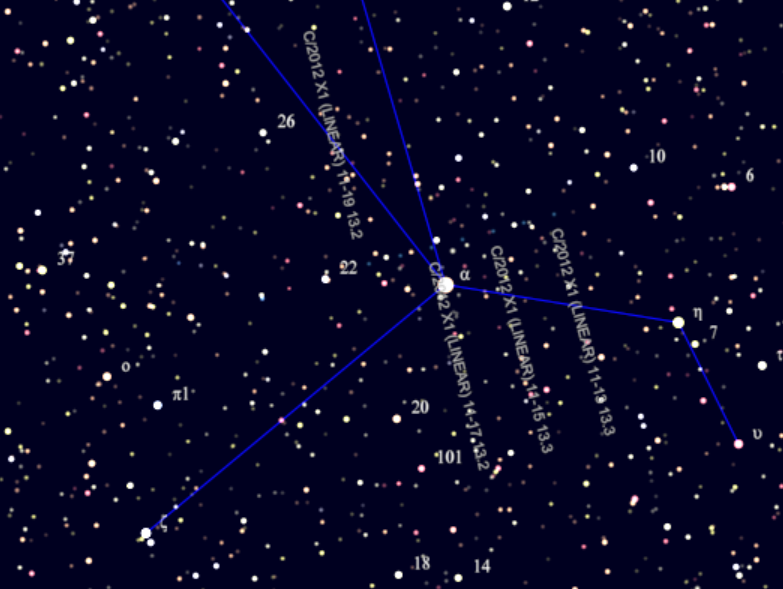
Comet LINEAR track for November 13th through 19th 2013. Created using Cartes du Ciel.
The following are the latest magnitudes (brightnesses) recorded for these comets:
Comet               Magnitude
C/2012 S1 (ISON)    8  (1 magnitude dimmer than predicted)
P2 (Encke)          8
C/2013 R1 (Lovejoy) 6  (2.5 magnitudes brighter than predicted)
C/2012 X1 (LINEAR)  8  (5 magnitudes* brighter than predicted)
* 5 magnitudes brighter = 100 times brighter!

Source is http://www.icq.eps.harvard.edu/CometMags.html.
Search page using the C/???? ?? instead of name.
Comets Lovejoy and LINEAR have multiple entries.
11/12/2013 – Ephemeris – Not one but four comets grace the morning sky now
Ephemeris for Tuesday, November 12th. The sun will rise at 7:35. It’ll be up for 9 hours and 42 minutes, setting at 5:17. The moon, 2 days past first quarter, will set at 3:19 tomorrow morning.
Comet ISON has competition in the morning sky now. There are actually three other comets within range of telescopes gracing our morning sky now. Comet ISON is still not brightening as predicted. It is still 2 to 3 times dimmer than predicted. Comet Encke is still brighter, Comet C/2013 R1 (Lovejoy) discovered two months ago is almost as bright as ISON. It’s moving between Cancer and Leo now. C/2012 X1 (LINEAR) is the faintest of the four and a tough one to spot. It will appear to pass the bright star Arcturus a week from now. I’ll have finder charts for all these comets at bobmoler.wordpress.com with today’s transcript. Apparently the nucleus of ISON is still holding together.
Times are for the Traverse City/Interlochen area of Michigan. They may be different for your location.
Addendum
This is a busy chart with Comets ISON and Encke and Mercury for the period November 13th through 19th of November 2013 at 6 a.m. Created using Carts du Ciel.
Note that the star designated α is Spica, Alpha Virginis.
Comet Lovejoy and the constellation Leo for November 13th through 19th, 2013 at 6 a.m. Created using Cartes du Ciel.
Comet LINEAR track for November 13th through 19th 2013. Created using Cartes du Ciel.
The star designated α is Arcturus or Alpha Boötis. The brightest star is Boötes. Remember follow the arc of the Big Dipper handle to Arcturus.
The following are the latest magnitudes (brightnesses) recorded for these comets:
Comet               Magnitude
C/2012 S1 (ISON)    8  (1 magnitude dimmer than predicted)
P2 (Encke)          8
C/2013 R1 (Lovejoy) 6  (2.5 magnitudes brighter than predicted)
C/2012 X1 (LINEAR)  8  (5 magnitudes* brighter than predicted)
* 5 magnitudes brighter = 100 times brighter!
Source is http://www.icq.eps.harvard.edu/CometMags.html.  Search page using the C/???? ?? instead of name.  Comets Lovejoy and LINEAR have multiple entries.
11/11/2013 – Ephemeris – D-Day and the moon
Ephemeris for Veteran’s Day, Monday, November 11th. The sun will rise at 7:34. It’ll be up for 9 hours and 44 minutes, setting at 5:18. The moon, 1 day past first quarter, will set at 2:12 tomorrow morning.
Veterans’ day used to be called Armistice Day, celebrating the end of War to End All Wars. There was, of course a great war after that, and its greatest battle was the invasion on D-Day, a date governed by the position of the Moon. The full moon on June the 6th, 1944 gave light for the gliders and paratroopers light to carry out their operations at midnight. Plus the high tides were near noon and midnight and the low tides near dawn. The idea was to hit the beach at low tide to enable the landing craft to operate without hitting the obstacles the Germans planted in the tidal zone. It was great for the landing craft, but the troops had a lot of open beach to cover to get to some sort of shelter.
Times are for the Traverse City/Interlochen area of Michigan. They may be different for your location.
11/08/2013 – Ephemeris – Star Party in the Grand Traverse area tomorrow night
Ephemeris for Friday, November 8th. The sun will rise at 7:30. It’ll be up for 9 hours and 51 minutes, setting at 5:21. The moon, 2 days before first quarter, will set at 10:42 this evening.
Tomorrow, Saturday the 9th, the Grand Traverse Astronomical Society will host a star party at Northwestern Michigan College’s Rogers Observatory from 9m to 11 p.m. On tap if it’s clear will be the moon and later on in the evening the planet Jupiter will rise in the east with its retinue of moons and its cloud bands. There are still some northern summer telescopic wonders; plus rising in the east some star clusters and galaxies bright enough to see in the moonlight. Best of these star clusters is the Double Cluster, and the best of all the galaxies is the Great Andromeda Galaxy. This will be the last Saturday evening viewing opportunity of the year. There will still be a star party on Friday December 6th after the society meeting.
Times are for the Traverse City/Interlochen area of Michigan. They may be different for your location.
11/07/2013 – Ephemeris – The Big Dipper’s lowest appearance in the north
Ephemeris for Thursday, November 7th. The sun will rise at 7:28. It’ll be up for 9 hours and 54 minutes, setting at 5:23. The moon, 3 days before first quarter, will set at 9:32 this evening.
The entire Big Dipper is at its lowest in the sky at 9 p.m. with the Dipper’s bowl centered due north under the pole star Polaris. The southernmost star of the Big Dipper is the star at the tip of the handle, named Alkaid. Alkaid will be at its lowest at 11:20 this evening, 4 degrees above the horizon for Traverse City, so is circumpolar, meaning it doesn’t set in the IPR (Interlochen Public Radio) listening area. The star name is Arabic and means something like the Chief of the daughters mourning at the Bier. The bier is the bowl of the dipper supporting, I suppose, the body of their father or mother. To the Anishinabek native peoples around here the Big Dipper was the Fisher or Fisher Star, a weasel like creature, whose bloody tail swept over the maple trees, turning their leaves red.
Times are for the Traverse City/Interlochen area of Michigan. They may be different for your location.
Addendum
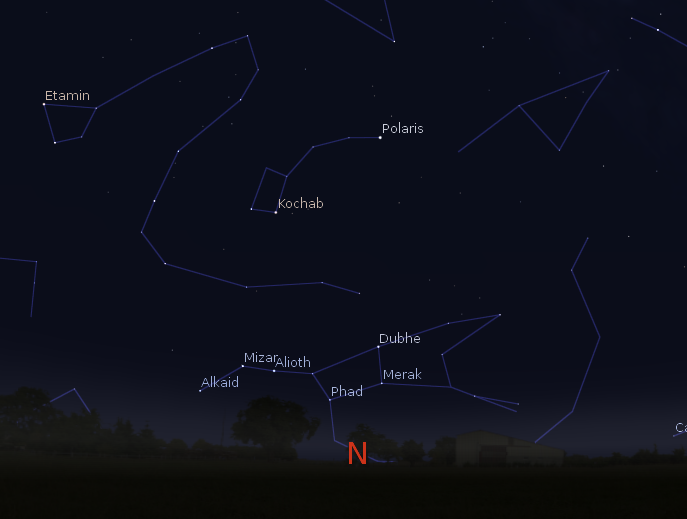
The Big Dipper low in the north at 9 p.m. November 7, 2013. Created using Stellarium.
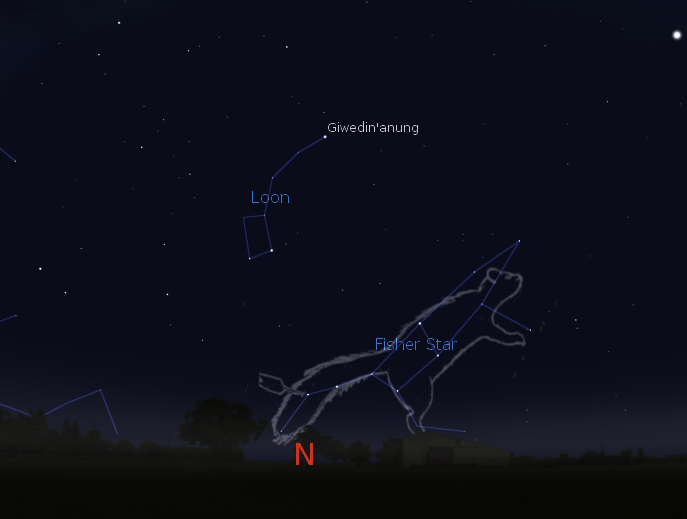
Fisher Star paints the autumn trees red at 11:20 p.m. November 7, 2013. Created using Stellarium.
For the story of the Fisher Star click here.
11/06/2013 – Ephemeris – Where’s the bright planets and comets this week?
Ephemeris for Wednesday, November 6th. The sun will rise at 7:27. It’ll be up for 9 hours and 57 minutes, setting at 5:24. The moon, 3 days past new, will set at 8:25 this evening.
Let’s check out the bright planets. Venus is brilliant in the west southwest after sunset. It will set at 7:46 p.m. The giant planet Jupiter will rise at 9:27 p.m. in the east northeast. It’s cruising against the stars of Gemini now. It will pass due south at 5:04 a.m. Mars will rise at 2:01 a.m. also in the east northeast. Reddish Mars is below and left of the slightly brighter star Regulus in Leo now. It’s in the east at 5 a.m. Comet ISON is nearly the distance below Mars that Mars is below Regulus and nearly in line with the two. My guesstimate for magnitude is about 8, about half as bright as current predictions, but probably visible in small telescopes. Comet ISON will rise about 3:30 a.m. and be visible before the sky begins to brighten around 6 a.m.
Times are for the Traverse City/Interlochen area of Michigan. They may be different for your location.
Addendum
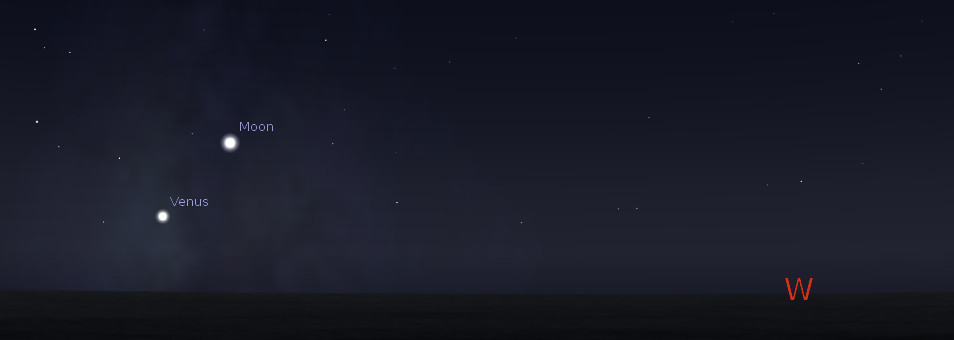
Venus and the Moon at 7 p.m. November 6, 2013. Created using Stellarium.
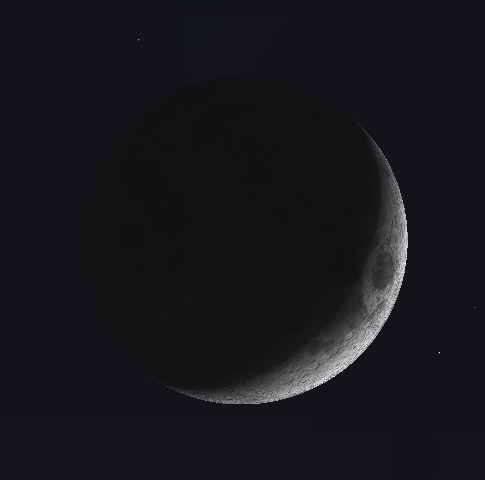
Closeup of the Moon at 7 p.m. November 6, 2013. Created using Stellarium.
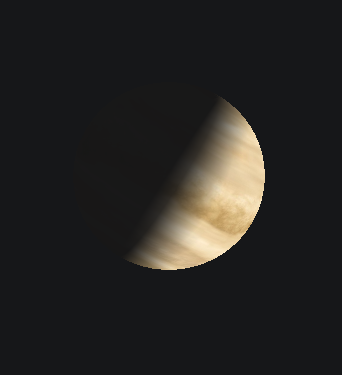
Telescopic view of Venus at 7 p.m. November 6, 2013. Created using Stellarium. The faint stripes are not seen in visible light.
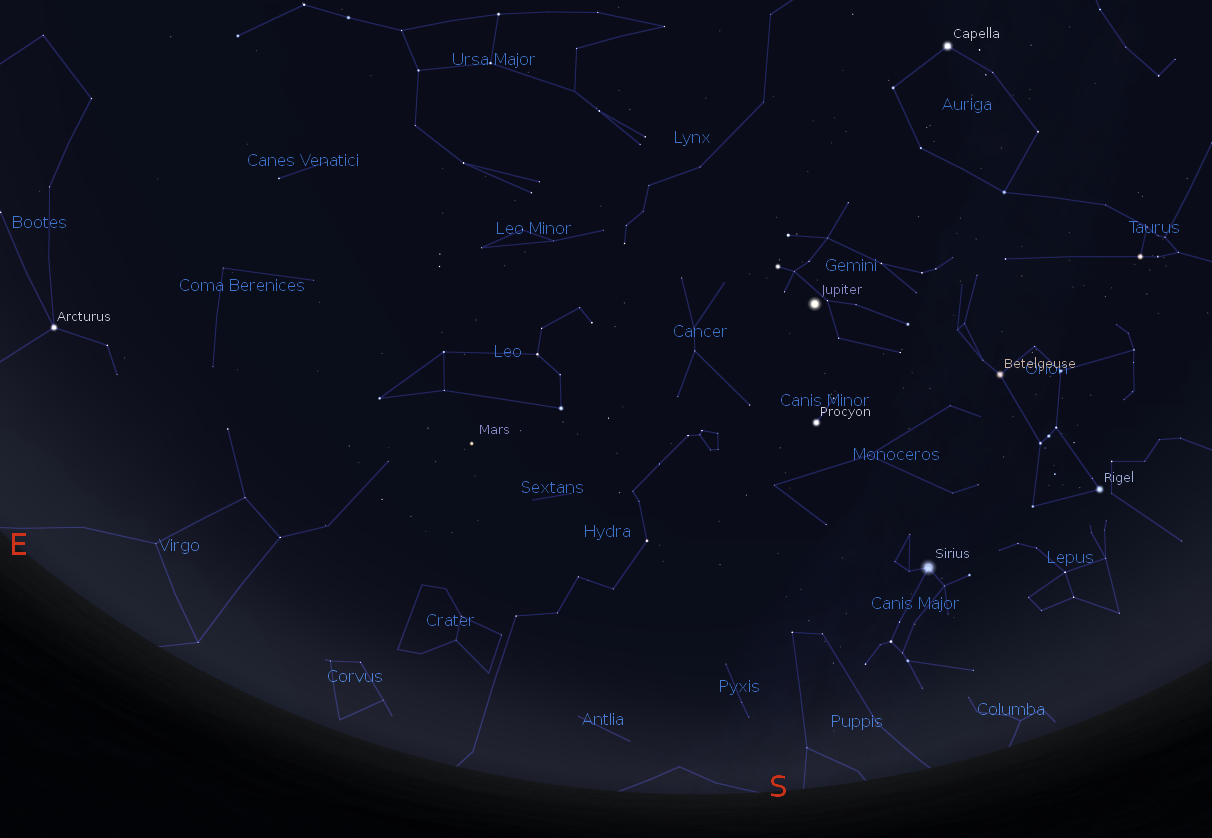
Jupiter and Mars with the winter and spring constellations at 6 a.m. November 7, 2013. Created using Stellarium.
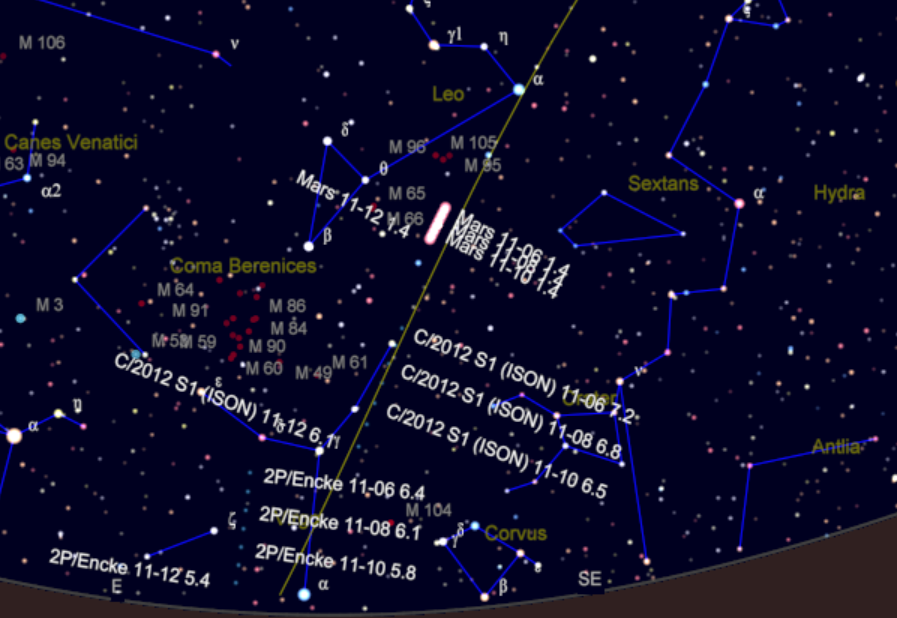
Comets ISON and Encke and Mars at 6 a.m. from November 5 to 12, 2013. Created with Cartes du Ciel.
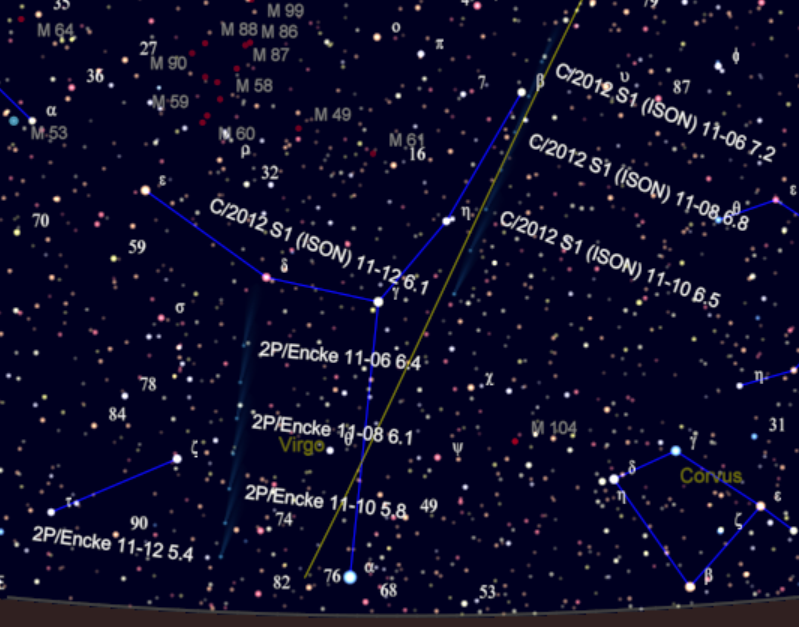
Closeup charts of comets ISON and Encke at 6 a.m. for November 6 through 12, 2013. Created using Cartes du Ciel.
11/05/2013 – Ephemeris – Latest on Comet ISON
Ephemeris for Election Day, Tuesday, November 5th. The sun will rise at 7:25. It’ll be up for 9 hours and 59 minutes, setting at 5:25. The moon, 2 days past new, will set at 7:23 this evening.
I’ve seen some observed brightness measurements of Comet ISON reported to the Minor Planet Center, which is the clearing house for all things asteroid and comet related, and Comet ISON is still fainter than predicted by a factor of two. There was one report of someone spotting it with 10X50 binoculars. From all the reports I’ve seen the comet’s nucleus is holding together, and there is great optimism that ISON will survive its close brush with the sun on Thanksgiving day. Some astronomers think that the comet’s nucleus spin axis is currently pointed toward the sun. After perihelion or closest approach to the sun, the opposite pole will be exposed showing fresh material to the sun for a brighter comet in December.
Times are for the Traverse City/Interlochen area of Michigan. They may be different for your location.
Addendum
Comets ISON and Encke and Mars at 6 a.m. from November 6 to 12, 2013. Created with Cartes du Ciel.
Closeup charts of comets ISON and Encke at 6 a.m. for November 6 through 12, 2013. Created using Cartes du Ciel.
 Bob Moler's Ephemeris Blog