Archive
01/20/2014 – Ephemeris – Wake up Rosetta!
Ephemeris for Dr. Martin Luther King Day, Monday, January 20th. The sun will rise at 8:12. It’ll be up for 9 hours and 22 minutes, setting at 5:34. The moon, 4 days before last quarter, will rise at 10:22 this evening.
Wake up Rosetta! That’s the message The that the European Space Agency or ESA wants sent to the Rosetta spacecraft to wake it up after 33 months of hibernation when it was too far from the sun for its solar panels to provide adequate power. The wake up call is ESA’s way of gaining the public’s attention for the events later this year when the spacecraft will rendezvous with a comet. Actually the probe will have to wake itself up. It set three alarm clocks, er… timers to wake it up today, find the sun and charge its batteries and phone home. The comet is 67P/Churyumov-Gerasimenko. After orbiting the comet’s nucleus the main spacecraft will release a probe called Philae to land, or actually grapple it. [the two and a half mile [4 km] diameter nucleus, which is known to be of an odd non-round shape.]
Times are for the Traverse City/Interlochen area of Michigan. They may be different for your location.
Addendum
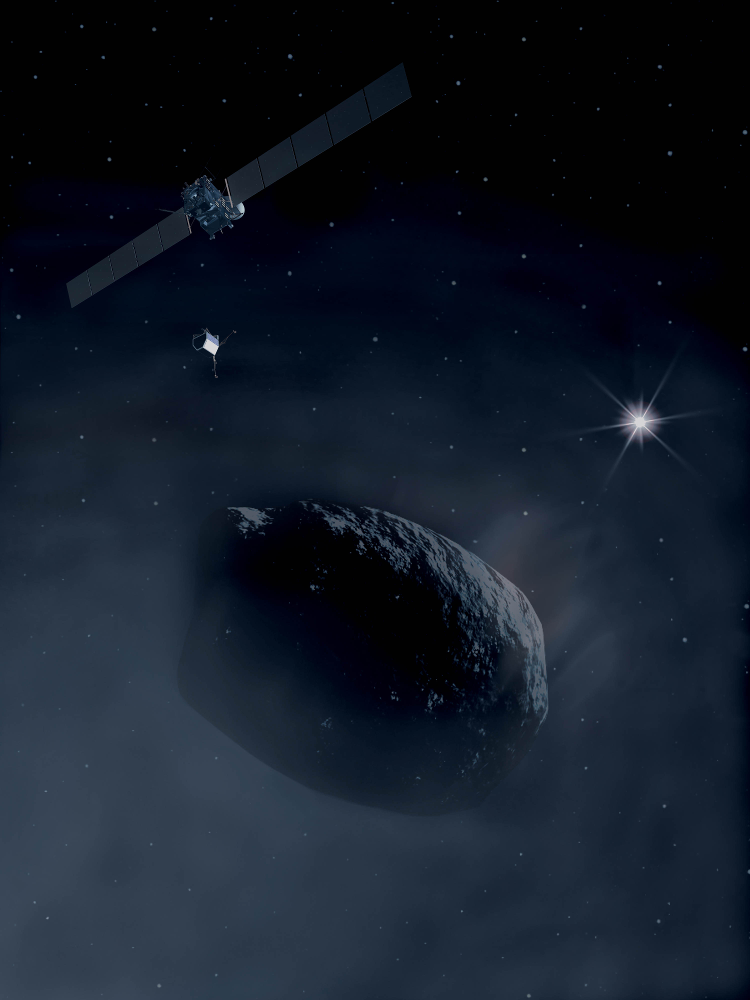
Artist’s rendering of Rosetta orbiting comet 67P/Churyumov–Gerasimenko and sending the Philae lander to the comet’s surface. Credit: ESA
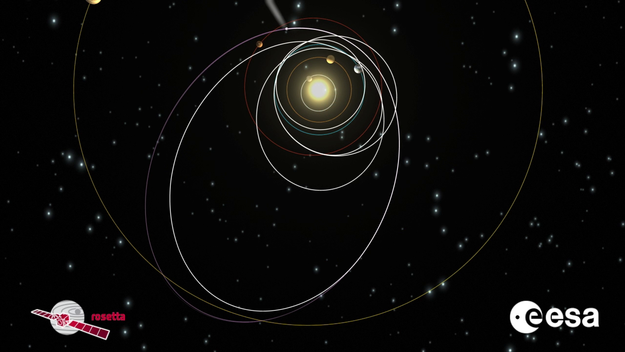
12 years of orbital maneuvers of Rosetta to match orbits with the comet. Credit ESA.
01/17/2014 – Ephemeris – The Moon tonight
Ephemeris for Friday, January 17th. The sun will rise at 8:14. It’ll be up for 9 hours and 16 minutes, setting at 5:30. The moon, 2 days past full, will rise at 7:23 this evening. | Let’s take a look at the moon as it’s still dominates the evening sky. The terminator, now that it’s after full moon is the sunset line. It is just starting to encroach on the small distinctive sea at the moon’s upper right edge called the Sea of Crises or Mare Crisium. Where is is situated on the edge of the spherical moon it appears to be elongated north to south. However if you saw it from overhead it would actually be elongated somewhat east to west. On the terminator at the moon’s equator is a large crater called Langrenus with a central peak on the edge of the Sea of Fertility or Mare Fecunditatis, that should be an easy binocular and a great telescopic crater some 80 miles in diameter. The smallest ting you can see on the moon in a small telescope is 2 miles in diameter.
Times are for the Traverse City/Interlochen area of Michigan. They may be different for your location.
Addendum
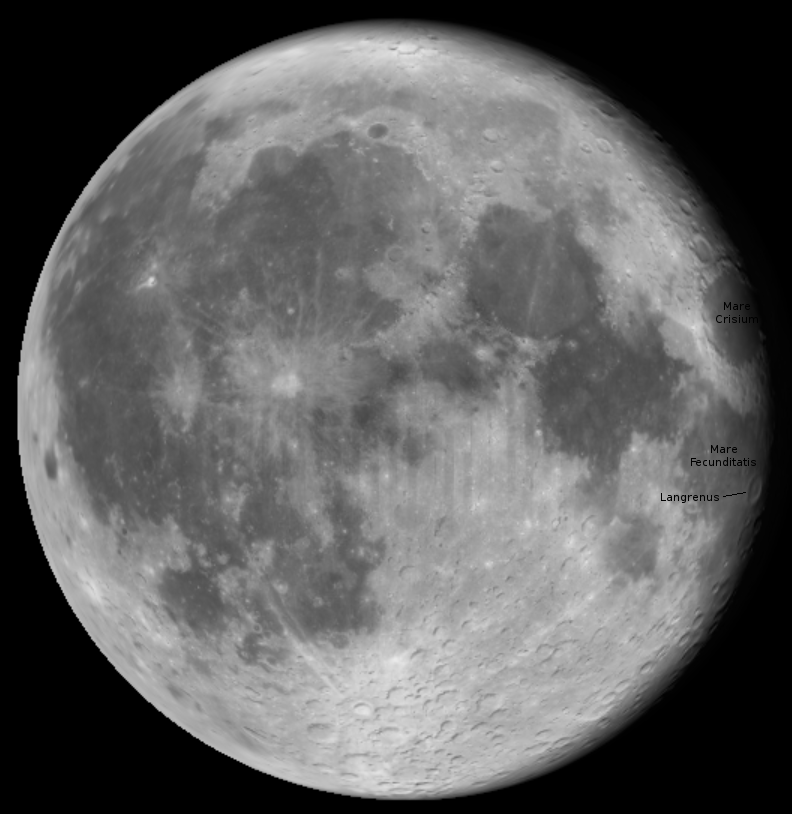
The Moon at 9 p.m., January 17, 2014. Created using Virtual Moon Atlas.
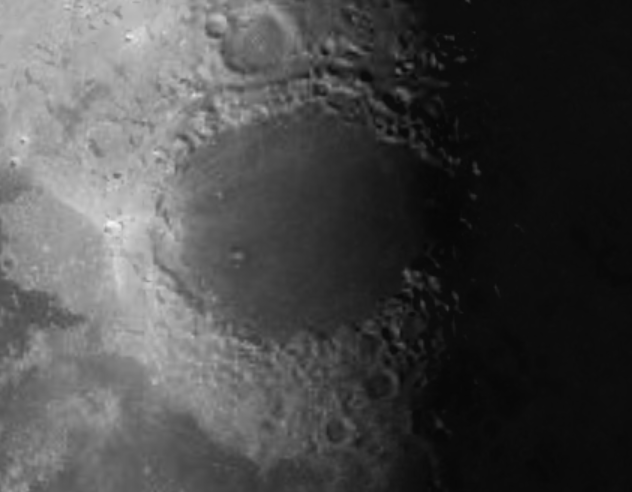
Mare Crisium as seen from overhead at 9 p.m., January 17, 2014. Created using Virtual Moon Atlas.
This last image cannot be seen without a spacecraft. The image was created using data from the Clementine spacecraft.
01/16/2014 – Ephemeris – NASA/JPL Solar System Ambassador
Ephemeris for Thursday, January 16th. The sun will rise at 8:15. It’ll be up for 9 hours and 14 minutes, setting at 5:29. The moon, 1 day past full, will rise at 6:25 this evening.
I am proud to announce that I have been appointed one of the NASA Jet Propulsion Laboratory’s new 38 new Solar System Ambassadors for 2014. Solar System Ambassadors are volunteers that host star parties, and provide presentations about space, the universe, and NASA missions to promote awareness of the STEM or Science, Technology, Engineering and Math fields as career choices or at least to encourage the students to become more science literate voters. Ambassadors work with school classes, scout groups and non-profit organizations. Being now newly retired I have the freedom of daytime visits. I will be serving the northwestern Lower Peninsula of Michigan. Interested? The easiest way to initially contact me by email is at info@gtastro.org or bob@bjmoler.org.
Times are for the Traverse City/Interlochen area of Michigan. They may be different for your location.
RIP John Dobson
I just learned that John Dobson passed away today. He was 98 years old. Dobson was the inventor of the Dobsonian Mount for Newtonian telescopes that revolutionized the mounting of large reflector telescopes, thus greatly reducing their price. He was also a co-founder of San Francisco’s Sidewalk Astronomers, an idea that got our society out of the NMC Observatory and on the road.
For new members of the Grand Traverse Astronomical Society he was invited here (Traverse City, MI) to give a talk at Northwestern Michigan College’s Hagarty Center in February 2007 when we were trying to raise money for our own Dobsonian telescope. That was a Saturday night, On Sunday night he came out to Northwestern Michigan College’s Joseph H. Rogers Observatory for a free get together, where he autographed some of our Dobsonian mounts. On Monday I took him out to the Leelanau School in Glen Arbor for a presentation, and he sat in on an astronomy class and an English class taught by Norm Wheeler at the school’s Lanphier Observatory.
Here are some photos from that visit.

John Dobson talking with an audience member after his talk.

John Dobson answering a question at Rogers Observatory

John Dobson with some members of the GTAS at the Rogers Observatory.
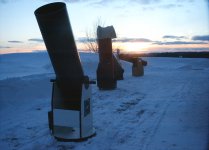
Members brought their Dobsonian telescopes to the Rogers Observatory for the event.
Update: John’s visit was 2007. I originally posted his visit was in 2008. Time flies when you’re not paying attention.
01/15/14 – Ephemeris – Where are the bright planets this week?
Ephemeris for Wednesday, January 15th. The sun will rise at 8:15. It’ll be up for 9 hours and 12 minutes, setting at 5:28. The moon, at full today, will rise at 5:28 this evening.
Let’s take our weekly look at the planets. The giant planet Jupiter is now alone in the evening sky. It will be in the eastern sky as darkness falls tonight. It’s cruising against the stars of Gemini now. It will pass due south at 12:05 a.m., and will set at 7:42 a.m. in the west northwest. Mars will rise at 12:28 a.m. in the east. Reddish Mars is in Virgo now and to the upper right of the bright star Spica by the three-quarters of the width of your fist held at arm’s length. Saturn will rise at 3:26 a.m. in the east southeast. It’s seen against Libra the scales this year. Venus will rise at 7:18 tomorrow morning, so it may become visible around 7:45 or so very low in the east southeast. It’s sudden appearance has caused come airport tower controllers to give it permission to land.
Times are for the Traverse City/Interlochen area of Michigan. They may be different for your location.
Addendum
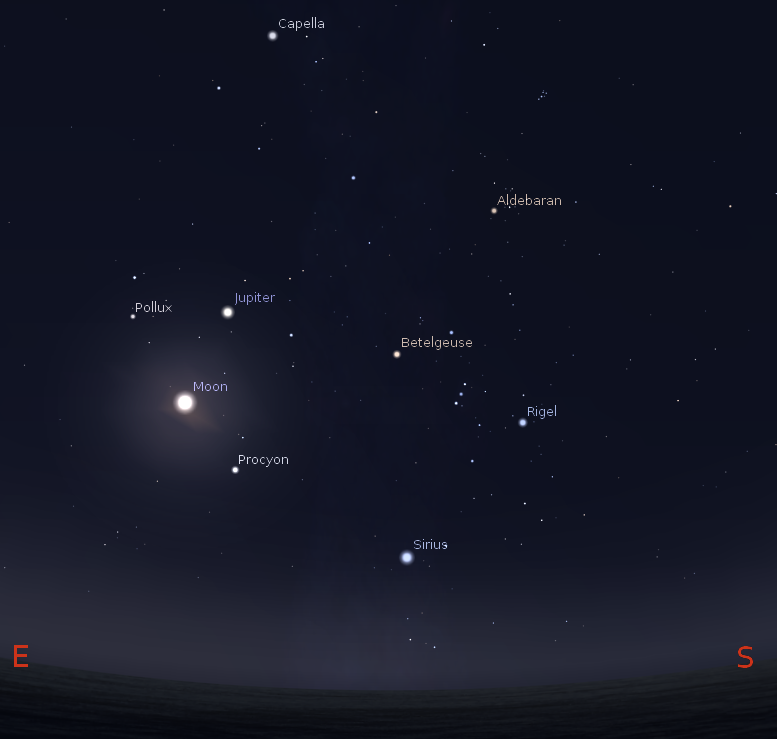
Jupiter, the Moon with the winter stars at 9 p.m. on January 15, 2014. Created using Stellarium.
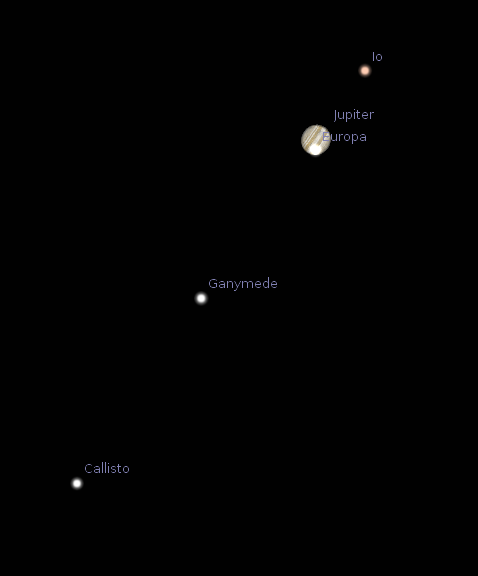
The telescopic Jupiter at 9 p.m. and January 15, 2014. The moon Europa is in front or transiting Jupiter. Created using Stellarium.
Europa, the smallest of the four Galilean satellites of Jupiter will transit the face of Jupiter tonight. It’s shadow will also cross that planet. The transit starts at 9:02 p.m. Stellarium is slightly off in that regard. Cartes du Ceil is better in that regard. Europa’s shadow starts to cross Jupiter at 9:33 p.m. Europa’s transit ends at 11:43 p.m., while it’s shadow leaves the face of Jupiter at 12:16 a.m. The source for these times is Project Pluto’s Jupiter Satellite Events page.
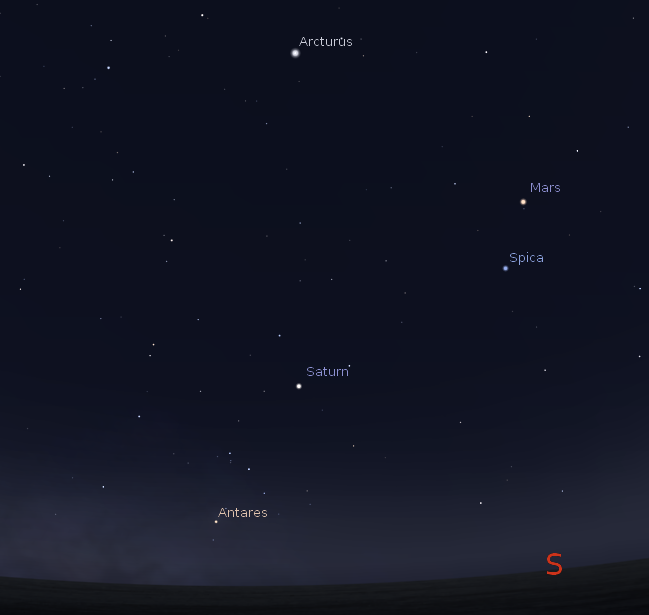
Mars and Saturn with the spring stars at 6:30 a.m. on January 16, 2014. Created using Stellarium.
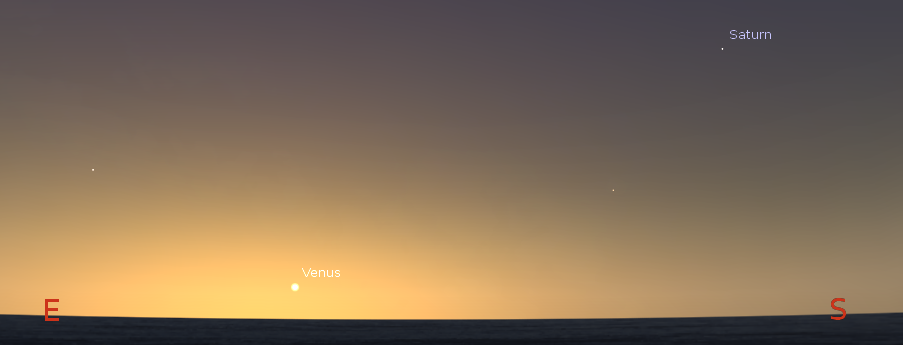
For the adventurous, Venus at 7:45 a.m. tomorrow morning January 16, 2014. Created using Stellarium.
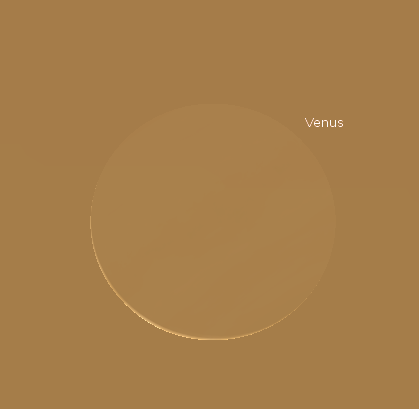
Venus as it might appear in a telescope at 7:45 a.m. tomorrow morning January 16, 2014. You will not see its night side, just the crescent. Created using Stellarium.
Want to see Venus closer to inferior conjunction? Check out Universe Today’s Virtual Star Party for January 12, 2014.
01/14/2014 – Ephemeris – The moon will appear to pass Jupiter tonight
Ephemeris for Tuesday, January 14th. The sun will rise at 8:16. It’ll be up for 9 hours and 10 minutes, setting at 5:27. The moon, 1 day before full, will set at 7:29 tomorrow morning.
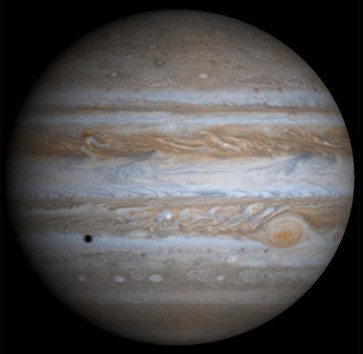
The planet Jupiter will appear close to the nearly full moon this evening. The moon will pass about 10 of its diameters south of Jupiter around 1 a.m. tomorrow morning. Until then, Jupiter will appear to the left of the moon. This is a good time to view Jupiter with a small telescope. Even binoculars will detect a tiny disk and several of Jupiter’s satellites. Jupiter is a gas giant planet made primarily of hydrogen. The clouds contain methane and ammonia whipped into parallel bands by Jupiter’s rapid rotation of nearly 10 hours. The planet has a noticeable equatorial bulge, which is accentuated visually by its horizontal cloud bands. Jupiter’s equatorial diameter is 89,000 miles [143,000 km], 11 times that of the earth. [Jupiter’s volume could hold about 1,300 Earths, but its mass is only about 318 Earths. Jupiter is less dense than the Earth by a factor of four.]
Times are for the Traverse City/Interlochen area of Michigan. They may be different for your location.
Addendum
[Content in brackets was not included in the broadcast program due to time constraints.]
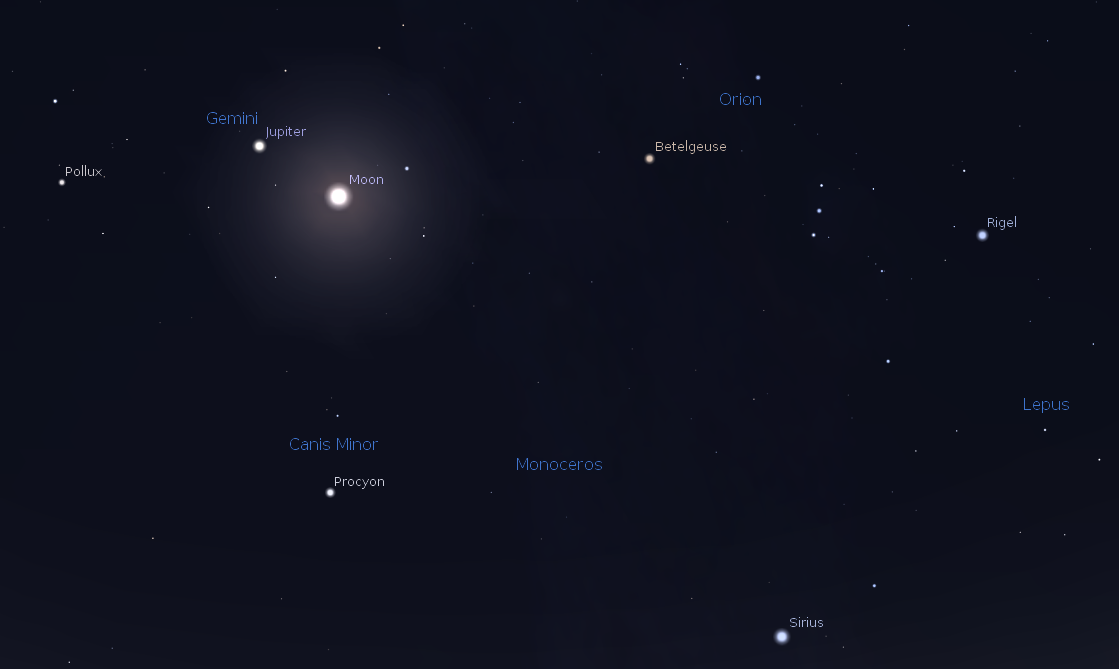
Jupiter, the Moon and the bright stars of winter at 9 p.m. on January 14, 2014. By 1 a.m. the Moon will have slipped to be directly below Jupiter. The Moon moves about its own diameter against the stars each hour. Created using Stellarium.
Jupiter as seen by the Cassini spacecraft as it passed by Jupiter gaining velocity on its way to Saturn. The black dot is the shadow of Europa. Credit: NASA/JPL – Caltech.
01/13/2014 – Ephemeris – Jupiter’s Great Red Spot
Ephemeris for Monday, January 13th. The sun will rise at 8:16. It’ll be up for 9 hours and 9 minutes, setting at 5:25. The moon, 2 days before full, will set at 6:49 tomorrow morning.
Jupiter is my youngest granddaughter’s favorite planet. She has books and pictures of Jupiter sporting its famous Great Red Spot. When I was a teenager in the 1950s, a bit older than she is now the Great Red Spot on Jupiter was indeed bright red. You couldn’t miss it in even the smallest telescopes. Since the early 1970s the spot has faded. At best it’s a pastel pink. The Great Red Spot appears to be a permanent feature of the Jovian atmosphere, an anti-cyclone that distorts the dark belts and bright zones of the planet. The dark belts are thought to be where air is sinking and the white zones are upwelling clouds. The Great Red Spot wanders east and west at about the same latitude within the atmosphere. I hope it gets really red soon.
Times are for the Traverse City/Interlochen area of Michigan. They may be different for your location.
Addendum
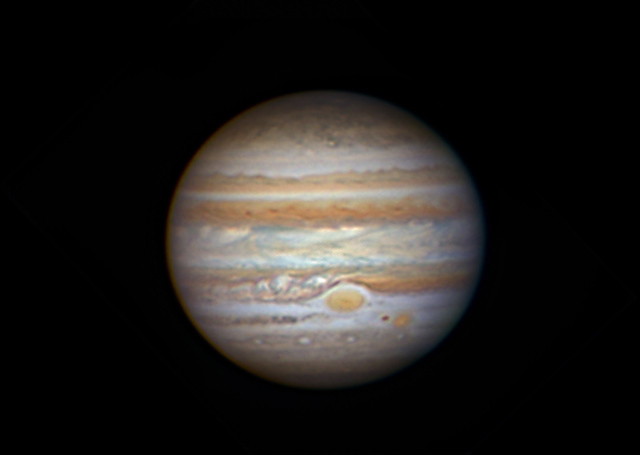
Jupiter with its Great Red Spot November 18, 2012 by Scott Anttila.
01/10/2014 – Ephemeris – Venus will pass inferior conjunction with the sun tomorrow.
Ephemeris for Friday, January 10th. The sun will rise at 8:18. It’ll be up for 9 hours and 4 minutes, setting at 5:22. The moon, 3 days past first quarter, will set at 4:19 tomorrow morning.
Tomorrow what has been our evening star during summer an autumn will pass between the Earth and the Sun and will enter the morning sky, where sharp-eyed observers will pick it up just before sunrise. That passage is called inferior conjunction, because Venus moves between the Earth and the Sun. Venus and Mercury are called inferior planets, not because of their quality, but because they orbit inside the earth’s orbit. Mars through Neptune are then of course superior planets. The last time Venus passed inferior conjunction, on June 5th, 2012 it passed directly in front of the sun in a rare transit. This time it will be north of the sun by about 5 angular degrees. There’s only a hundred and four years before the next transit.
Times are for the Traverse City/Interlochen area of Michigan. They may be different for your location.
Addendum
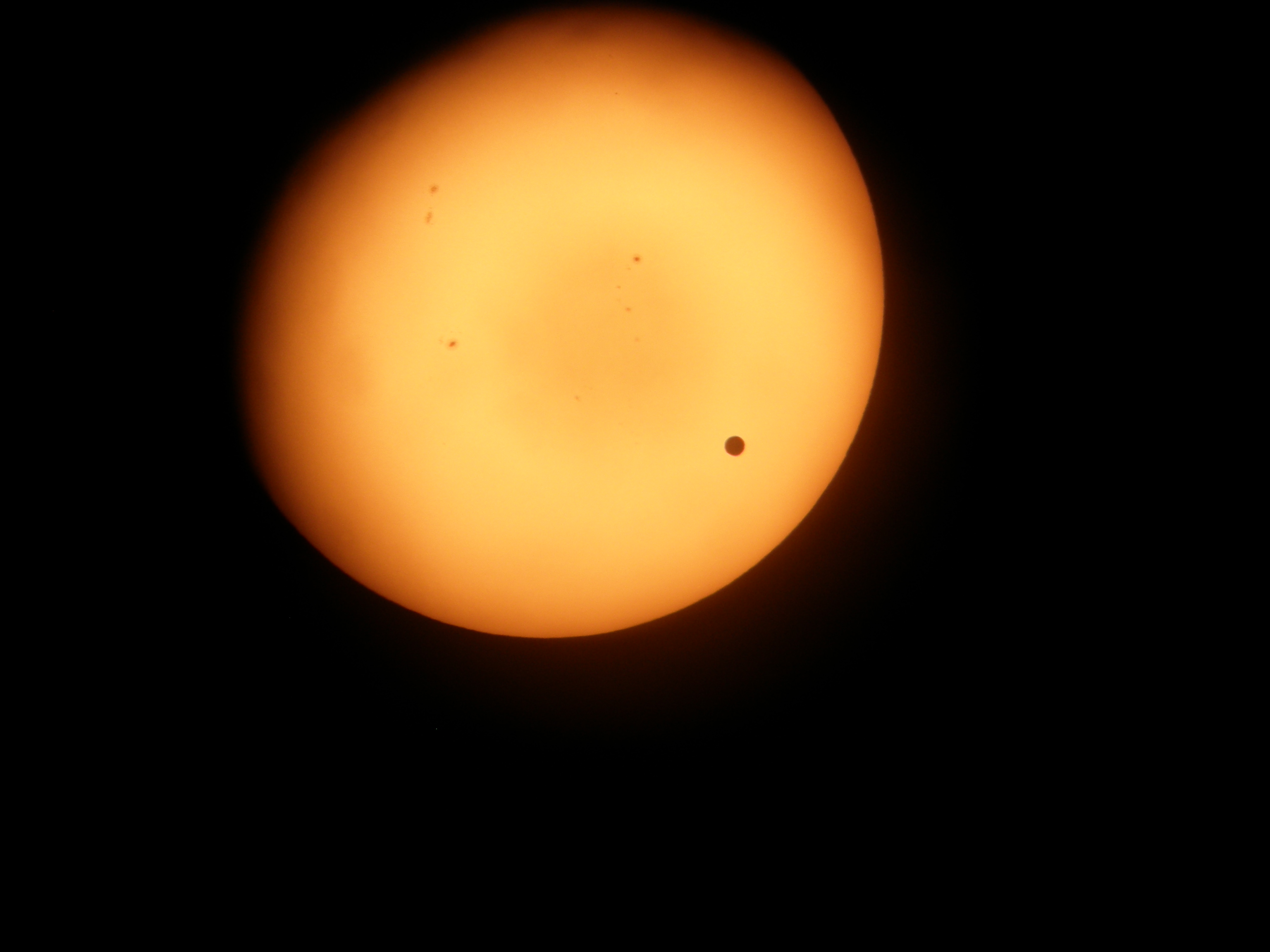
Gary Carlisle’s photo of the transit of Venus, June 5, 2012..
01/09/2014 – Ephemeris – More on Jupiter’s Galilean moons.
Ephemeris for Thursday, January 9th. The sun will rise at 8:18. It’ll be up for 9 hours and 3 minutes, setting at 5:21. The moon, 2 days past first quarter, will set at 3:20 tomorrow morning.
The planet Jupiter has, as of the latest count, 67 satellites or moons. However only four can be seen in small to medium-sized telescopes. Astronomers use the term moon and satellite interchangeably, though only moons orbit planets. A satellite is a more generic term and is a smaller body that orbits another larger body. Though we don’t usually call an artificial satellite orbiting the Earth a moon. Anyway, the four bright moons of Jupiter are called the Galilean moons, because Galileo discovered then in early 1610. Their names from Jupiter on out are Io, Europa, Ganymede and Callisto. They orbit over Jupiter’s equator. Since the planet has a very small axial tilt the moons seem to move back and forth from one side to the other of Jupiter in a nearly straight line.
Times are for the Traverse City/Interlochen area of Michigan. They may be different for your location.
Addendum
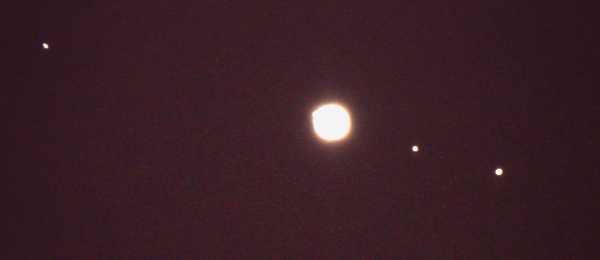
Jupiter and its four Galilean moons. The planet has to be over exposed to pick up the moons. But the eye can handle the brightness difference with no problem. This is one of my old pictures I do believe.
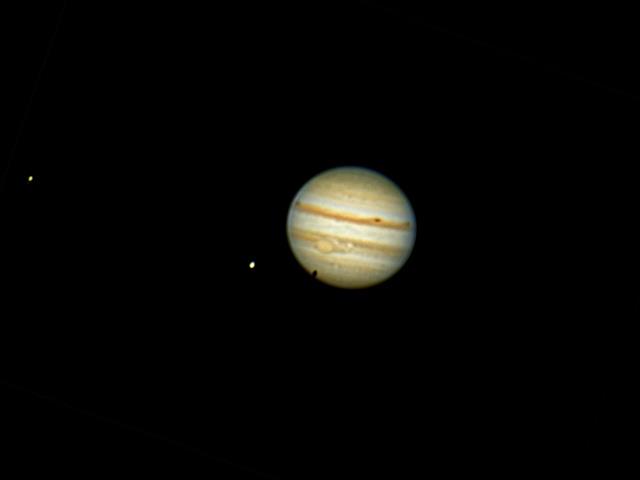
Jupiter with a solar eclipse in progress as Ganymede, lower left, casts its shadow on Jupiter on November 14, 2011 at about 10:15 p.m.. Credit: Scott Anttila.
The moon Io is off to the far left. This eclipse can be simulated with Cartes du Ciel.
01/08/2014 – Ephemeris – Where are the bright planets this week?
Ephemeris for Wednesday, January 8th. The sun will rise at 8:18. It’ll be up for 9 hours and 2 minutes, setting at 5:20. The moon, 1 day past first quarter, will set at 2:18 tomorrow morning.
This is our weekly look at the planets. Venus is only three days from passing between the Earth and the Sun in what astronomers call inferior conjunction. Sharp eyed observers may be able to spot it in the bright twilight glow before it sets at 5:57 p.m. tonight. It will then pass into the morning sky. The giant planet Jupiter will be in the eastern sky as darkness falls tonight. It’s cruising against the stars of Gemini now. It will pass due south at 12:32 a.m., and will set at 8:13 a.m. Mars will rise at 12:39 a.m. in the east. Reddish Mars is in Virgo now and to the upper right of the bright star Spica by the width of your fist held at arm’s length. Saturn will rise at 3:47 a.m. in the east southeast. It’s seen against Libra the scales this year.
Times are for the Traverse City/Interlochen area of Michigan. They may be different for your location.
Addendum
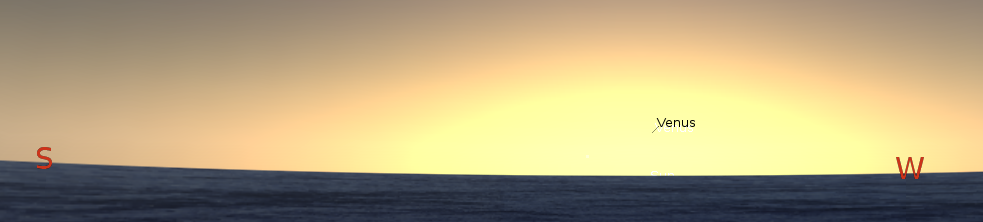
For diehards, Venus 15 minutes before it will set tonight January 8, 2014.
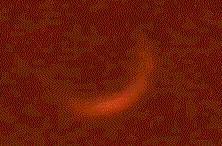
Venus at 3 days before inferior conjunction back in the late 1960’s. My photograph.
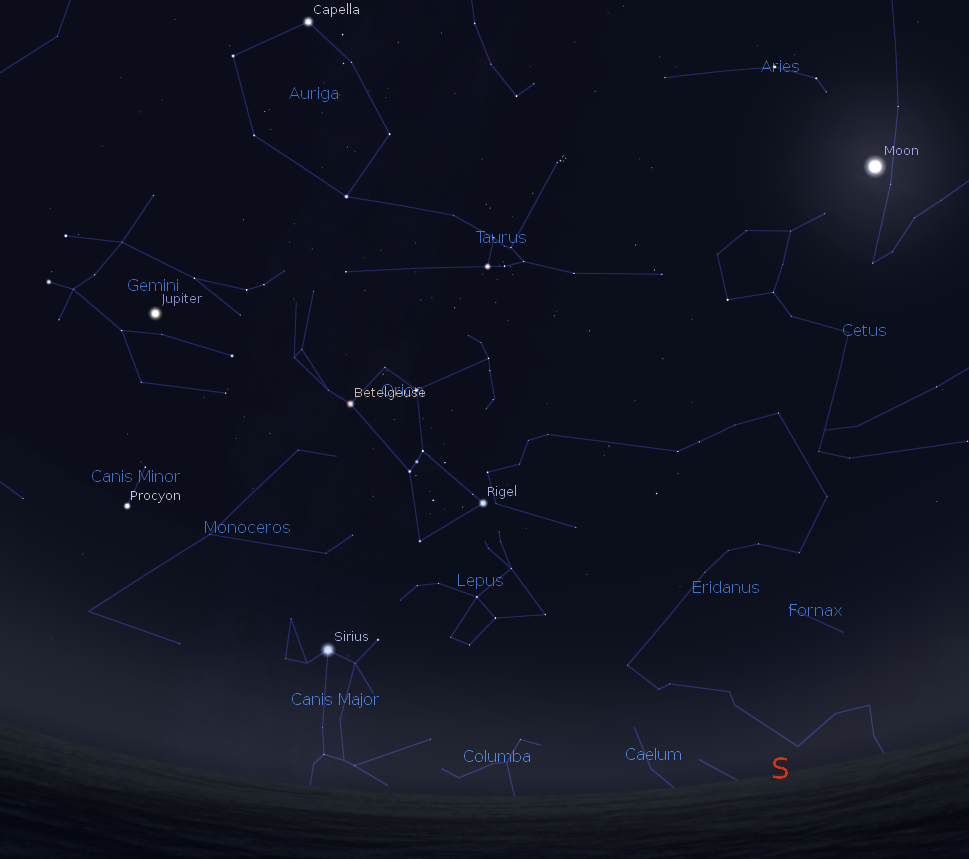
Jupiter, the Moon with the winter constellations at 9 p.m. on January 8, 2014. Created using Stellarium.
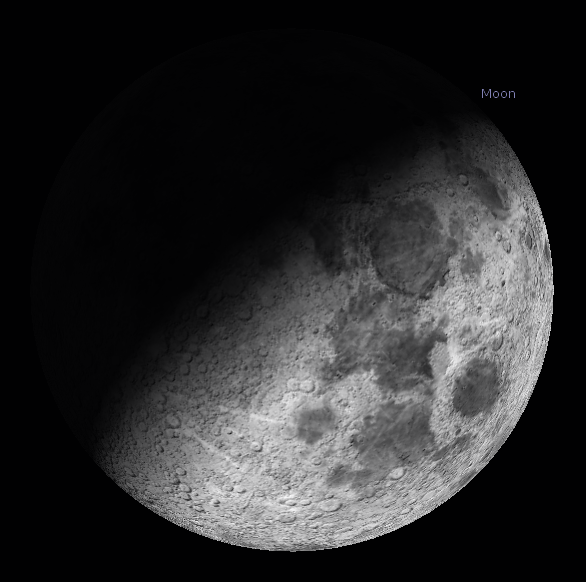
The telescopic moon at 9 p.m. January 8, 2014. Created using Stellarium.
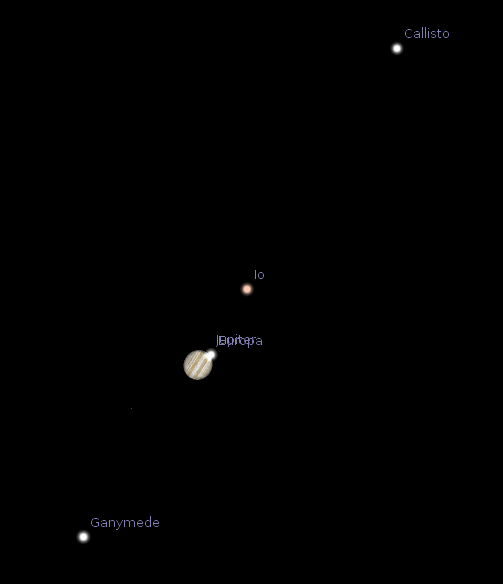
The telescopic Jupiter at 9 p.m. and January 8, 2014. The label for the moon Europa overlaps that of Jupiter. Created using Stellarium.
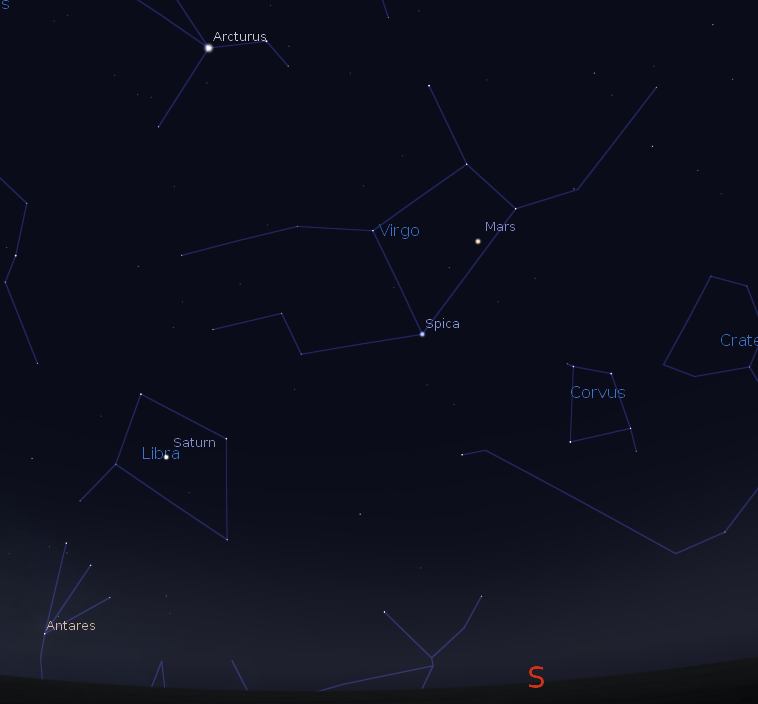
Mars and Saturn with the spring constellations at 6:30 a.m. on January 9, 2014. Created using Stellarium.
 Bob Moler's Ephemeris Blog