Archive
03/31/2014 – Ephemeris – Previewing April skies
Ephemeris for Monday, March 31st. The sun will rise at 7:25. It’ll be up for 12 hours and 43 minutes, setting at 8:08. The moon, 1 day past new, will set at 9:30 this evening.
The 4th month of the year begins tomorrow. Daylight hours in the Interlochen/Traverse City area and will increase from 12 hours and 46 minutes tomorrow to 14 hours 11 minutes on April 30th. The altitude, or angle, of the sun above the southern horizon at local noon will be 50 degrees tomorrow and will ascend to 60 degrees on April 30th. The altitude of the sun in the Straits area will be a degree lower. The actual time of local apparent noon this month for the Interlochen/Traverse City area, when the sun passes due south, will be about 1:43 p.m. The big event for this month will be a total lunar eclipse visible from our area in the wee hours of the morning on April 15th. It’s the first or two lunar eclipses visible from here this year. The other is in October.
Times are for the Traverse City/Interlochen area of Michigan. They may be different for your location.
Addendum
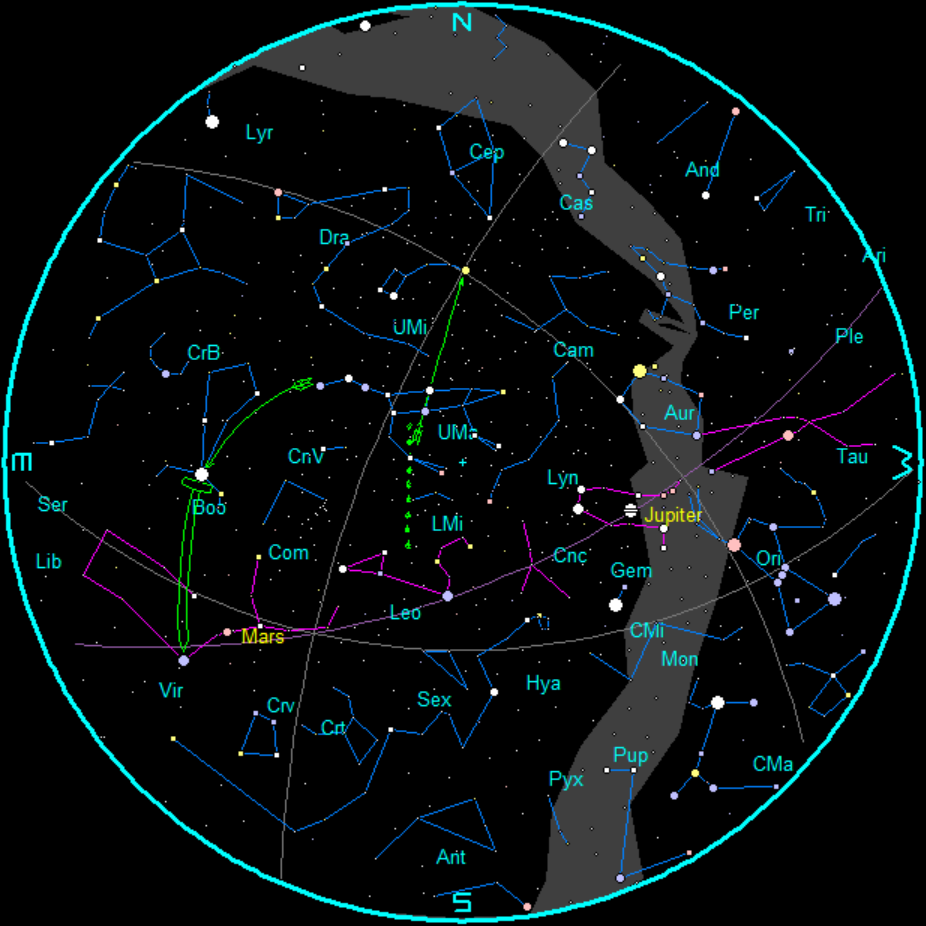
Star Chart for mid-month for April 2014 at 10 p.m. Credit: Bob Moler.
Add a half hour to every week before the 15th and subtract and hour for every week after the 15th.
For a list of constellation names to go with the abbreviations click here.
03/28/2014 – Ephemeris – Mars approaches
Ephemeris for Friday, March 28th. The sun will rise at 7:30. It’ll be up for 12 hours and 34 minutes, setting at 8:04. The moon, 2 days before new, will rise at 6:40 tomorrow morning.
The planet Mars is making its every 26 month on average close approach to the Earth. Mars will reach opposition from the sun on April 8th, rising at sunset and setting at sunrise. Due to Mars’ strongly elliptical orbit, it will actually be closest to us 6 days later on April 14th. That distance will be about 57.4 million miles, nearly twice that if its closest distance of 34.6 million miles it came back in 2003. But take heart, the opposition distances are closing. On July 31, 2018 it will again be below 36 million miles away. Even at its closest, Mars is a tiny object for the telescope. It’s half the size of the Earth and at its closest will appear less that half the size that Jupiter appears to us.
Times are for the Traverse City/Interlochen area of Michigan. They may be different for your location.
Addendum
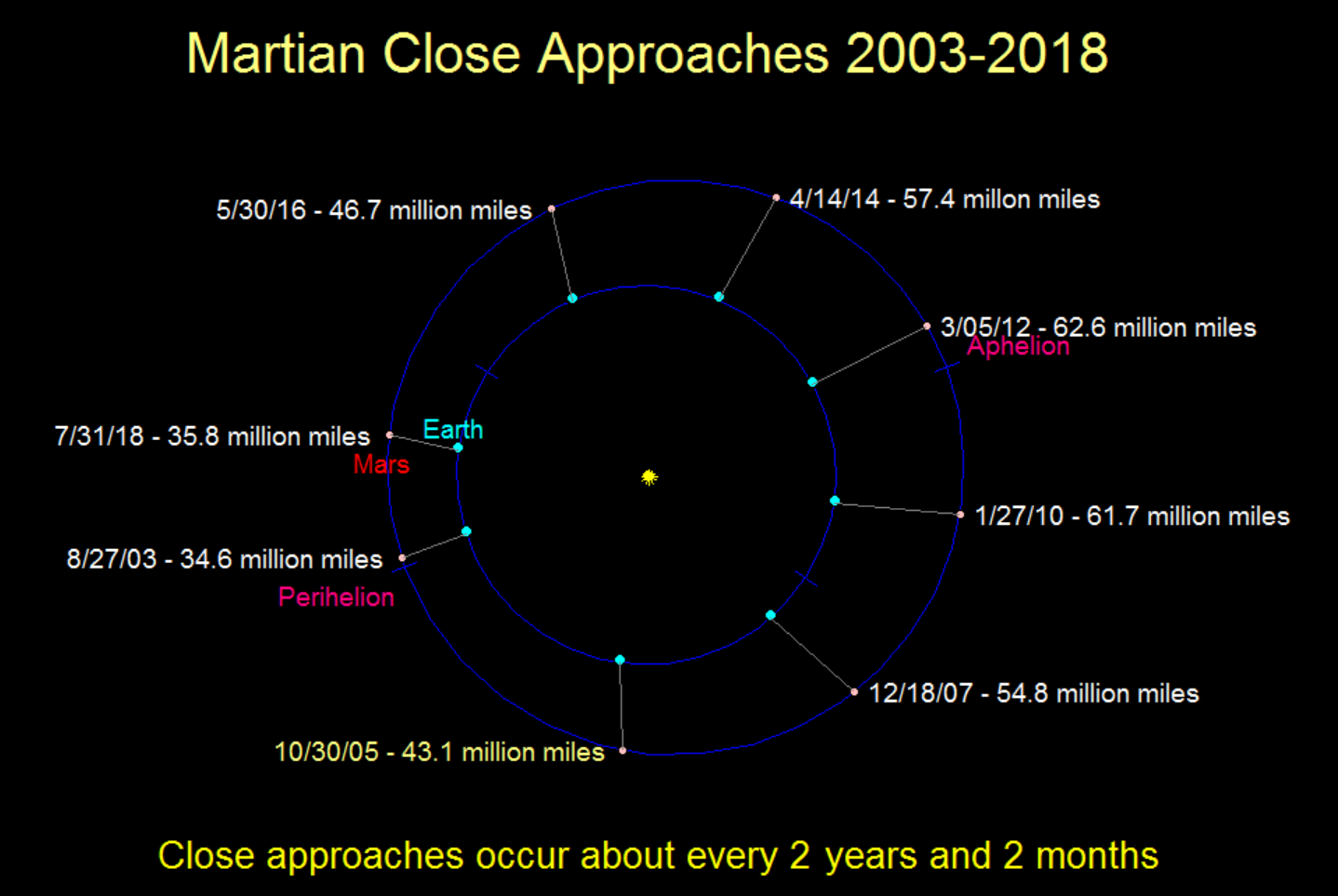
Mars’ closest approaches with the earth 2003 to 2018. Created with my LookingUp program.
03/27/2014 – Ephemeris – Hydra and the Great Underwater Panther
Ephemeris for Thursday, March 27th. The sun will rise at 7:32. It’ll be up for 12 hours and 31 minutes, setting at 8:03. The moon, 3 days before new, will rise at 6:06 tomorrow morning.
Today I will take a fresh, for me at least look at the constellation of Hydra the water snake of Greek origin and the Great Underwater Panther of our local Anishinabek people. Between the bright star Regulus in Leo the lion and Procyon in Canis Minor, Orion’s small hunting dog is a drooping group of 6 stars that makes up the head of Hydra. The rest of his stars trail snakily to the southeastern horizon at 10 p.m. He won’t be fully risen until 1 a.m. In the mythology of the Anishinabek people The head of Hydra is the head of the Great Underwater Panther, his back and tail run to Regulus and the front of Leo. In the spring of thinning ice when someone broke through it was credited to this panther, who pulled the person underwater.
Times are for the Traverse City/Interlochen area of Michigan. They may be different for your location.
Addendum
The Anishinabek people contain the Ojibwe or Chippewa, Ottawa or Odawa, and Algonquin peoples. The Chippewa and Ottawa are indigenous to much of northern Michigan.
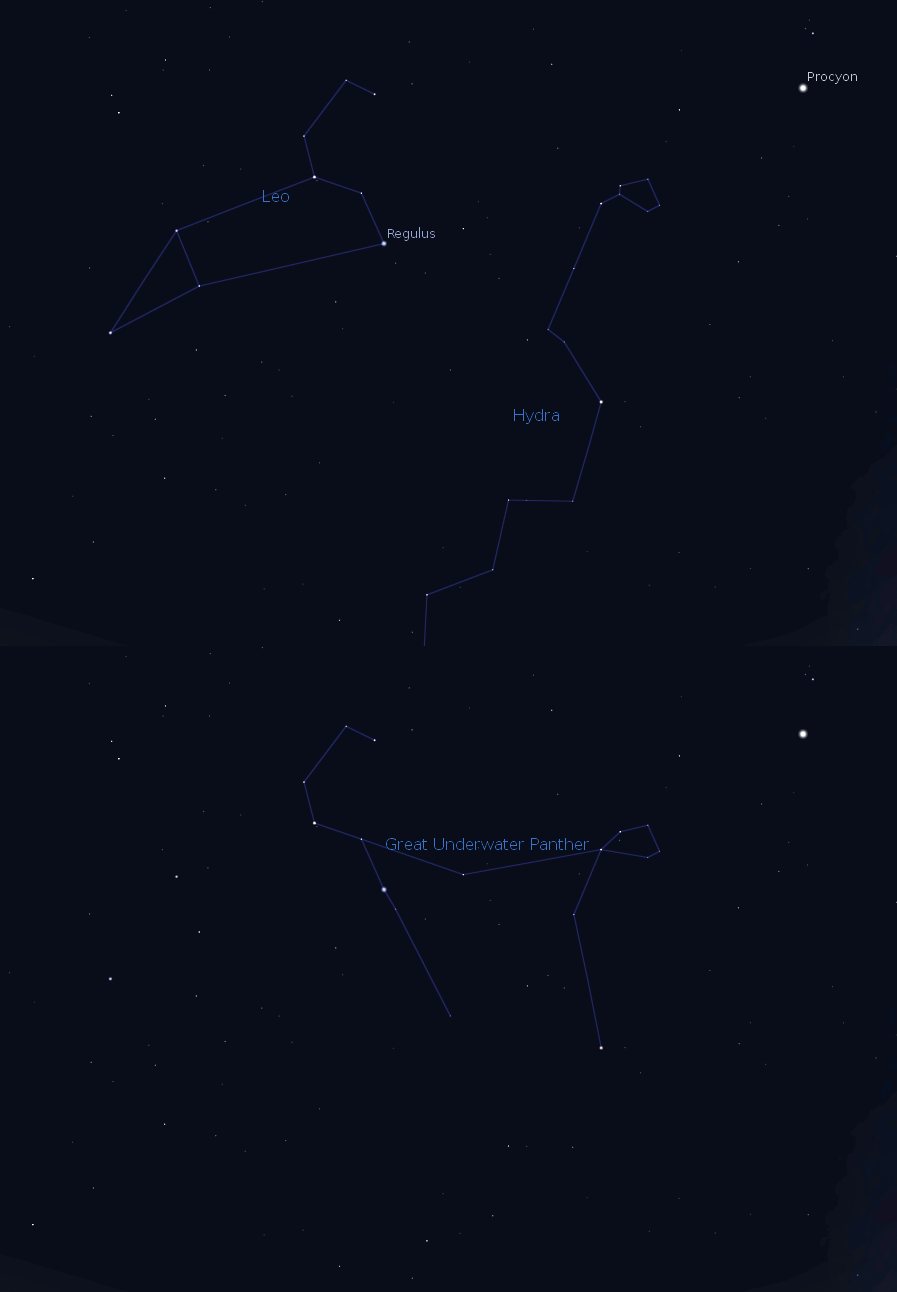
Alternately showing Leo and Hydra of our “Western” constellations and the Anishinabek constellation of the Great Underwater Panther. Created using Stellarium. The constellation drawing of the panther is mine after Michael Wassegijig Price.

The constellation Great Underwater Panther screen shot taken from the YouTube video “Stellar Connections: Explorations in Cultural Astronomy – Pt. 2” by Michael Wassegijig Price.
Below is the video source for the above image.
Here is a link to the video.
03/26/2014 – Ephemeris – It’s Wednesday, do you know where the bright planets are?
Ephemeris for Wednesday, March 26th. The sun will rise at 7:34. It’ll be up for 12 hours and 28 minutes, setting at 8:02. The moon, 3 days past last quarter, will rise at 5:31 tomorrow morning.
Wednesday is Bright Planets Day here on Ephemeris. Jupiter will be in the southern sky as darkness falls tonight. It’s cruising against the stars of Gemini now, and moving east after spending a couple of months backtracking to the west. It will set at 3:56 a.m. in the west-northwest. Reddish Mars is in Virgo now and left and a bit above bright star Spica in the late evening, which it now outshines. Mars will rise at 9:19 p.m. It will pass due south at 2:54 a.m. It’s 61 million miles away now. Saturn will rise at 11:53 p.m. in the east-southeast. It’s seen against the stars of Libra the scales this year. Venus will rise at 5:43 tomorrow morning. The crescent moon will appear above left of Venus then.
Times are for the Traverse City/Interlochen area of Michigan. They may be different for your location.
Addendum
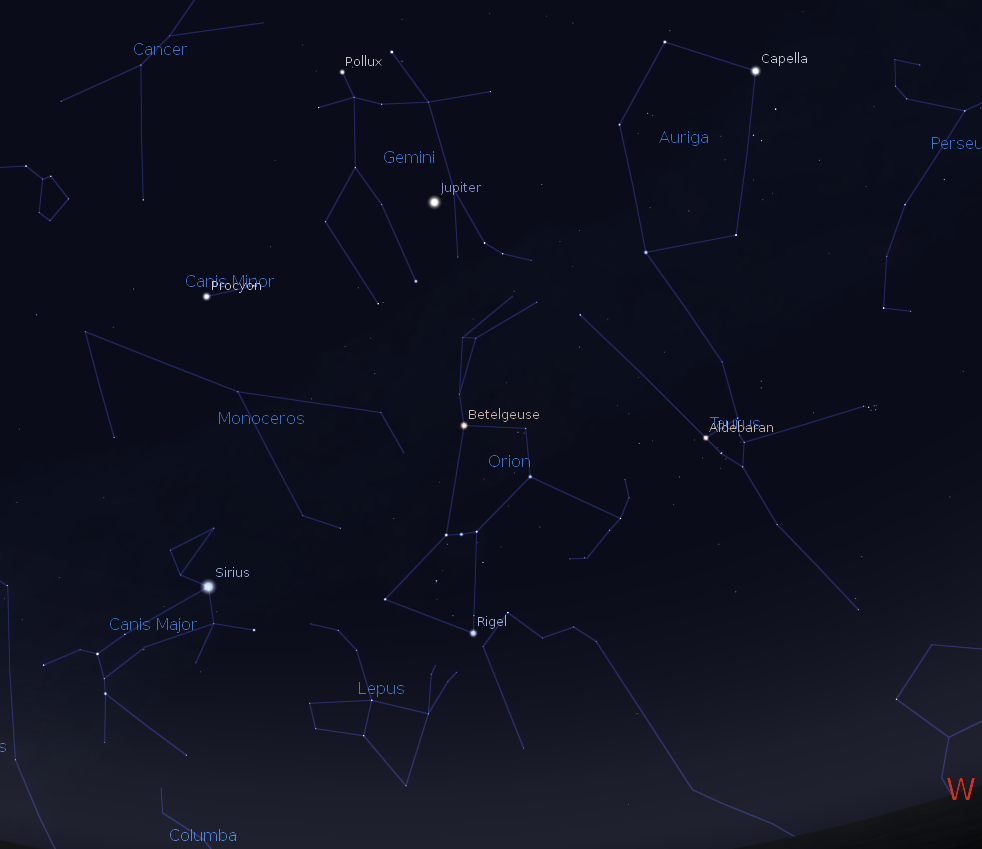
Jupiter and the winter constellations at 10 p.m. on March 26, 2014. Created using Stellarium.
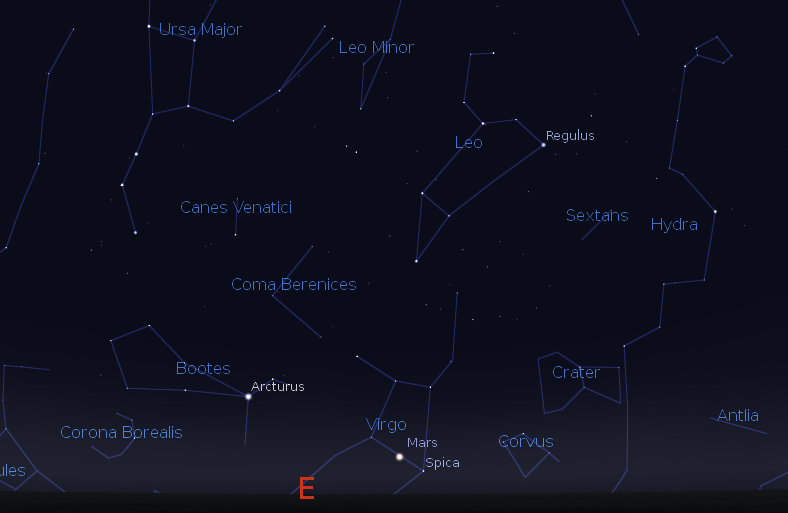
Mars and the spring constellations at 10 p.m. on March 26, 2014. Created using Stellarium.
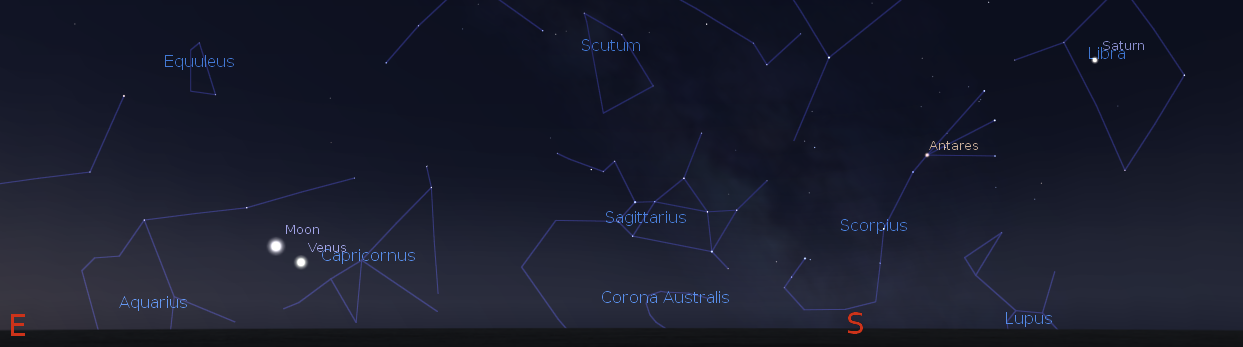
Saturn, Venus and the Moon with the constellations of summer at 6:30 a.m. on March 27, 2014. I’ve added Venus’ orbit and the ecliptic. Created using Stellarium.
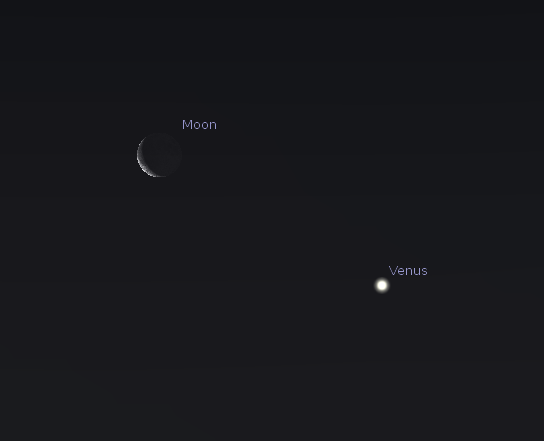
Venus and the crescent Moon at 6:30 a.m. March 27, 2014. Created using Stellarium.
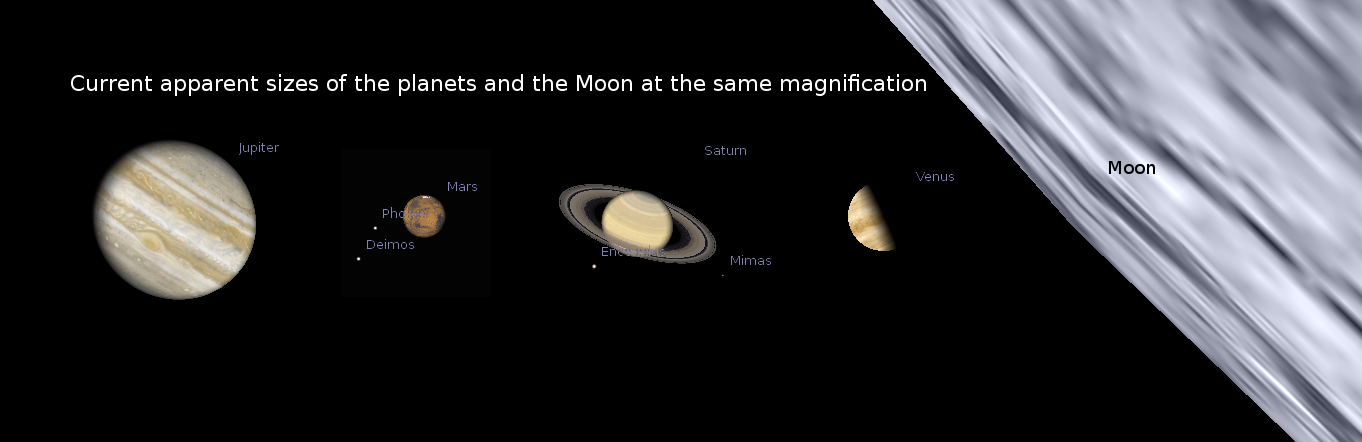
Relative sizes of the planets as seen in a telescope using the same magnification. Created using Stellarium.
03/25/2014 – Ephemeris – The new Cosmos series
Ephemeris for Tuesday, March 25th. The sun will rise at 7:36. It’ll be up for 12 hours and 24 minutes, setting at 8:01. The moon, 2 days past last quarter, will rise at 4:52 tomorrow morning.
Unless you’ve been living under a rock for the past few months, you are aware of the new Cosmos series that’s been broadcast on Fox and National Geographic Channels. The title is Cosmos, a Spacetime Odyssey, and it’s hosted by New York’s Hayden Planetarium director Neil deGrasse Tyson. If the TV is not your thing there are free apps for the iPhone, iPad and Android devices to view the programs. Also there’s a website cosmosontv.com, where the episodes can be replayed. However it looks like each episode will be only be available for something like 8 weeks from the air date. It’s on Fox TV at 9 p.m. on Sundays, National Geographic Channel at 10 p.m. on Mondays. Cosmos: A Spacetime Odyssey is a really great series, a worthy successor to Carl Sagan’s original Cosmos series 34 years ago.
Times are for the Traverse City/Interlochen area of Michigan. They may be different for your location.
03/24/2014 – Ephemeris – The spring constellation of Leo the lion
Ephemeris for Monday, March 24th. The sun will rise at 7:38. It’ll be up for 12 hours and 21 minutes, setting at 7:59. The moon, 1 day past last quarter, will rise at 4:09 tomorrow morning.
Tonight about 10:00 the constellation of Leo the lion can be seen half way up the sky in the east-southeast. The head and mane of a male lion is seen as a backward question mark. This pattern of stars is also called the sickle. The bright star that is the dot at the bottom is Regulus, the “Little King Star”. To the lower left is a triangle of stars that is the lion’s hind end with the star Denebola at the far end. It is said that the reason the figure of a lion came to be seen in the stars here is because lions came from the desert, driven by the heat, to drink from the river Nile the time of the year that the sun was in this part of the sky. Leo is one of the constellations of the Zodiac. Leo can also be found by first locating the Big Dipper high in the northeast. Imagine a hole drilled in the bowl of the dipper and the water will fall on Leo’s back.
Times are for the Traverse City/Interlochen area of Michigan. They may be different for your location.
Addendum
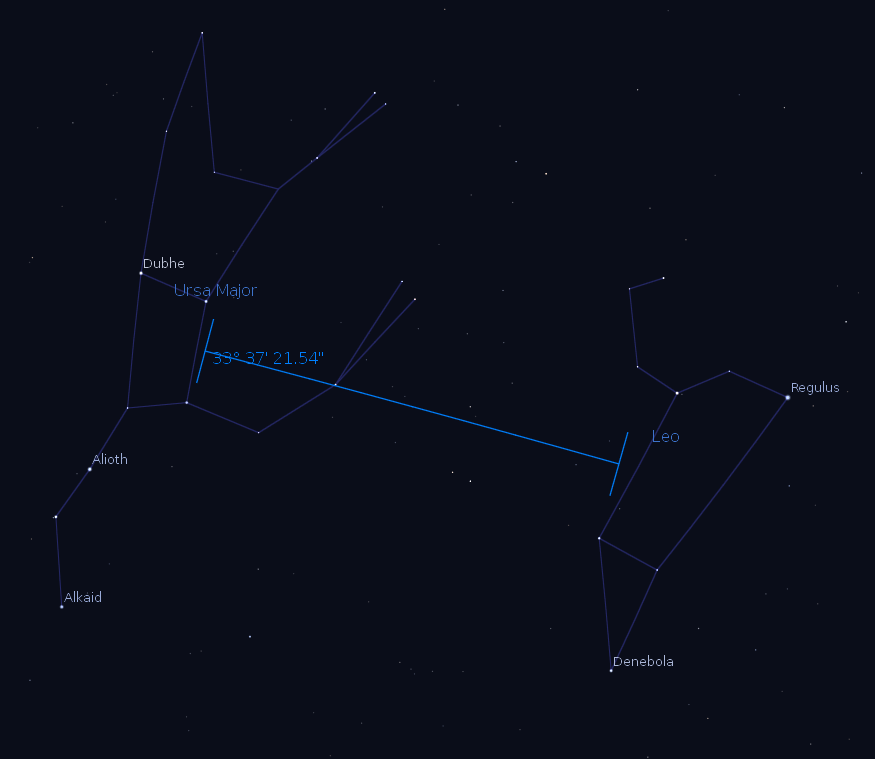
Leo and the Big Dipper (Ursa Major) using the angle measuring tool as an arrow. Date: March 24, 10 p.m. Created using Stellarium.
03/21/2014 – Ephemeris – Star party and Venus this weekend
Ephemeris for Friday, March 21st. The sun will rise at 7:43. It’ll be up for 12 hours and 12 minutes, setting at 7:56. The moon, 2 days before last quarter, will rise at 1:27 tomorrow morning.
Tomorrow evening the Grand Traverse Astronomical Society will host a star party at Northwestern Michigan College’s Rogers Observatory starting at 9 p.m. On tap if it’s clear will be the planets Jupiter and Mars. As it gets darker, the wonders of the winter sky will still be visible, along with those of the spring skies. The observatory is located south of Traverse City, on Brimley Road between Garfield and Keystone roads. There is a small admission charge for the college. For early morning risers the planet Venus will reach its greatest elongation west of the sun tomorrow at an angle of 47 degrees. From there on late October Venus will appear to be approaching the sun, before emerging into the evening sky.
Times are for the Traverse City/Interlochen area of Michigan. They may be different for your location.
Addendum
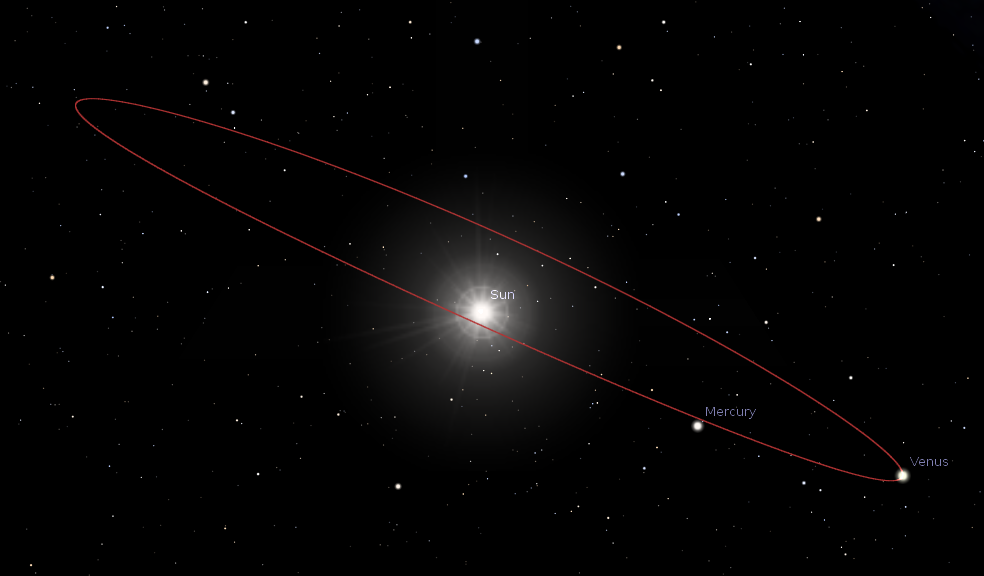
Venus at greatest western elongation and its orbit as seen from the earth on March 22, 2014. Created using Stellarium.
The sun looks off-center because we are looking at the orbit from the Earth, and Venus’ orbit is inclined by about 3º from our orbit. The near side of the orbit is only 25 million miles (40 million km) from Earth and is thus foreshortened. The part of the orbit right below the Sun is beyond the Sun and about 93 million miles (150 million km) away from us. Mercury is shown, but not its orbit.
03/20/2014 – Ephemeris – Spring is a few hours away
Ephemeris for Thursday, March 20th. The sun will rise at 7:45. It’ll be up for 12 hours and 9 minutes, setting at 7:54. The moon, 3 days before last quarter, will rise at 12:24 tomorrow morning.
Just hang on for a few more hours and winter will be over. At 12:57 p.m. this afternoon (16:57 UT, March 20, 2014) the sun will appear to cross the earth’s celestial equator heading northward signaling the start of spring in the northern hemisphere. Unfortunately our weather won’t change that instantaneously. The word equinox means equal night, meaning at day and night are of equal length. However due to how astronomers actually define the instant of sunrise and sunset we are already above 12 hours daylight, and increasing by 3 minutes a day. The southern hemisphere of the earth will see the start of autumn as we see spring. The sun will rise due east today and set due west, which may mean hazardous visibility on east west roads with the low sun for a few days.
Times are for the Traverse City/Interlochen area of Michigan. They may be different for your location.
Addendum
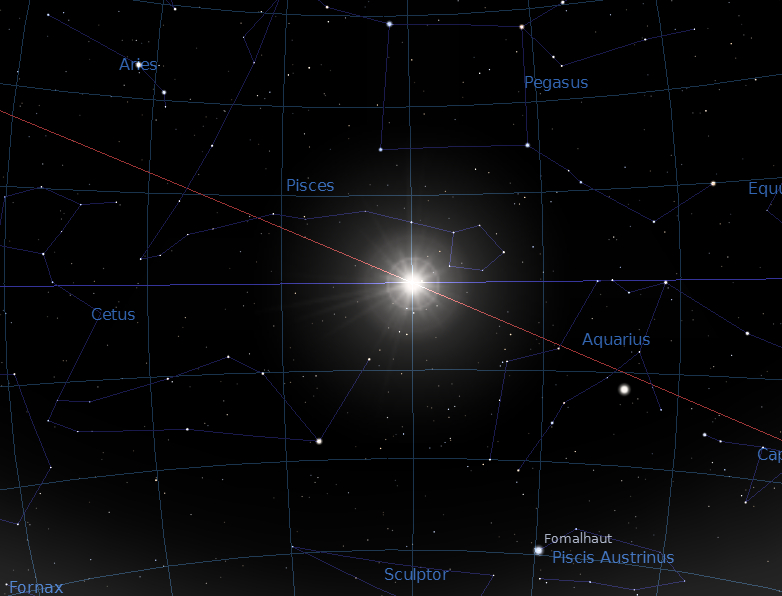
The sun at the vernal equinox point in the sky. The horizontal line the sun is crossing is the celestial equator. The red line is the sun’s path, the ecliptic. The sun is heading to the upper left. Created using Stellarium.
03/19/2014 – Ephemeris – Wednesday is bright planet day
Ephemeris for Wednesday, March 19th. The sun will rise at 7:47. It’ll be up for 12 hours and 6 minutes, setting at 7:53. The moon, 3 days past full, will rise at 11:19 this evening.
Wednesday is bright planet day on Ephemeris. Jupiter will be in the southern sky as darkness falls tonight. It’s cruising against the stars of Gemini now, and moving east after spending a couple of months backtracking to the west. It will pass due south at 8:39 p.m., and will set at 4:22 a.m. in the west-northwest. Reddish Mars is in Virgo now and left and a bit above bright star Spica in the late evening, which it now outshines. Mars will rise at 9:56 p.m. It will pass due south at 3:29 a.m. Saturn will rise at 12:21 a.m. in the east-southeast. It’s seen against the stars of Libra the scales this year. Venus will rise at 5:48 tomorrow morning and shines brightly in the southeast before sunrise. It will reach its greatest angle from the sun on Saturday.
Times are for the Traverse City/Interlochen area of Michigan. They may be different for your location.
Addendum
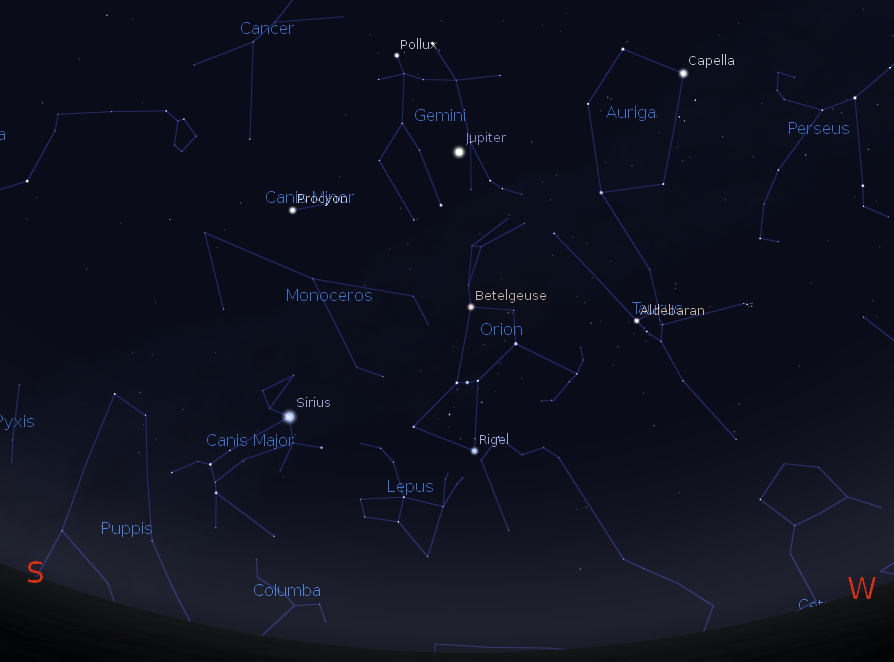
Jupiter and the winter constellations at 10 p.m. on March 19, 2014. Created using Stellarium.
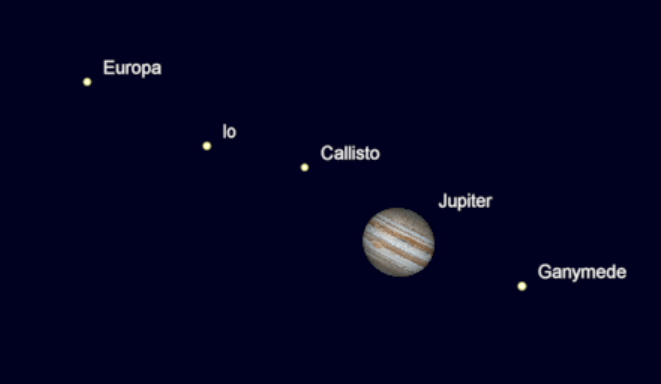
- Jupiter and moons at 10 p.m. on March 19, 2014. Created using Cartes du Ciel.
Note the Great Red Spot. It will transit the disk ( be centered) at 10:48 p.m. Since the 1960’s the Great Red Spot has not been that red. It’s faded quite a bit since then. I tend to think of it a a pastel pink. This is a north is up view, but most telescopes invert the image and/or show a mirror image, so don’t give up too soon.
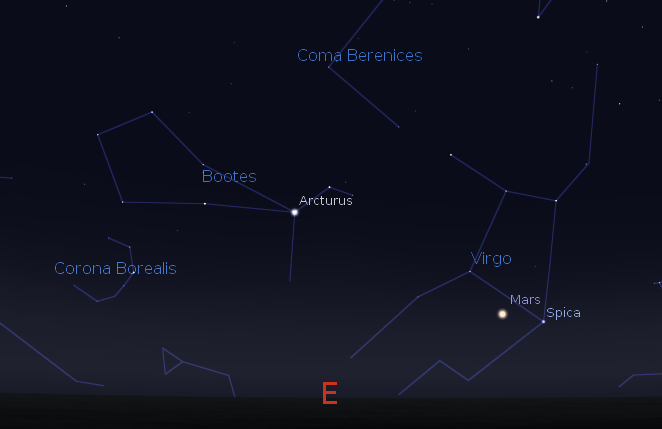
Mars low in the east at 11 p.m. on March 19, 2014. Created using Stellarium.
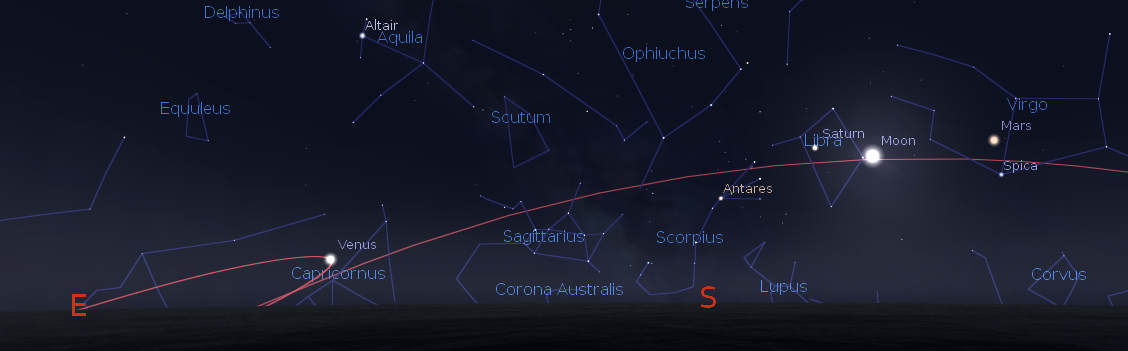
- Mars, Saturn, and Venus with the constellations of summer at 6:30 a.m. on March 20, 2014. I’ve added Venus’ orbit and the ecliptic. Created using Stellarium.
Saturday Venus will be at its greatest western elongation from the sun of 47º. As can be seen it’s about there now. The ecliptic is the plane of the earth’s orbit, and the other planets stick reasonably close to it because the solar system is essentially flat. I’m sure the new Cosmos will cover how the solar system formed and the reason the solar system is flat and also one way.
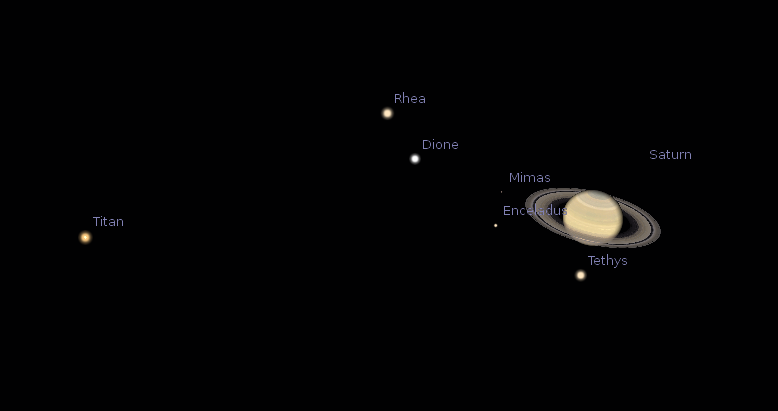
Saturn and its moons at 6:30 a.m., March 20, 2014. Only the moon Titan can be easily seen in small telescopes. Created using Stellarium.
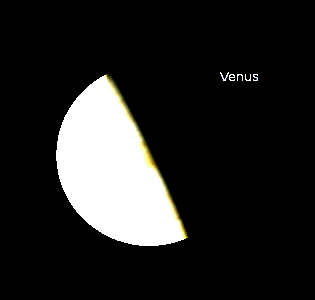
Venus at 6:30 a.m., March 20, 2014. I burned in the image of Venus because that’s what it looks like. Stellarium shows the Venusian clouds as seen in ultraviolet light. In white light Venus is a cue ball. Created using Stellarium.
Spring starts tomorrow!
03/18/2014 – Ephemeris – Thursday a.m. many folks including New Yorkers will see a bright star wink out
Ephemeris for Tuesday, March 18th. The sun will rise at 7:49. It’ll be up for 12 hours and 3 minutes, setting at 7:52. The moon, 2 days past full, will rise at 10:15 this evening.
On Thursday morning the 20th around 2 a.m. the star Regulus, the brightest star in the constellation Leo the lion will wink out for up to 14 seconds for observers in New York City. That will be exceptionally cool, because Regulus is one of the few stars actually bright enough to be visible from that metropolis. Regulus will not be at fault, but for a narrow band of the earth running northwest of there the asteroid 163 Erigone will pass in front of Regulus in an extremely rare occultation of a bright star. This will allow observers on the ground to time the duration of the event and put together the silhouette of the asteroid, which is thought to be 45 miles wide. Observers have in the past spotted secondary occultations of another asteroid and discovered an asteroid satellite.
Times are for the Traverse City/Interlochen area of Michigan. They may be different for your location.
Addendum
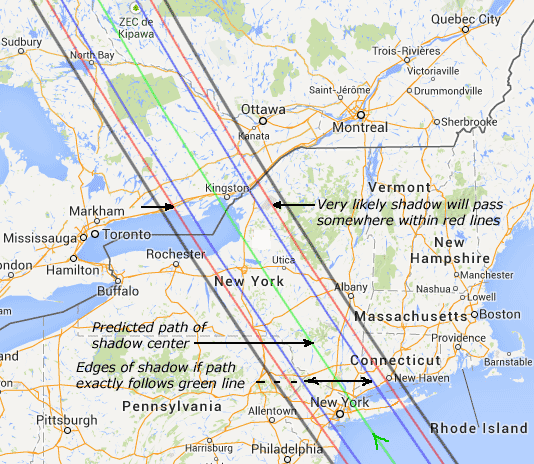
Part of the occultation path of Regulus. See link below. Credit: Geoff Hitchcox / IOTA and Sky & Telescope magazine
Here’s a link to the Sky and Telescope site with lots more information. Clicking on their map will bring up an interactive Google earth map.
 Bob Moler's Ephemeris Blog