Archive
04/16/2014 – Ephemeris – It’s our weekly look at the classical planets
Ephemeris for Wednesday, April 16th. The sun rises at 6:56. It’ll be up for 13 hours and 31 minutes, setting at 8:28. The moon, 1 day past full, will rise at 10:14 this evening.
Wednesday is Bright Planets Day, or should I say classical planets day here on Ephemeris. Bright Jupiter will be in the western sky as darkness falls tonight. It will set at 2:42 a.m. Reddish Mars is in Virgo and outshines the bright bluish star Spica below it as darkness falls. Mars is up at sunset in the east. It will pass due south at 1:03 a.m. It’s 57.4 million miles away now, very near its closest. It will set at 6:48 a.m. Saturn will rise at 10:24 p.m. and be seen to the left of the bright moon tonight. It will pass due south at 3:22 a.m. The telescope will bring out Saturn’s beautiful rings, whose short dimension now is as wide as the planet. Brilliant Venus will rise in the east at 5:22 a.m. and will stay pretty low to the horizon.
Times are for the Traverse City/Interlochen area of Michigan. They may be different for your location.
Addendum
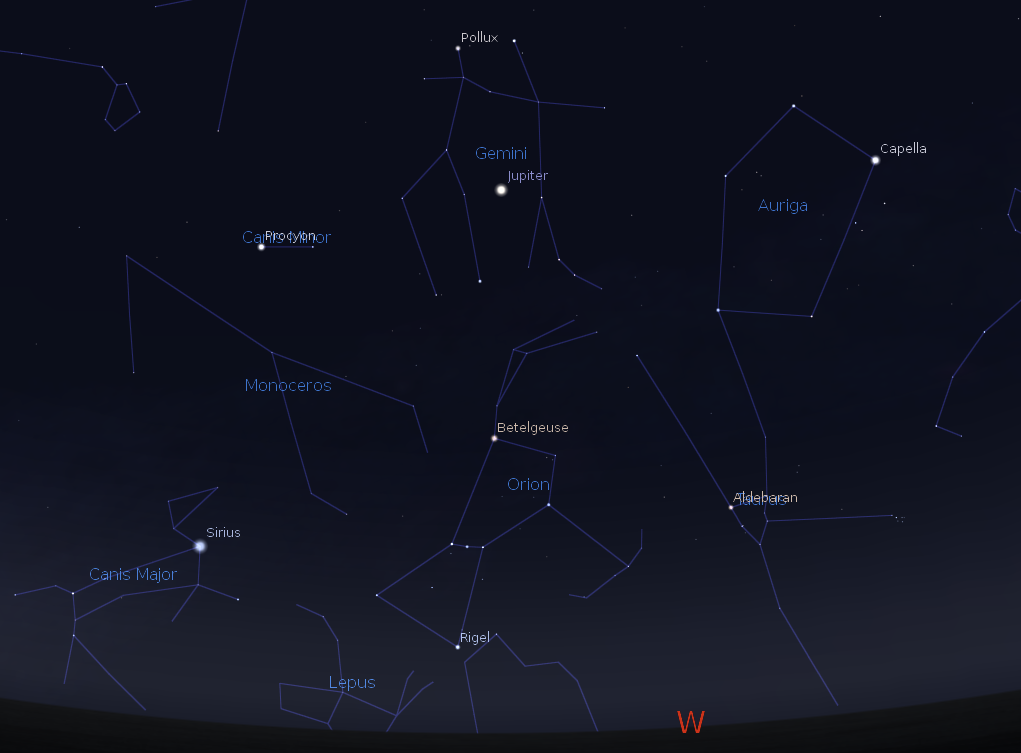
Jupiter and the setting winter constellations in the west at 10 p.m. on April 16, 2014. Created using Stellarium.
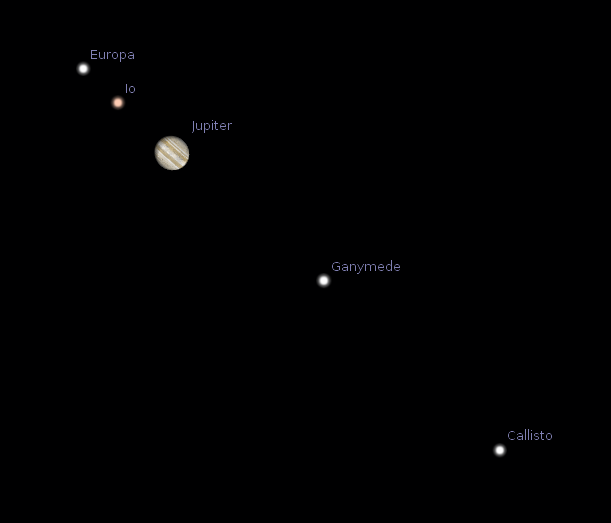
Jupiter and satellites through a telescope at 10 p.m. on April 16, 2014. Created using Stellarium.
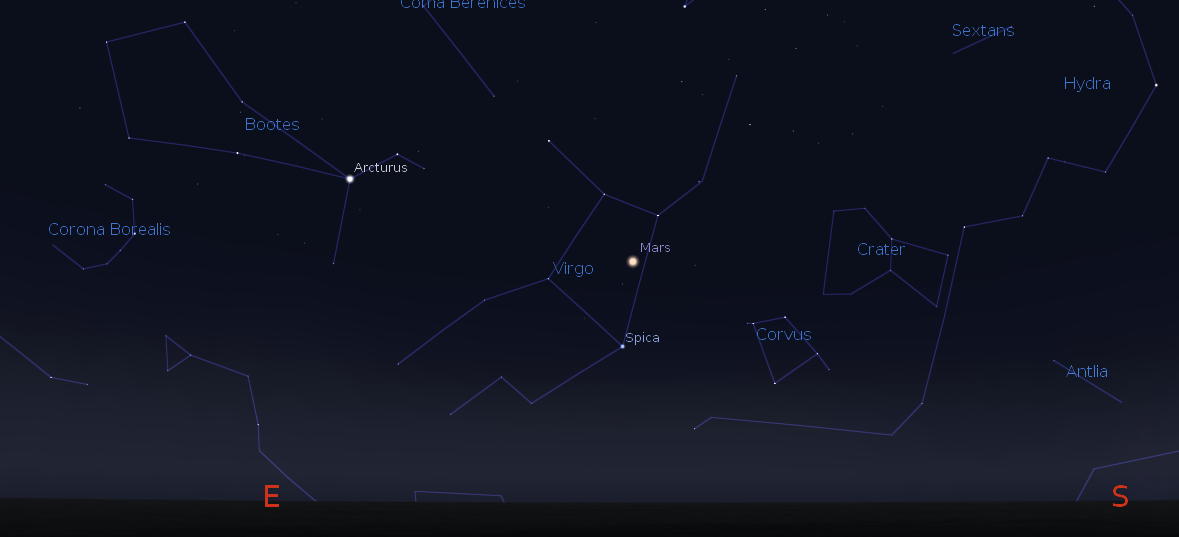
Mars and some low spring constellations in the southeast at 10 p.m. on April 16, 2014. Created using Stellarium.
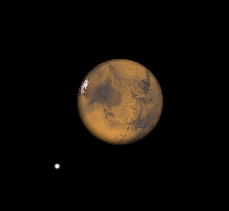
Telescopic Mars. Actually Mars is much smaller in appearance than Jupiter. Interesting albedo* features can be seen. For 10 pm. April 16, 2014. Created using Stellarium.
* Albedo – reflectance value, dark and bright features. Values are 1 for perfectly reflectant (white), to 0 for black.
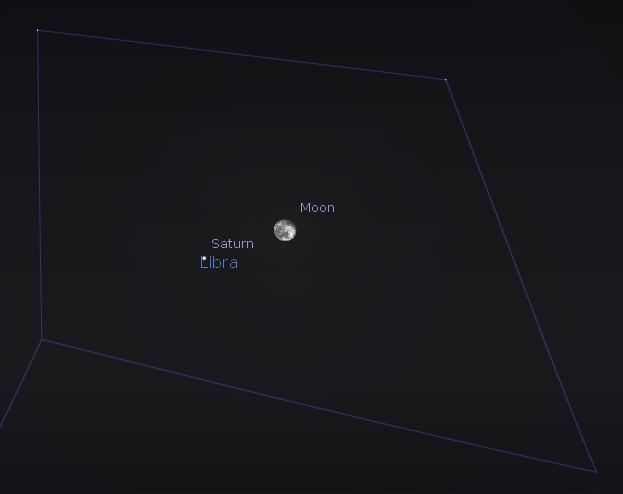
Saturn and the Moon rising in the southeast at 11 p.m. Created using Stellarium.
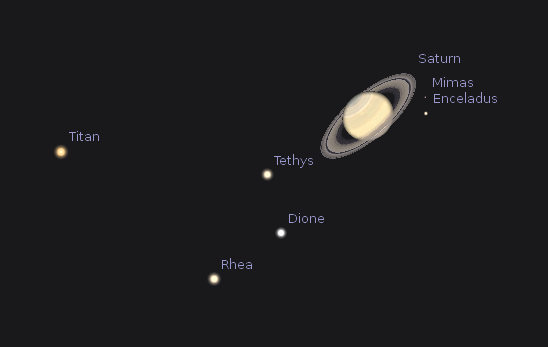
Telescopic Saturn at 11 p.m. April 16, 2014. You may want to wait a bit for it to rise some more for clearer views. Created using Stellarium.
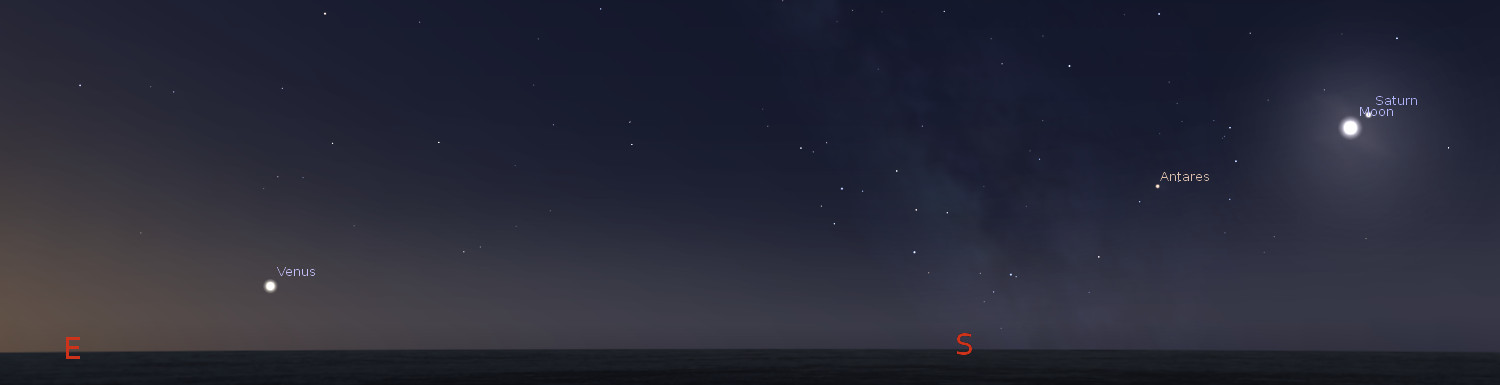
Venus and Saturn at 6 a.m. April 17, 2014. Note that the Moon has scooted to the left of Saturn overnight. Created using Stellarium.
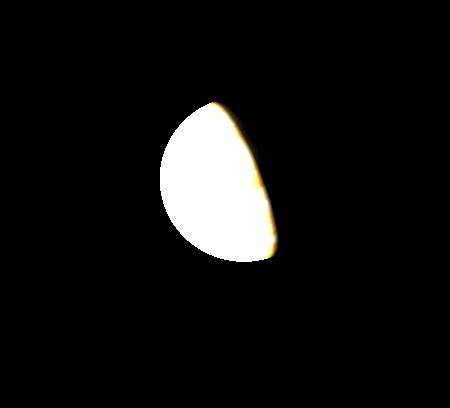
Venus through a telescope at 6 a.m. April 17, 2014. Note that none of these planetary images are to the same scale. Created using Stellarium.
04/15/2014 – Ephemeris – One eclipse down, what’s next?
Ephemeris for Tuesday, April 15th, Tax Deadline Day. The sun rises at 6:58. It’ll be up for 13 hours and 29 minutes, setting at 8:27. The moon, at full today, will rise at 9:08 this evening.
Since I’m recording this before this morning’s eclipse, I don’t know if it was visible from the northern Lower Peninsula. However we do have a shot at another total lunar eclipse this year. That one is on October 8th. Though it’s in the morning, it’s closer to dawn. One which one can catch by going to bed early and getting up early to enjoy. The weather prospects are somewhat better in October than they are in April. That eclipse we’ll miss a bit of the ending partial phase as the moon sets during that time. As a bonus, 15 days later we will see half of a partial solar eclipse, because the sun will set around mid eclipse. That eclipse will not be total anywhere as the core of the moon’s shadow misses to the north of the Earth.
Times are for the Traverse City/Interlochen area of Michigan. They may be different for your location.
Addendum
There’s another eclipse I didn’t mention due to time. It follows this one by 14 days, on April 29th. It is an odd partial eclipse visible from the Indian Ocean, Australia and a bit of Antarctica. It is an annular eclipse, where the moon is too far away to completely cover the bright ball of the sun. The annular shadow touches the earth in Antarctica, but not the central part, which just misses the earth. It’s truly an odd eclipse. Next year will provide us with two more lunar eclipses. The first one we’ll see a part of before the moon sets, and the second will be an evening eclipse well placed for viewing. None of next years solar eclipses will be visible from North America.
Check out this and next year’s eclipses on the NASA Eclipse website.
04/14/2014 – Ephemeris – The total lunar eclipse is tonight after midnight.
Updated 4 p.m. EDT: See bottom of the post.
Ephemeris for Monday, April 14th. The sun will rise at 7:00. It’ll be up for 13 hours and 26 minutes, setting at 8:26. The Moon, 1 day before full, will set at 7:05 tomorrow morning.
We’re hoping for clear skies for tonight’s total lunar eclipse. Actually it’s in the wee hours of tomorrow morning. So if you’re a night owl, stay up tonight or otherwise catch all or part of it by setting your alarm clock. Here’s the timings: The partial phase begins as the Moon enters the earth’s inner shadow at 1:58 a.m. Totality starts at 3:06 a.m. Totality will last until 4:24,when the upper left edge of the moon again peeks into sunlight. The ending partial phase will end at 5:33 a.m. If it’s clear or at least partly cloudy there are two locations in the Grand Traverse area to view the eclipse, other than your own back yard, which is perfectly acceptable. The first is the NMC Rogers Observatory, and the other is the Dune Climb parking lot at Sleeping Bear Dunes.
Times are for the Traverse City/Interlochen area of Michigan. They may be different for your location.
Addendum
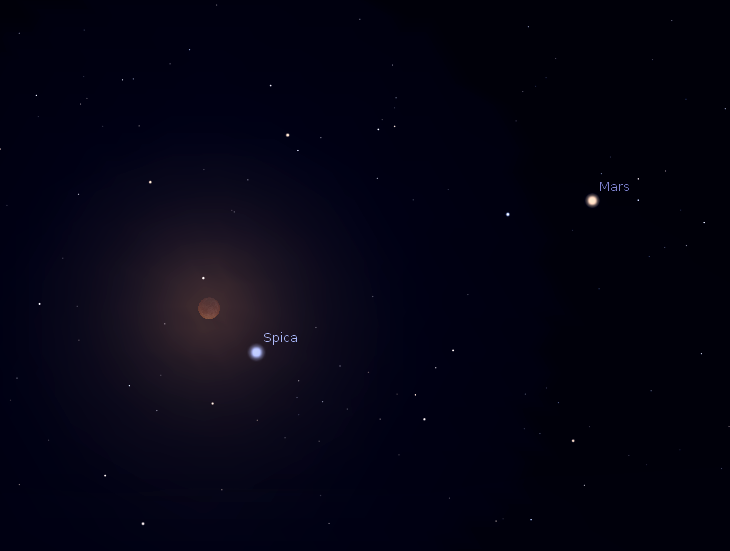
The April 15, 2014 lunar eclipse simulated by Stellarium. Note that Mars and the star Spica will be nearby.
As of 24 hours before the eclipse the weather prospects don’t look good for northwestern lower Michigan or all the east coast for that matter. We’re on the edge of the clouds. The western shore Lake Michigan and parts of the U.P. may be clear. But things could change.
There will be a live webcast from University of Georgia at http://www.ccssc.org/webcast.html, who may be stuck with the same overcast we may have. Hat Tip to Spaceweather.com
There is also another live stream of the eclipse from Griffith Observatory in Los Angeles. Or go to http://www.griffithobservatory.org and click on the Griffith TV button. Coverage starts at 9:45 PDT or 12:45 a.m. EDT which is a bit more than an hour before the partial phase of the eclipse starts. Hat Tip to Carla Johns of the NASA Museum Alliance for the links.
Here’s a link to the official NASA eclipse website for this eclipse.
Here’s a link to my in-depth discussion of the April 15, 2014 eclipse.
Update
Here’s another link to a live feed of the eclipse: Virtual Telescope Project.
Universe Today has more links.
The Sleeping Bear eclipse viewing has been canceled.
04/11/2014 – Ephemeris – Get ready for Tuesday’s total lunar eclipse
Ephemeris for Friday, April 11th. The sun will rise at 7:05. It’ll be up for 13 hours and 17 minutes, setting at 8:22. The Moon, half way from first quarter to full, will set at 5:36 tomorrow morning.
Next Tuesday morning’s total eclipse of the moon is the first we’ve seen for several years. The partial phase begins as the Moon enters the earth’s inner shadow at 1:58 a.m. Totality starts at 3:06 a.m. The entire Moon should be a red or orange color. The depth of color will slowly change during totality until 4:24, when totality ends and the upper left edge of the moon again peeks into sunlight. The ending partial eclipse will end at 5:33 a.m. If it’s clear or at least partly cloudy there are two locations in the Grand Traverse area to view the eclipse, other than your own back yard, which is perfectly acceptable. The first is the NMC Rogers Observatory, and the other is the Dune Climb parking lot at Sleeping Bear Dunes.
Times are for the Traverse City/Interlochen area of Michigan. They may be different for your location.
Addendum

Something like what Tuesday’s eclipse will look like from the eastern US. Total lunar eclipse in Egypt. Photo credit: Sean Bagshaw from sservi.nasa.gov.
In a composite photo like this the Earth’s rotation is carrying the moon westward (right) toward setting, while the Moon’s orbital motion is carrying it toward the east (left) more slowly through the Earth’s shadow. This appears to be a real composite. Morning twilight would approach from the opposite side of the sky.
04/10/2014 – Ephemeris – Get ready for the April 15, 2014 total lunar eclipse
Ephemeris for Thursday, April 10th. The sun will rise at 7:07. It’ll be up for 13 hours and 14 minutes, setting at 8:21. The Moon, 3 days past first quarter, will set at 5:09 tomorrow morning.
Next Tuesday morning we’re in for a treat as the Moon enters the Earth’s shadow producing a total lunar eclipse. The eclipse will be a challenge especially if you wait for April 15th to do your taxes. Next Tuesday is tax deadline day, and the eclipse will happen is the wee hours of that morning. You don’t have to watch the whole thing, but I will if it’s clear. The partial phase begins as the Moon enters the earth’s inner shadow at 1:58 a.m. Totality starts at 3:06 a.m. The entire Moon should be a red or orange color. The depth of color will slowly change during totality until 4:24, when totality ends and the upper left edge of the moon again peeks into sunlight. The ending partial eclipse will end at 5:33 a.m.
Times are for the Traverse City/Interlochen area of Michigan. They may be different for your location.
Addendum

How a lunar eclipse happens. Credit spaceplace.nasa.gov
The outer shadow is the Earth’s penumbra which gradually darkens from the outside edge to the umbra, the Earth’s inner shadow. It’s been my experience that it isn’t noticeable until about a half hour before the partial phase starts, when the Moon starts to dip into the umbra.
Here’s a link to the official NASA eclipse website for this eclipse.Here’s a link to my in-depth discussion of the April 15, 2014 eclipse.
04/09/2014 – Ephemeris – Where are Mars and the other planets this week?
Ephemeris for Wednesday, April 9th. The sun will rise at 7:08. It’ll be up for 13 hours and 11 minutes, setting at 8:19. The Moon, 2 days past first quarter, will set at 4:40 tomorrow morning.
Wednesday is Bright Planets Day here on Ephemeris. Jupiter will be in the southwestern sky as darkness falls tonight. It’s cruising against the stars of Gemini now. It will set at 3:06 a.m. in the west-northwest. Reddish Mars is in Virgo now above and a bit left of the bright star Spica in the late evening, which it now outshines. Mars is up at sunset in the east. It will pass due south at 1:40 a.m. It’s 57.7 million miles away now, almost as close as it will get this year. It will set at 7:23 a.m. Saturn will rise at 10:54 p.m. in the east-southeast and pass due south at 3:51 a.m.. It’s seen against the stars of Libra the scales this year. Venus will rise at 5:30 tomorrow morning and be seen low in the southeast.
Times are for the Traverse City/Interlochen area of Michigan. They may be different for your location.
Addendum
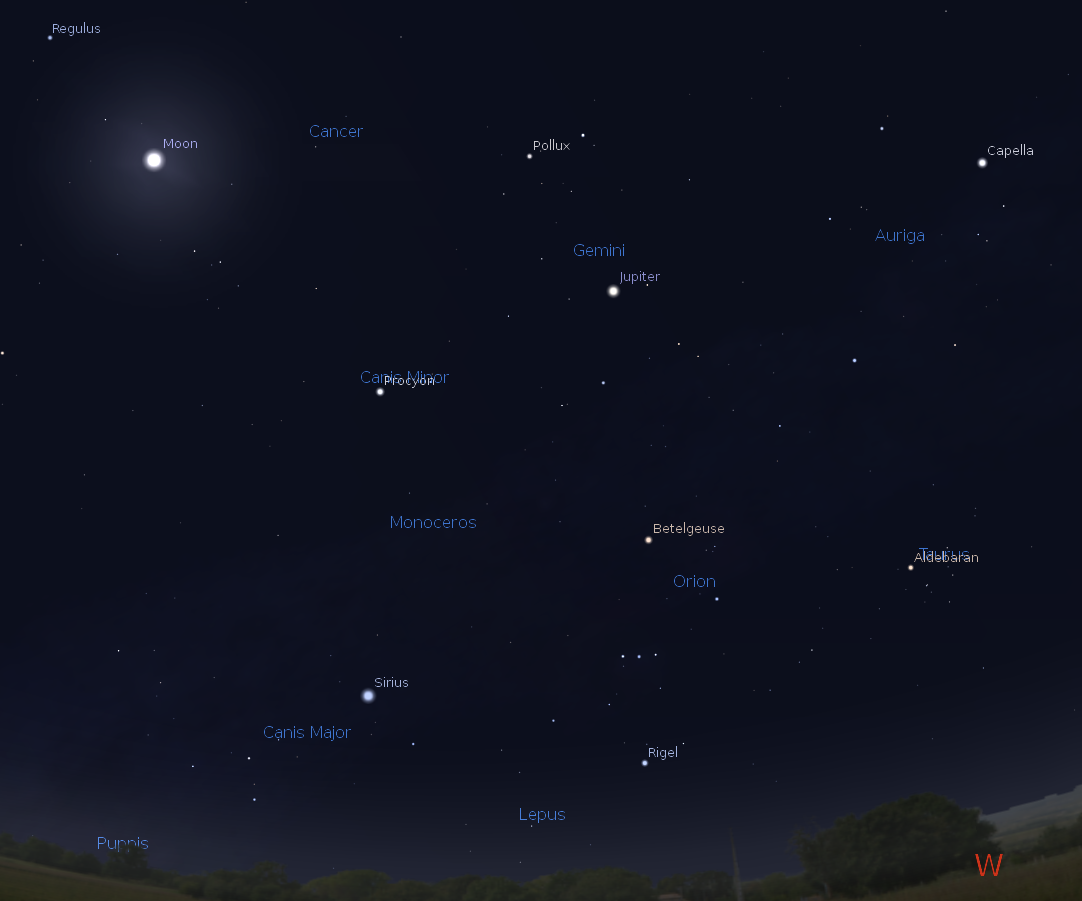
Jupiter, the Moon and the winter constellations at 10 p.m. on April 9, 2014. Created using Stellarium.
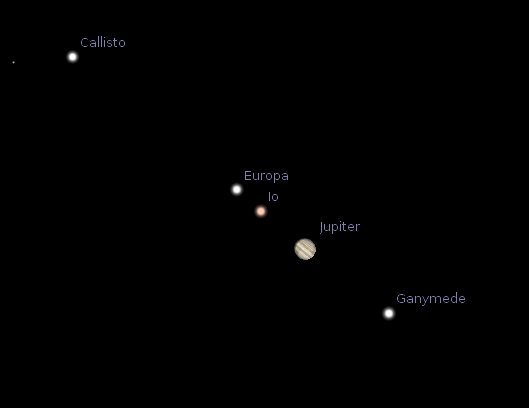
Jupiter and moons through a small telescope at 10 p.m. on April 9, 2014. Created using Stellarium.
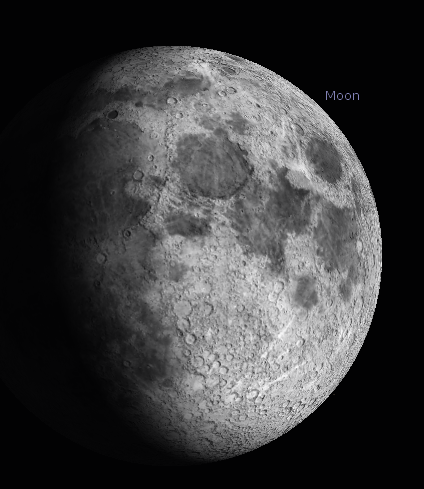
The gibbous Moon through a small telescope at 10 p.m. on April 9, 2014. Created using Stellarium.
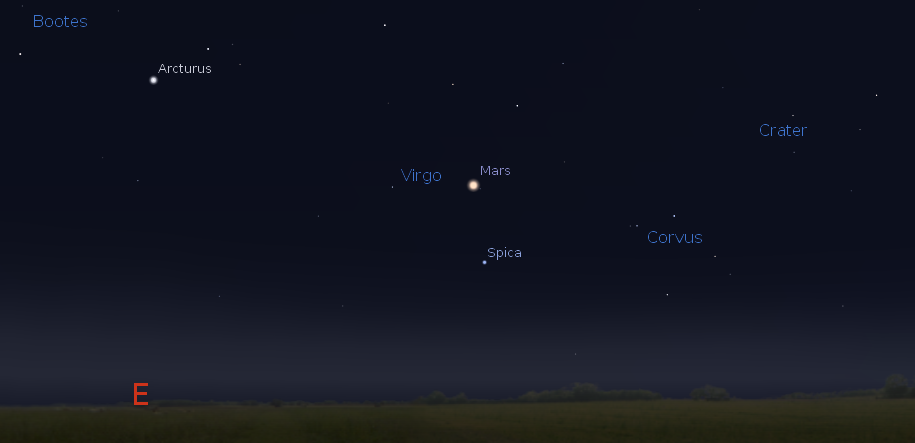
Mars rising at 10 p.m. on April 9, 2014. Created using Stellarium.
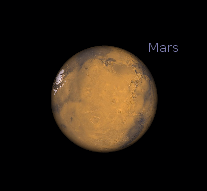
Mars through a telescope at 11 p.m. on April 9, 2014. Created using Stellarium.
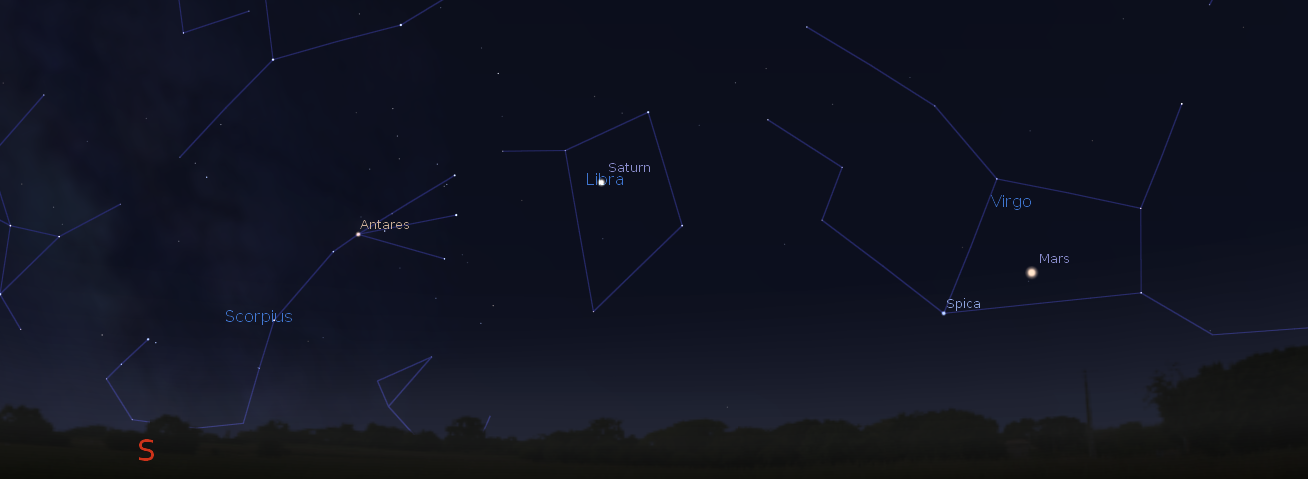
Mars and Saturn with some spring and summer constellations at 6 a.m. on April 10, 2014. Created using Stellarium.
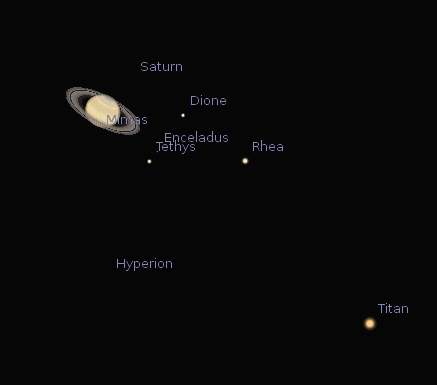
Saturn through a telescope at 6 a.m. on April 10, 2014. Created using Stellarium.
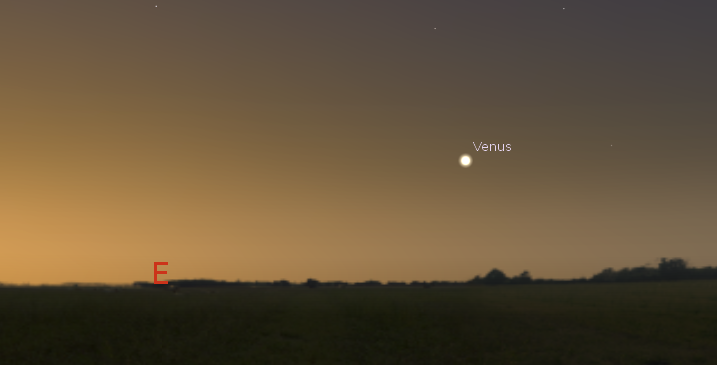
Venus in twilight at 6:30 a.m. on April 10, 2014. Created using Stellarium.
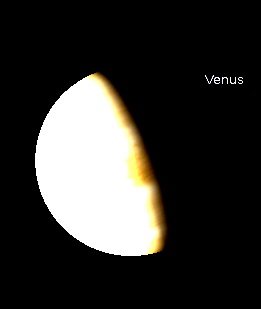
Venus through a telescope at 6:30 a.m. on April 10, 2014. Created using Stellarium.
04/08/2014 – Ephemeris – Mars is at opposition today!
Ephemeris for Tuesday, April 8th. The sun will rise at 7:10. It’ll be up for 13 hours and 7 minutes, setting at 8:18. The Moon, 1 day past first quarter, will set at 4:10 tomorrow morning.
Mars is at opposition from the Sun today. That doesn’t mean that Mars and the Sun are opposed to each other. Well, I guess they are, sort of. It really means that the Sun and Mars are opposite one another in the sky with Mars rising at sunset, staying up all night and setting at sunrise. That puts the earth smack dab between the Sun and Mars. For most planets this is the time of closest approach. Mars, however, has a markedly elliptical orbit, and in its orbit, it is moving closer to the sun, so it will actually come a bit closer to the Earth this go around on April 14th, next Monday when it will be 372,000 miles closer. That’s not much out of 57 million miles. Still Mars is a tiny planet in telescopes.
Times are for the Traverse City/Interlochen area of Michigan. They may be different for your location.
Addendum
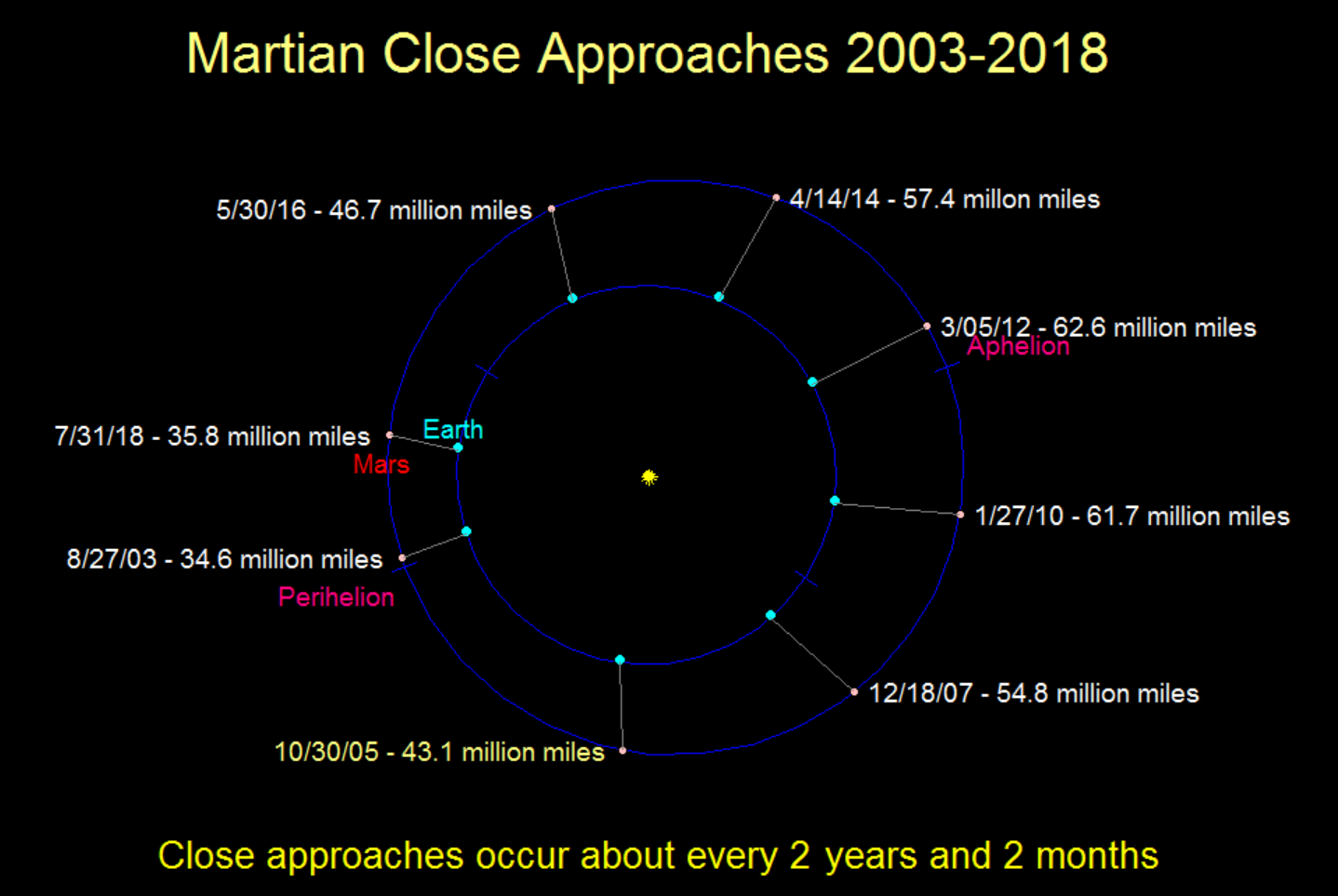
Mars’ closest approaches with the earth 2003 to 2018. Created with my LookingUp program.
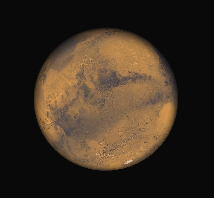
Mars through a telescope tonight (April 8, 2014). Apparent diameter 15.1″. Created using Stellarium.
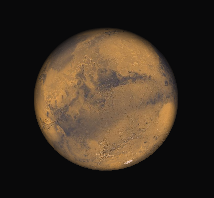
Mars at its closest approach in 50,000 or so years on August 27, 2003. Apparent diameter 25.1″. Created using Stellarium.
Apparent diameters are in seconds or arc. One second of arc is 1/3600th of a degree. or about 1/1800th of the width of the Moon or Sun.
04/07/2014 – Ephemeris – Why does the Moon have all those craters?
Ephemeris for Monday, April 7th. The sun will rise at 7:12. It’ll be up for 13 hours and 4 minutes, setting at 8:17. The Moon, at first quarter today, will set at 3:37 tomorrow morning.
Today the Moon is at first quarter. That moment in time actually occurred a couple of hours ago, so by tonight the Moon’s terminator, the sunrise line on the Moon will be slightly bowed to be a slight gibbous phase. With binoculars or small telescope it’s a fine time to spot craters and mountains near that terminator where the shadows are longest. On the Earth mountains are thrown up by the collision of tectonic plates or volcanoes. There are no tectonic plates as such on the Moon. Mountains that we recognize are the walls of the seas, which are really vast craters caused for the most part by collisions with small asteroids. The reason the Earth doesn’t carry those scars is that the Earth erodes and recycles its surface.
Times are for the Traverse City/Interlochen area of Michigan. They may be different for your location.
Addendum
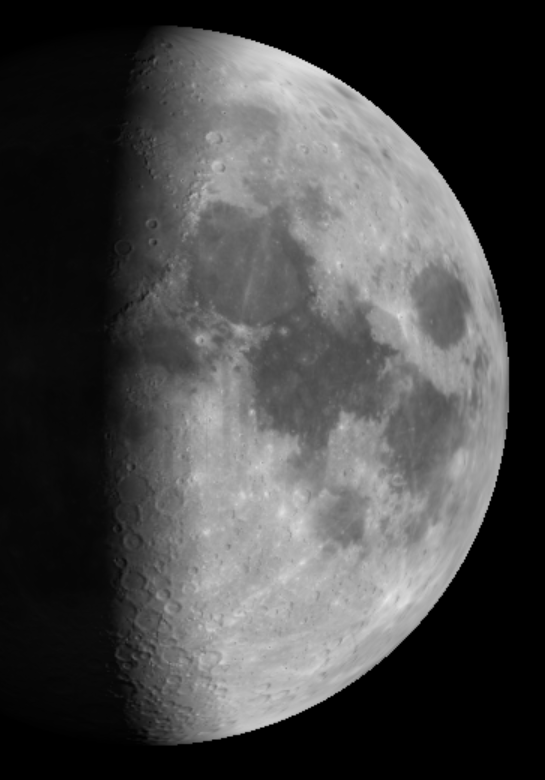
The Moon tonight (10 p.m. April 7, 2014). Created using Virtual Moon Atlas.
Tax Day Eclipse – April 15, 2014
From the April 2014 Stellar Sentinel, the newsletter of the Grand Traverse Astronomical Society
If you stay up April 14th or get up early on April 15th to watch the total lunar eclipse that morning, make sure your taxes are done, because you might not be good for much of anything during the day on the 15th.
That being said, let’s take a look at the what and where of the eclipse. Lunar eclipses only occur at full moon. The Sun, Earth and Moon have to line up so the the Earth casts its shadow on the Moon. This occurs in about one in six full moons. Below is the Moon and the earth’s shadow at the March full moon.
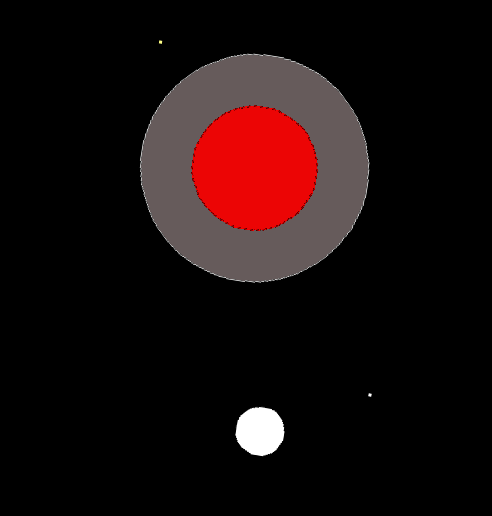
On March 16, 2014 the full Moon missed the Earth’s shadow, so no eclipse was seen. Created using Cartes duCiel.
In the illustration above the “bulls-eye” is the Earth’s shadow as it would appear at the Moon’s distance. The outer gray circle represents the Earth’s penumbra, where the sun’s light is increasingly blocked by the earth. The umbra (in red for emailed PDF versions of this newsletter) is the Earth’s inner shadow where no direct sunlight enters. When the Moon enters the umbra the partial phase of the eclipse begins. When the Moon is entirely within the umbra the Moon will be totally eclipsed. The Moon back on March 16th missed the earth’s shadow by passing several degrees south of it. When the moon is in the umbra it is still dimly lit indirectly to some degree by the combined rays of the sun that are refracted through Earth’s from all the accumulated sunrises and sunsets occurring around the Earth at that time. Back in 1967 the robotic lunar soft lander Surveyor 3 was able to take some images of the earth during a lunar eclipse. For Surveyor this was a solar eclipse and illustrated the light being refracted around the earth.
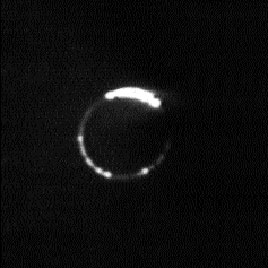
Solar eclipse by the Earth as viewed by Surveyor 3, April 24, 1967. Credit: NASA
The current Chinese Chang’e 3, should it survive one more lunar night, has a chance to take a better quality photograph of the eclipsed Sun this April 15th if its camera can tilt far up enough.
The light that illuminates the Moon in the Earth’s umbra is generally red in color, though the edge of the umbra generally has a gray cast to it. The light level is so low in the umbra, that, to the naked eye, it appears that the Moon is indeed being eaten by something invisible as the ingress partial phase progresses. About three quarters the way in the color of the umbra can be perceived even to the naked eye.
There are exceptions. Two notable lunar eclipse of this person’s memory occurred in 1982. On July 6, 1982 the early morning eclipse when the Moon passed centrally through the umbra the Moon was unevenly lit. The top or northern half was much darker than the southern half. In late March and early April that year the El Chichón volcano erupted in southern Mexico sending 20 million metric tons of ash high into the stratosphere. Apparently it masked the light from the northern hemisphere making it into the earth’s shadow. That year’s December 30th lunar eclipse was exceptionally dark. In fact during totality one had to hunt to find the Moon at all with the naked eye.
The events of the April 15th eclipse
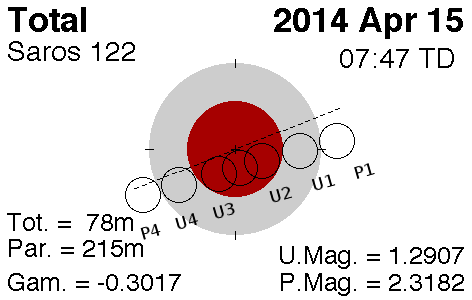
The Moon travels through the Earth’s shadow from right to left. What are seen are points of contact with the shadow and mid-eclipse. From Five Millennium Canon of Lunar Eclipses (Espenak & Meeus) NASA.
Contact times are labeled P1, U1, U2, U3, U4, and P4. P2 and P3 are omitted because they are synonymous with U2 and U3 respectively:
P1 – 12:53:37 a.m. Enter the penumbra (unseen). By about 1:30 the duskiness on the left edge of the Moon will start to be pronounced.
U1 – 1:58:19 a.m. Enter the umbra (partial eclipse begins).
U2 – 3:06:47 a.m. Totality begins.
Mid eclipse 3:49:40 a.m.
U3 – 4:24:35 a.m. Totality ends, egress partial phase begins.
U4 – 5:33:04 a.m. Partial phase ends. The Moon’s upper right edge should appear dusky for the next half hour or so.
P4 – 6:37:37 a.m. Penumbral phase ends (unseen).
Note: The duskiness of the penumbral phase of the eclipse can be enhanced by viewing through sunglasses.
Weather permitting there will be two Grand Traverse Astronomical Society venues to view this eclipse. The first will be the NMC Rogers Observatory. The second will be at the Sleeping Bear Dunes National Lakeshore in the Dune Climb parking lot on M109. Both start at 1:30 a.m. if it’s clear.
Note: All times are Eastern Daylight Time. For locations other than Northwestern Lower Michigan, check with your local astronomy club. However this is a perfect event to be viewed from one’s back yard. No optical aid is required.
Correction: The U2 timing was incorrectly stated in the original post.
04/04/2014 – Ephemeris – Follow the Moon this weekend
Note: Sorry for the late post.
Ephemeris for Friday, April 4th. The sun will rise at 7:17. It’ll be up for 12 hours and 55 minutes, setting at 8:13. The Moon, 3 days before first quarter, will set at 1:32 tomorrow morning.
During this weekend the Moon will be slowly crossing the evening sky, approaching the planet Jupiter. Pay attention if you can to each night’s position and how its phase changes. It is moving farther from the sun in the sky, so we see it more and more illuminated by the sun. Sunday night it will draw even with Jupiter, with the planet some 10 moon widths north or above the Moon. It doesn’t seem at first thought that the Moon rotates, since we see the same face from the Earth all the time,. But the Moon does rotate, once a month. If it didn’t rotate we’d see all of it from our changing view of it over the month. The part of the Moon we can’t see from Earth is not the dark side, it is the far side which is fully illuminated at our new moon.
Times are for the Traverse City/Interlochen area of Michigan. They may be different for your location.
Addendum
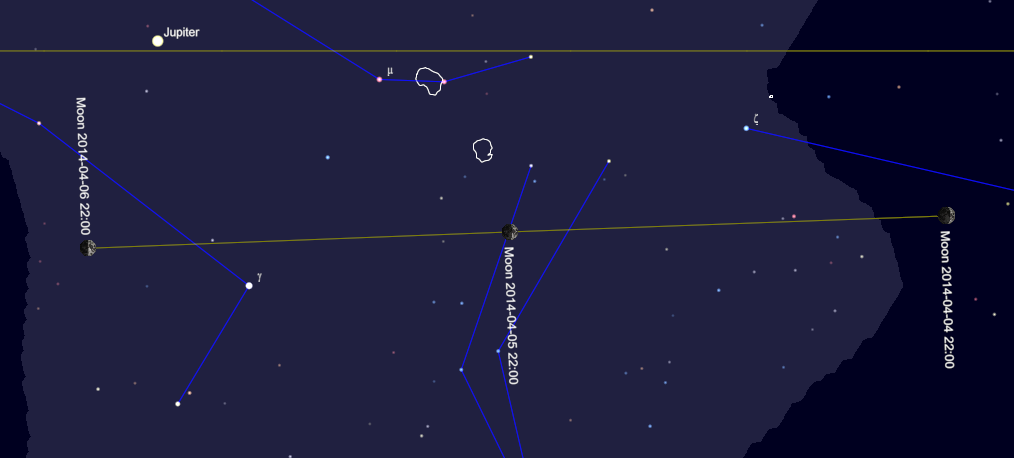
Motion and phase of the Moon for April 4, 5, and 6 2014. Created using Cartes duCiel (SkyCharts).
Click on image to enlarge. Yes, the moon is really that small.
 Bob Moler's Ephemeris Blog