Archive
10/03/2014 – Ephemeris – Sundials and Fall Astronomy Day on tap tomorrow at the NMC Observatory
Ephemeris for Friday, October 3rd. The sun will rise at 7:42. It’ll be up for 11 hours and 36 minutes, setting at 7:19. The moon, 2 days past first quarter, will set at 3:01 tomorrow morning.
Tomorrow is Fall Astronomy Day. To celebrate the Grand Traverse Astronomical Society will move its first Friday of the month meeting and star party to Saturday the 4th. At 8 p.m local landscape architect and sundial expert Dean Connors will talk about, of course, sundials and the myriad of forms they take. Starting at 9 p.m. the star party portion of the night will begin with the moon as the featured celestial object. Members of the society will also provide information on this month’s two eclipses and how to observe a solar eclipse safely. The meeting and star party will be held at Northwestern Michigan College’s Rogers Observatory located south of Traverse City on Birmley Road. Between Garfield and Keystone roads.
Times are for the Traverse City/Interlochen area of Michigan. They may be different for your location.
10/02/2014 – Ephemeris – The gibbous Moon tonight
Ephemeris for Thursday, October 2nd. The sun will rise at 7:41. It’ll be up for 11 hours and 39 minutes, setting at 7:21. The moon, 1 day past first quarter, will set at 1:50 tomorrow morning.
Tonight the moon will be featuring some of my favorite lunar landmarks, and if you spend any time looking at the moon with a small telescope, they become yours. The place to look is at the terminator, the sunrise line on the moon. In the north not far from the terminator is the walled plain called Plato. A bit farther away is a gash in the lunar Alps mountains caller the Alpine Valley. Near the center of the terminator and split by it is the fabulous crater Copernicus with a triple central peak which should poke into sunlight. Near the south pole is the large crater Clavius with an arc of decreasingly smaller craterlets on its floor. A bit north of that is the crater Tycho, which is more prominent when the moon is full than it is now.
Times are for the Traverse City/Interlochen area of Michigan. They may be different for your location.
Addendum
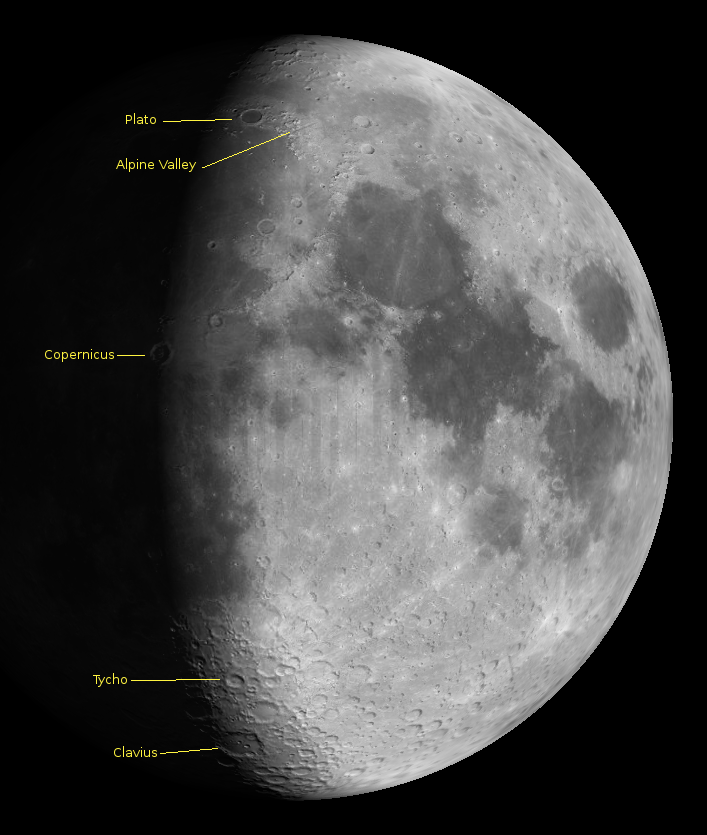
The gibbous Moon one day after first quarter at 9 p.m. October 2, 2014. Created using Virtual Moon Atlas.
10/01/2014 – Ephemeris – Let’s start off the month with a look at the bright planets
Ephemeris for Wednesday, October 1st. The sun will rise at 7:40. It’ll be up for 11 hours and 42 minutes, setting at 7:23. The moon, at first quarter today, will set at 12:43 tomorrow morning.
Let’s check out the bright planets for this week. Mars and Saturn are in the southwestern sky at 8:30 p.m. with Mars above the equally bright and red star Antares with Saturn a ways right of them and as high in the sky as Antares. Saturn will set at 9:16 p.m. Mars is in the constellation of Ophiuchus as astronomers draw constellation boundaries, though it looks to be in Scorpius. Mars will set at 10:04. In the morning sky brilliant Jupiter will rise in the east-northeast at 3:02 a.m. Venus will rise about a half hour before the sun, so it will not be visible. On the 25th of this month Venus will be in superior conjunction with the sun, that is it will move behind the sun, and will then enter the evening sky.
Times are for the Traverse City/Interlochen area of Michigan. They may be different for your location.
Addendum
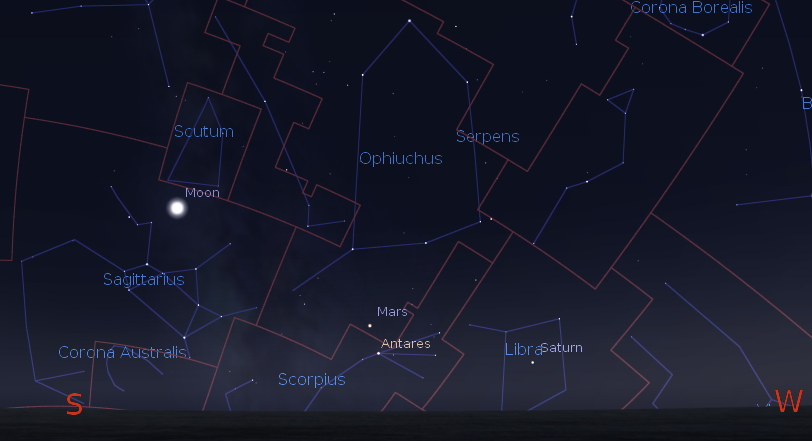
Saturn and Mars with the evening constellations, showing constellation boundaries in red at 8:30 p.m. on October 1, 2014. Created using Stellarium.
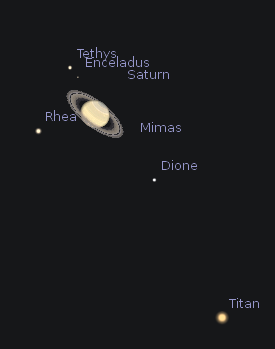
Saturn through a telescope. Of the satellites only Titan should be visible with Saturn so low in the sky at 8:30 p.m. Created using Stellarium.
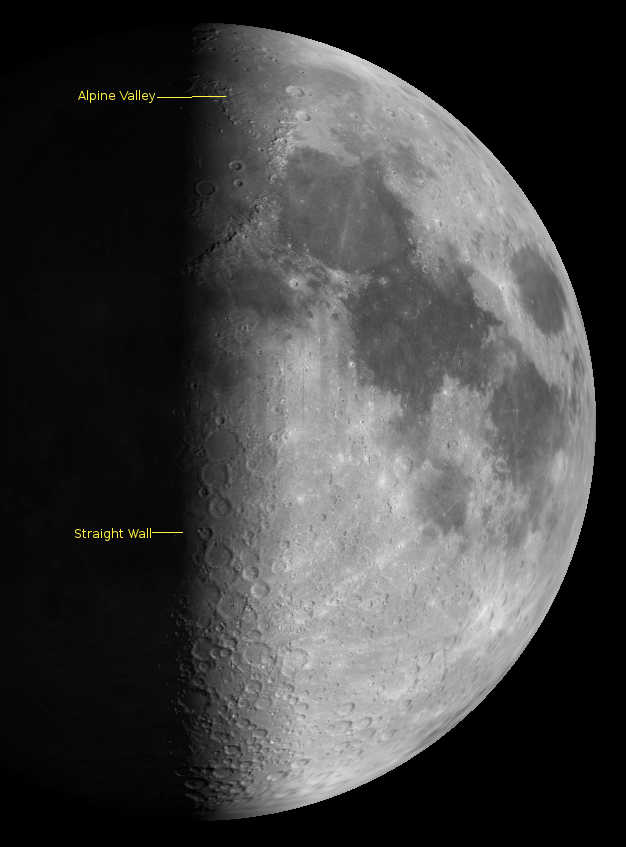
The first quarter Moon tonight at 8:30 p.m. with some interesting locations. Created using Virtual Moon Atlas.
Points of interest on the moon tonight:
- Alpine Valley – This is a fault valley some 79 miles (130 km) long and 7 miles (11 km) wide through the lunar Alps.
- Straight Wall – This is a fault that runs north-south on the moon and is only seen either one day after first quarter or one day after last quarter. It is 67 miles (110 km) long and 900 feet (300 meters) high. But instead of being a wall, it has only a 7 degree slope, which explains its brief appearance. Tonight it will cast a shadow. One day after last quarter the sun will shine directly on the slope, which is covered by lighter material and will show as a bright line.
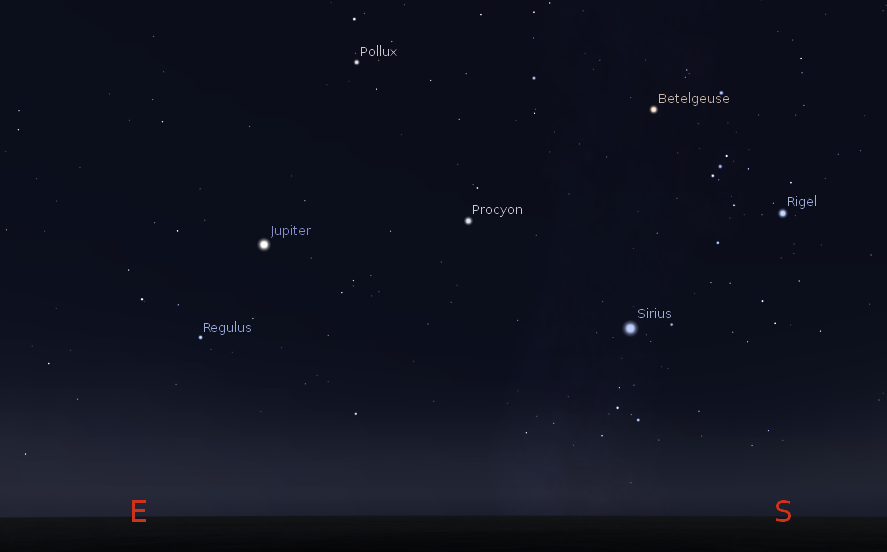
Jupiter and the winter stars at 6:30 a.m. on October 2, 2014. Created using Stellarium.
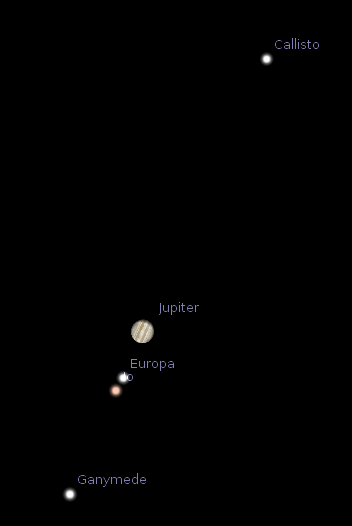
Jupiter and its satellites as seen through a telescope at 6:30 a.m. October 2, 2014. Created using Stellarium.
 Bob Moler's Ephemeris Blog