Archive
11/17/2015 – Ephemeris – The Leonid peak is expected to be today and tonight
Ephemeris for Tuesday, November 17th. The Sun will rise at 7:42. It’ll be up for 9 hours and 30 minutes, setting at 5:12. The Moon, 2 days before first quarter, will set at 10:49 this evening.
The Leonid meteor shower is predicted to reach its peak or rather peaks today. One this afternoon is a newly computed peak, which we obviously cannot see, and another around 11 p.m. which occurs just before the radiant rises. The radiant is the point in the sky from which the meteors seem to come from, so to see any meteors that source point must be above the horizon. The Leonid meteors are the debris of Comet 55P/Tempel-Tuttle, which was discovered independently by Ernst Tempel in 1865 and Horace Tuttle 18 days later. The 55P in the name means that it was the 55th recognized periodic comet. It has a period of 33.24 years giving rise to meteor storms every 33 years or so. This isn’t one of those years.
Times are for the Traverse City/Interlochen area of Michigan. They may be different for your location.
Addendum
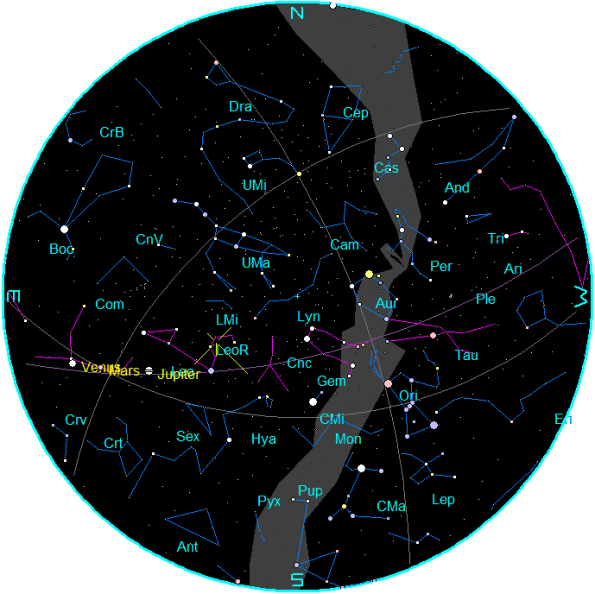
An all sky chart for 5 a.m for the Leonid meteor shower for 2015. Created by my LookingUp program. The yellow pattern marked LeoR is the Leonid radiant.
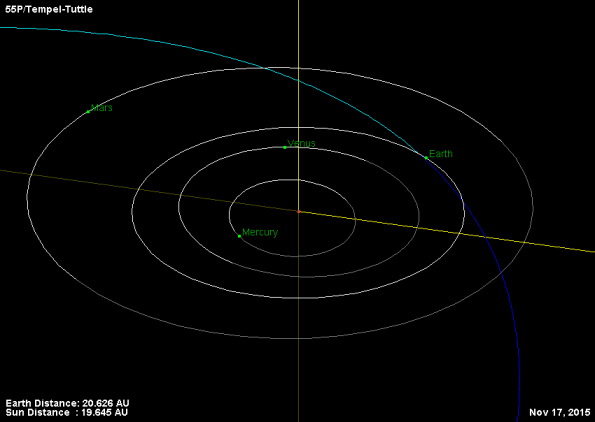
The orbit of 55P/Tempel-Tuttle near the Earth. The color or the orbit is lighter north of the Earth’s orbital plane. Note that the orbit of the comet crosses the Earth’s orbital plane as it passes just inside the Earth’s orbit. Created with JPL Small-Body Database Browser.
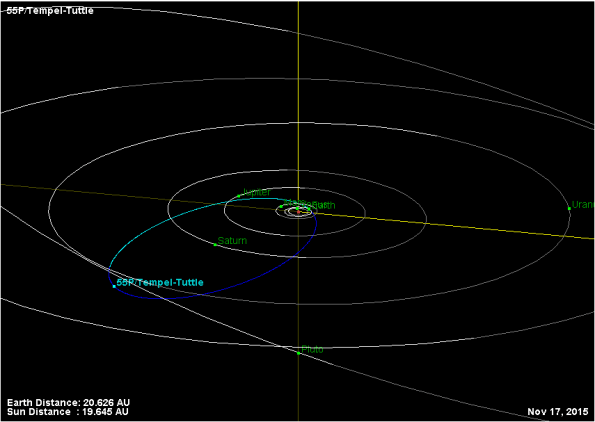
The entire orbit of 55P/Tempel-Tuttle. The color or the orbit is lighter north of the Earth’s orbital plane. Created with JPL Small-Body Database Browser.
11/16/2015 – Ephemeris – The Leonid meteors are expected to reach their peak tomorrow
Ephemeris for Monday, November 16th. The Sun will rise at 7:40. It’ll be up for 9 hours and 33 minutes, setting at 5:13. The Moon, 3 days before first quarter, will set at 9:45 this evening.
Tomorrow night is the expected peak of the Leonid meteor shower. The expected peak will be at 11 p.m. (4 hr UT November 18). Problem is that the radiant won’t rise until just after midnight for northern Michigan. For the best visible numbers the peak of the meteor shower should coincide with the time the radiant is highest in the sky. For the Leonids, that’s when morning twilight starts. There’s another possible peak for those in Asia at 21 hr UT November 17. It’s afternoon for us. The Leonids generally produce their meteor storms of thousands of meteors an hour about every 33 years, when the comet is back near the Earth and the Sun. That next time would be around the year 2031 give or take a year. I personally missed the meteor storm of 1966 by a couple of hours. I missed the one in the late 90s by more than that. The next around 2031 may be a bridge too far for me.
Times are for the Traverse City/Interlochen area of Michigan. They may be different for your location.
Addendum
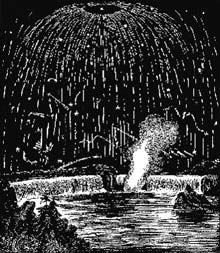
The 1933 Leonid meteor storm depicted over Niagara Falls in this woodcut. Public Domain. by A Pickering.

The 1997 Leonid meteor shower as seen from orbit. Credit NASA.
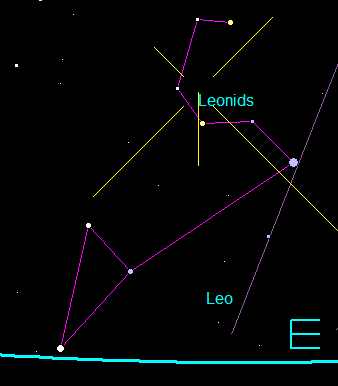
Leonid meteor radiant
11/13/2015 – Ephemeris – The Leonid meteor shower will reach peak next week
Ephemeris for Friday, November 13th. The Sun will rise at 7:36. It’ll be up for 9 hours and 40 minutes, setting at 5:16. The Moon, 2 days past new, will set at 7:02 this evening.
I’m talking about meteors a lot this week. Well this is about next week’s peak of the Leonid meteor shower. The Leonid meteor shower has spectacular peaks about every 33 years when the responsible litter bug, er… comet is near us and the Sun. The last time the comet names 55P/Tempel-Tuttle passed perihelion, its closest to the Sun was 1998. We are about half way between that and the next perihelion in 2031, so we’d expect it to be a dull year with 15 meteors an hour expected tops, but either the Leonids are getting more unpredictable, or astronomers, both professional and amateur are paying better attention. The main peak is expected Tuesday night around 11 p.m. (4 hr UT Wednesday, November 18), with another peak prior to that in the afternoon (21 hr UT Tuesday, November 17). The radiant, however, will rise just before midnight in northern Michigan. The timing will be better for Europe
Times are for the Traverse City/Interlochen area of Michigan. They may be different for your location.
Addendum
Leonid meteor radiant
11/12/2015 – Ephemeris – The North Taurid meteor shower
Ephemeris for Thursday, November 12th. The Sun will rise at 7:35. It’ll be up for 9 hours and 42 minutes, setting at 5:18. The Moon, 1 day past new, will set at 6:19 this evening.
Today is the expected peak of the Northern Taurid meteor shower. While poor in numbers, the two Taurid showers produce many fireballs, that are really, really bright. So bright they are not hindered by a bright moon. They will be visible all night because the radiant, near the head of Taurus the bull will rise in the east by the end of twilight. The radiant is below the Pleiades star cluster and just above the letter V group of stars that is the head of the bull. The path of Encke’s comet, which is responsible, crosses near the Earth’s orbit twice a year. Now and where the Earth is on June 30th. Those meteors then would seem to come from out of the Sun, leaving some to speculate that the Tunguska event in 1908 was caused by a piece of Encke’s Comet.
Times are for the Traverse City/Interlochen area of Michigan. They may be different for your location.
Addendum
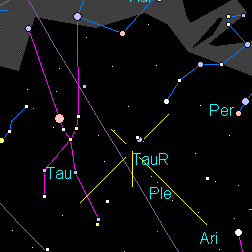
The Taurid Radiant
It turns out that Earth isn’t the only planet to have a meteor shower from Encke’s Comet. It happens to be Mercury. Dave Dickinson has a post on Universe Today pointing to an announcement of data returned from the MESSENGER spacecraft that orbited Mercury at the Division of Planetary Sciences of the American Astronomical Society (#DPS15) meeting this week.
11/11/2015 – Ephemeris – The bright planets separate in the morning sky
Ephemeris for Veteran’s Day, Wednesday, November 11th. The Sun will rise at 7:34. It’ll be up for 9 hours and 45 minutes, setting at 5:19. The Moon is new today, and won’t be visible.
Let’s check out the whereabouts of the bright naked eye planets. The numbers of visible planets is getting a bit thin. The planet Saturn will be low in the west-southwest after sunset and will set at 6:16 p.m., less than an hour after sunset. It would be as harder to find than Mercury would be at its best in the evening sky. And Mercury itself is too close to the direction of the Sun to be spotted. However in the morning sky there are three bright planets. Jupiter will be the first to rise, at 2:12 a.m. in the east-northeast. Mars will rise at 3:20 a.m., followed by Venus at 3:31 a.m. Mars lies in line between Venus below and Jupiter above, a bit less than a third the way from Venus to Jupiter. These three planets will continue to separate.
Times are for the Traverse City/Interlochen area of Michigan. They may be different for your location.
Addendum
Saturn can no longer be shown at a reasonable altitude with Stellarium.
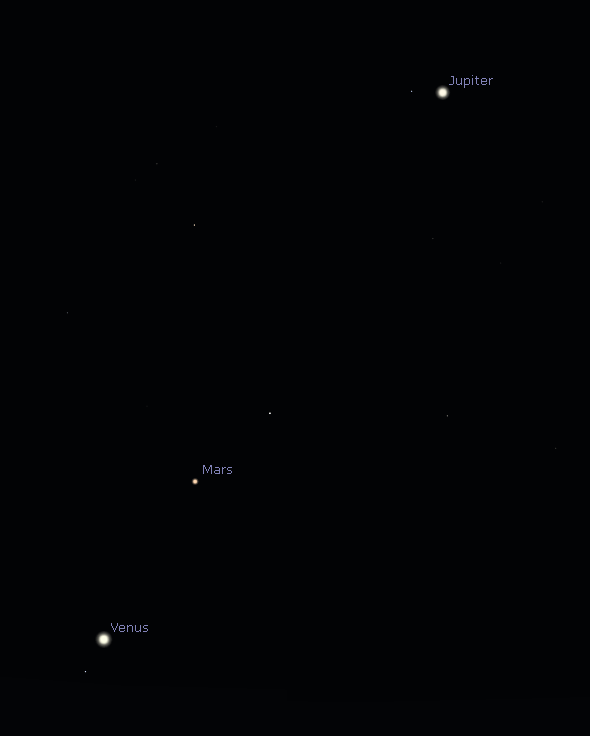
Jupiter, Mars and Venus appear in the southeast at 6 a.m., November 11, 2015. Created using Stellarium.
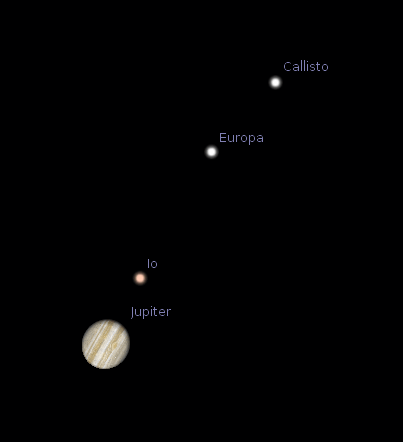
Jupiter and its moons in a telescope at 6 a.m., November 12, 2015. Ganymede enters into Jupiter’s shadow at 5:30 a.m. Created using Stellarium.
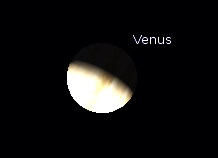
Venus as seen in a telescope at 6 a.m. November 12, 2015. This is not to the same scale as the Jupiter image above. Created using Stellarium.
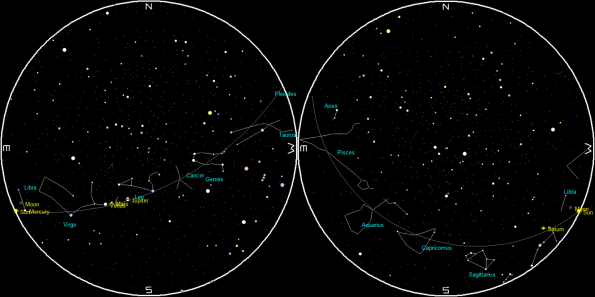
This is a chart showing the sunrise and sunset skies for November 11, 2015 showing the location of the planets and the Moon at that time. Created using my LookingUp program. Click on the image to enlarge.
11/10/2015 – Ephemeris – Twin meteor showers ongoing now
Ephemeris for Tuesday, November 10th. The Sun will rise at 7:32. It’ll be up for 9 hours and 47 minutes, setting at 5:20. The Moon, 1 day before new, will rise at 7:14 tomorrow morning.
Now through Thursday the North and South Taurid meteors will be most active. The North radiant, the point from which the meteors, or “shooting stars” will seem to come from, is just above the letter V star cluster that’s the head of Taurus the bull in the east in the early evening. The southern radiant is just below the V. Interestingly enough they belong to the same comet: Encke’s Comet. It has the shortest period on any known comet. Only 3.3 years. I’ll have more to say about Encke’s Comet on Thursday when I talk about the peak of the Northern Taurids that day. Today is the peak of the Southern Taurids. Both have expected peaks of only 5 meteors an hour. However both showers have a great number of fireballs.
Times are for the Traverse City/Interlochen area of Michigan. They may be different for your location.
Addendum
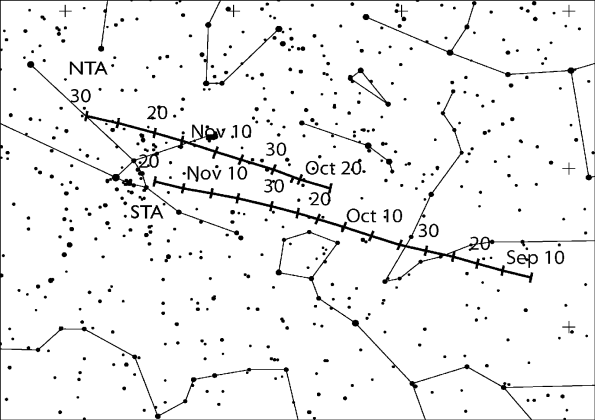
Tracks of how the North (NTA) and South (STA) Taurid radiants move in the sky with time. Credit International Meteor Organization 2015 Meteor Shower Calendar.
11/09/2015 – Ephemeris – The celestial sisters
Ephemeris for Monday, November 9th. The Sun will rise at 7:31. It’ll be up for 9 hours and 50 minutes, setting at 5:21. The Moon, 2 days before new, will rise at 6:15 tomorrow morning.
A marvelous member of the autumn skies can be found rising in the east at 8 in the evening. It is the famous star cluster called the Pleiades or the Seven Sisters. I might also add the ‘Tiny Dipper’. Many people can spot a tiny dipper shape in its six or seven stars, and mistake it for the Little Dipper. As nearsighted as I am, though corrected, I’ve never been able to see more than a few stars and a bit of fuzz. However with binoculars, over a hundred stars appear along with the dipper shape of the brightest. The fuzz I saw was unresolved stars, but in photographs the Pleiades actually contains wisps of dust that reflect the star’s blue light which the cluster is passing through. In Greek and Plains Indian mythology the sisters were young maidens.
Times are for the Traverse City/Interlochen area of Michigan. They may be different for your location.
Addenda
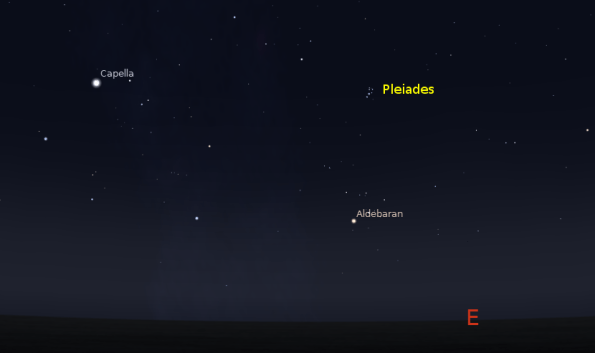
The Pleiades rising at 8 p.m. November 9th. Created using Stellarium.
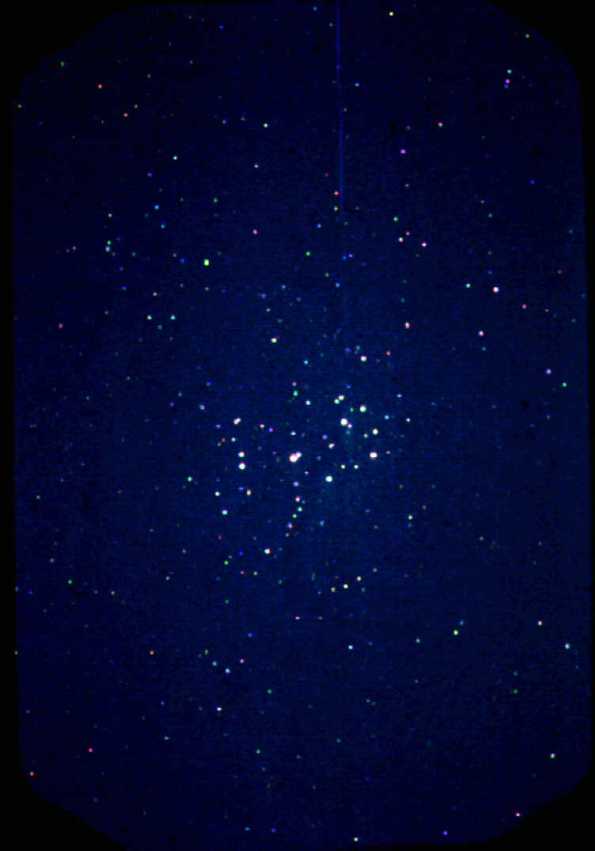
The Pleiades, about what you’d see in binoculars.
I’ll be in Cadillac tonight
I’ll be giving an illustrated talk tonight to the Cadillac Garden Club at St. Ann’s Parish in Cadillac at 7 p.m. I’ll be talking about all the ways the Sun affects the Earth. At 8 p.m., if it’s clear, I and other members of the Grand Traverse Astronomical Society will have some telescopes set up in the parking lot to view the wonders of the heavens. The meeting appears to be open to the public and the viewing after definitely is.
11/06/2015 – Ephemeris – A program about the contributions of women astronomers
Ephemeris for Friday, November 6th. The Sun will rise at 7:27. It’ll be up for 9 hours and 57 minutes, setting at 5:25. The Moon, 3 days past last quarter, will rise at 3:21 tomorrow morning.
The Moon will be close to the planet Jupiter this morning and closer to Venus tomorrow morning. Check them out if it’s clear. Tonight however, there is a meeting of the Grand Traverse Astronomical Society featuring a graduate from Northwestern Michigan College and the astronomy program: Becky Shaw who will present a talk Women in Astronomy. I especially recommend this for girls interested in the STEM fields, that is Science, Technology, Engineering and Math to find out the wonderful contributions these women have made. Astronomy, by the way encompasses all the STEM fields. The meeting starts at 8 p.m. at Northwestern Michigan College’s Rogers Observatory on Birmley Road, south of Traverse City. At 9 p.m. the will also be star party if it’s clear.
Times are for the Traverse City/Interlochen area of Michigan. They may be different for your location.
Addendum
From yesterday’s post a reminder of the Moon’s procession past the morning planets starting this a.m.
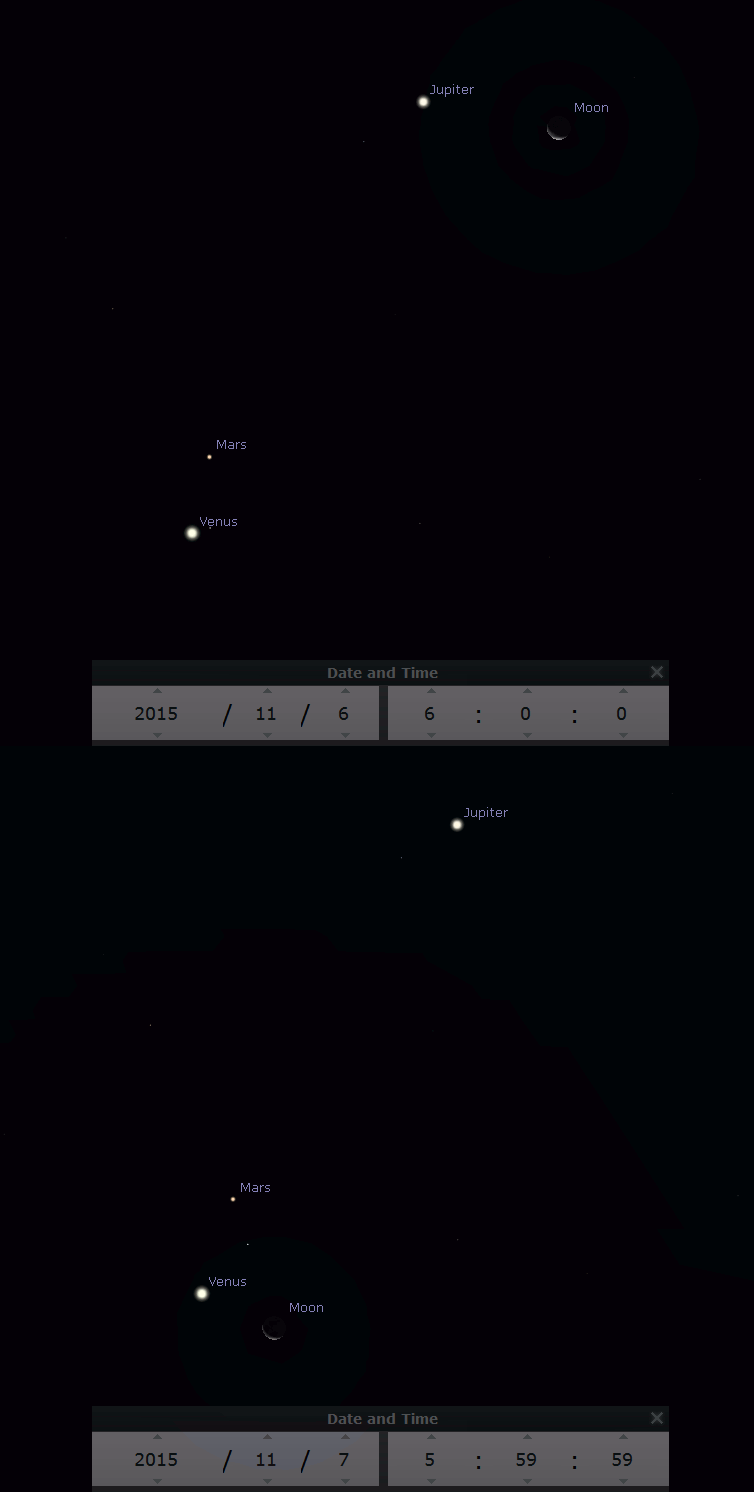
Animation of the Moon passing Jupiter this morning ans Mars and Venus tomorrow morning. Created using Stellarium and GIMP.
What’s with the 5:59:59 time for the 7th? This is what happens when you store and compute time as a binary computer value (base 2) and display it as a sexagesimal (base 60) number. Thanks Sumerians.
11/05/2015 – Ephemeris – The Moon will be among the morning planets in the next two days
Ephemeris for Thursday, November 5th. The Sun will rise at 7:25. It’ll be up for 10 hours and 0 minutes, setting at 5:26. The Moon, 2 days past last quarter, will rise at 2:23 tomorrow morning.
Over the next two mornings the Moon will pass, first, the planet Jupiter and then on Saturday Mars and Venus. These will be readily visible at 6 a.m. and less so at 7 a.m. when twilight is brighter. This month and next we will have two times the Moon will actually pass in front of another bright celestial object. Both will occur in the morning. These events are called occultations. The first will be an occultation of the bright star Aldebaran, the bright star in Taurus the bull, which I sometimes call the bull’s angry bloodshot eye. That will occur on the morning of November 26th. The next will be really spectacular. On December 7th the crescent Moon will occult the planet Venus. I’ll keep you updated on both these events.
Times are for the Traverse City/Interlochen area of Michigan. They may be different for your location.
Addendum
Animation of the Moon passing Jupiter tomorrow morning and Mars and Venus Saturday morning. Created using Stellarium and GIMP.
11/04/2015 – Ephemeris – Most of the bright planet action is in the morning
Ephemeris for Wednesday, November 4th. The Sun will rise at 7:24. It’ll be up for 10 hours and 3 minutes, setting at 5:27. The Moon, 1 day past last quarter, will rise at 1:25 tomorrow morning.
Let’s check out the whereabouts of the bright naked eye planets. The numbers of visible planets is getting a bit thin. The planet Saturn will be low in the west-southwest after sunset and will set at 6:41 p.m. It would be as hard to find as Mercury would be at its best in the evening sky. And Mercury itself is too close to the direction of the Sun to be spotted. However in the morning sky there are three bright planets. Jupiter will be the first to rise, at 2:34 a.m. in the east-northeast. Mars and Venus will rise within 5 minutes of each outer by 3:20 a.m. Mars will be almost directly above Venus by a degree or two Moon diameters. Friday and Saturday mornings the Moon will appear near these planets.
Times are for the Traverse City/Interlochen area of Michigan. They may be different for your location.
Addendum
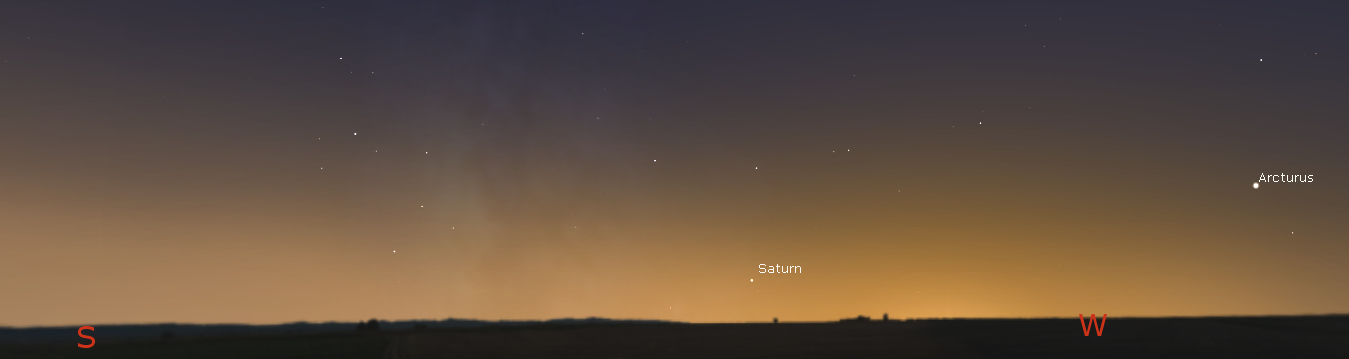
Saturn’s pretty low to the horizon at 6:15 p.m. November 4, 2015. Created using Stellarium. Click on image to enlarge.
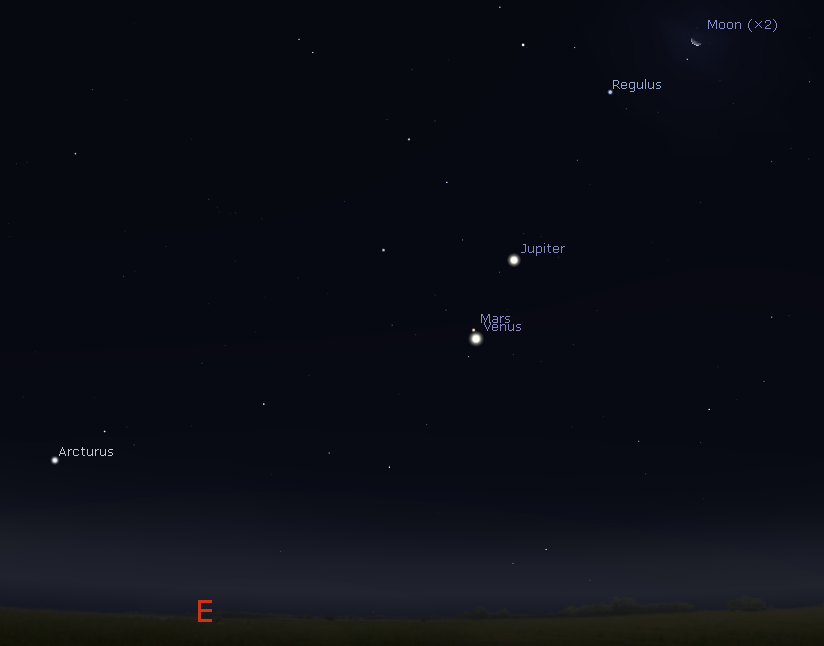
Mars is still close to Venus with Jupiter nearby in the southeast at 6 a.m. November 5, 2015. Created using Stellarium.
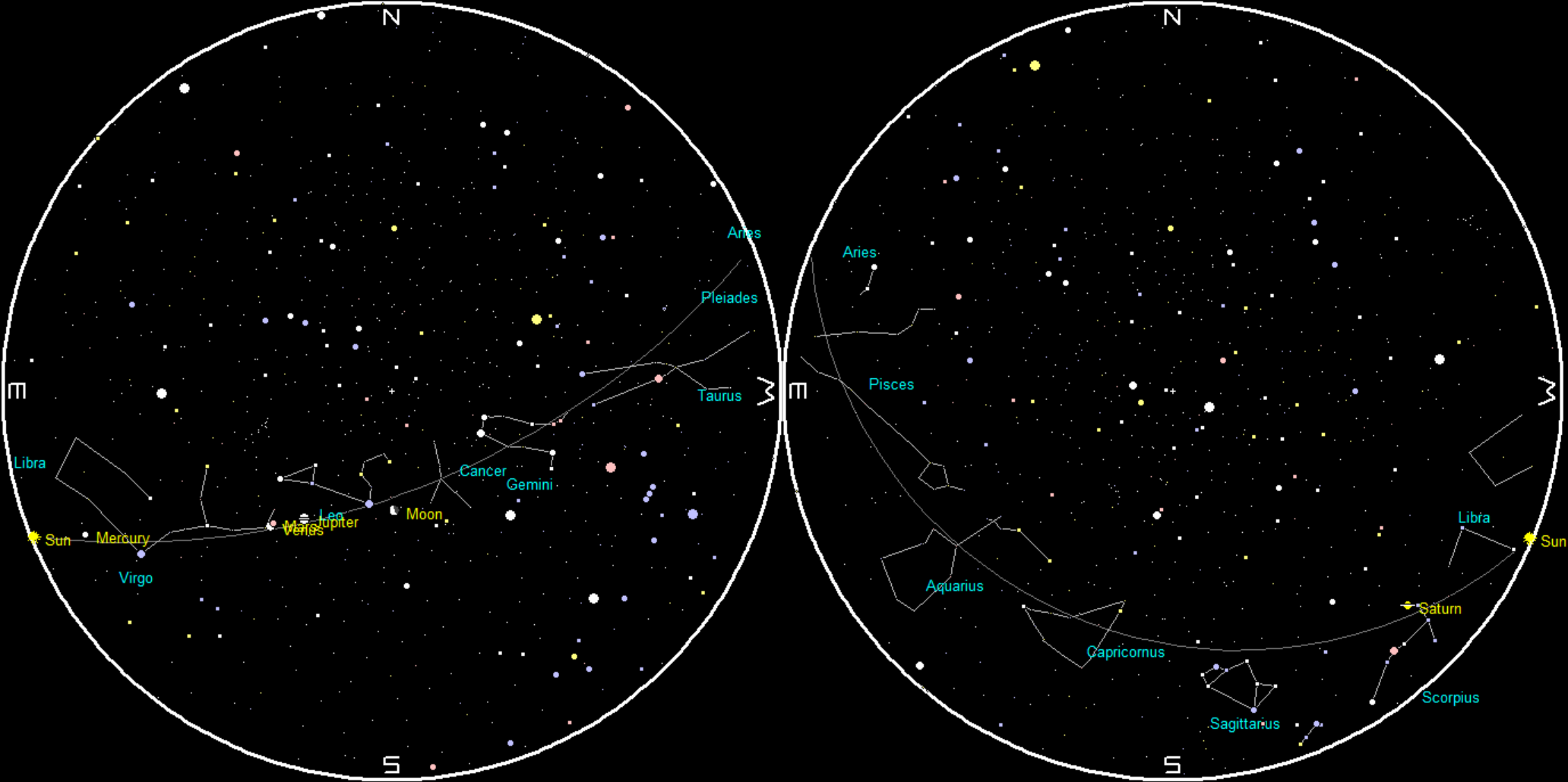
This is a chart showing the sunrise and sunset skies for November 4, 2015 showing the location of the planets and the Moon at that time. Created using my LookingUp program. Click on the image to enlarge.
 Bob Moler's Ephemeris Blog