Archive
02/17/2016 – Ephemeris – All the bright planets are in the morning sky, but two of them are trying to sneak out
Ephemeris for Wednesday, February 17th. The Sun will rise at 7:40. It’ll be up for 10 hours and 32 minutes, setting at 6:13. The Moon, 2 days past first quarter, will set at 4:39 tomorrow morning.
Let’s check out the whereabouts of the bright naked eye planets. All the classical planets visible from antiquity are officially now in the morning sky. Though Mercury is too close to the Sun to be spotted. Jupiter will rise at 7:57 p.m., in the east. Jupiter is still a morning planet since it’s not up at sunset. Mars will rise next at 1:24 a.m. in the east-southeast. It’s brighter than the bright star Spica growing even farther to the right of it.. Saturn will rise at 3:40 a.m. in the east-southeast. Venus will rise at 6:27 a.m. again in the east-southeast. Mercury is too deep in the twilight glare to be seen. Comet Catalina is up all night and is a binocular object and fading fast. At 10 p.m. is above the constellation of Cassiopeia and right of Perseus.
Times are for the Traverse City/Interlochen area of Michigan. They may be different for your location.
Addendum
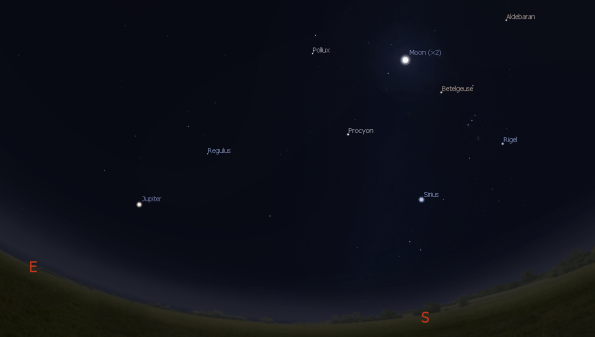
Jupiter, the Moon and the bright winter stars at 10 p.m. February 17, 2016. Created using Stellarium.
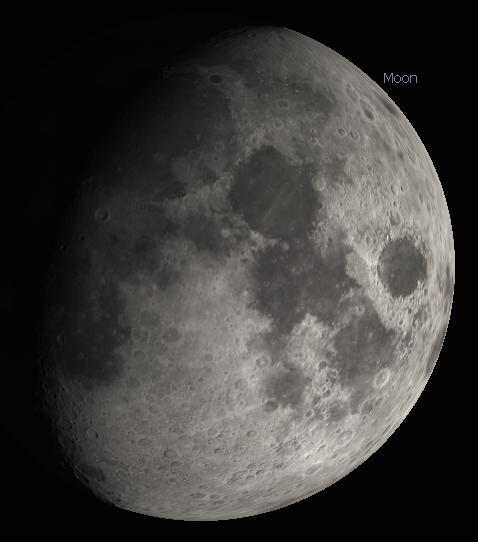
The Moon as it might be seen in binoculars at 10 p.m. February 17, 2016. Created using Stellarium.
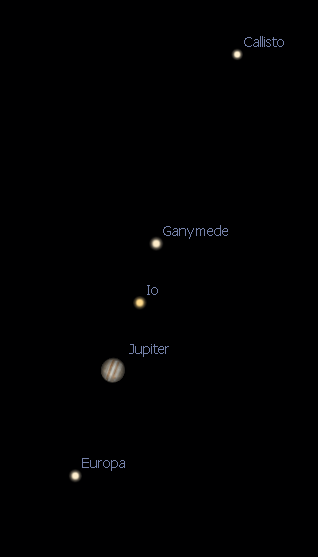
Jupiter and its moons as they would be seen in a telescope, at 10 p.m. February 17, 2016. Jupiter has an apparent diameter of 43.9″ Created using Stellarium.
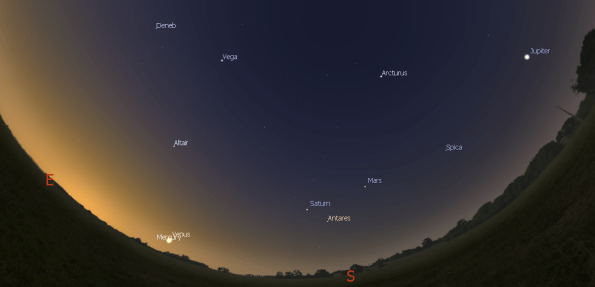
Morning planets and the bright s tar preview of summer. Mercury, though labeled can’t compete with the bright twilight. Observers south of here may have better luck. At 7 a.m. February 18, 2016. Created using Stellarium.
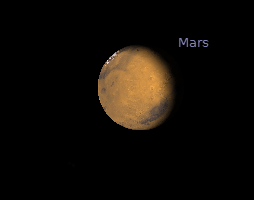
Mars in a telescope at high power. It’s apparent diameter is 7.9″. At 6 a.m. February 18, 2016. Created using Stellarium.
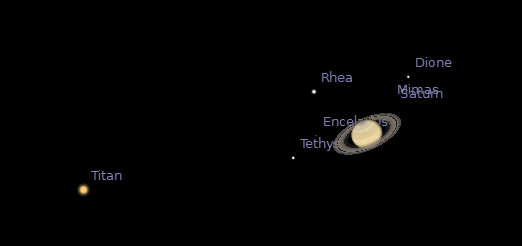
Saturn and its large satellite Titan and other moons as they should appear in a telescope at 6 a.m. February 18, 2016. The planet is 16.2″ in diameter while the rigs span 37.8″. Created using Stellarium.
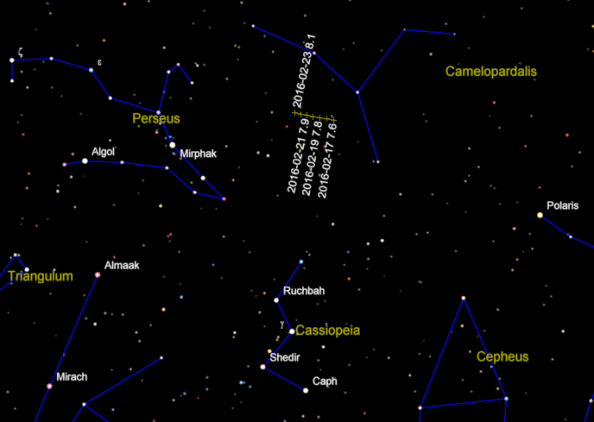
Comet Catalina’s path for the next week. Note that it is fading fast. It will take binoculars or a small telescope to spot the comet which will not show a tail visually. Created using Stellarium.
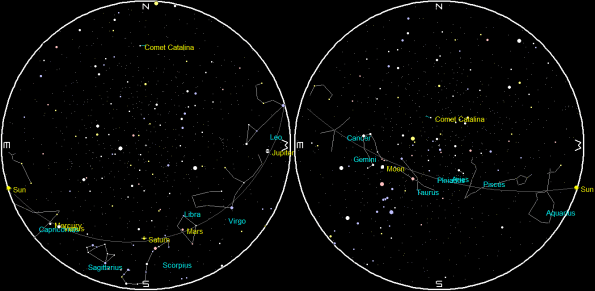
This is a chart showing the sunrise and sunset skies for February 17, 2016 showing the location of the planets, the Moon and Comet Catalina at that time. Created using my LookingUp program.
Some of these images above are shown smaller than actual size. Image expansion lately hasn’t worked. If you are using Firefox, right-click on the image, and then click on View Image.
 Bob Moler's Ephemeris Blog