Archive
03/03/2016 – Ephemeris – How to spot Zodiacal Light
Ephemeris for Thursday, March 3rd. The Sun will rise at 7:15. It’ll be up for 11 hours and 17 minutes, setting at 6:33. The Moon, 2 days past last quarter, will rise at 4:00 tomorrow morning.
There is a faint glow in the west that lingers after the end of twilight. It is visible to the careful observer. It’s Zodiacal Light, the reflected glow from countless bits of dust in the plane of the solar system. Its glow can be seen after twilight officially ends at 8:11 p.m. You’ll need to go to a spot with no towns or cities immediately to the west of you. The glow will appear as a thin pyramidal glow tilted to the left. It’s very difficult to find the first time, but once seen you’ll easily find it again. Zodiacal Light is easiest seen on spring evenings and autumn mornings when the ecliptic, the path of the planets and zodiac are nearest to vertical. The farther south one goes the easier it is to see. I first saw it when I was stationed in the Air Force in Louisiana.
Times are for the Traverse City/Interlochen area of Michigan. They may be different for your location.
Addendum
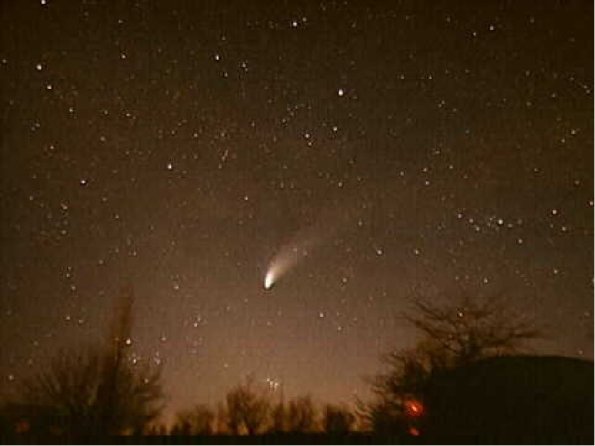
Zodiacal Light and Comet Hale-Bopp April 1997. My image.
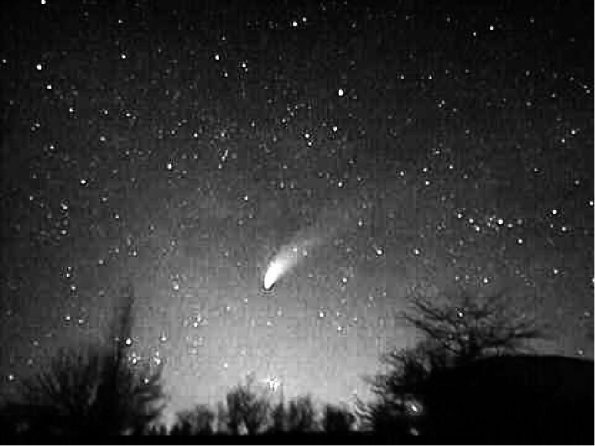
Zodiacal Light and Comet Hale-Bopp April 1997. Enhanced contrast.
I find I have better luck photographing Zodiacal Light if I take picture in its general direction of something else.
03/02/2016 – Ephemeris – The morning planet gang is breaking up
Ephemeris for Wednesday, March 2nd. The Sun will rise at 7:17. It’ll be up for 11 hours and 14 minutes, setting at 6:32. The Moon, 1 day past last quarter, will rise at 3:08 tomorrow morning.
Let’s check out the whereabouts of the bright naked eye planets. All the classical planets visible from antiquity are officially now in the morning sky. I won’t be able to say that next week. Mercury is too close to the Sun and too dim to be spotted. Jupiter will rise at 6:53 p.m., in the east. Jupiter is going to be the morning sky defector as of next Tuesday. It’s below the stars of Leo. Mars will rise next at 12:59 a.m. in the east-southeast. It’s seen against the stars of Libra now. Saturn will rise at 2:23 a.m. in the east-southeast. It’s above the stars of Scorpius, actually in Ophiuchus. Venus will rise at 6:24 a.m. again in the east-southeast. Mercury will pass behind the Sun in superior conjunction on the 23rd.
Times are for the Traverse City/Interlochen area of Michigan. They may be different for your location.
Addendum
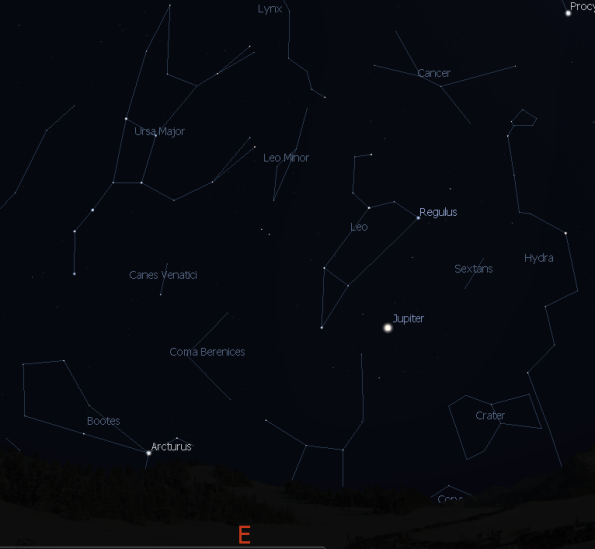
Jupiter and the rising spring constellations at 10 p.m. March 2, 2016. Created using Stellarium.
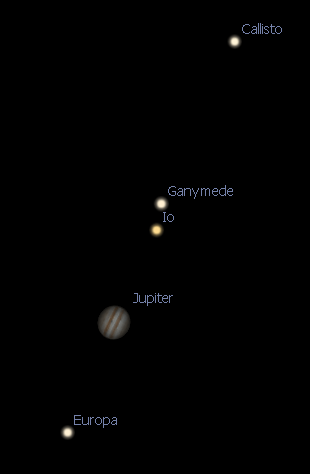
Jupiter and its moons as they would be seen in a telescope, at 10 p.m. March 2, 2016. Jupiter has an apparent diameter of 44.4″ Created using Stellarium.
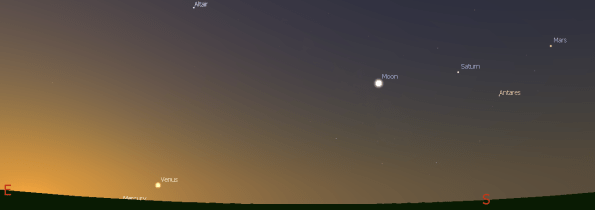
The morning planets and the Moon with the bright stars at 6:45 a.m. March 3, 2016. Created using Stellarium.
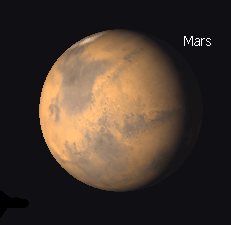
Mars as might look through a large amateur telescope at 6:45 a.m. March 3, 2016. North is at top. Apparent diameter is 8.9″.
In the Mars map below the center of the map pretty well matches the center of the Mars image above. The dark area to the upper left is Acidalia. The There’s a long dark feature to the right that has a blob at the end. The blob is Meridiani, where Mars’ prime meridian runs through. It is Meridiani where Opportunity landed, marked be MER-B.
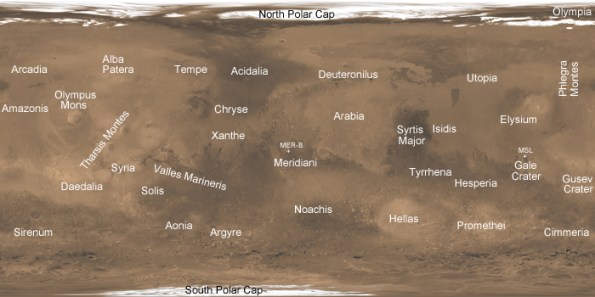
Annotated Mars Map. Credit NASA.
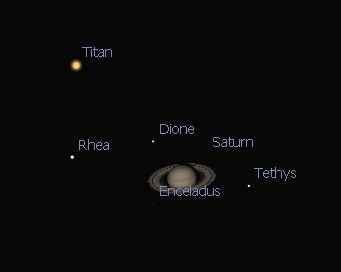
Saturn and its large satellite Titan and other moons as they should appear in a telescope in the morning of March 3, 2016. The planet is 16.6″ in diameter while the rings span 38.7″. Created using Stellarium.
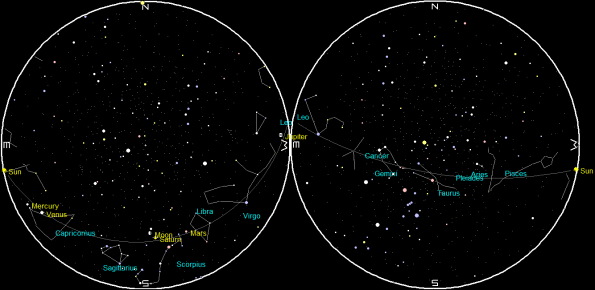
This is a chart showing the sunrise and sunset skies for March 2, 2016 showing the location of the planets and the Moon at that time. Created using my LookingUp program.
Some of these images above are shown smaller than actual size. Image expansion lately hasn’t worked. If you are using Firefox, right-click on the image, and then click on View Image.
03/01/2016 – Ephemeris – Previewing March skies
Ephemeris for Tuesday, March 1st. The Sun will rise at 7:19. It’ll be up for 11 hours and 11 minutes, setting at 6:31. The Moon, at last quarter today, will rise at 2:15 tomorrow morning.
Let’s look at the skies for the month of March. The sun will pass the celestial equator as the promising season of spring will begin. Daylight hours in the Interlochen/Traverse City area and will increase from 11 hours and 11 minutes today to 12 hours 45 minutes on the 31st. The altitude, or angle, of the sun above the southern horizon at local noon will be 38 degrees today and will ascend to nearly 50 degrees on the 31st. Jupiter will reach opposition from the Sun on the 8th and enter the evening sky. That evening our time a total solar eclipse will be visible from Indonesia to the Pacific Ocean. Spring will begin on the 20th at 12:31 a.m. Easter, announced by the full moon on the 23rd will be celebrated on the 27th for western churches.
Times are for the Traverse City/Interlochen area of Michigan. They may be different for your location.
Addendum
March Star Chart
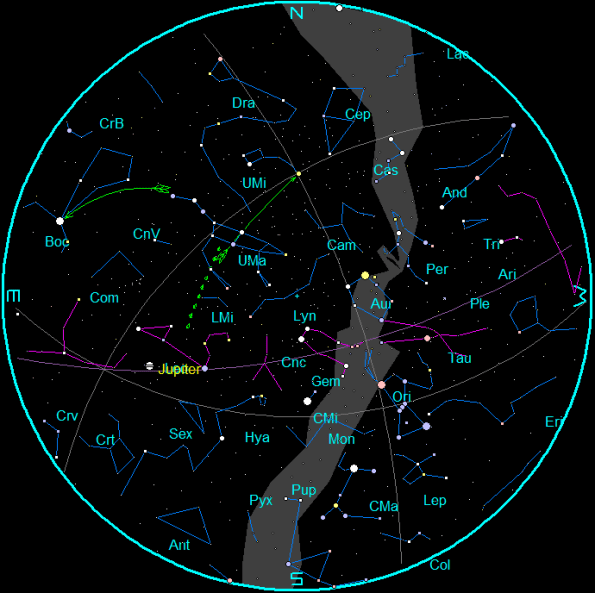
Star Chart for March 2016. Created using my LookingUp program. To enlarge in Firefox Right-click on image then click View image.
The planets and stars are plotted for the 15th at 10 p.m. EST. That is chart time. Note, Traverse City is located 45 minutes behind our time meridian. To duplicate the star positions on a planisphere you may have to set it to 45 minutes earlier than the current time.
Evening astronomical twilight ends at 7:34 p.m. EST on the 1st, increasing to 9:14 p.m. EDT on the 31st.
Morning astronomical twilight starts at 6:16 a.m. EDT on the 1st, and decreasing to 6:20 a.m. EST on the 31st.
Add a half hour to the chart time every week before the 15th and subtract a half hour for every week after the 15th. Before the 13th also subtract an hour for Standard Time.
For a list of constellation names to go with the abbreviations click here.
- Pointer stars at the front of the bowl of the Big Dipper point to Polaris the North Star
- A leaky Big Dipper drips on Leo
- Follow the arc of the handle of the Big Dipper to the star Arcturus
Calendar of Planetary Events
Credit: Sky Events Calendar by Fred Espenak and Sumit Dutta (NASA’s GSFC)
To generate your own calendar go to http://eclipse.gsfc.nasa.gov/SKYCAL/SKYCAL.html
Times are Eastern Time. Some additions made to aid clarity.
    Date  Time(EST) Event
Mar 01  Tu          Venus: 24.9° W
    01  Tu  6:11 pm Last Quarter
    02  We  1:53 am Moon-Saturn: 3.9° S
    03  Th  9:19 am Moon South Dec.: 18.2° S
    07  Mo  5:54 am Moon-Venus: 3.5° S
    08  Tu  4:58 am Jupiter Opposition from the Sun
    08  Tu  8:54 pm New Moon
    08  Tu  8:58 pm Total Solar Eclipse* (Indonesia & Pacific)
    09  We  1:31 am Moon Descending Node
    10  Th  2:02 am Moon Perigee: 359500 km
    13  Su  2:00 am Daylight Saving Time starts (EDT) Boo Hiss!
    14  Mo  9:44 am Moon-Aldebaran: 0.3° S
    15  Tu  1:03 pm First Quarter
    16  We  1:01 am Moon North Dec.: 18.2° N
    20  Su 12:31 am Vernal Equinox – Yea Spring!
    20  Su  3:05 pm Moon-Regulus: 2.8° N
    21  Mo 11:57 pm Moon-Jupiter: 2.3° N
    22  Tu  8:58 pm Moon Ascending Node
    23  We  7:48 am Penumbral Lunar Eclipse (not visible from here)
    23  We  8:01 am Full Moon
    23  We  4:05 pm Mercury Superior Conjunction with the Sun
    25  Fr 10:16 am Moon Apogee: 406100 km
    28  Mo  2:45 pm Moon-Mars: 4.6° S
    29  Tu 10:58 am Moon-Saturn: 3.8° S
    30  We  6:12 pm Moon South Dec.: 18.2° S
    31  Th 11:17 am Last Quarter
Apr 01              Venus: 17.4° W

* Coverage on NASA-TV-2 & www.exploratorium.edu/eclipse from 8 p.m. to 9 p.m.
Comet Catalina
Comet Catalina has become too faint to be seen in binoculars as it heads out of the solar system. To follow the comet further go to Seiichi Yashida’s Weekly Bright Comets page. Comet Catalina is no longer the brightest comet on the list, and is currently listed second. Click on it [C/2013 US10 ( Catalina )] for finder charts and other information.
When last we saw the comet was headed toward the constellation. But it’s headed almost straight away from the Earth now, and the Earth’s motion around the Sun is making the comet appear to start a loop north of Perseus. Another proof that Copernicus was right.
 Bob Moler's Ephemeris Blog