Archive
07/05/2017 – Ephemeris – Our weekly look at the bright planets
Ephemeris for Wednesday, July 5th. Today the Sun will be up for 15 hours and 26 minutes, setting at 9:30, and it will rise tomorrow at 6:04. The Moon, 4 days before full, will set at 4:22 tomorrow morning.
Let’s take our weekly look at the bright planets. Jupiter is in the southwest as it gets dark in the evening. The bright blue-white star Spica, which pales in comparison to Jupiter, is seen left of it. In even the smallest telescopes Jupiter’s four largest moons can be seen. They shift positions night from to night and sometimes even as you watch. Jupiter will set at 1:25 a.m. Saturn can now be seen in the evening as twilight fades in the south, tonight it’s just left of the bright waxing gibbous Moon. Saturn’s rings are spectacular in telescopes. In the morning sky, brilliant Venus will rise at 3:36 a.m. and be visible until about quarter to 6 tomorrow morning. Mars and Mercury are too close to the direction of the Sun to be seen.
The times given are for the Traverse City/Interlochen area of Michigan. They may be different for your location.
Addendum
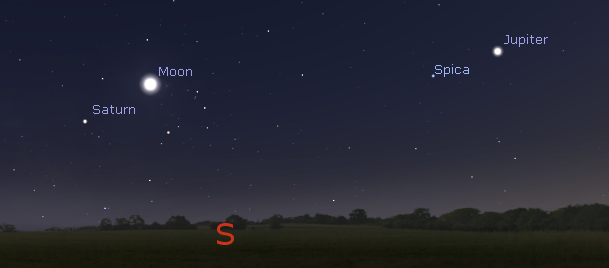
Jupiter, Saturn and the Moon at 10:30 p.m., July 5, 2017. Created using Stellarium.
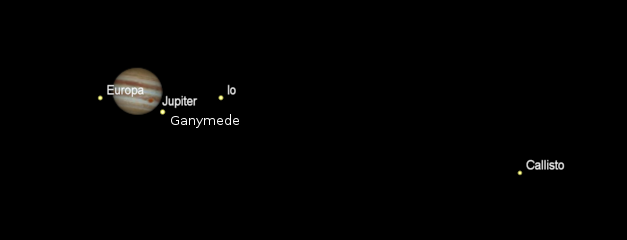
Jupiter and its four Galilean moons in tight to the planet as they might be seen in a telescope at 10:30 p.m,. July 5, 2017. Created using Cartes du Ciel (Sky Charts).
Project Pluto has the following events for the 5/6th:
Time is UT. Events prior to 5 July 1:41 UT (9:41 p.m. EDT) and after 6 July 4:08 UT (12:08 a.m. EDT) will not be visible from Northern Michigan. Data from Project Pluto: https://www.projectpluto.com/jevent.htm#jul
I : Tra start: 5 Jul 2017 21:30
I : Sha start: 5 Jul 2017 22:46
II : Occ start: 5 Jul 2017 23:12
I : Tra end : 5 Jul 2017 23:41
I : Sha end : 6 Jul 2017 0:56
II : Occ end : 6 Jul 2017 1:41
II : Ecl start: 6 Jul 2017 1:46
III: Occ start: 6 Jul 2017 3:09
II : Ecl end : 6 Jul 2017 4:08
III: Occ end : 6 Jul 2017 5:44
Satellites: I = Io, II = Europa, and III = Ganymede
Ecl = Eclipse (In Jupiter’s shadow), Occ = Occultation (Moon behind the planet), Sha = Moon’s shadow crossing the face of the planet, Tra = Transit of the moon across the face of the planet
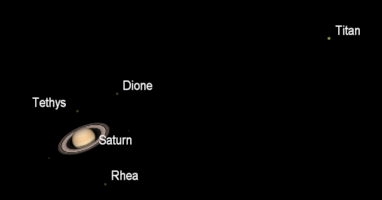
Saturn and its brightest moons overnight July 5/6, 2017. Created using Cartes du Ciel (Sky Charts).
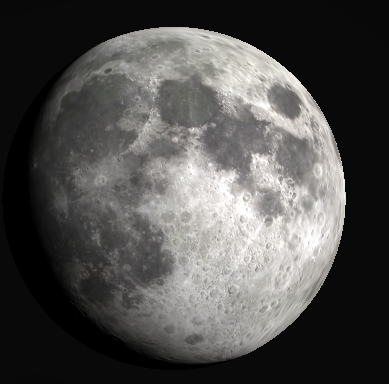
The Moon as it would appear in binoculars at 10:30 p.m. July 5, 2017. Created using Stellarium.
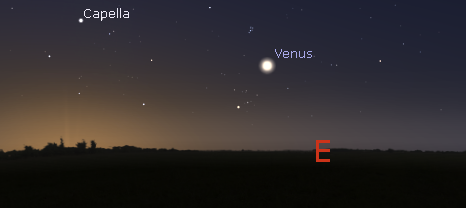
Venus at 5 a.m. July 6, 2017. Created using Stellarium.
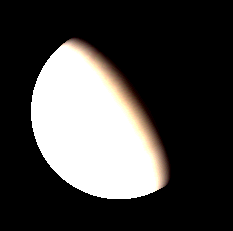
Venus as it might be seen through a telescope at 5 a.m. July 6, 2017. This is displayed at a larger scale/magnification than the Jupiter or Saturn images above. Created using Stellarium.
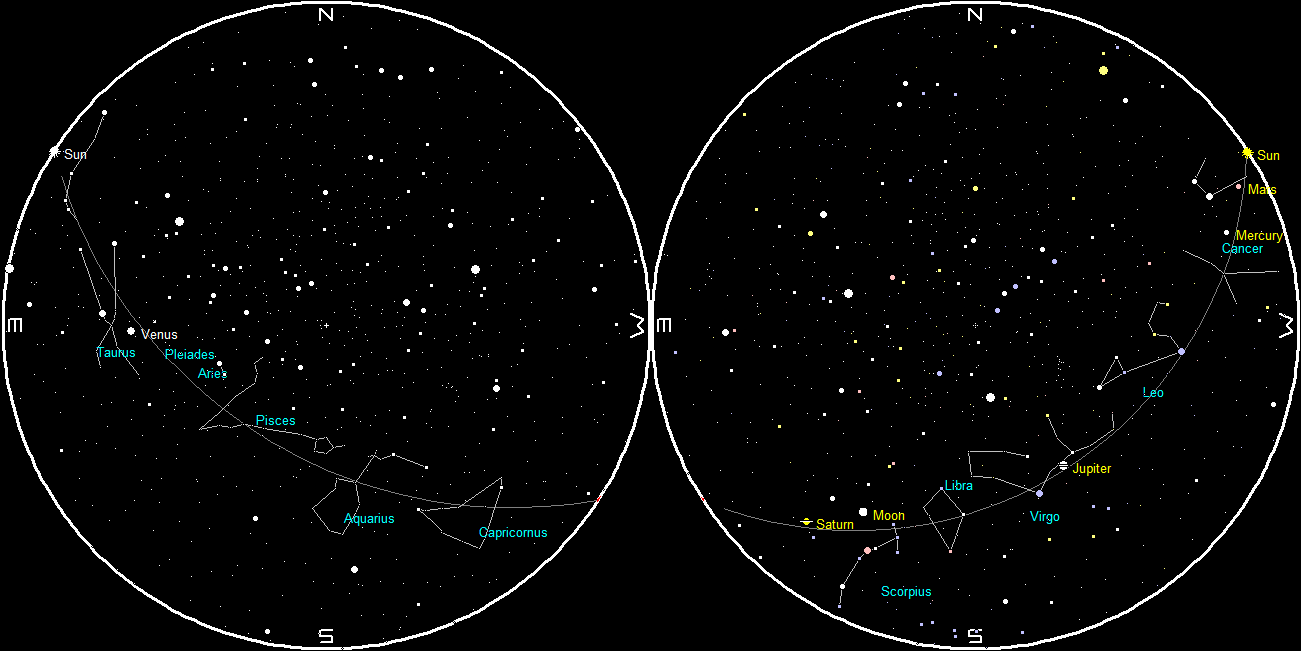
Planets at sunset and sunrise of a single night starting with sunset on the right on July 5, 2017. The night ends on the left with sunrise on July 6. Click on the image to enlarge. Created using my LookingUp program.
07/04/2017 – Ephemeris – Happy birthday America! Tomorrow morning Venus will appear near the Pleiades
Ephemeris for Independence Day, Tuesday, July 4th. Today the Sun will be up for 15 hours and 27 minutes, setting at 9:30, and it will rise tomorrow at 6:03. The Moon, 4 days past first quarter, will set at 3:46 tomorrow morning.
This is the 241st anniversary of the signing of the Declaration of Independence. Venus is our morning star now, and back in 1776 it too was a morning planet, but a lot closer to the rising Sun, and harder to spot.
Tonight Venus will pass south of the famous Pleiades star cluster, so that tomorrow morning at about 4:30 it will be dark enough to see the Pleiades above and left of our brilliant Morning Star.
Planets to us appear as stars to the naked eye due to their distance, though they are close enough to appear as disks in small telescopes. Very few of the largest telescopes can ever see the disk of a star, other than the Sun,, and only if that star is really huge, like Betelgeuse in the winter constellation of Orion.
The times given are for the Traverse City/Interlochen area of Michigan. They may be different for your location.
Addendum
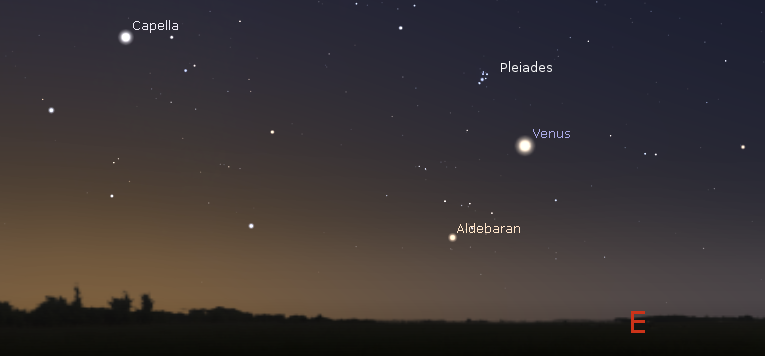
The eastern sky at 5 a.m. July 5, 2017 with the Pleiades above and left of Venus. Created using Stellarium.
We’ll be seeing the Pleiades in the evening sky in four months when summer is a memory.
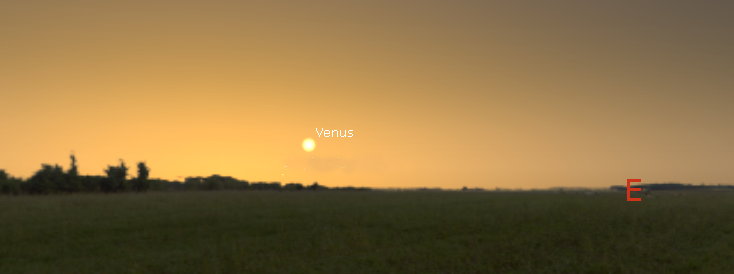
The morning sky to the east and Venus about 20 minutes before sunrise that auspicious morning July 4, 1776 from Philadelphia. Created using Stellarium.
Excuse the fact that the landscape is the same in both images.
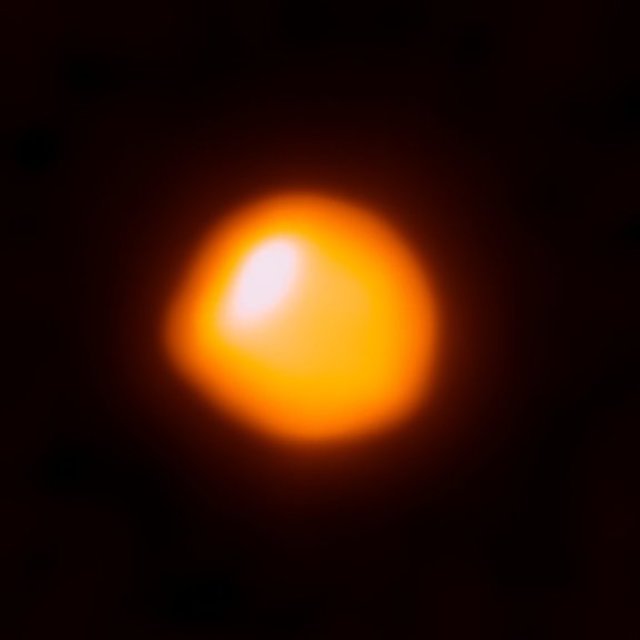
This is the disk of the star Betelgeuse in Orion. It is not an image from an optical telescope of an image created in submillimeter microwaves by the Atacama Large Millimeter/submillimeter Array (ALMA) in Chile. Credit: ALMA (ESO/NAOJ/NRAO)/E. O’Gorman/P. Kervella.
Betelgeuse, though it is 600 light years away has a radius of slightly more than the orbit of Jupiter. The bump on the left side of the image may be a plume of gas erupting from the star.
07/03/2017 – Ephemeris – The Earth is farthest from the Sun today
Ephemeris for Monday, July 3rd. Today the Sun will be up for 15 hours and 28 minutes, setting at 9:30, and it will rise tomorrow at 6:03. The Moon, 3 days past first quarter, will set at 3:13 tomorrow morning.
At 8:59 tonight the Earth will pass a point in its orbit of the sun called aphelion, the farthest point from the sun of 94.5 million miles (152 million km). The whole Earth gets something like 6% less heat from the Sun than early January when the Sun is closest. So why is it summer now? The difference in distance from the sun pales as a cause of the seasons next to the tilt of the earth’s axis. Six months ago, because the sun was up for a shorter period each day, and didn’t rise very high in the sky, the sun gave us in northern Michigan something like 70% less heat than it does now. The real effect of aphelion coming in summer is that it makes summer the longest season at 94 days. This is because the farther the Earth is from the Sun, the slower it travels. Hey, it’s summer – take the hint and slow down and enjoy the season.
The times given are for the Traverse City/Interlochen area of Michigan. They may be different for your location.
 Bob Moler's Ephemeris Blog