Archive
07/17/2017 – Ephemeris – Constellations of the Summer Triangle III: Aquila the Eagle
Ephemeris for Monday, July 17th. Today the Sun will be up for 15 hours and 9 minutes, setting at 9:23, and it will rise tomorrow at 6:14. The Moon, 1 day past last quarter, will rise at 2:08 tomorrow morning.
Aquila the eagle is a constellation that lies in the Milky Way. It’s in the southeastern sky as it gets dark. Its brightest star, Altair is one of the stars of the Summer Triangle, the group of three bright stars dominating the eastern sky in the evening now. Altair, in the head of the eagle, is flanked by two slightly dimmer stars, the shoulders of the eagle. The eagle is flying northeastward through the Milky Way. Its wings are seen in the wing tip stars. A curved group of stars to the lower right of Altair is its tail. Within Aquila the Milky Way shows many dark clouds as part of the Great Rift that splits it here. The other summer bird is Cygnus the swan above and left of Aquila, flying in the opposite direction.
The times given are for the Traverse City/Interlochen area of Michigan. They may be different for your location.
Addendum
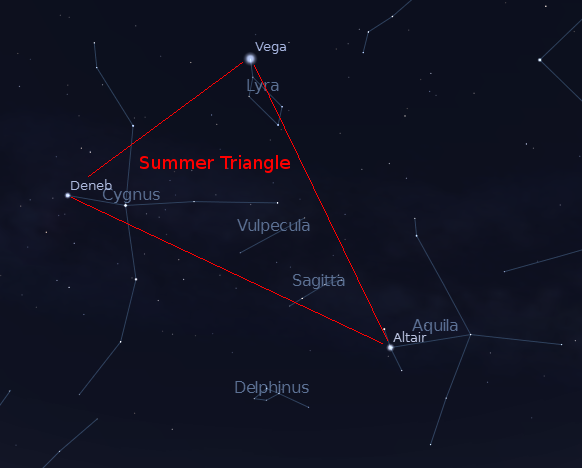
The Summer Triangle. Created using Stellarium and The Gimp.
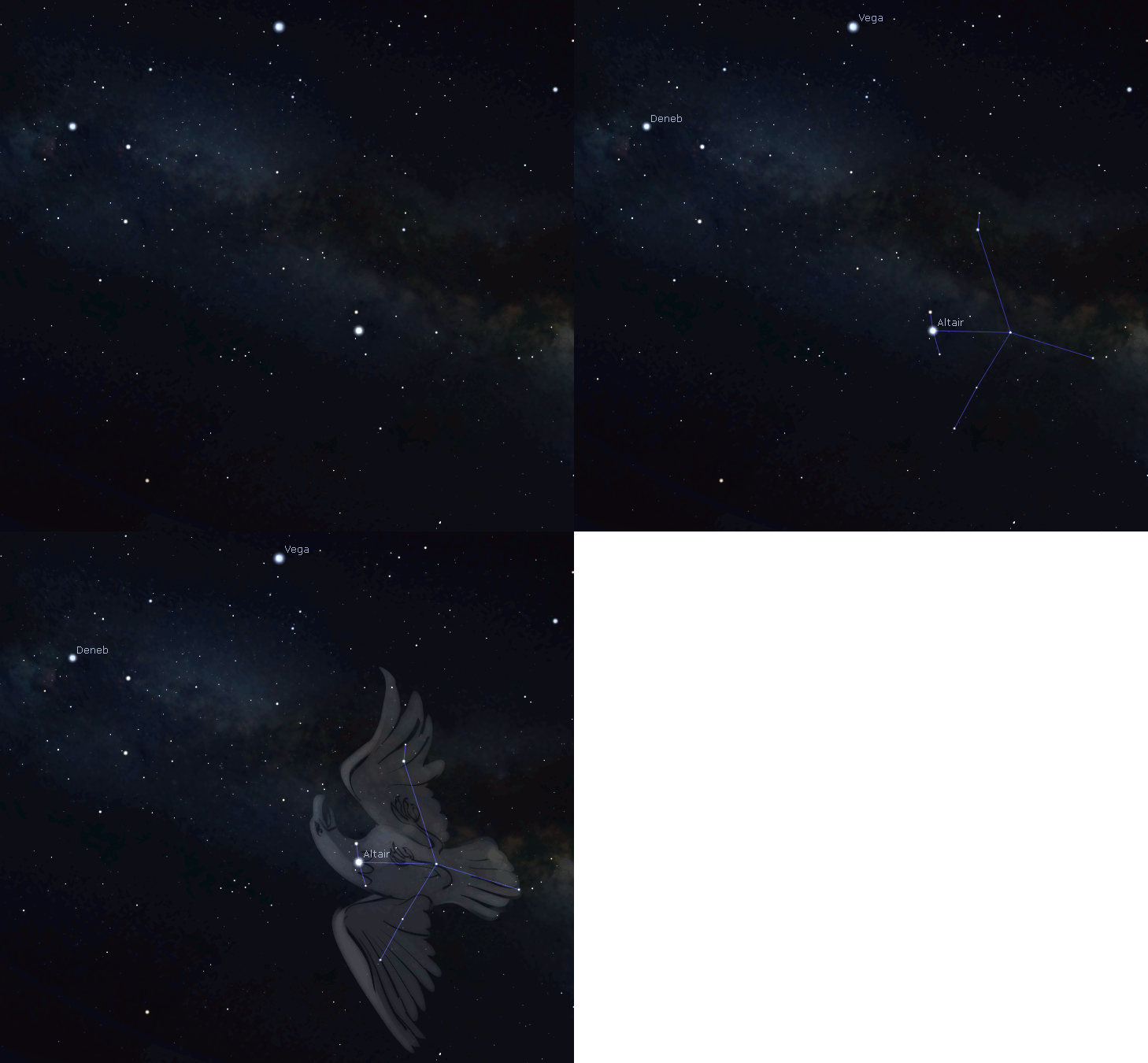
Animated Cygnus finder chart. Created using Stellarium.
07/15/17 – Ephemeris Extra – Possible Auroras to be visible this weekend
The National Oceanic and Atmospheric Administration (NOAA) Space Weather Prediction Center has issued a Geomagnetic Storm Watch for 16-17 July 2017 UT (Universal Time). The watch period starts tonight for the US. The 16th UT starts at 8 p.m. tonight, the 15th EDT. What it means, among other things, is that the Aurora Borealis (Northern Lights) may be visible from the northern tier of states in the United States and Canada, Scotland, Scandinavia, and Russia. And maybe even farther south. See the map below:
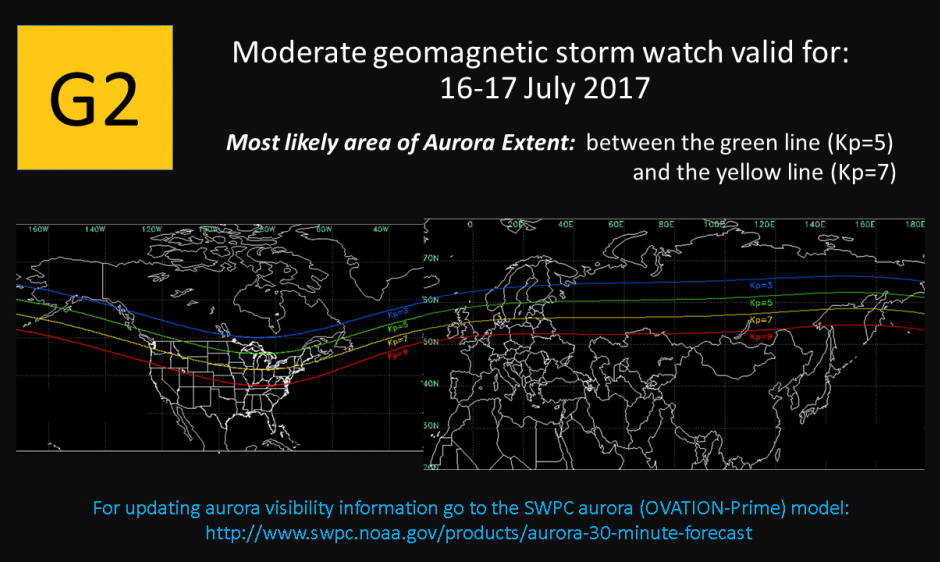
From the NOAA website. Click on the image to enlarge. Click here for the link mentioned in the image: http://www.swpc.noaa.gov/products/aurora-30-minute-forecast.
This alert was issued due to a Coronal Mass Ejection (CME) from the large, but decaying, sunspot group AR2665 at 2:09 UT on the 14th (10:09 p.m. on the 13th EDT). The CME is expected to encounter the Earth’s magnetosphere on the 16th.
A tip of the old observer’s hat to spaceweather.com for the heads up email.
07/14/2017 – Ephemeris – Constellations of the Summer Triangle II: Cygnus the swan
Ephemeris for Friday, July 14th. Today the Sun will be up for 15 hours and 14 minutes, setting at 9:25, and it will rise tomorrow at 6:11. The Moon, 2 days before last quarter, will rise at 12:32 tomorrow morning.
Fairly high in the east at 11 p.m. Is the constellation of Cygnus the swan, flying south through the Milky Way. It is also called the Northern Cross. At the left, the tail of the swan or the head of the cross is the bright star Deneb, one of the stars of the Summer Triangle. The next star right is Sadr the intersection of the body and the wings of the swan seen in flight, or the intersection of the two pieces of the cross. There are two or three stars farther to the right that delineate the swan’s long neck or upright of the cross, that ends with the star Alberio in the beak of the swan or foot of the cross. The crosspiece of the cross extends to the stars on either side of the intersection star Sadr, while the swan’s wings extend to a couple more stars each.
The times given are for the Traverse City/Interlochen area of Michigan. They may be different for your location.
Addendum
The Summer Triangle. Created using Stellarium and The Gimp.
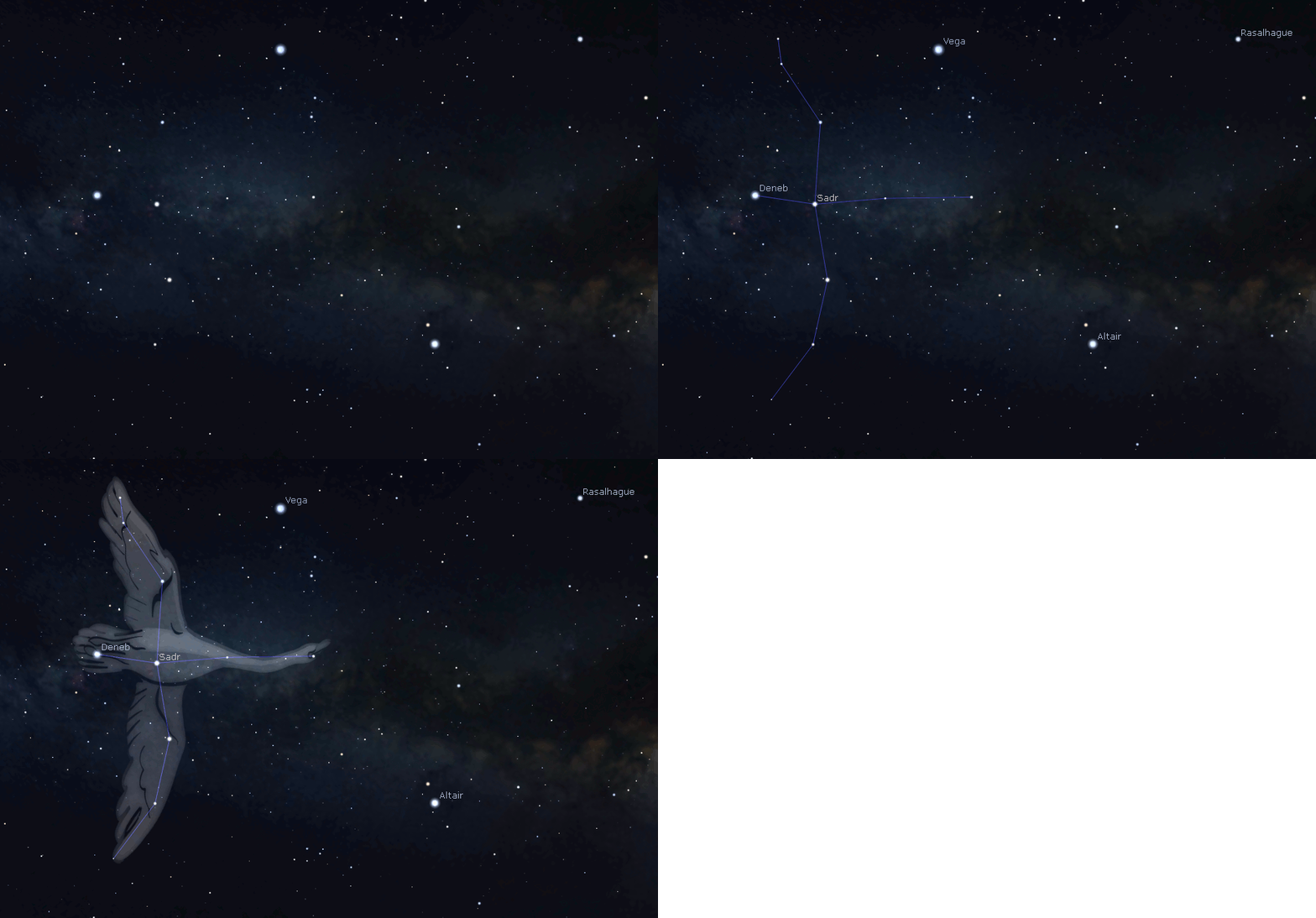
Animated Cygnus finder chart. Created using Stellarium.
In mythology Cygnus was the form Zeus took in the Leda and the swan affair. Out of that union was born Pollux of Gemini fame. His half-brother and twin Castor was fathered by a mere mortal. Go here for their story.
Alberio is the star that shows in Cygnus’ eye. In telescopes of even low power Alberio shows as a binary star whose components are distinctly and beautiful blue and gold. Binoculars are not quite powerful enough to split these two.
07/13/2017 – Ephemeris – Constellations of the Summer Triangle I: Lyra the harp
Ephemeris for Thursday, July 13th. Today the Sun will be up for 15 hours and 16 minutes, setting at 9:26, and it will rise tomorrow at 6:10. The Moon, 3 days before last quarter, will rise at 12:02 tomorrow morning.
Very high up in the eastern sky at 11 p.m. can be found a bright star just above a small, narrow, but very distinctive parallelogram of stars. They are the stars of the constellation Lyra the harp. The bright star is Vega, member of the Summer Triangle and one of the twenty one brightest first magnitude stars. Vega is actually the 5th brightest night-time star. The harp, according to Greek mythology, was invented by the Greek god Hermes. The form of the harp in the sky, is as he had invented it: by stretching strings across a tortoise-shell. Hermes gave it to his half-brother Apollo, who in turn gave it to the great musician Orpheus. The Sun’s motion with respect to most stars around it is towards the vicinity of Lyra.
The times given are for the Traverse City/Interlochen area of Michigan. They may be different for your location.
Addendum
The Summer Triangle. Created using Stellarium.
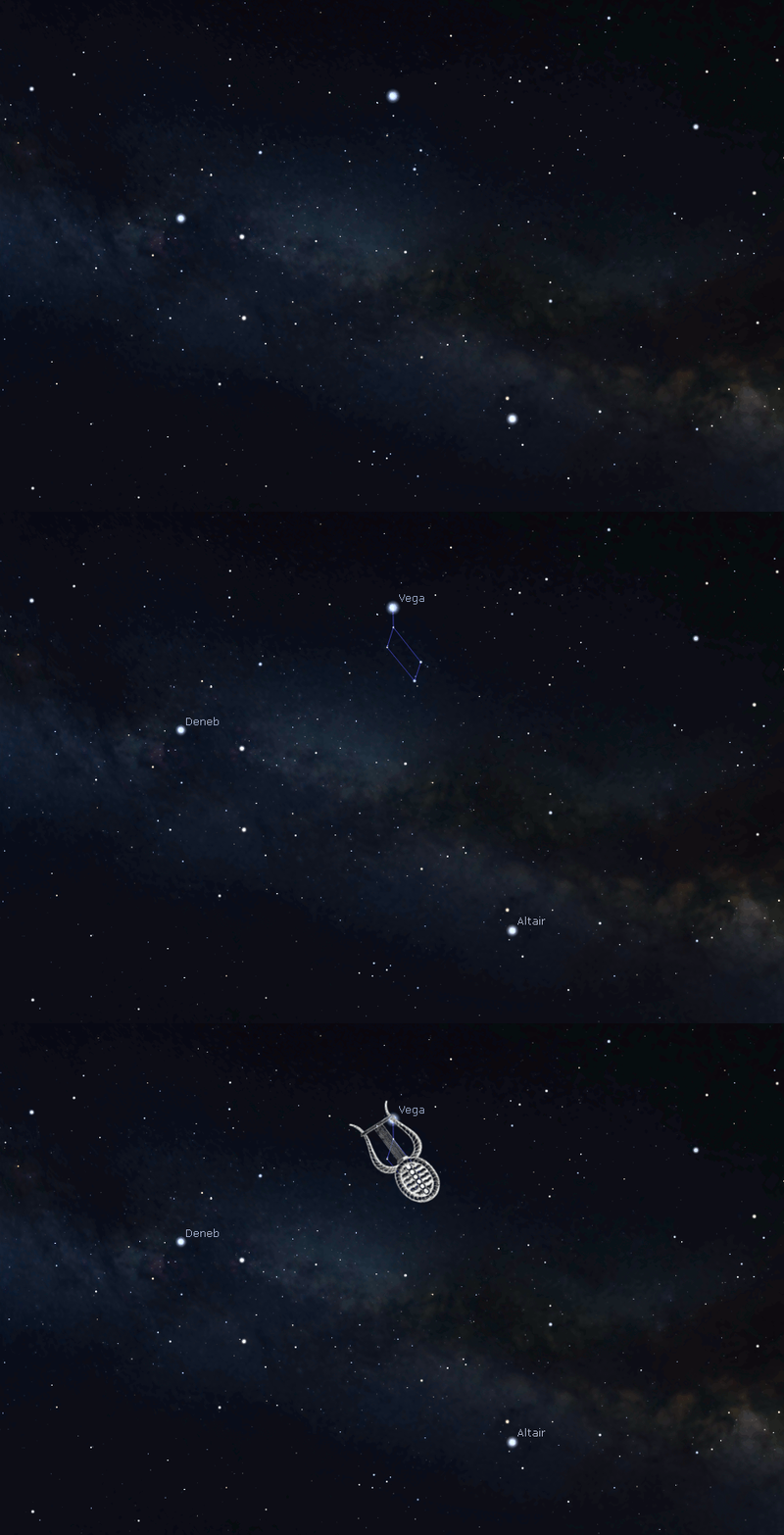
Animated Lyra finder chart. The lyre image not supplied by Stellarium but is from The World’s Earliest Music by Hermann Smith, a Project Gutenberg E book, figure 60, captioned “The Chelys or Greek Tortoiseshell Lyre”. Image created using Stellarium and GIMP.
07/12/2017 – Ephemeris – Let’s check out the whereabouts of the bright planets
Ephemeris for Wednesday, July 12th. Today the Sun will be up for 15 hours and 17 minutes, setting at 9:26, and it will rise tomorrow at 6:10. The Moon, 3 days past full, will rise at 11:32 this evening.
Let’s take our weekly look at the bright planets. Jupiter is in the southwest as it gets dark in the evening. The bright blue-white star Spica, which pales in comparison to Jupiter, is seen left of it. In even the smallest telescopes Jupiter’s four largest moons can be seen. They shift positions from night to night. Jupiter will set at 12:58 a.m. Saturn can now be seen in the evening as twilight fades in the south. The reddish star Antares is off to the right of Saturn. Saturn’s rings are spectacular in telescopes. Saturn will set at 4:15 a.m. In the morning sky, brilliant Venus will rise at 3:23 a.m. and be visible until about quarter to 6 tomorrow morning. Mercury sets too close to sunset to be easily seen now.
The times given are for the Traverse City/Interlochen area of Michigan. They may be different for your location.
Addendum
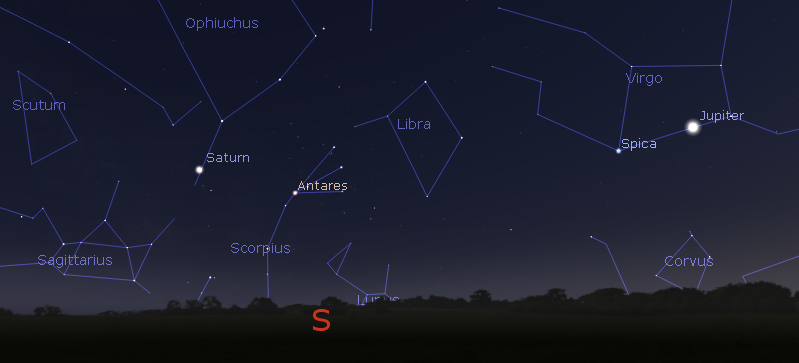
Jupiter and Saturn with the southern summer constellations at 10:30 p.m., July 12, 2017. Created using Stellarium.
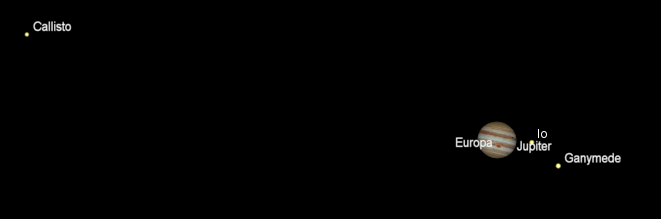
Jupiter and three of its moons. Europa is behind the planet at 10:30 p.m,. July 12, 2017. Created using Cartes du Ciel (Sky Charts).
Project Pluto has the following events for the 12/13th:
Time is UT. Events prior to 13 July 1:47 UT (9:47 p.m. 12 July EDT) will not be visible from Northern Michigan. Data from Project Pluto: https://www.projectpluto.com/jevent.htm#jun. The website also has a link to a list of Great Red Spot transits.
I : Tra start: 12 Jul 2017 23:25
I : Sha start: 13 Jul 2017 0:41
I : Tra end : 13 Jul 2017 1:36
II : Occ start: 13 Jul 2017 1:47
I : Sha end : 13 Jul 2017 2:51
II : Occ end : 13 Jul 2017 4:16
II : Ecl start: 13 Jul 2017 4:20
II : Ecl end : 13 Jul 2017 6:42
III: Occ start: 13 Jul 2017 7:10
III: Occ end : 13 Jul 2017 9:45
III: Ecl start: 13 Jul 2017 12:29
III: Ecl end : 13 Jul 2017 14:40
Satellites: I = Io, II = Europa, and III = Ganymede
Tra = Transit of a satellite across the face of Jupiter, Sha = Transit of a moon’s shadow, Ecl = Eclipse (In Jupiter’s shadow), Occ = Occultation (Moon behind the planet).
The Great Red Spot transit: 13 Jul 2017 02:01 (10:01 p.m. 12 July EDT).
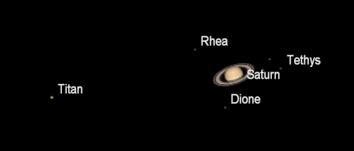
Saturn and its brightest moons overnight July 12/13, 2017. Created using Cartes du Ciel (Sky Charts).
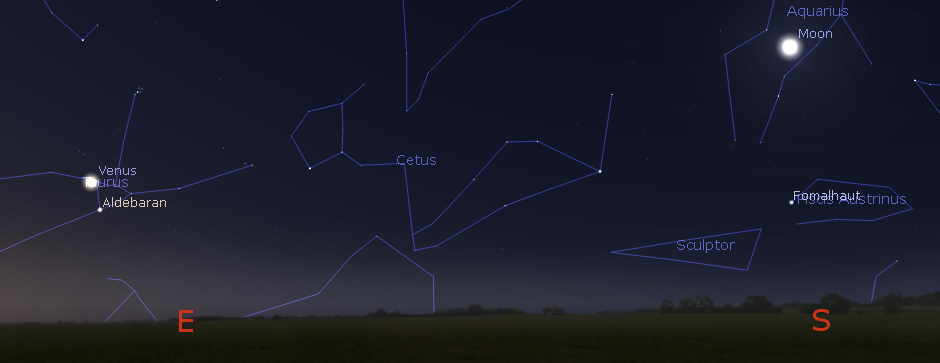
Venus and the Moon at 5 a.m. July 13, 2017. Created using Stellarium. Click on the image to expand.
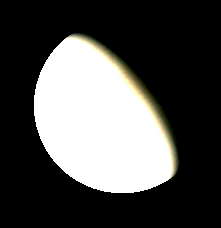
Venus as it might be seen through a telescope at 5 a.m. July 13, 2017. This is displayed at a larger scale/magnification than the Jupiter or Saturn images above. Created using Stellarium.
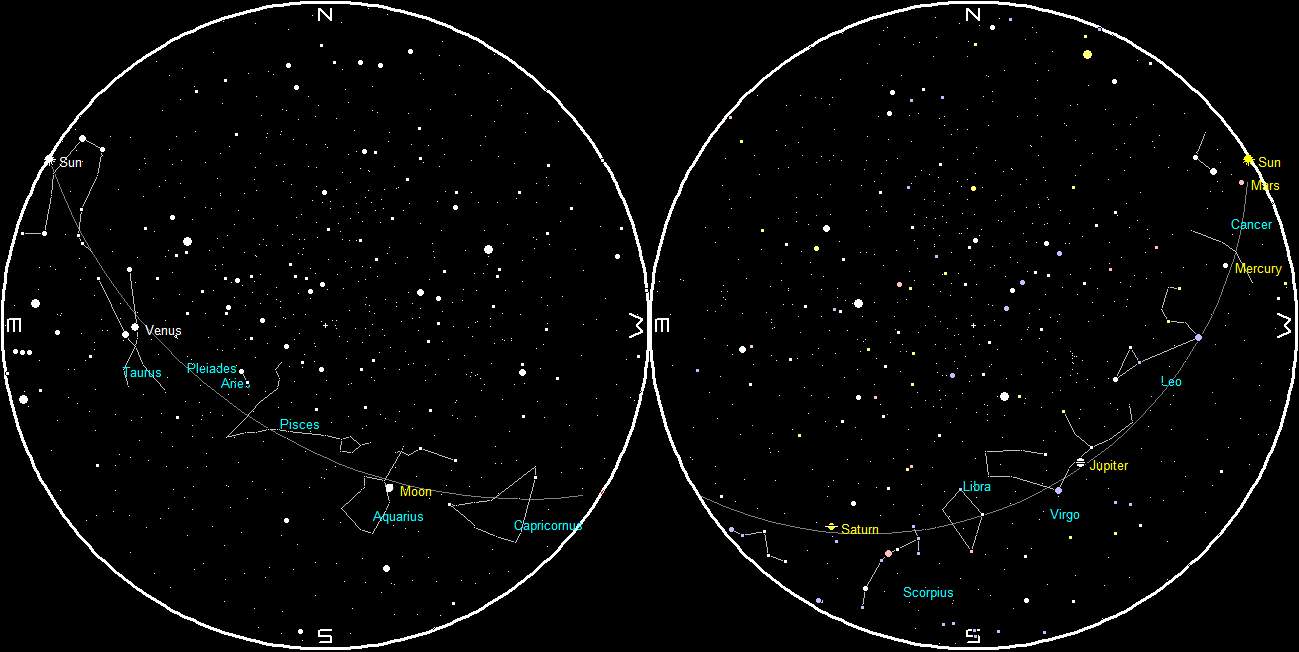
Planets at sunset and sunrise of a single night starting with sunset on the right on July 12, 2017. The night ends on the left with sunrise on July 13. Click on the image to enlarge. Created using my LookingUp program.
07/11/2017 – Ephemeris – Altair the nearest star of the Summer Triangle
Ephemeris for Tuesday, July 11th. Today the Sun will be up for 15 hours and 18 minutes, setting at 9:27, and it will rise tomorrow at 6:09. The Moon, 2 days past full, will rise at 10:59 this evening.
The southernmost star of the Summer Triangle is Altair, high in the east-southeast. The other two stars of the triangle are Vega nearly overhead in the east, and Deneb high in the east-northeast. Altair is the closest of the three at a distance of 16.7 light years away. One light year is nearly 6 trillion miles. Altair is 10 times the brightness of the Sun. If seen at Altair’s distance, the Sun would only be as bright as one of the two stars that flank it. What is rather different about Altair is its rapid rotation. While it’s almost twice the sun’s diameter, it rotates once in about 9 hours, The CHARA Interferometer at Mt. Wilson has actually imaged its squashed disk in the infrared. Our sun’s a slow poke, taking nearly a month to rotate once.
The times given are for the Traverse City/Interlochen area of Michigan. They may be different for your location.
Addendum
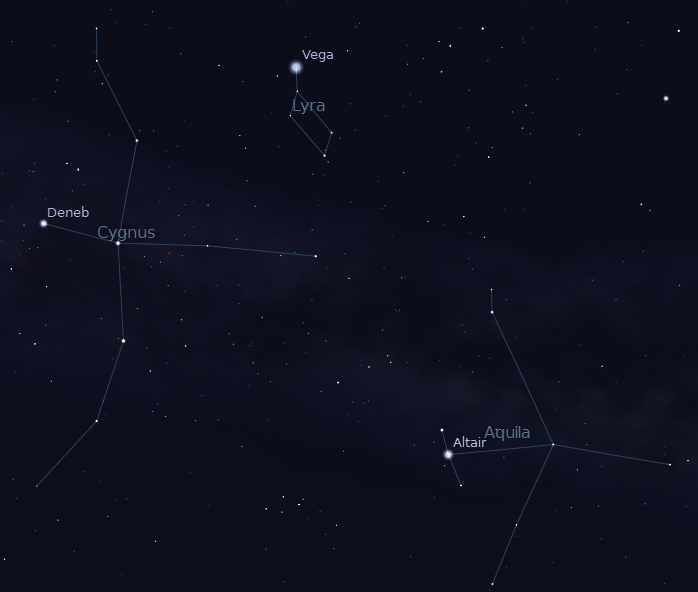
Summer Triangle. Created using Stellarium.
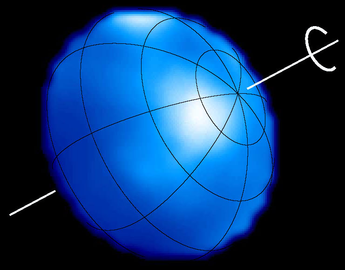
False-color image of the rapidly rotating star Altair, made with the MIRC imager on the CHARA array on Mt. Wilson. Credit: Ming Zhao, University of Michigan
07/10/2017 – Ephemeris – Deneb, a super bright star
Ephemeris for Monday, July 10th. Today the Sun will be up for 15 hours and 20 minutes, setting at 9:27, and it will rise tomorrow at 6:08. The Moon, 1 day past full, will rise at 10:24 this evening.
This evening when it gets dark the bright star Deneb in Cygnus the swan will be high in the east-northeast. Deneb is the dimmest star of the summer triangle. Of the other stars of the triangle, Vega is higher in the east, while Altair is lower in the southeast. While Deneb’s apparent magnitude, or brightness as seen from Earth, makes it the dimmest of the three bright stars, Deneb’s vast distance of possibly 1,400 light years* makes it over 50 times the distance of Vega. If brought as close as Vega, Deneb would be as bright at least as the quarter moon. It is possibly as bright as 200 thousand Suns; and a huge star, possibly as large in diameter as the orbit of the Earth. For all this it is only 20 to 25 times the mass of the sun.
The times given are for the Traverse City/Interlochen area of Michigan. They may be different for your location.
* Deneb’s distance is not well known. Over the years with the Ephemeris program and this blog I’ve given various distances to the star. Having no companion and being beyond the distance where trigonometric parallax is used, at least from the ground, makes distance measurement difficult. Hipparcos satellite measurements give a distance about twice as great. Estimates of the true brightness of a star are based on its known distance. An error in distance by a factor of two gives an error in terms of intrinsic luminosity by a factor of 4, due to the inverse square law of brightness with distance.
Addendum
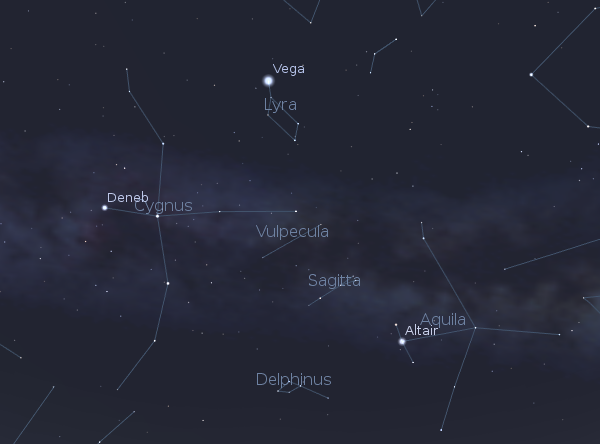
Deneb with the other stars and constellations in the Summer Triangle. Created using Stellarium.
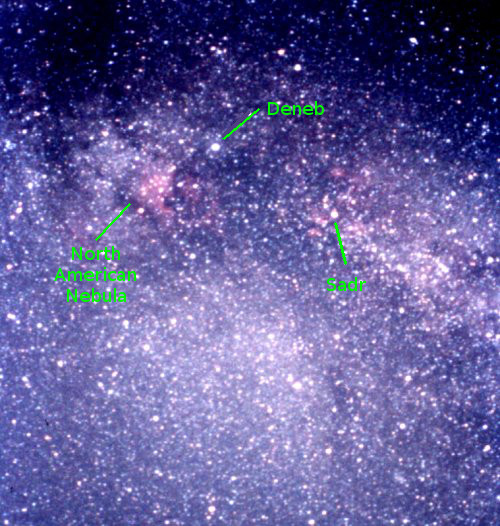
One of my old photographs of Deneb and the North American Nebula digitized from a slide. Deneb’s ultraviolet emissions cause the North American and unnamed here Pelican Nebulae to glow. The red color is due to hydrogen.
Ephemeris Extra – Some easy summertime deep sky objects
The finder charts were created using Cartes du Ciel (Sky Charts). This post is based on my article in the July 2017 Stellar Sentinel, the newsletter of the Grand Traverse Astronomical Society. It’s part of the Extras section for those receiving the emailed version.
What are Deep Sky Objects? These are objects, other than individual stars, beyond the solar system generally visible in binoculars or telescopes rather than the naked eye such as galaxies, nebulae and star clusters.
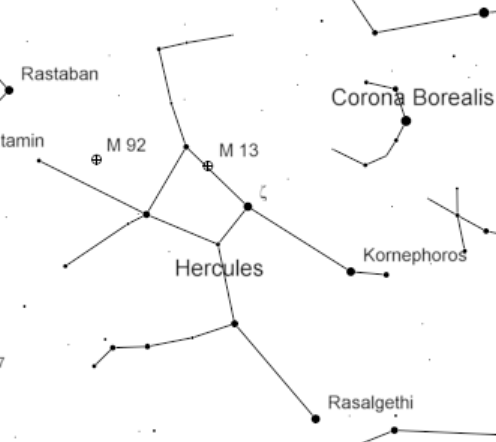 The Great Hercules Globular Star Cluster, M13 is the finest globular star cluster in the northern hemisphere of the sky. It is visible from late spring to early autumn. Globular star clusters have populations of hundreds of thousands of stars. They date back to the origin of the Milky Way of ten or a bit more billion of years old. There are only about 150 of these that belong to the Milky Way Galaxy. M13 is visible in binoculars on the western side of the Keystone pattern of stars, about one-third the distance from the north star on that side to the south side. It takes a much larger telescope to see individual stars. The star cluster will be a large circular glow. M92 is another star cluster which is dimmer and will be quite a challenge to find.
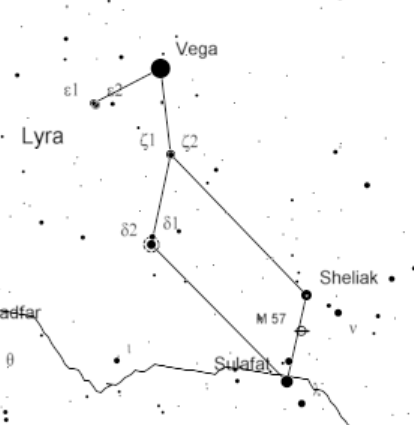 The Ring Nebula, M57 is small and cannot be seen with the naked eye or with binoculars, but it is still reasonably easy to find. A nebula is a cloud of gas and/or dust. M57 is in the constellation of Lyra the harp, a constellation visible in summer and early autumn. Point the telescope’s finder about half way between the two southern stars of the parallelogram of stars that’s the harp’s body, Sulafat and Sheliak. Move the telescope in a small spiral enlarging the search pattern by half the field of view at a time. The Ring Nebula will appear a ghostly small circular glow. Once centered, more magnification may be used. The center will be darker than the edge. Inside is a very faint invisible star that blew out its outer layers of gas into a smoke ring near the end of its life.
The Southern Milky Way contains lots of star clusters and nebulae. The chart below can be used to find the many Messier objects. Or just sweep through this gold mine of objects with binoculars or a low power telescope, most of which are in the next spiral arm in toward the center of the Milky Way. As far as the symbols go, open dotted circles are open or galactic star clusters. Crossed circles are globular star clusters. Squares are nebulae. M8, the Lagoon nebula, and M16 the Eagle nebula also contain star clusters. M8 and its associated star cluster appear as a horizontal spash of light in binoculars. As far as popular names go: M11 is the Wild Duck Cluster, M17 is the Omega or Swan Nebula, and M20 is the Trifid Nebula. An easy binocular star cluster is M7.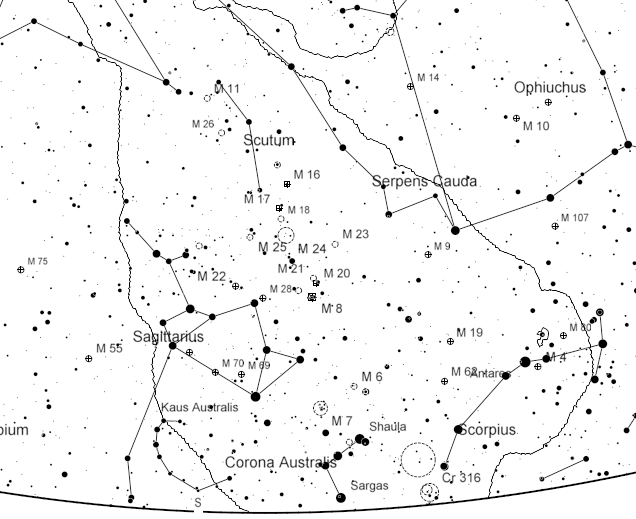
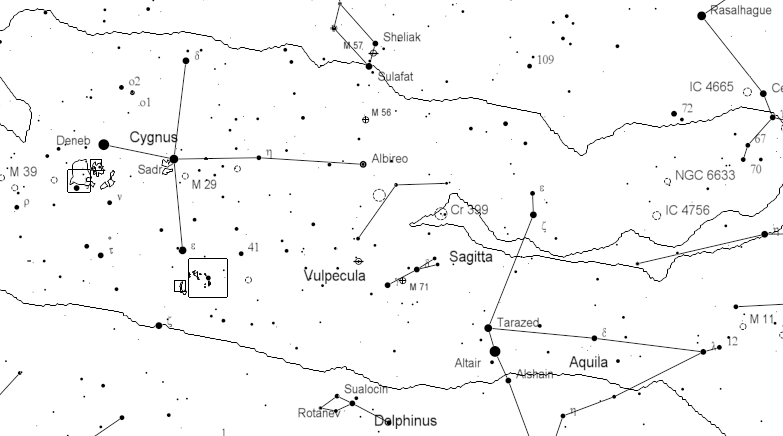
The Milky Way Overhead contains some notable deep sky objects. Note that the Milky Band splits here, though closer to the star Sadr in Cygnus than it shows here. The Dark expanse that runs through Aquila is called the Great Rift, and is caused by a cloud of dust and gas. Its edges can be probed with binoculars, especially in Aquila by watching star density drop off as one pans through the area. Don’t forget the blue and gold binary star Alberio. There’s another fainter blue and gold binary about a degree directly north of the Ring Nebula, M57. It’s 8th magnitude. The unmarked planetary nebula just above the second ‘l’ in Vulpecula is M27, the Dumbbell nebula. The other Messier (M) numbers are relatively easy to find. The large nebula below Deneb is the North American Nebula which can actually be seen with the naked eye or with binoculars on a moonless night away from city lights. The three-part nebula below Cygni is the Veil Nebula, a supernova remnant and very hard to spot but doable. The cluster Cr 399 (Collinder 399 or Brocchi’s Cluster) is better known as the Coathanger and is best seen in binoculars or a telescope finder, which inverts it, making it a properly oriented hanger.
07/07/2017 – Ephemeris – Tonight’s topic: Dark Matter
Ephemeris for Friday, July 7th. Today the Sun will be up for 15 hours and 24 minutes, setting at 9:29, and it will rise tomorrow at 6:05. The Moon, 2 days before full, will set at 5:48 tomorrow morning.
This evening the Grand Traverse Astronomical Society will hold its monthly meeting at the Northwestern Michigan College’s Rogers Observatory at 8 p.m. with a program featuring Dr. David Penney and his talk Dark Matter: What Is It? What Does It Mean? Dark matter, whatever it is appears to be the stuff that holds the universe together. We can’t see it, but we can see its effects in the rotation of galaxies, the motions of galaxies in clusters and their distribution and how it distorts the images of galaxies beyond it. After the talk, at 9 p.m. there will be a star party to view the heavens including the Moon, Saturn and Jupiter. The observatory is located south of Traverse City, on Birmley Road between Garfield and Keystone roads.
The times given are for the Traverse City/Interlochen area of Michigan. They may be different for your location.
Addendum
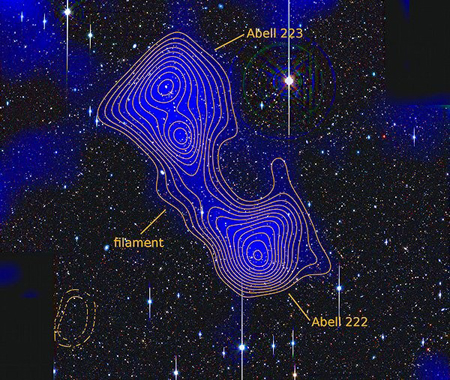
Dark Matter filament bridge between two galaxy clusters, discovered by Jörg Dietrich and his colleagues at the University of Michigan. The blue color is added to show the presence of dark matter. See the text below. Image from http://www.outerspacecentral.com/dark_matter_page.html.
Dark matter is detected by the distortions it creates in the distant galaxies behind it. These galaxies are not visible in the scale of the image shown. The gravitation of dark matter distorts spacetime as predicted by Einstein’s general theory of relativity, which distorts the shapes of the galaxies behind it.
07/06/2017 – Ephemeris – Saturn will appear near the Moon tonight
Ephemeris for Thursday, July 6th. Today the Sun will be up for 15 hours and 25 minutes, setting at 9:29, and it will rise tomorrow at 6:05. The Moon, 3 days before full, will set at 5:02 tomorrow morning.
The waxing gibbous Moon and the planet Saturn will appear together tonight. They are said to be in conjunction. The brightness of the Moon may make it hard to pick out Saturn which is right under the Moon by about seven Moon diameters. The Moon is very bright in binoculars or a telescope and looking at it destroys the dark adaption in the eye or eyes that look at it, at least for a while. So when viewing both Saturn and the Moon, concentrate of Saturn first. In a telescope Saturn’s rings are glorious. With a good telescope and enough magnification one might see the split in the rings, just inside the outer edge of them called Cassini’s Division, after it’s discoverer. The large moon Titan is off the western extremity of the rings tonight.
The times given are for the Traverse City/Interlochen area of Michigan. They may be different for your location.
Addendum
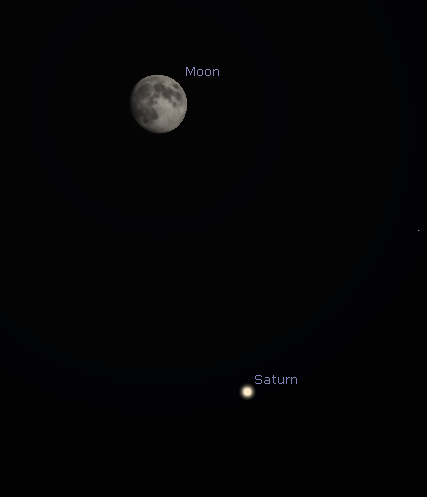
The Moon and Saturn at 10:30 p.m., July 6, 2017, as it would be seen from northern Michigan. Created using Stellarium.
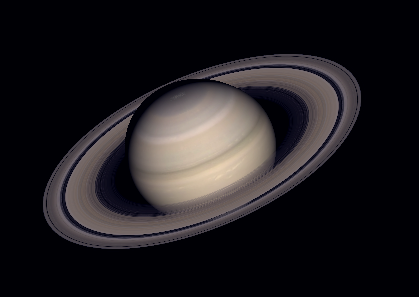
Saturn and its rings with Cassini’s Division. Created using Stellarium.
Ring particles at the distance of Cassini’s Division from Saturn orbit the planet twice in the time the satellite Mimas, nicknamed the Death Star, orbits the planet once. Ring particles are thus tugged by Mimas’ gravity away from Saturn in the same place every other orbit, which pulls them out of that particular orbital resonance.
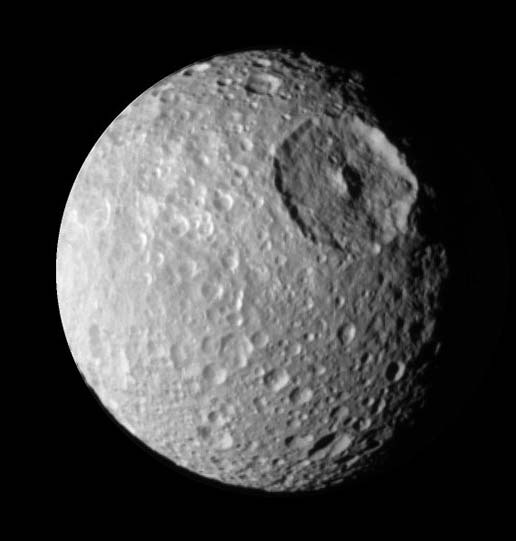
“That’s no moon!” Yes it is. Saturn’s moon Mimas, It’s diameter is 123 miles (198 km). The huge crater is named Herschel, after the moon’s discoverer William Herschel. Credit: NASA / JPL-Caltech / Space Science Institute.
 Bob Moler's Ephemeris Blog