Archive
05/31/2018 – Ephemeris – Previewing June skies
Ephemeris for Thursday, May 31st. Today the Sun will be up for 15 hours and 19 minutes, setting at 9:20, and it will rise tomorrow at 6:00. The Moon, 2 days past full, will rise at 11:10 this evening.
Let’s preview June skies. There will be a lot of Sun in June and very little night. The daylight hours will increase a bit from 15 hours and 21 minutes Tomorrow to 15 hours and 34 minutes on the 21st, retreating back to 15 hours 31 minutes at month’s end. The altitude of the sun above the southern horizon at local noon will hover around 68 to 69 degrees. Local noon, when the sun is actually due south will occur at about 1:43 p.m. Summer begins on the 21st at 6:07 a.m. when the sun reaches its farthest north. The actual amount of night-time will be quite short mostly due to the length of daylight, but also because twilight lasts much longer than average because the sun sets at a shallow angle. On the 21st there’s theoretically only 3 ½ hours of total darkness.
The times given are for the Traverse City/Interlochen area of Michigan. They may be different for your location.
Addendum
June Evening Star Chart
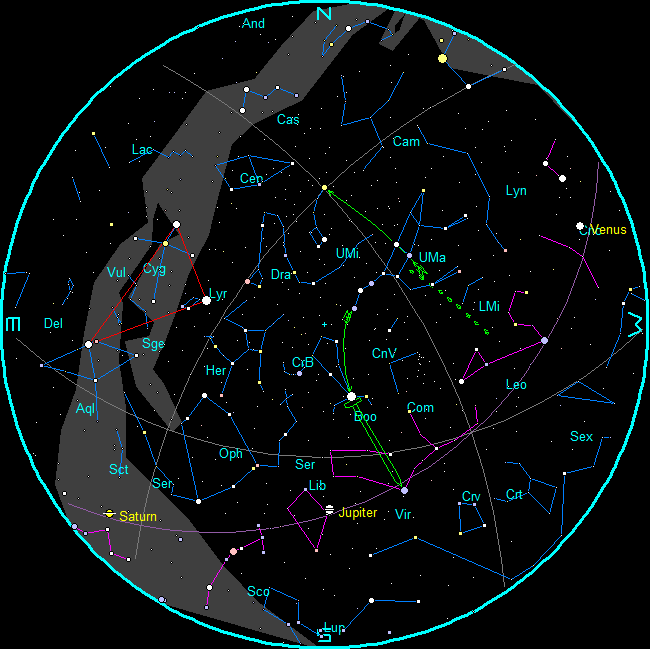
Star Chart for June 2018 (11 p.m. EDT June 15, 2018). Created using my LookingUp program. Click on image to enlarge.
The planets and stars are plotted for the 15th at 11 p.m. EDT in the evening and 4:30 a.m. for the morning chart. These are the chart times. Note that Traverse City is located approximately 45 minutes behind our time meridian. (An hour 45 minutes behind our daylight saving time meridian during EDT). To duplicate the star positions on a planisphere you may have to set it to 1 hour 45 minutes earlier than the current time.
Note the chart times of 11 p.m. and 4:30 a.m. are for the 15th. For each week before the 15th add ½ hour (28 minutes if you’re picky). For each week after the 15th subtract ½ hour. The planet positions are updated each Wednesday on this blog. For planet positions on dates other than the 15th, check the Wednesday planet posts on this blog.
June Morning Star Chart
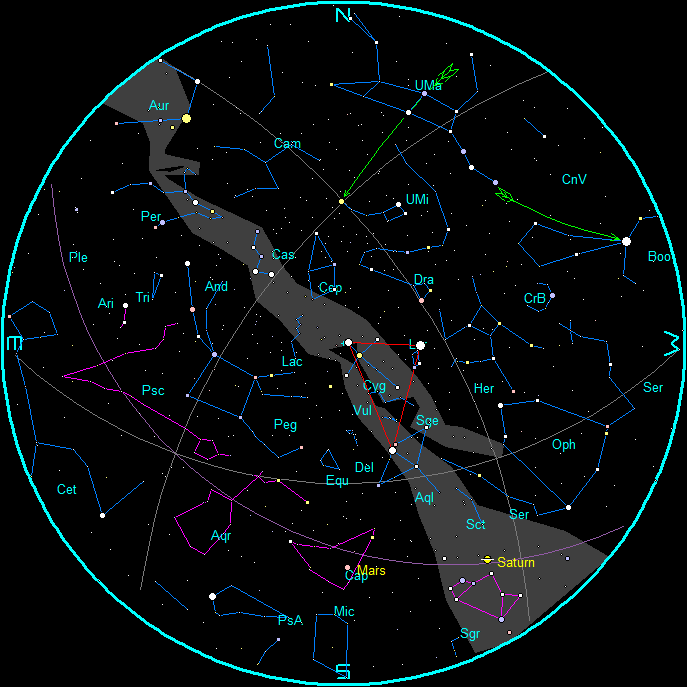
Star Chart for June 2018 mornings based on 4:30 a.m. June 15th. Created using my LookingUp program. Click on image to enlarge.
For a list of constellation names to go with the abbreviations click here.
Star chart annotations
- Pointer stars at the front of the bowl of the Big Dipper point to Polaris the North Star.
- Leaky Big Dipper drips on Leo.
- Follow the arc of the handle of the Big Dipper to the star Arcturus and
- Continue with a spike to Spica.
- The Summer Triangle is in red.
Twilight
Evening nautical twilight ends at 10:46 p.m. EDT on the 1st, increasing to 10:59 p.m. EDT on the 30th.
Evening astronomical twilight ends at 11:44 p.m. EDT on the 1st, increasing to 12:02 a.m. EDT on the 30th.
Morning astronomical twilight starts at 3:44 a.m. EDT on the 1st, and decreasing to 3:38 a.m. EDT on the 30th.
Morning nautical twilight starts at 4:42 a.m. EDT on the 1st, and decreasing to 4:40 a.m. EDT on the 30th.
NASA Calendar of Planetary Events
Date        Time    Event
Jun 01  Fr          Venus: 34.5° E
    01  Fr  3:09 am Moon South Dec.: 20.7° S
    02  Sa 12:34 pm Moon Apogee: 405300 km
    03  Su  7:58 am Moon-Mars: 3.5° S
    03  Su  8:39 am Moon Descending Node
    05  Tu  9:53 pm Mercury Superior Conj.
    06  We  2:32 pm Last Quarter
    07  Th 11:35 pm Venus-Pollux: 4.7° S
    13  We  3:43 pm New Moon
    14  Th  7:55 pm Moon Perigee: 359500 km
    14  Th  8:52 pm Moon North Dec.: 20.8° N
    16  Sa  9:13 am Moon-Venus: 2.3° N
    16  Sa  1:50 pm Moon Ascending Node
    16  Sa  3:38 pm Moon-Beehive: 1.5° N
    18  Mo  3:25 am Moon-Regulus: 1.7° S
    19  Tu 10:23 pm Venus-Beehive: 0.4° N
    20  We  6:51 am First Quarter
    21  Th  6:07 am Summer Solstice
    23  Sa  2:47 pm Moon-Jupiter: 4.6° S
    24  Su  5:35 pm Mercury-Pollux: 4.8° S
    27  We  8:25 am Saturn Opposition
    27  We 11:59 pm Moon-Saturn: 2° S
    28  Th 12:53 am Full Moon
    28  Th 10:30 am Moon South Dec.: 20.8° S
    29  Fr 10:43 pm Moon Apogee: 406100 km
    30  Sa 12:44 pm Moon Descending Node
Jul 01  Su          Venus: 40.7° E
Sky Events Calendar by Fred Espenak and Sumit Dutta (NASA’s GSFC),
http://eclipse.gsfc.nasa.gov/SKYCAL/SKYCAL.html
If you go to the above site you can print out a list like the above for the entire year
or calendar pages for your time zone.
Sun and Moon Rising and Setting Events
     LU                  Ephemeris of Sky Events for NMC Observatory
     June, 2018    Local time zone: EDT
     +-----------------------------------------------------------------------+
     | DATE |  SUN     SUN  DAYLIGHT|   TWILIGHT*    |MOON  RISE OR    ILLUM |
     |      |  RISE    SET    HOURS |  END    START  |PHASE SET** TIME FRACTN|
     +=======================================================================+
     |Fri  1| 06:00a  09:20p  15:20 | 10:43p  04:37a |      Rise 11:56p   90%|
     |Sat  2| 05:59a  09:21p  15:21 | 10:44p  04:36a |      Rise 12:38a   83%|
     +------+-----------------------+----------------+-----------------------+
     |Sun  3| 05:59a  09:22p  15:22 | 10:45p  04:36a |      Rise 01:14a   75%|
     |Mon  4| 05:59a  09:22p  15:23 | 10:46p  04:35a |      Rise 01:46a   67%|
     |Tue  5| 05:58a  09:23p  15:25 | 10:47p  04:34a |      Rise 02:15a   58%|
     |Wed  6| 05:58a  09:24p  15:26 | 10:48p  04:34a |L Qtr Rise 02:43a   48%|
     |Thu  7| 05:57a  09:25p  15:27 | 10:49p  04:33a |      Rise 03:10a   38%|
     |Fri  8| 05:57a  09:25p  15:28 | 10:50p  04:33a |      Rise 03:37a   28%|
     |Sat  9| 05:57a  09:26p  15:28 | 10:51p  04:32a |      Rise 04:06a   19%|
     +------+-----------------------+----------------+-----------------------+
     |Sun 10| 05:57a  09:26p  15:29 | 10:52p  04:32a |      Rise 04:39a   11%|
     |Mon 11| 05:57a  09:27p  15:30 | 10:52p  04:31a |      Rise 05:17a    5%|
     |Tue 12| 05:56a  09:28p  15:31 | 10:53p  04:31a |      Rise 06:02a    1%|
     |Wed 13| 05:56a  09:28p  15:31 | 10:54p  04:31a |New   Set  09:20p    0%|
     |Thu 14| 05:56a  09:29p  15:32 | 10:54p  04:31a |      Set  10:26p    2%|
     |Fri 15| 05:56a  09:29p  15:32 | 10:55p  04:31a |      Set  11:25p    7%|
     |Sat 16| 05:56a  09:29p  15:33 | 10:55p  04:30a |      Set  12:14a   14%|
     +------+-----------------------+----------------+-----------------------+
     |Sun 17| 05:56a  09:30p  15:33 | 10:56p  04:30a |      Set  12:55a   24%|
     |Mon 18| 05:56a  09:30p  15:33 | 10:56p  04:30a |      Set  01:30a   34%|
     |Tue 19| 05:56a  09:30p  15:33 | 10:56p  04:31a |      Set  02:01a   45%|
     |Wed 20| 05:57a  09:31p  15:33 | 10:57p  04:31a |F Qtr Set  02:29a   56%|
     |Thu 21| 05:57a  09:31p  15:33 | 10:57p  04:31a |      Set  02:57a   66%|
     |Fri 22| 05:57a  09:31p  15:33 | 10:57p  04:31a |      Set  03:24a   76%|
     |Sat 23| 05:57a  09:31p  15:33 | 10:57p  04:31a |      Set  03:54a   84%|
     +------+-----------------------+----------------+-----------------------+
     |Sun 24| 05:58a  09:31p  15:33 | 10:57p  04:32a |      Set  04:26a   90%|
     |Mon 25| 05:58a  09:31p  15:33 | 10:57p  04:32a |      Set  05:02a   95%|
     |Tue 26| 05:58a  09:31p  15:32 | 10:57p  04:33a |      Set  05:42a   99%|
     |Wed 27| 05:59a  09:31p  15:32 | 10:57p  04:33a |      Set  06:27a  100%|
     |Thu 28| 05:59a  09:31p  15:31 | 10:57p  04:34a |Full  Rise 09:54p   99%|
     |Fri 29| 06:00a  09:31p  15:31 | 10:56p  04:34a |      Rise 10:37p   97%|
     |Sat 30| 06:00a  09:31p  15:30 | 10:56p  04:35a |      Rise 11:15p   93%|
     +-----------------------------------------------------------------------+
     * Nautical Twilight
     ** Moonrise or moonset, whichever occurs between sunrise and sunset
05/30/2018 – Ephemeris – Its Wednesday, time to locate the bright planets
Ephemeris for Wednesday, May 30th. Today the Sun will be up for 15 hours and 18 minutes, setting at 9:19, and it will rise tomorrow at 6:00. The Moon, 1 day past full, will rise at 10:18 this evening.
It’s Wednesday again and time to look for the bright planets. Two of them are in the evening sky. The brilliant beacon of Venus will be visible in the western twilight from about 9:40 p.m. until it sets at 12:04 a.m. Jupiter will be in the southeast as it gets dark. Jupiter is only outshone by Venus and the Moon. And after Venus sets will have the night to itself as the brightest star-like object until it sets at 5:02 a.m. Binoculars will show it to be bigger than star-like in size, that is it will appear as a tiny orb flanked by little star-like moons. Saturn will rise at 11:14 p.m. in the east-southeast. Mars will rise at 1:28 a.m. and is now outshining Saturn, and will, this summer even outshine Jupiter.
The times given are for the Traverse City/Interlochen area of Michigan. They may be different for your location.
Addendum
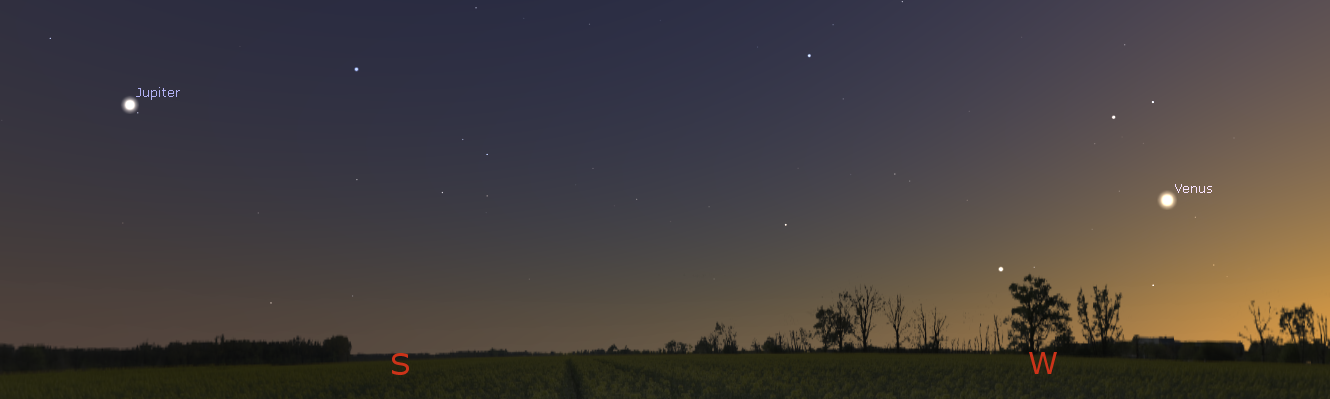
Venus and Jupiter tonight May 30 2018. at 10 p.m. Click on image to enlarge. Created using Stellarium.
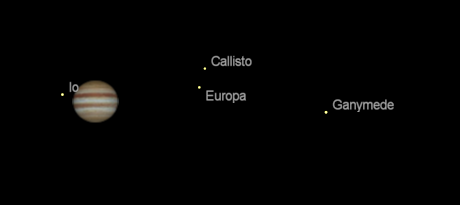
Jupiter and moons in a telescope at 10 p.m., May 30, 2018 Created using Cartes du Ciel.
Io is in front of the planet. Its transit will begin at 10:37 p.m. EDT (2:37 UT May 31)
Io’s shadow will start to cross Jupiter at 11:07 p.m. EDT (3:07 UT May 31)
Io’s transit og Jupiter will end at 12:45 a.m. May 31 (4:45 UT)
Io’s Shadow will leave the face of Jupiter at 1:16 a.m. May 31 (5:16 UT)
Times above from https://www.projectpluto.com/jevent.htm
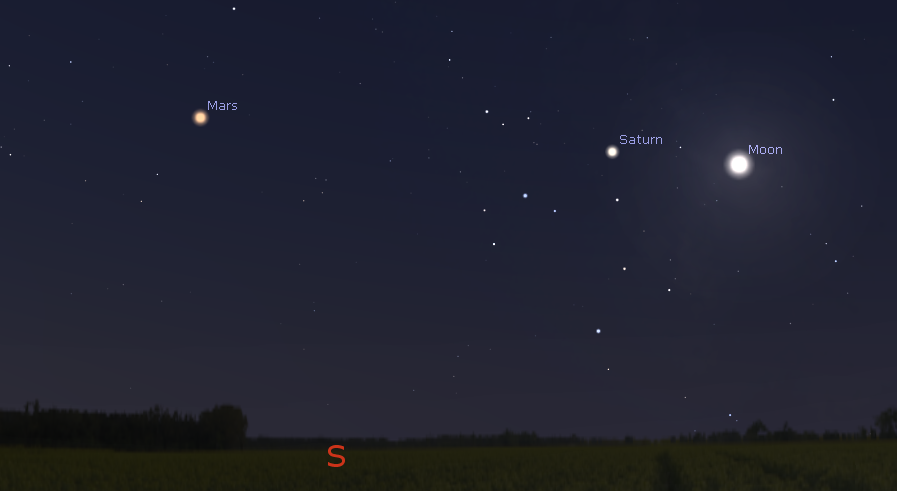
Morning planets Saturn and Mars plus the Moon at 5 a.m. May 31, 2018. Created using Stellarium.
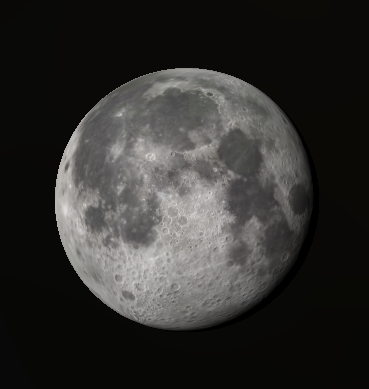
The Moon as it might appear in binoculars at 5 a.m. May 31, 2018. Created using Stellarium.
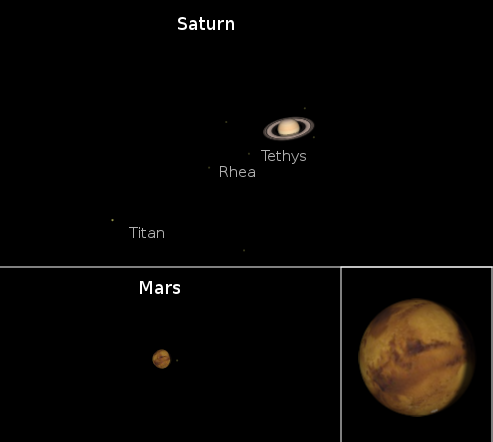
Saturn and Mars with the same magnification with an inset of Mars at higher magnification at 5 a.m. May 31, 2018. Created using Cartes du Ciel (Sky Charts).
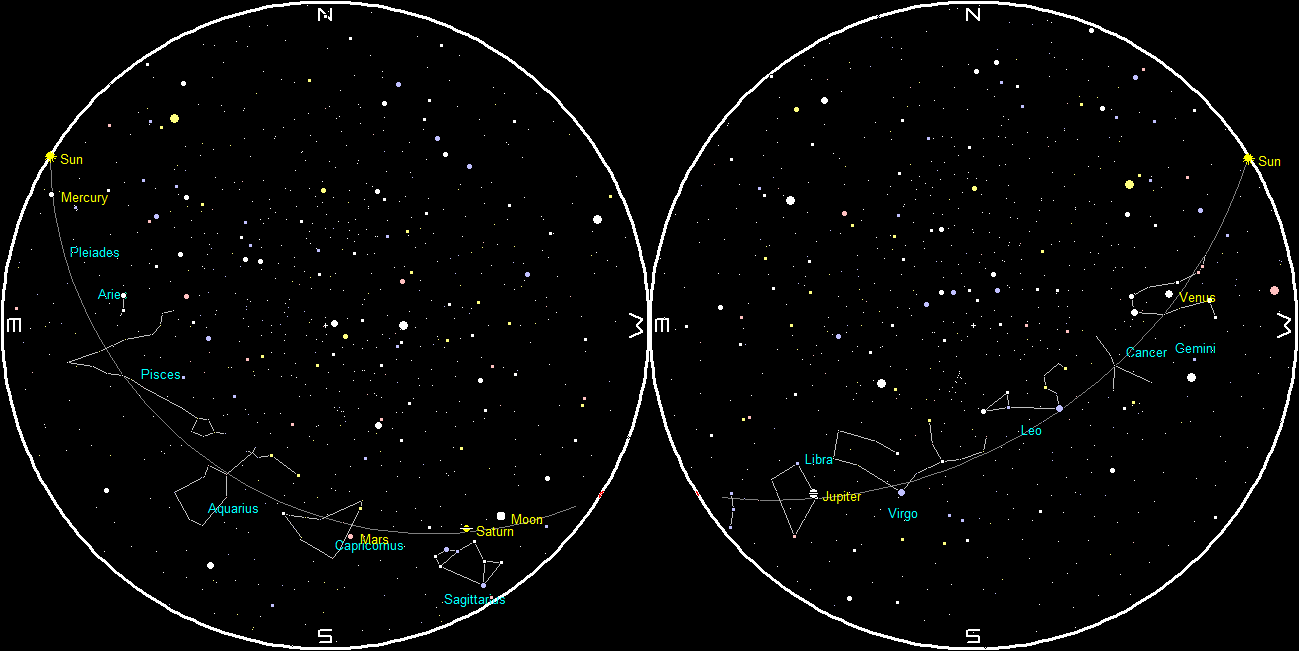
Planets and the Moon at sunset and sunrise of a single night starting with sunset on the right on May 30, 2018. The night ends on the left with sunrise on the 31st. Click on the image to enlarge. Created using my LookingUp program.
05/29/2018 – Ephemeris – Jupiter, big and massive
Ephemeris for Tuesday, May 29th. Today the Sun will be up for 15 hours and 16 minutes, setting at 9:18, and it will rise tomorrow at 6:01. The Moon, at full today, will rise at 9:21 this evening. | Jupiter is not only the largest planet, but the largest appearing planet pretty much all the time. Venus can look larger when it is a thin crescent about to or having just passed between the Earth and the Sun. Mars, because of its small actual size, that of half the Earth varies greatly in distance, and at its closest appears about half the size of Jupiter in telescopes. Jupiter’s great mass is the key to reasonable travel times of spacecraft to Saturn and beyond. A spacecraft sent to catch up to Jupiter will be accelerated with respect to the Sun into a faster trajectory to arrive at their destination sooner. New Horizon’s trip to Pluto would have taken 13 years, that’s 3 years longer without Jupiter’s gravity assist.
The times given are for the Traverse City/Interlochen area of Michigan. They may be different for your location.
Addendum
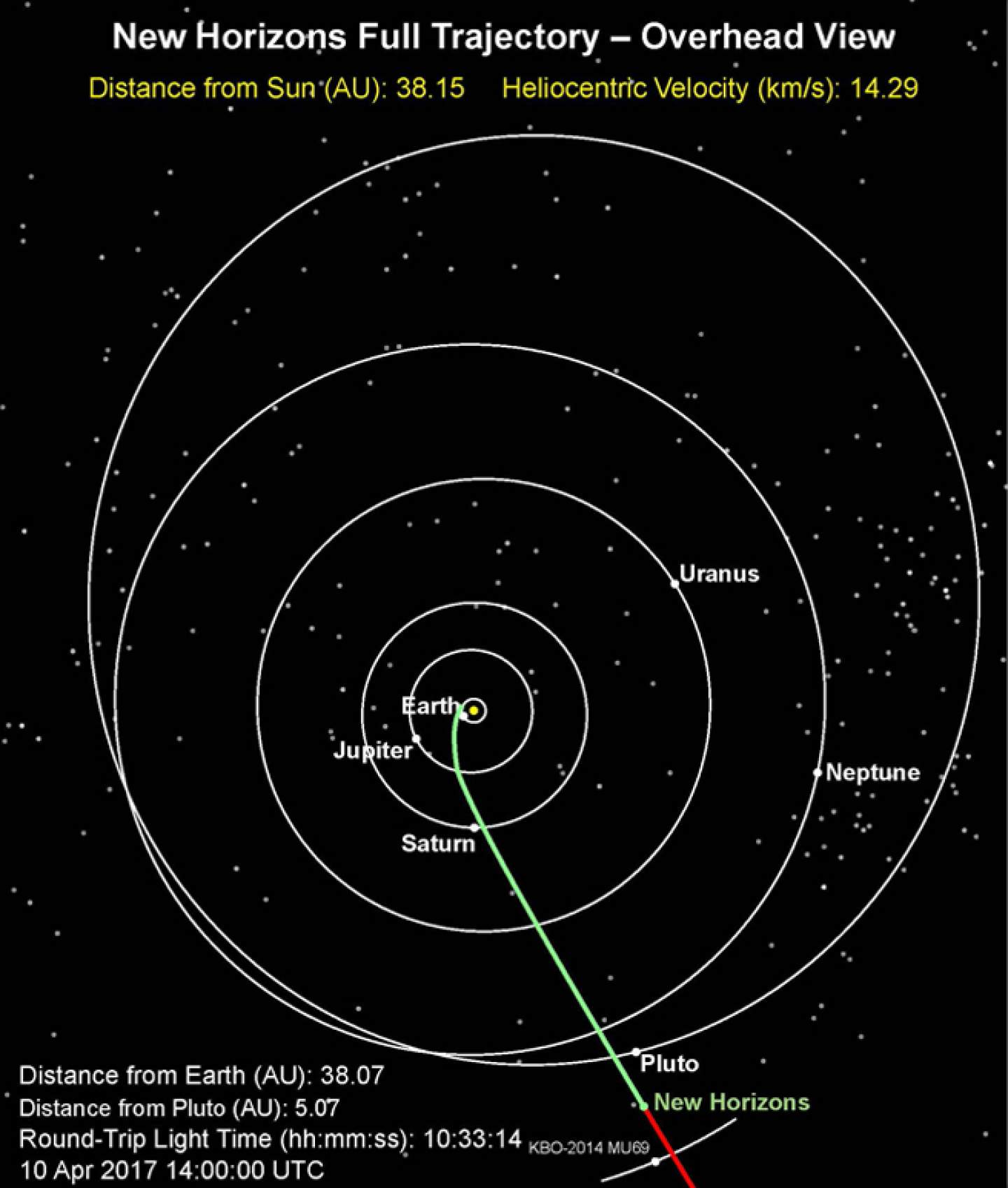
New Horizons trajectory as of last April showing the effect og Jupiter’s gravitational assist. Credit: NASA/Johns Hopkins University Applied Physics Laboratory/Southwest Research Institute.
05/28/2018 – Ephemeris – NASA’s Juno spacecraft takes deep dives at Jupiter
Ephemeris for Memorial Day, Monday, May 28th. Today the Sun will be up for 15 hours and 15 minutes, setting at 9:17, and it will rise tomorrow at 6:02. The Moon, 1 day before full, will set at 6:24 tomorrow morning.
NASA’s Juno spacecraft has made 11 close passes of Jupiter since being inserted into Jovian orbit in July 2016. It has a highly elliptical orbit. It comes in over the north pole, passes only 2,000 miles over the cloud tops at the equator and heads out over the south pole, avoiding the most intense parts of Jupiter’s radiation belts. The high latitude and polar clouds appear more chaotic than expected. We can’t see these very well from the Earth. The magnetic field is much stronger and lumpier than thought before. A very much improved and complex picture of our largest planet is emerging, as we expected. The mission isn’t over and years of analysis are ahead to begin to more fully understand the solar system’s greatest planet.
The times given are for the Traverse City/Interlochen area of Michigan. They may be different for your location.
Addenda
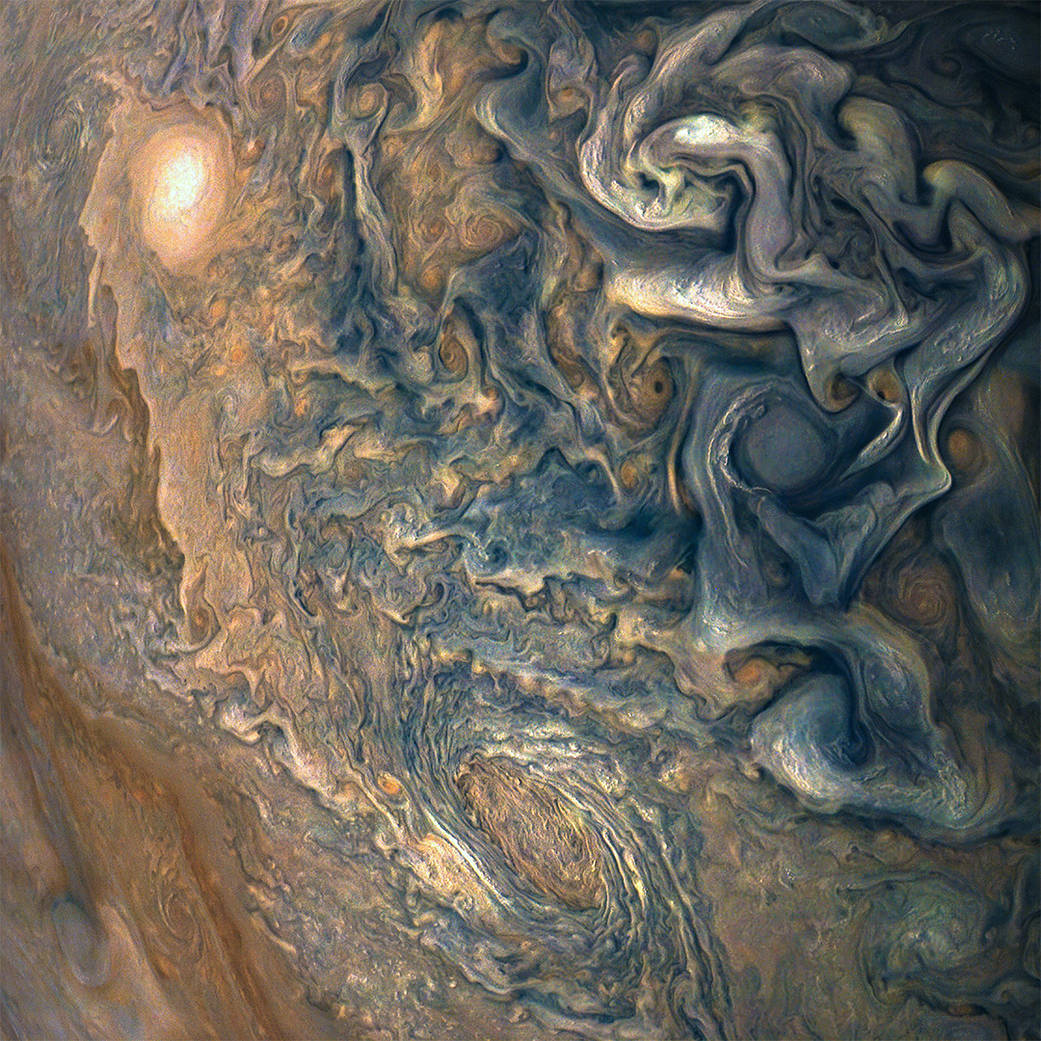
Chaotic storms at Jovian high latitudes. Credit NASA/JUNO
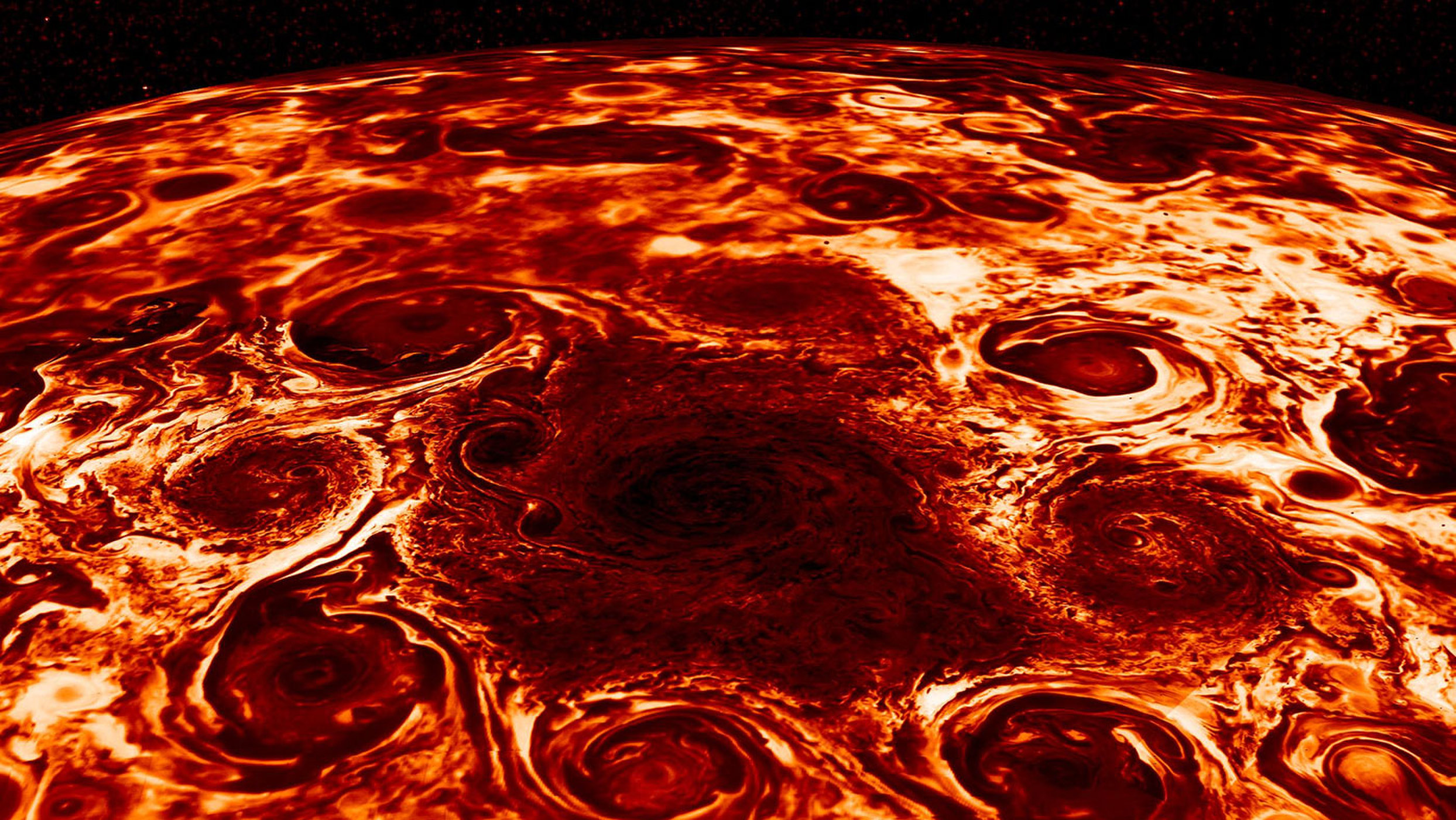
Jupiter’s North Pole in the infrared. 8 cyclones surrounding a 9th at the pole. Credit: NASA/JPL-Caltech/SwRI/ASI/INAF/JIRAM
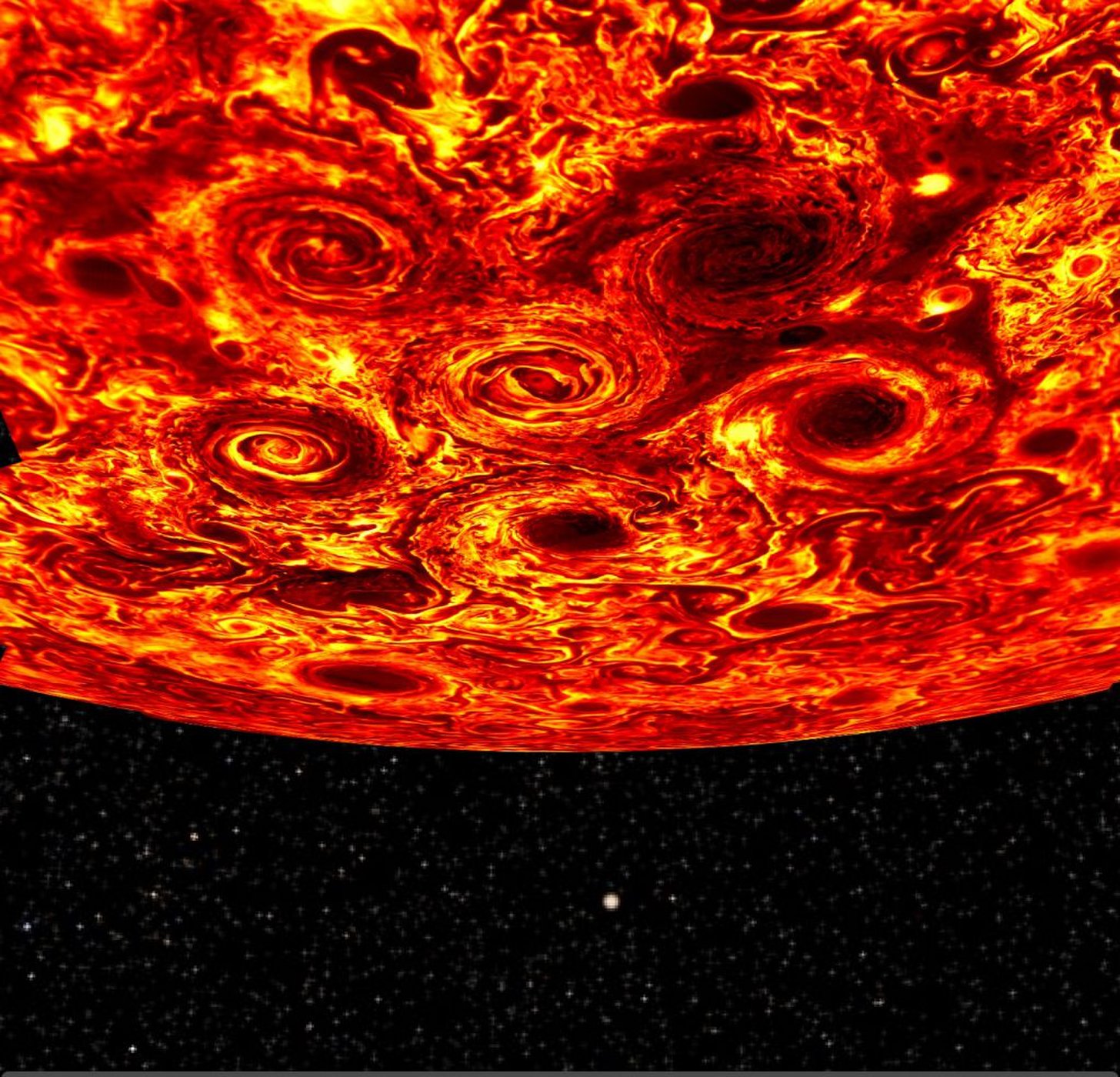
Jupiter’s South Pole in the infrared. 5 cyclones surrounding a 6th at the pole. Credit: NASA/JPL-Caltech/SwRI/ASI/INAF/JIRAM
Alan Bean
Astronaut Alan Bean, 4th person to walk on the Moon with Apollo 12 passed away this weekend. He also commanded the second Skylab mission and retired to become an artist, a painter of his adventures on the Moon and in space. Of the twelve men who walked on the Moon, only four survive.
05/25/2018 – Ephemeris – Star party scheduled for Sleeping Bear Dunes National Lakeshore May 26, 2018
Ephemeris for Friday, May 25th. Today the Sun will be up for 15 hours and 9 minutes, setting at 9:15, and it will rise tomorrow at 6:04. The Moon, half way from first quarter to full, will set at 4:52 tomorrow morning.
Tomorrow night May 26th there will be, weather permitting a star party at Sleeping Bear Dunes National Lakeshore, this will take place at the Dune Climb. Telescopes will take over the parking lot closest to the Dunes The event starts at 9 p.m., while it’s still light out and the location can be found. The nearly full Moon will be first to be spotted, followed by Venus and Jupiter. The planet Jupiter’s four brightest moon will be seen along with its cloud bands. Starting at 9 p.m. there will be a short ranger talk, followed by an astronomer to explain what will be seen that night. The star party is made possible by the rangers of the park and the Grand Traverse Astronomical Society.
The times given are for the Traverse City/Interlochen area of Michigan. They may be different for your location.
Addendum
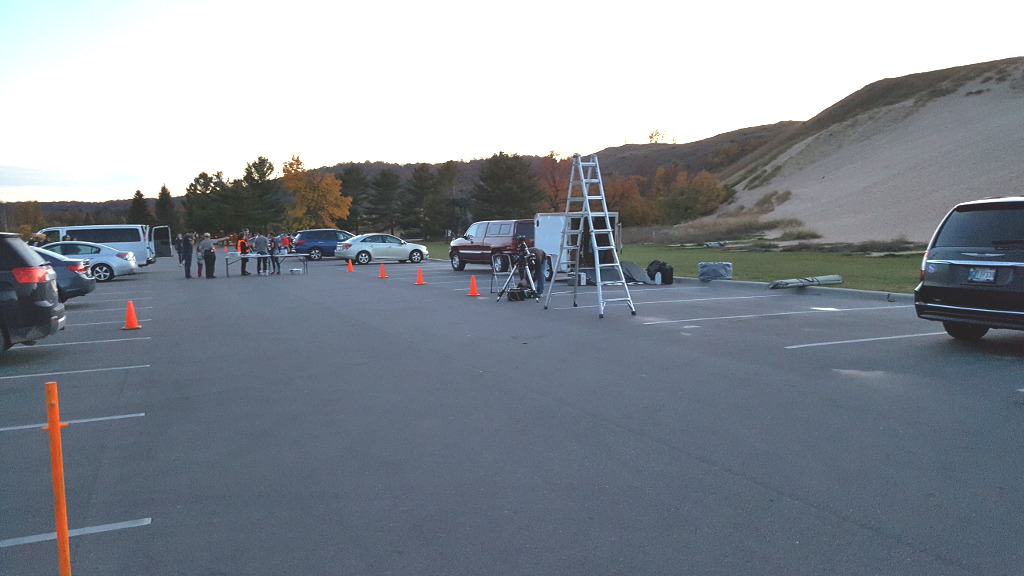
This is the beginning of setup for the October 21, 2017 star party at the dune climb. Taken early while there was enough light. The dune blocks up to 12 degrees from the southwest to northwest, but the rest of the horizon is quite low. Venus will be high enough to clear the dune for most of the evening. The ladder is up to assemble the society’s 25 inch “Emmettron” Obsession Dobsonian telescope. The telescope was overhauled including having the mirror aluminized and new encoders over the winter, thanks to Don Flegel our telescope wrangler. Click to enlarge. Photo by Bob Moler.
05/24/2018 – Ephemeris – Jupiter is really BIG
Ephemeris for Thursday, May 24th. Today the Sun will be up for 15 hours and 8 minutes, setting at 9:14, and it will rise tomorrow at 6:05. The Moon, 3 days past first quarter, will set at 4:24 tomorrow morning.
Jupiter is a big planet. How big is it? One could fit thirteen hundred Earths inside it. Even so Jupiter has the mass of only 318 Earths, so Jupiter is made of lighter stuff than the Earth, including a lot of hydrogen and helium. NASA’s Juno spacecraft is currently orbiting Jupiter, working that out. Still, Jupiter is massive. The late science and science fiction writer Isaac Asimov wrote that the solar system consists of the Sun, Jupiter and debris. Jupiter contains more than twice the mass of all the other planets and asteroids combined. Jupiter is also surrounded by a huge set of radiation belts, lethal to all but the most radiation hardened spacecraft. And that goes for would be astronauts too.
The times given are for the Traverse City/Interlochen area of Michigan. They may be different for your location.
Addendum
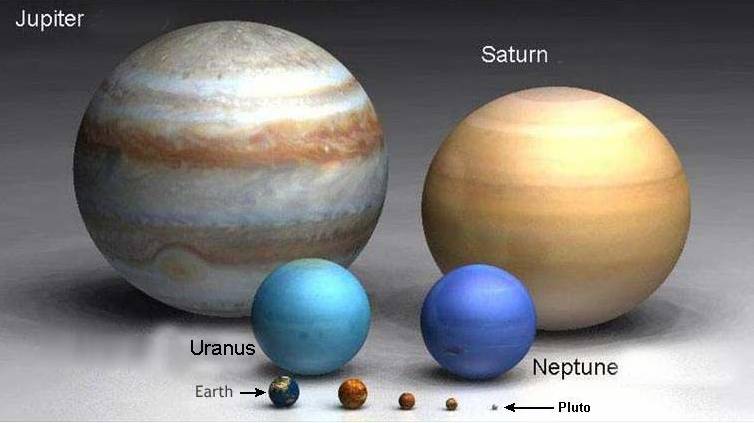
Planet size comparison. Note that even though Saturn looks almost as large as Jupiter it is less than 30% of Jupiter’s mass. From connormorency.wordpress.com
05/23/2018 – Ephemeris – Wednesday is bright planet day on Ephemeris
Ephemeris for Wednesday, May 23rd. Today the Sun will be up for 15 hours and 6 minutes, setting at 9:13, and it will rise tomorrow at 6:05. The Moon, 2 days past first quarter, will set at 3:56 tomorrow morning.
It’s Wednesday again and time to look for the bright planets. Two of them are in the evening sky. The brilliant beacon of Venus will be visible in the western twilight from about 9:35 p.m. until it sets at 11:54. Jupiter will be in the southeast as it gets dark. Jupiter is only out shown by Venus and the Moon. And after Venus sets will have the night to itself as the brightest star-like object until it sets at 5:31 a.m. Binoculars will show it to be not quite star-like in size, that is it will appear as a tiny orb flanked by little star-like moons. Saturn will rise at 11:43 p.m. in the east-southeast. Mars will rise at 1:28 a.m. and is now outshining Saturn, and will, this summer even outshine Jupiter.
The times given are for the Traverse City/Interlochen area of Michigan. They may be different for your location.
Addendum
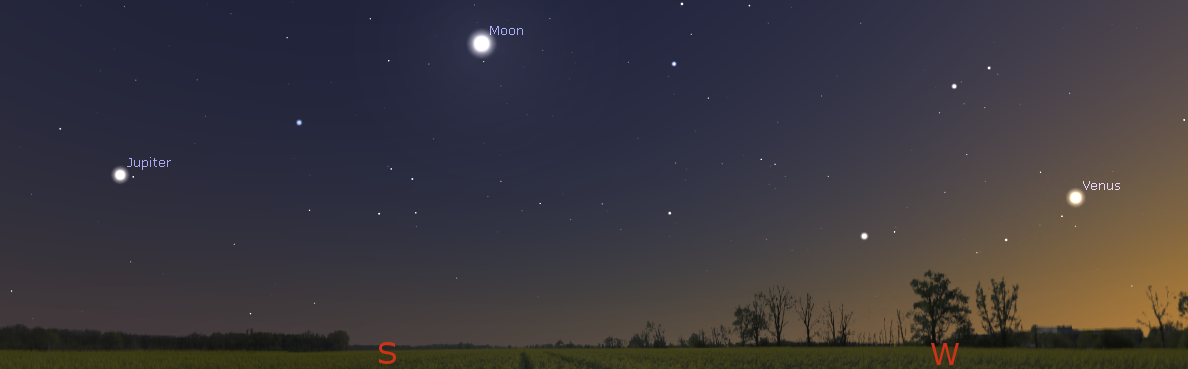
Panorama of the Moon and planets Venus and Jupiter at 10 p.m. May 23, 2018. Click on image to enlarge. Created using Stellarium.
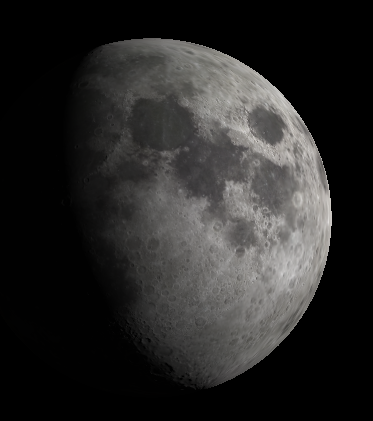
The Moon as it might appear in a small telescope or binoculars tonight May 23, 2018 at 10 p.m. Created using Stellarium.
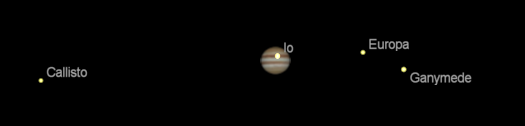
Jupiter and its 4 Galilean moons at 10 p.m. EDT May 23, 2018 (2:00 UT, May 24, 2018) Io is transiting the face of Jupiter at that time. Io transit begins at 8:52 p.m. EDT ():52 UT, Shadow start 9:13 p.m. EDT 1:13 UT, Transit ends 11:00 p.m. EDT, 3:00 UT, Shadow ends at 11:22 p.m. EDT, 3:22 UT. Io actually will be practically invisible during its transit, but its shadow may be spotted in small telescopes. Created using Stellarium.
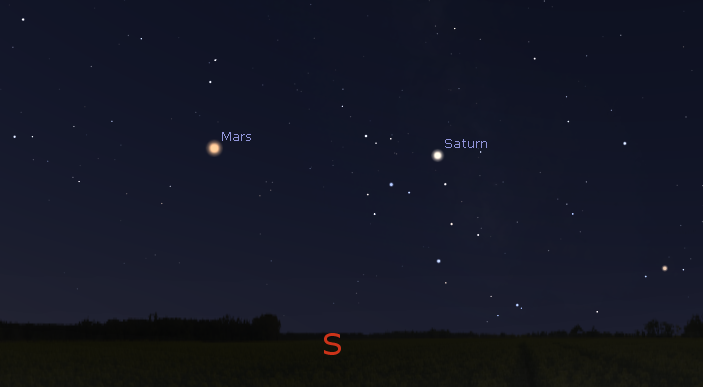
The morning planets Mars and Saturn at 5 a.m. May 24, 2018. Created using Stellarium.
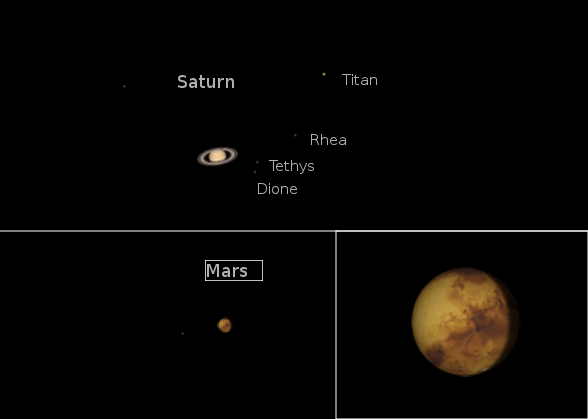
Saturn and Mars with the same magnification with an inset of Mars at higher magnification at 5 a.m. May 24, 20`8. Created using Cartes du Ciel (Sky Charts).
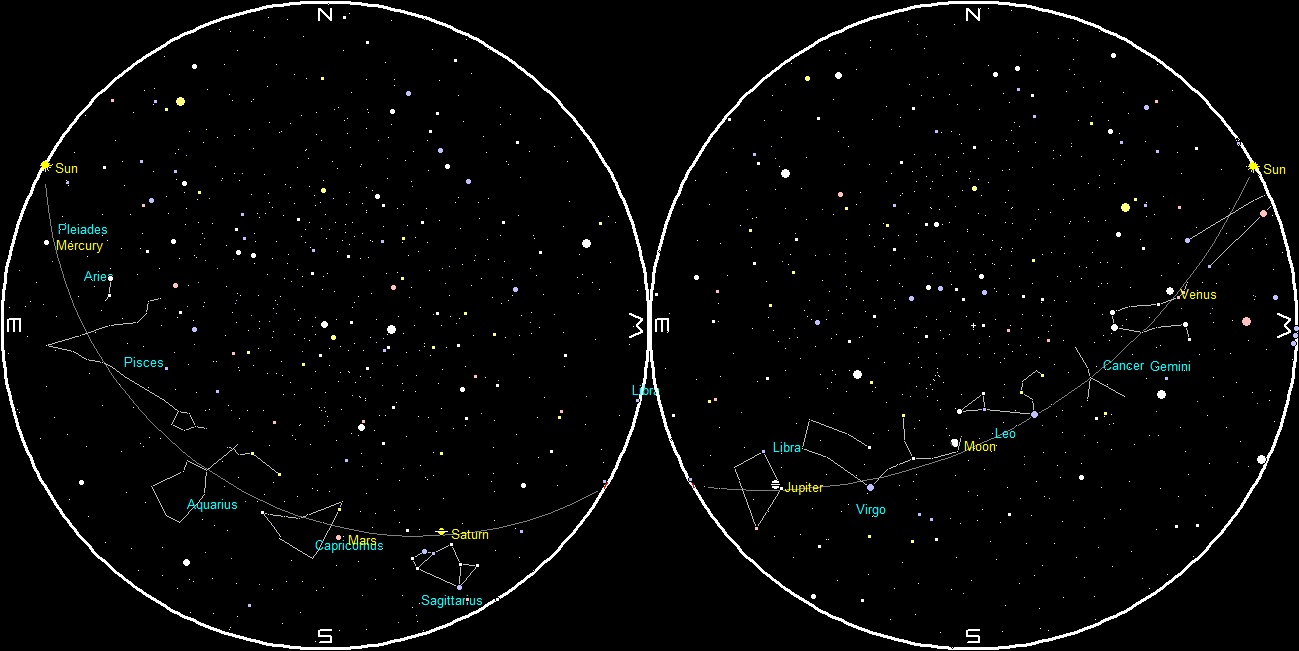
Planets and the Moon at sunset and sunrise of a single night starting with sunset on the right on May 23, 2018. The night ends on the left with sunrise on the 24th. Click on the image to enlarge. Created using my LookingUp program.
05/22/2018 – Ephemeris – Seeing detail on the face of Jupiter with a small telescope
Ephemeris for Tuesday, May 22nd. Today the Sun will be up for 15 hours and 4 minutes, setting at 9:12, and it will rise tomorrow at 6:06. The Moon, 1 day past first quarter, will set at 3:27 tomorrow morning.
Even in small telescopes Jupiter shows some detail. The larger the telescope in diameter the more detail can be seen. It also depends on what astronomers call seeing, or the steadiness of the atmosphere. The easiest detail to spot are the parallel brown and cream-colored cloud bands. These run in the direction that Jupiter’s moons move, since the four Galilean moons orbit over Jupiter’s equator. Jupiter, 11 time’s the Earth’s diameter, rotates on its axis in a bit less than 10 hours, though the clouds at the equator rotate faster than those at higher latitudes. It also gives Jupiter a slightly squashed appearance., enhanced by the horizontal stripes. Embedded in one of the dark stripes is the famous Great Red Spot.
The times given are for the Traverse City/Interlochen area of Michigan. They may be different for your location.
Addendum
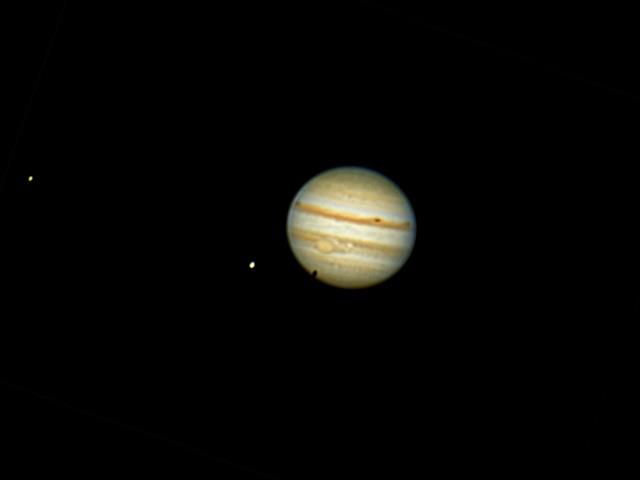
Scott Anttila image of Jupiter from November 14, 2011.
05/21/2018 – Ephemeris – 408 years ago Galileo discovered that Jupiter had moons
Ephemeris for Monday, May 21st. Today the Sun will be up for 15 hours and 2 minutes, setting at 9:10, and it will rise tomorrow at 6:07. The Moon, at first quarter today, will set at 2:55 tomorrow morning.
Jupiter is the bright star-like object in the southeast in the evening. In telescopes and even in binoculars the observer can spot up to four stars nearby. These aren’t stars, but moons or satellites of Jupiter. Galileo discovered them 408 years ago with his small telescope. Jupiter has 69 satellites in all at last count, but the rest are tiny objects. Of the four ‘Galilean’ satellites all but one is larger than the Moon. They are, in order from Jupiter Io, a volcano riddled world which is constantly resurfacing itself. Next is Europa an icy moon with a good probability of a salty ocean beneath. Giant Ganymede is next, larger than Mercury, it is also icy with the possibility of an ocean. Last is Callisto a dark moon with bright craters.
The times given are for the Traverse City/Interlochen area of Michigan. They may be different for your location.
Addendum
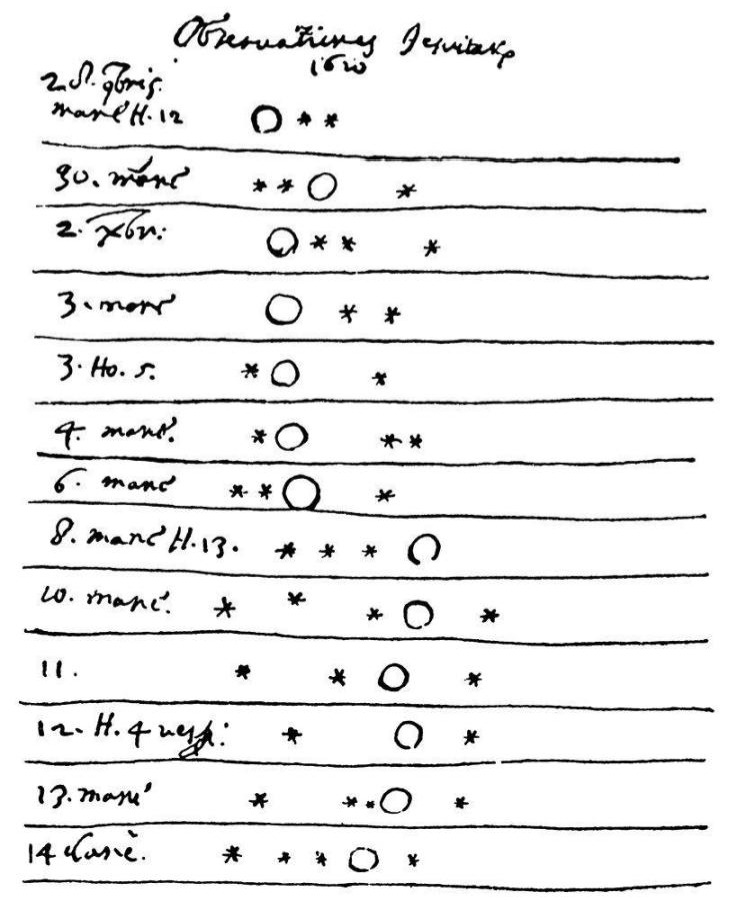
Multiple night sightings of Jupiter’s moons by Galileo.
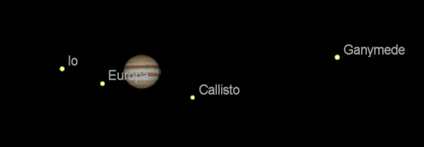
Jupiter and its moons tonight, May 21, 2018. Created using Cartes du Ciel (Sky Charts).
 Bob Moler's Ephemeris Blog