Archive
10/31/2018 – Ephemeris – The bright planets tonight
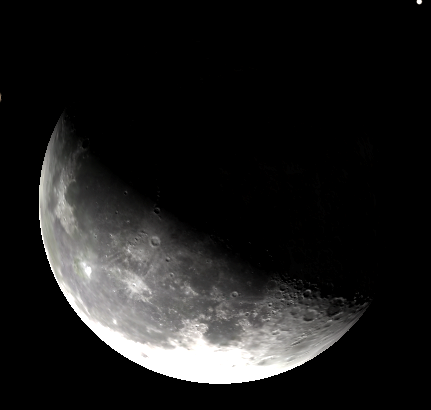
Ephemeris for Halloween, Wednesday, October 31st. The Sun will rise at 8:19. It’ll be up for 10 hours and 13 minutes, setting at 6:32. The Moon, at last quarter today, will rise at 1:02 tomorrow morning.
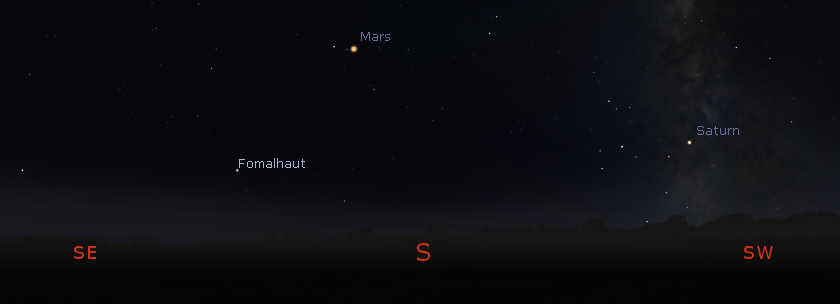
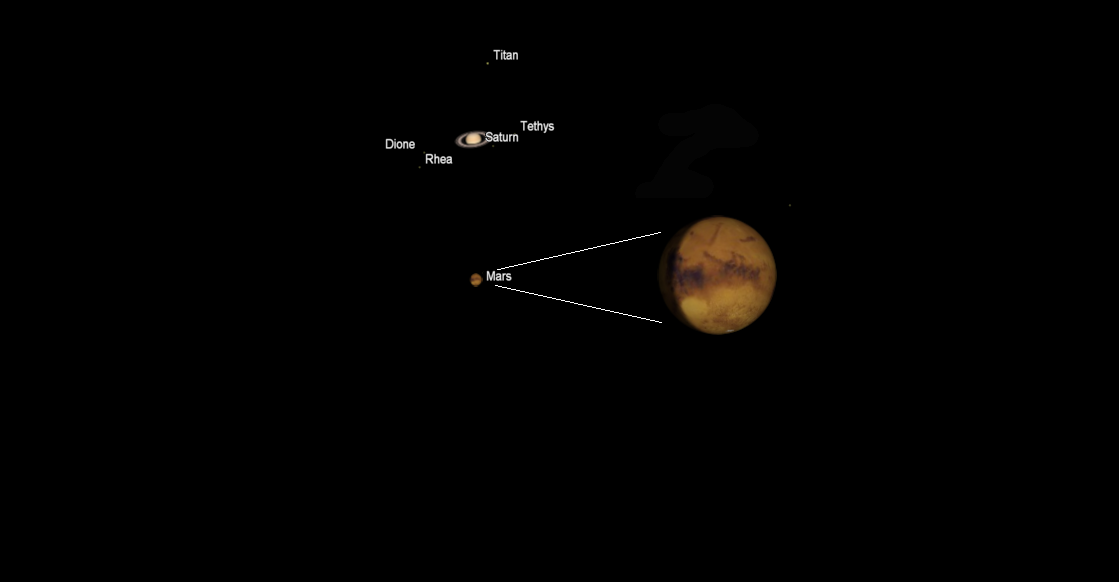
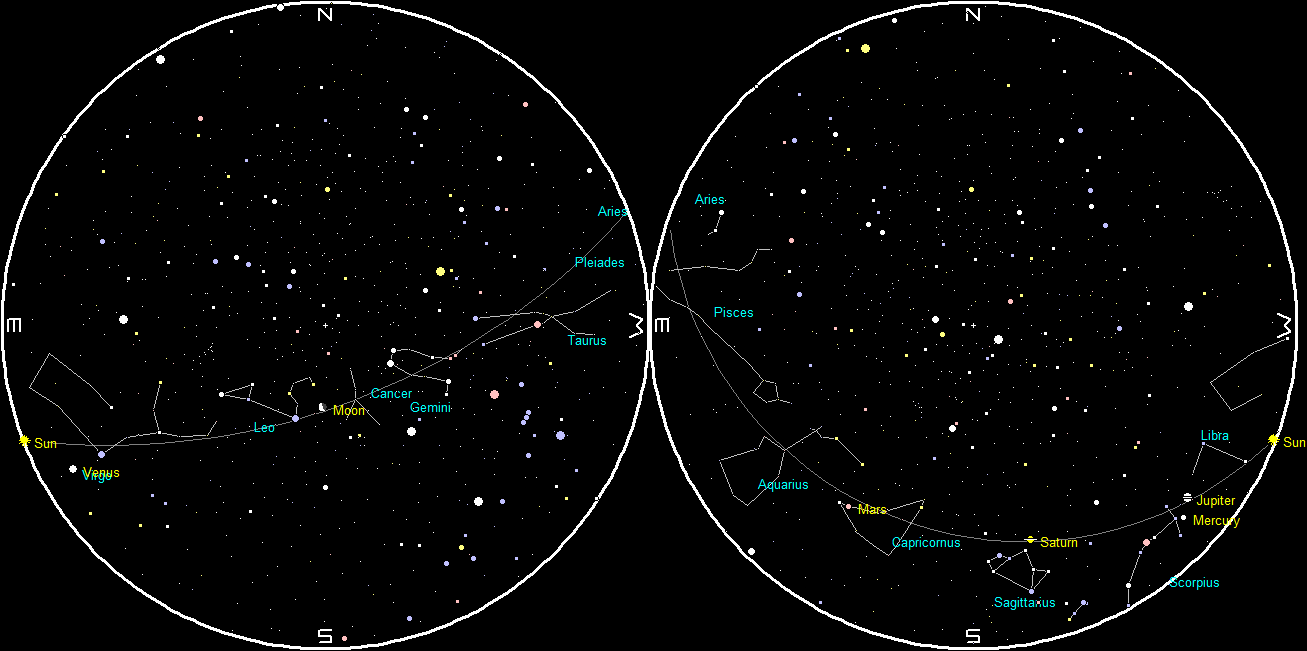
Let’s look at the bright planets for tonight. Three of them are visible in the evening sky. Jupiter will be barely visible very low in the west-southwest after sunset. It will set at 7:30 p.m. Saturn, the ringed planet, will start the evening low in the south-southwestern sky and will set at 9:49 p.m. Mars will be low in the south-southeast as the skies darken tonight. and is now 73.2 million miles (117.9 million km) away. Mars will be due south at 8:39 p.m., and it will set at 1:33a.m. Mars is picking up speed moving eastward, crossing the constellation of Capricornus this month. It’s currently in eastern Capricornus. Venus, now a morning planet, will rise at 7:45 tomorrow morning, 34 minutes after the Sun.
The times given are for the Traverse City/Interlochen area of Michigan. They may be different for your location.
Addendum
Update
I know, the content above isn’t very spooky for Halloween. However, NASA came to the rescue with their Halloween Special: Universe of Monsters. Fitting with our theme today, it’s about planets… of the Exo variety. Click here!
10/30/2018 – Ephemeris – Algol the spookiest star in the sky
Ephemeris for Tuesday, October 30th. The Sun will rise at 8:18. It’ll be up for 10 hours and 16 minutes, setting at 6:34. The Moon, 1 day before last quarter, will rise at 11:53 this evening.
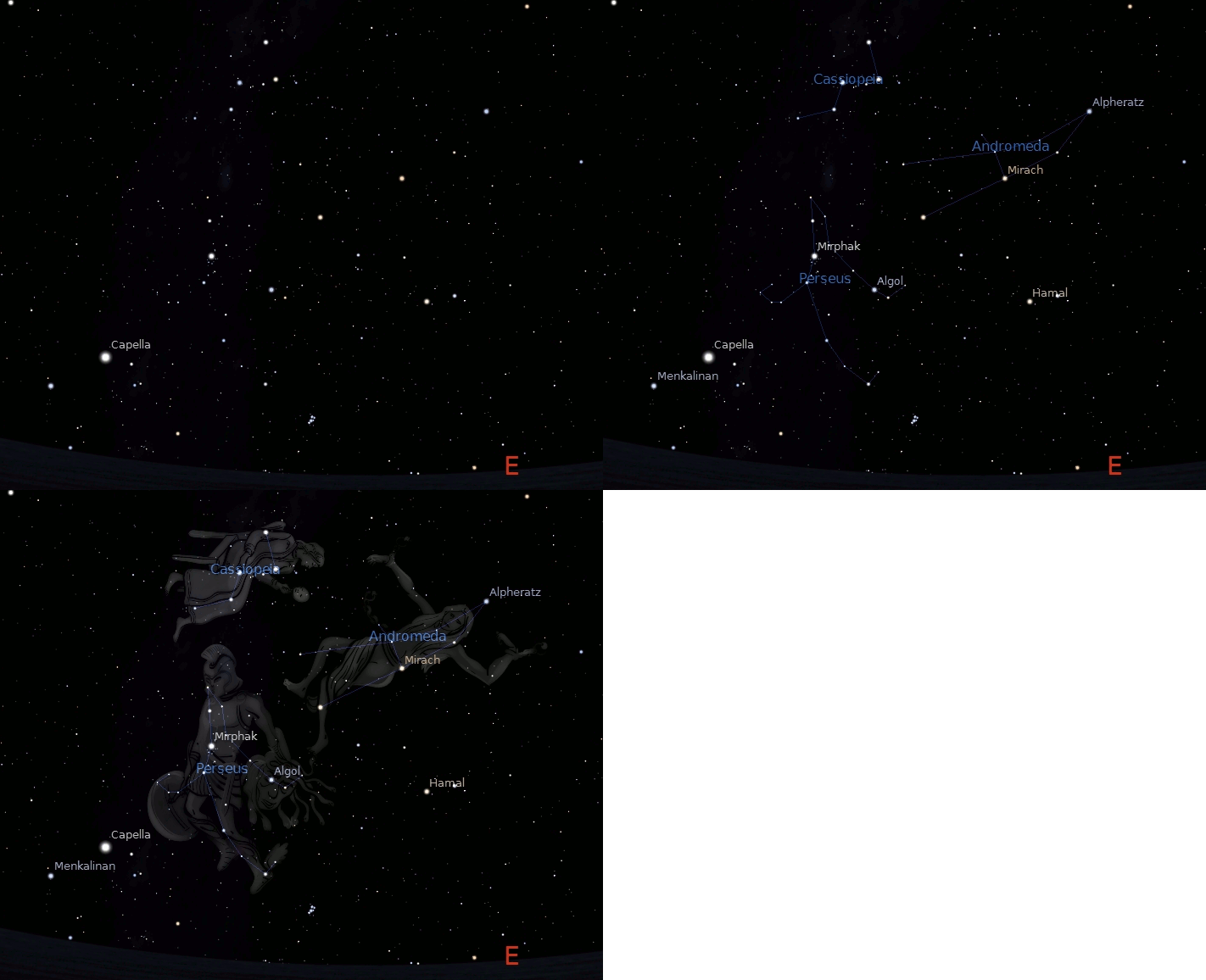
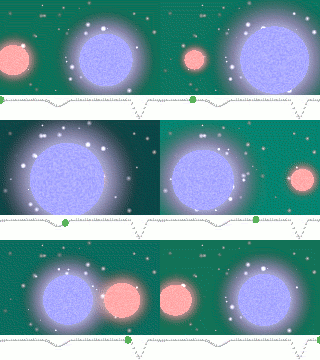
Not all the ghosts and goblins out tomorrow night will be children. One will be out every night because it’s a star. Its name is Algol, from the Arabic for Ghoul Star or Demon Star. The Chinese had a name for it that meant “piled up corpses”. It’s normally the second brightest star in the constellation Perseus the hero, visible in the northeast this evening. The star is located where artists have drawn the severed head of Medusa, whom he had slain. Medusa was so ugly that she turned all who gazed upon her to stone. Algol is her still glittering eye. The star got these names before astronomers found out what was wrong with it. They found out that it does a slow wink every two days, 21 hours. That’s because Algol is two stars that eclipse each other. Her next evening wink will be dimmest at 8:10 p.m. November 13th.
The times given are for the Traverse City/Interlochen area of Michigan. They may be different for your location.
Addendum
.
10/29/2018 – Ephemeris – Perseus the hero
Ephemeris for Monday, October 29th. The Sun will rise at 8:16. It’ll be up for 10 hours and 18 minutes, setting at 6:35. The Moon, 2 days before last quarter, will rise at 10:48 this evening.
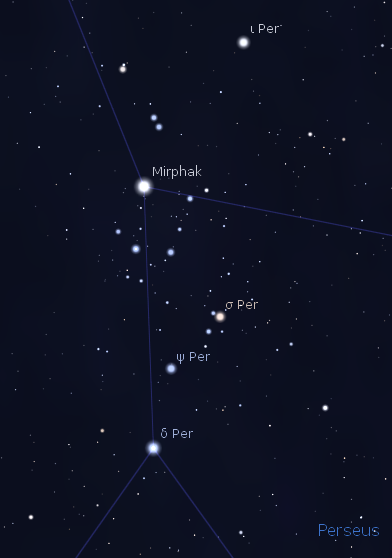
bout a third the way from the east northeastern horizon to the zenith at 9 p.m. and below the letter W shaped constellation of Cassiopeia the queen is Perseus the hero. It’s kind of a odd shape for a hero, To me it looks like the cartoon roadrunner. To those who’s imagination doesn’t run to cartoons, its shape is also like the Greek letter pi. It’s two brightest stars are Mirfak and Algol the demon star. Look at the area around Mirfak with binoculars and you will see a large group of stars just below naked eye visibility. It’s called the Alpha Persei association. That because Mirfak is Alpha Persei. The group is about 560 light years away, which means, though close, are farther away than the Pleiades, below and right of them.
The times given are for the Traverse City/Interlochen area of Michigan. They may be different for your location.
Addendum
10/26/2018 – Ephemeris – Venus passes inferior conjunction with the Sun today
Ephemeris for Friday, October 26th. The Sun will rise at 8:12. It’ll be up for 10 hours and 27 minutes, setting at 6:40. The Moon, 2 days past full, will rise at 8:19 this evening.
Later this morning the planet Venus will pass in inferior conjunction with the Sun, moving officially from the evening sky to the morning sky. Inferior conjunctions are when Venus is between the Earth and the Sun. We haven’t seen Venus for over a month, it setting too soon after the Sun to be spotted. It’s appearance in the morning sky will be much more sudden. On fall mornings the ecliptic, the path of the Sun and most planets is more vertical in the sky, opposite that of the evning sky, so that Venus will suddenly appear. Being south of the Sun, it will take 3 days, next Monday morning to rise with the Sun, but after that Venus will rise 8 minutes earlier each morning for a while. It should be easily visible in two weeks as the bright Morning Star
The times given are for the Traverse City/Interlochen area of Michigan. They may be different for your location.
10/25/2018 – Ephemeris – Europe and Japan launch a joint mission to Mercury
Ephemeris for Thursday, October 25th. The Sun will rise at 8:11. It’ll be up for 10 hours and 30 minutes, setting at 6:41. The Moon, 1 day past full, will rise at 7:44 this evening.
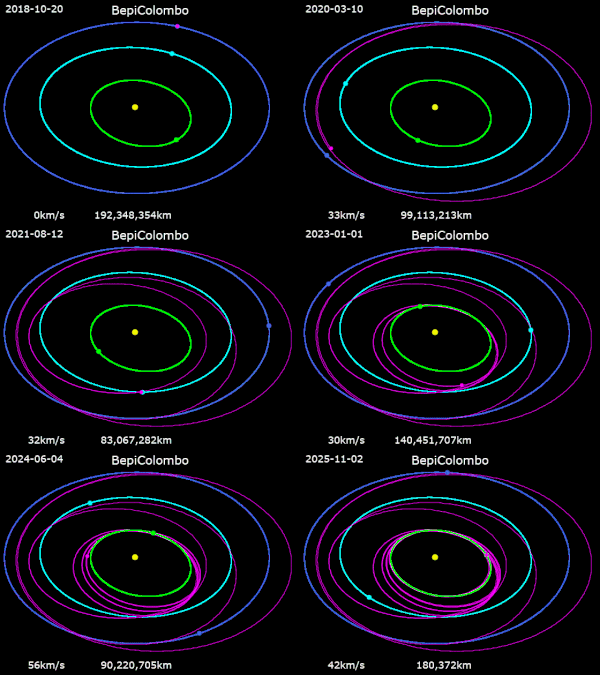
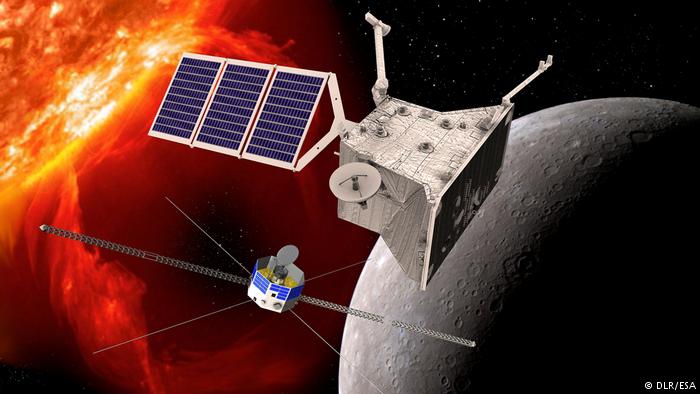
A joint mission to Mercury by the Europeans and the Japanese called BepiColumbo was launched late Friday night October 19th our time (EDT), 20th (UT). It will take 7 years to be able to drop into orbit of the innermost planet to make only the second spacecraft to do so. To drop into Mercury’s orbit from the Earth’s orbit the spacecraft will need to lose a whole lot of velocity. The trip there will entail one flyby of the Earth, two of Venus, and six of Mercury itself. Planetary flybys have been used since the 1970s to use a planet’s velocity to add to or subtract from a spacecraft’s velocity, depending on how it approaches the planet. If crossing in front of a planet some velocity is subtracted from the spacecraft, allowing it to drop closer to the Sun. If coming up from behind the spacecraft gets to add to its velocity relative to the Sun.
The times given are for the Traverse City/Interlochen area of Michigan. They may be different for your location.
Addendum
10/24/2018 – Ephemeris – Looking for the bright planets tonight
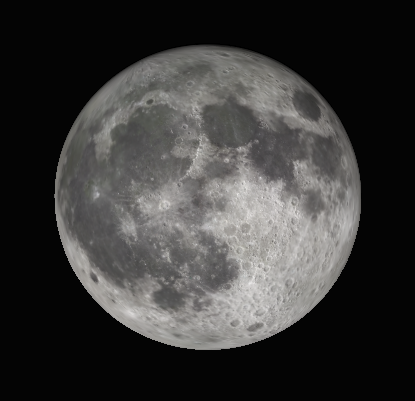
Ephemeris for Wednesday, October 24th. The Sun will rise at 8:10. It’ll be up for 10 hours and 33 minutes, setting at 6:43. The Moon, at full today, will rise at 7:13 this evening.
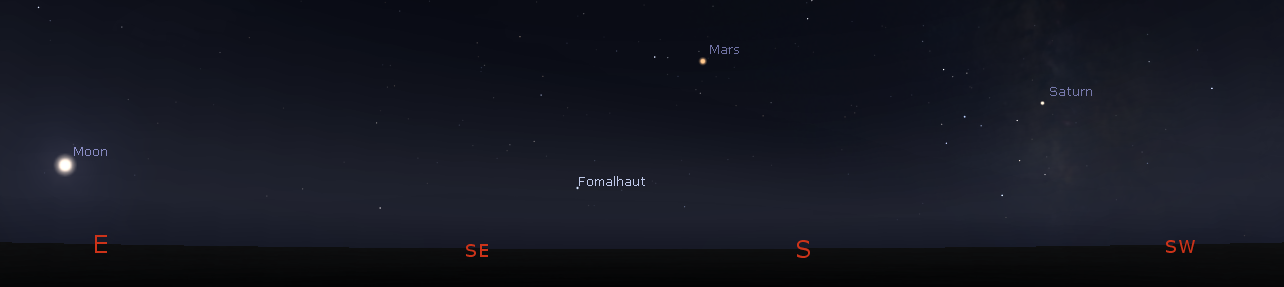
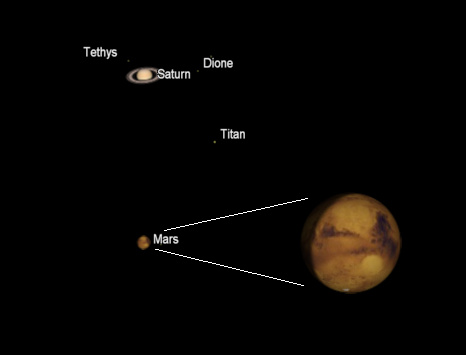
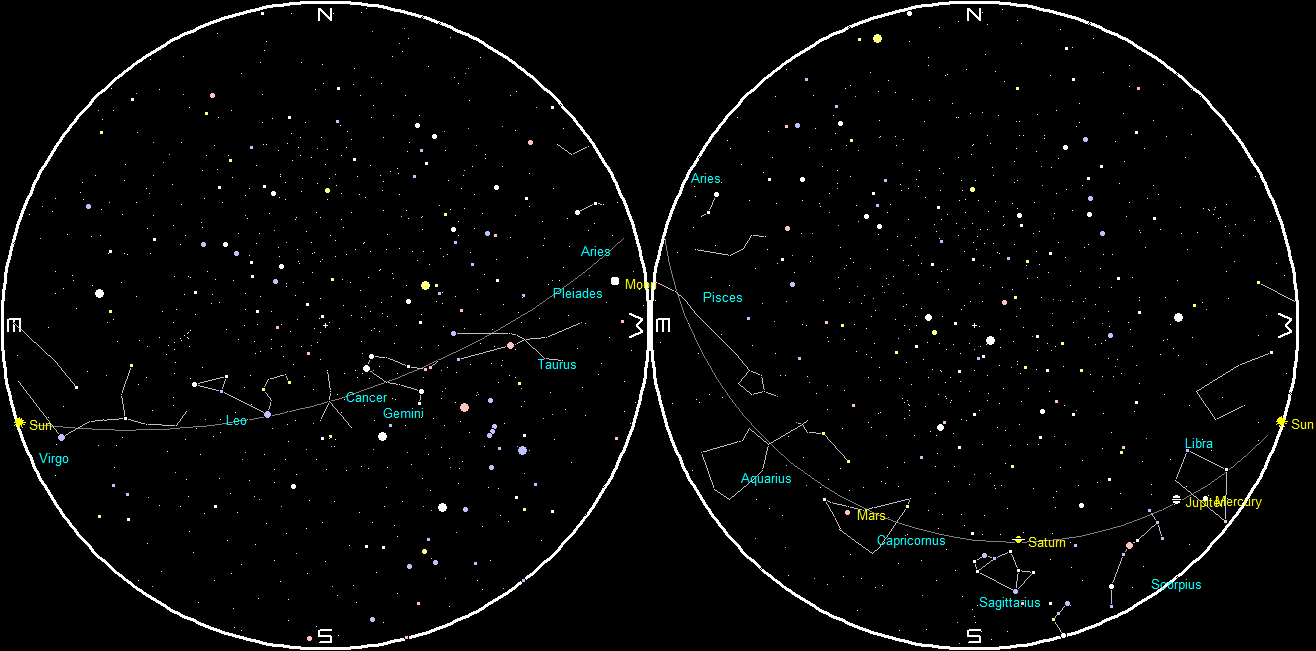
Let’s look at the bright planets for tonight. Three of them are visible in the evening sky. Venus, though still officially an evening planet for two more days sets before the Sun because it is south of the Sun’s path. Jupiter will be very low in the west-southwest after sunset. It will set at 7:53 p.m. Saturn, the ringed planet, will start the evening low in the southwestern sky and will set at 10:14 p.m. Mars will be low in the south as the skies darken tonight. and is now 68.9 million miles (111.0 million km) away. Mars will be due south at 8:51 p.m., and it will set at 1:39 a.m. Mars is picking up speed moving eastward, crossing the constellation of Capricornus this month. It’s currently in eastern Capricornus.
The times given are for the Traverse City/Interlochen area of Michigan. They may be different for your location.
Addendum
10/23/2018 – Ephemeris – Uranus is at opposition from the Sun today
Ephemeris for Tuesday, October 23rd. The Sun will rise at 8:08. It’ll be up for 10 hours and 36 minutes, setting at 6:44. The Moon, 1 day before full, will set at 7:48 tomorrow morning.
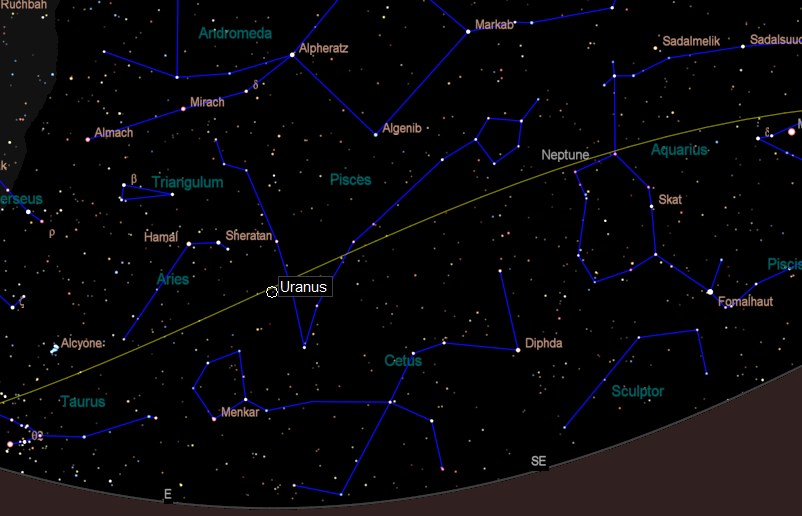
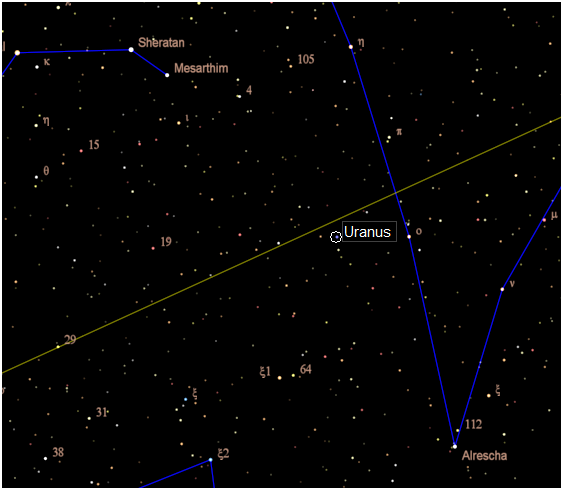
Later tonight the planet Uranus will reach opposition from the Sun. This is also about the time it is closest to the Earth at 18.9 Astronomical Units, or 18.9 times the Earth’s distance from the Sun, or 1.8 billion miles away. Uranus now is just barely visible to the naked eye by those with perfect vision at magnitude 5.7. It is fairly easy to spot in binoculars as a blue-green star. There are no blue-green stars. However it is in a rather star poor part of the sky. It is close to the bright Moon tonight, so I’d wait until Sunday night to try to spot it in dark skies. Then Uranus will be in the east at 9 p.m. below and right of the rightmost star of the three brightest stars of the constellation Aries. About half way from that star to the bottom leftmost star of Pisces. Uranus was the first new planet found since antiquity by William Herschel in 1781.
The times given are for the Traverse City/Interlochen area of Michigan. They may be different for your location.
Addendum
10/22/2018 – Ephemeris – The Hubble Space Telescope is on the mend
Ephemeris for Monday, October 22nd. The Sun will rise at 8:07. It’ll be up for 10 hours and 39 minutes, setting at 6:46. The Moon, 2 days before full, will set at 6:42 tomorrow morning.
Some of this news is a week old, but on October 5th the Hubble Space Telescope went into safe mode due to the loss of a functioning gyroscope. It needs three for fine stabilization for normal operation. Six new ones were installed by a servicing mission in 2009. In a worse case scenario, it can hobble along with just one. When a backup gyro was brought on-line it was showing anomalous readings. That was the status as of a week ago. Apparently, a workaround for the wonky gyro was found, and Hubble will go back into full operation soon. Another servicing mission is impossible because the Space Shuttle program has ended and all the surviving shuttle orbiters are in museums. With the James Web Space Telescope delayed until at least 2021, there may well be a gap in the reception of those exquisite images from space.
The times given are for the Traverse City/Interlochen area of Michigan. They may be different for your location.
Addendum

10/19/2018 – Ephemeris – Last 2018 outings for the GTAS this weekend
Ephemeris for Friday, October 19th. The Sun will rise at 8:03. It’ll be up for 10 hours and 47 minutes, setting at 6:51. The Moon, 3 days past first quarter, will set at 3:32 tomorrow morning.
Clouds willing, the Grand Traverse Astronomical Society will host two events this weekend. The first is Saturday night on the sidewalk on the 200 block of Front Street in Traverse City. It’s the International Observe the Moon Night, celebrated around the world. The event will begin at 8 p.m. Again the sky has to be at least partially clear for this event to happen.
Sunday night, again skies willing, members of the society will be at the Sleeping Bear Dunes National Lakeshore Dune Climb for the final star party of the year celebrating the 48th anniversary of the establishment of the park. On tap will be the Moon, Mars and Saturn plus some of the brighter wonders of the heavens including colorful binary stars and star clusters.
The times given are for the Traverse City/Interlochen area of Michigan. They may be different for your location.
10/18/2018 – Ephemeris – Halley’s Comet returns as the Orionids
Ephemeris for Thursday, October 18th. The Sun will rise at 8:02. It’ll be up for 10 hours and 50 minutes, setting at 6:53. The Moon, 2 days past first quarter, will set at 2:32 tomorrow morning.
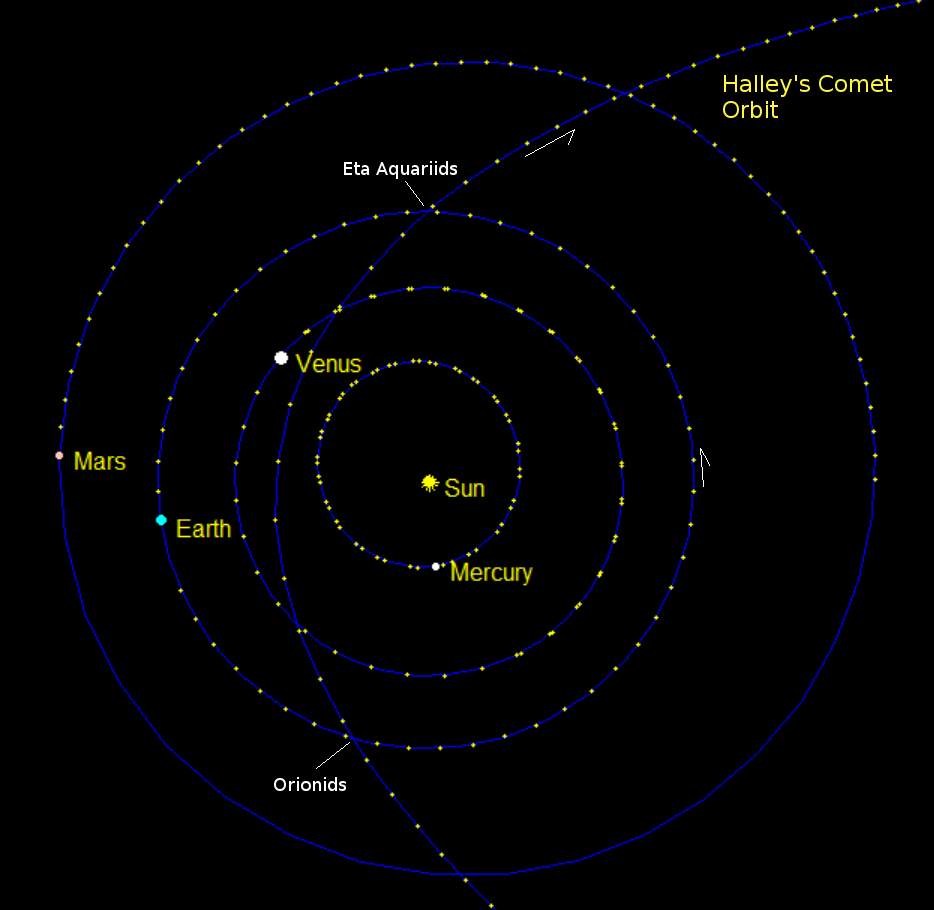
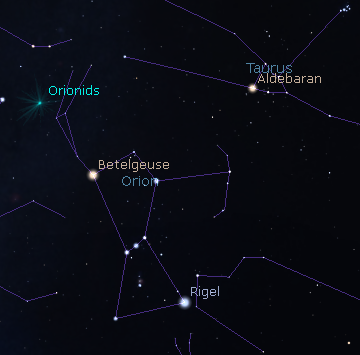
Halley’s Comet is back! (Pronounced Hall-ee’s) Well sorta. In the form of the Orionid meteor shower. Bits of Halley’s Comet from previous passes by the Earth’s orbit make their twice-yearly show in our skies as these bits collide with the Earth’s atmosphere. Halley’s orbit passes close to the earth’s orbit at points where the Earth is around May 6th and again near October 21st. Light dust and ionized gas get blown back into the tail of the comet. Heavier particles, still affected by the pressure of sunlight and the gravitational pull of the Sun and planets end up roughly following the comet’s orbit. In the morning after the Moon sets should be the best time to see them. They will seem to come from a spot above Orion and below Gemini.
The times given are for the Traverse City/Interlochen area of Michigan. They may be different for your location.
Addendum
 Bob Moler's Ephemeris Blog