Archive
04/02/2020 – Ephemeris – Let’s look at the Moon tonight
This is Ephemeris for Thursday, April 2nd. Today the Sun will be up for 12 hours and 51 minutes, setting at 8:12, and it will rise tomorrow at 7:18. The Moon, 1 day past first quarter, will set at 5:09 tomorrow morning.
Tonight’s gibbous Moon is a bright fixture in the evening sky it’s in the constellation of Cancer the crab which its brightness obliterates, between the stars Castor and Pollux of Gemini on the right and Regulus of Leo on the left. The Beehive star cluster in Cancer can be spotted in binoculars to the left of the Moon by about 7 to 8 of its diameters. On the Moon itself are the gray, so-called seas and two spectacular craters near the terminator. The first is near the bottom limb of the Moon, the very large crater Clavius with an interesting arc of small craters of decreasing size within. The other remarkable crater is Copernicus about half way up and left, near the terminator, the Moon’s sunrise line.
The event times given are for the Traverse City/Interlochen area of Michigan. They may be different for your location.
Addendum
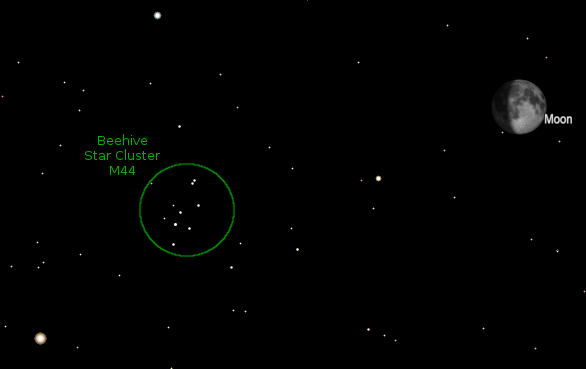
The Moon and Beehive Star Cluster at 10 p.m. tonight April 2, 2020. If you are not in the eastern daylight time the Moon will be in a different position if you are in a different time zone.
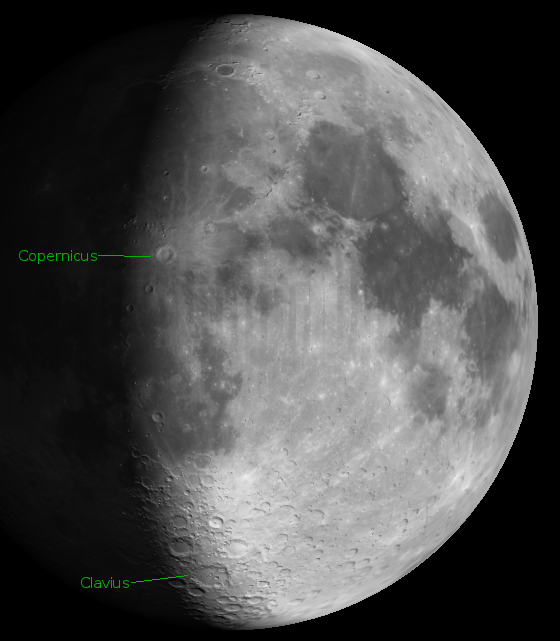
The Mon as it might appear in a low power telescope tonight at 10 p.m. April 2, 2020. Created using Virtual Moon Atlas (software).
04/01/2020 – Ephemeris – Looking at the naked-eye planets for this week
Ephemeris for April Fools Day, Wednesday, April 1st. Today the Sun will be up for 12 hours and 48 minutes, setting at 8:11, and it will rise tomorrow at 7:20. The Moon, at first quarter today, will set at 4:23 tomorrow morning.
Let’s look at the naked-eye planets for this week. Venus is our evening star shining brightly in the west just below the Pleiades. It will set at 12:26 a.m. The rest of the planet action is in the morning sky where there are three planets close together in the southeast. Bright Jupiter will rise first at 4:11 a.m. Followed by Saturn 4:31 a.m. Mars, left and below Saturn will rise at 4:39 a.m. It’s now as bright as a first magnitude star because it’s down to 135 million miles (217 million km) away, as the Earth slowly overtakes it at the rate of about 5 million miles (8 million km) a week. It’s brighter than the star Antares in the south-southwest. Mars passed Saturn yesterday afternoon moving eastward much faster than Saturn was.
The event times given are for the Traverse City/Interlochen area of Michigan. They may be different for your location.
Addendum
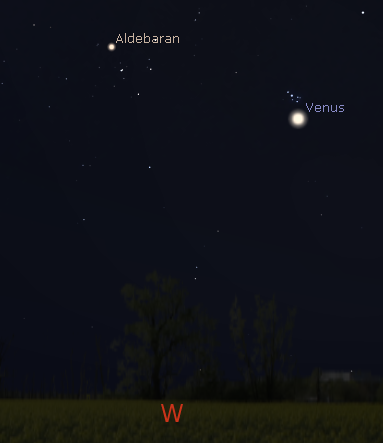
Venus under the Pleiades tonight at 10 p.m. April 1, 2020. Created using Stellarium.
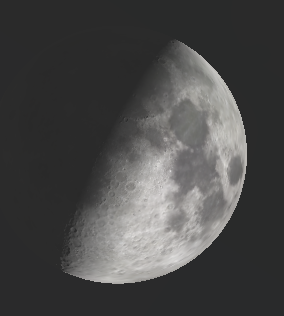
The Moon as it might look like in binoculars this evening April 1, 2020. Created using Stellarium.
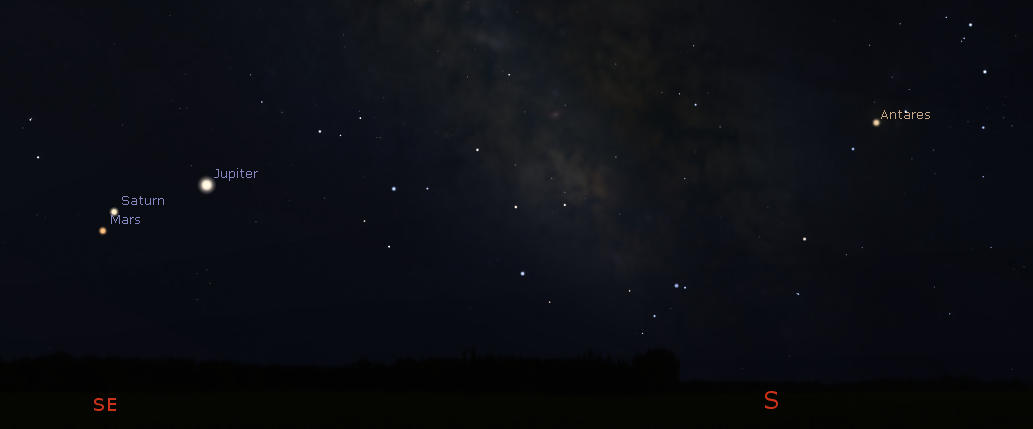
Morning planets and the southern stars of summer at 6 a.m. tomorrow morning April 2, 2020. Click on the image to enlarge. Created using Stellarium.
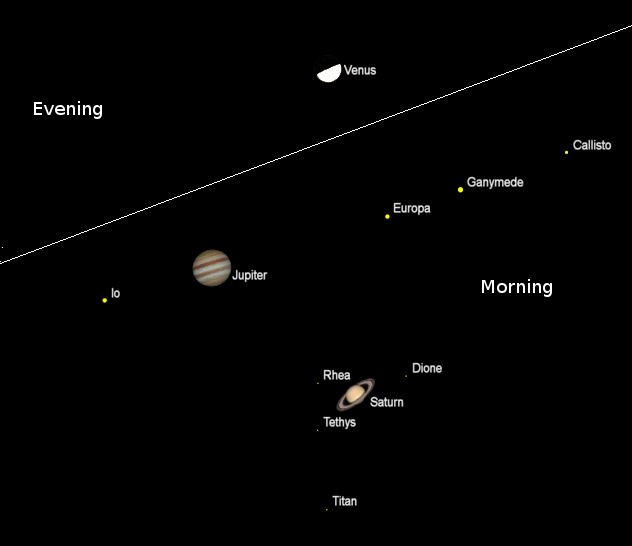
The planets as seen in a telescope with the same magnification. Venus in the evening and Jupiter and Saturn in the morning on the night of April 1/2, 2020. Apparent diameters: Venus, 25.85″; Jupiter, 37.21″; Saturn, 16.16″, rings, 37.65″. Mars at 6.46″ won’t be added until it reaches 10″. The ” symbol means seconds of arc (1/3600th of a degree.) Created using Cartes du Ciel (Sky Charts).
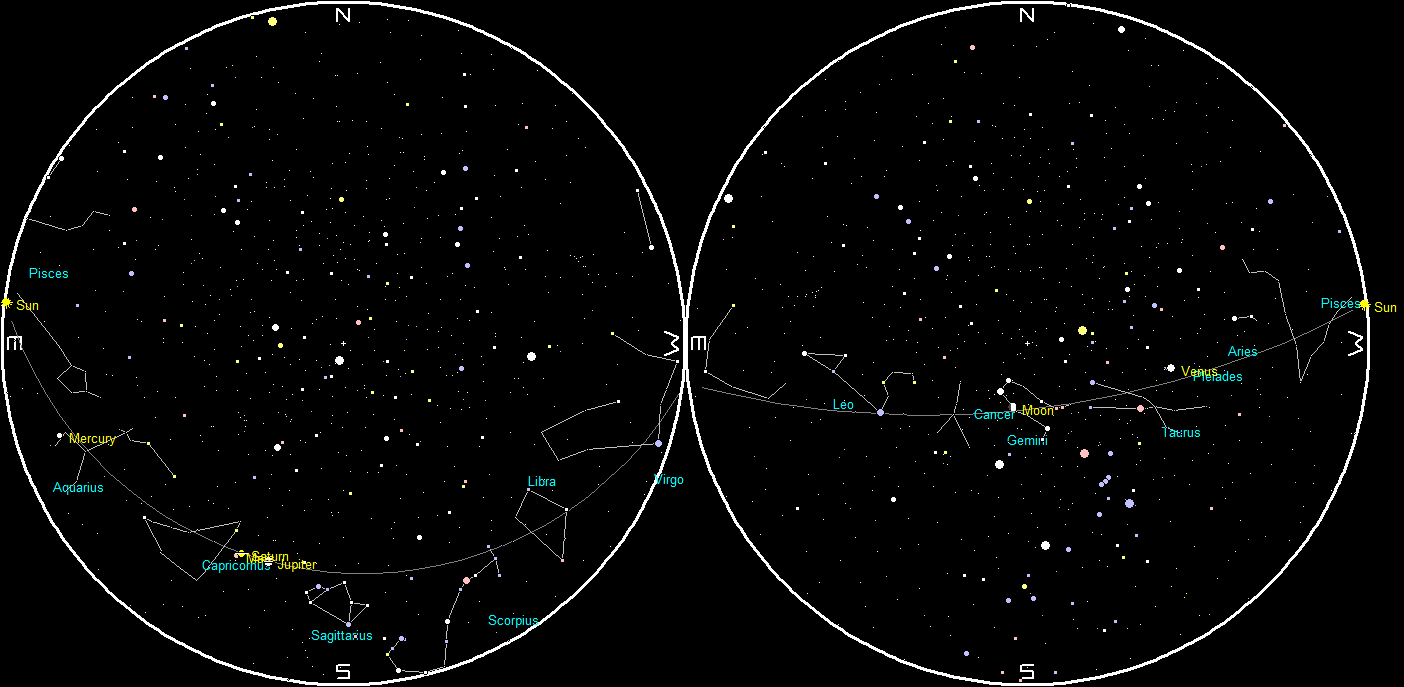
Planets and the Moon at sunset and sunrise of a single night starting with sunset on the right on April 1, 2020. The night ends on the left with sunrise on the 2nd. The planet traffic jam in the morning sky unfortunately overlays planets and labels. Click on the image to enlarge. Created using my LookingUp program.
 Bob Moler's Ephemeris Blog