Archive
03/03/2021 – Ephemeris – Let’s search for the naked-eye planets for this week
This is Bob Moler with Ephemeris for Wednesday, March 3rd. Today the Sun will be up for 11 hours and 17 minutes, setting at 6:33, and it will rise tomorrow at 7:14. The Moon, 2 days before last quarter, will rise at 12:09 tomorrow morning.
Let’s search for the naked-eye planets for this week. Unfortunately the only one you’ll find is Mars. The other four are hanging out in the direction of the Sun and won’t be seen for a week or so. Mars can be found high in the west-southwest and below left of the Pleiades at 8 pm tonight. Mars will be due south of the Pleiades tonight, which from our cockeyed view of the heavens, from north of the equator, places Mars below and left of the Pleiades. The Red Planet will set at 1:20 am. Of the outer planets Mars is the fastest, being the nearest to the Sun, and to the Earth. So unlike Jupiter, Saturn, and the stars which rise and set about four minutes earlier each night, Mars sets about a minute earlier each night now.
The astronomical event times given are for the Traverse City/Interlochen area of Michigan. They may be different for your location.
Addendum
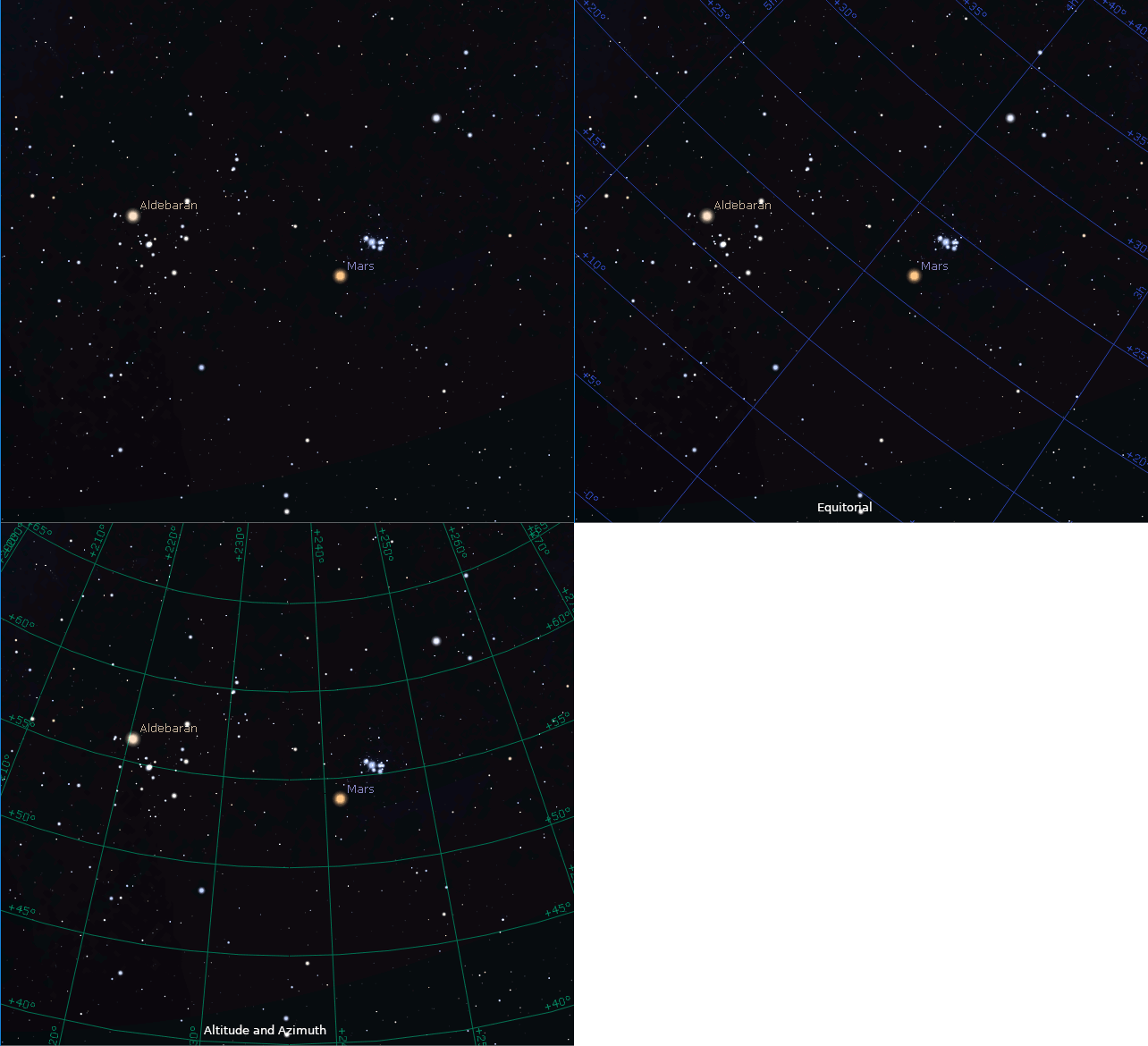
Here’s an animation showing why Mars being south of the Pleiades doesn’t look like it in the sky. This is all about directions on the celestial sphere. This will be the position of Mars at 8 pm on March 3rd, 2021, seen in the west-southwest. It is a three frame animation. The first is without coordinate grids as one would see it from about 45 degrees north latitude. The second frame contains the equatorial grid. The lines to the upper right point to the North Pole of the sky near Polaris, so that’s north. The third frame has an alt-azimuth grid. Its lines run vertically and horizontally. Created using Stellarium and GIMP.
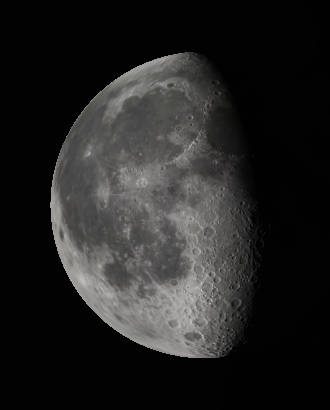
The moon as it might appear in binoculars at 6 am tomorrow morning March 4, 2021. Created using Stellarium.
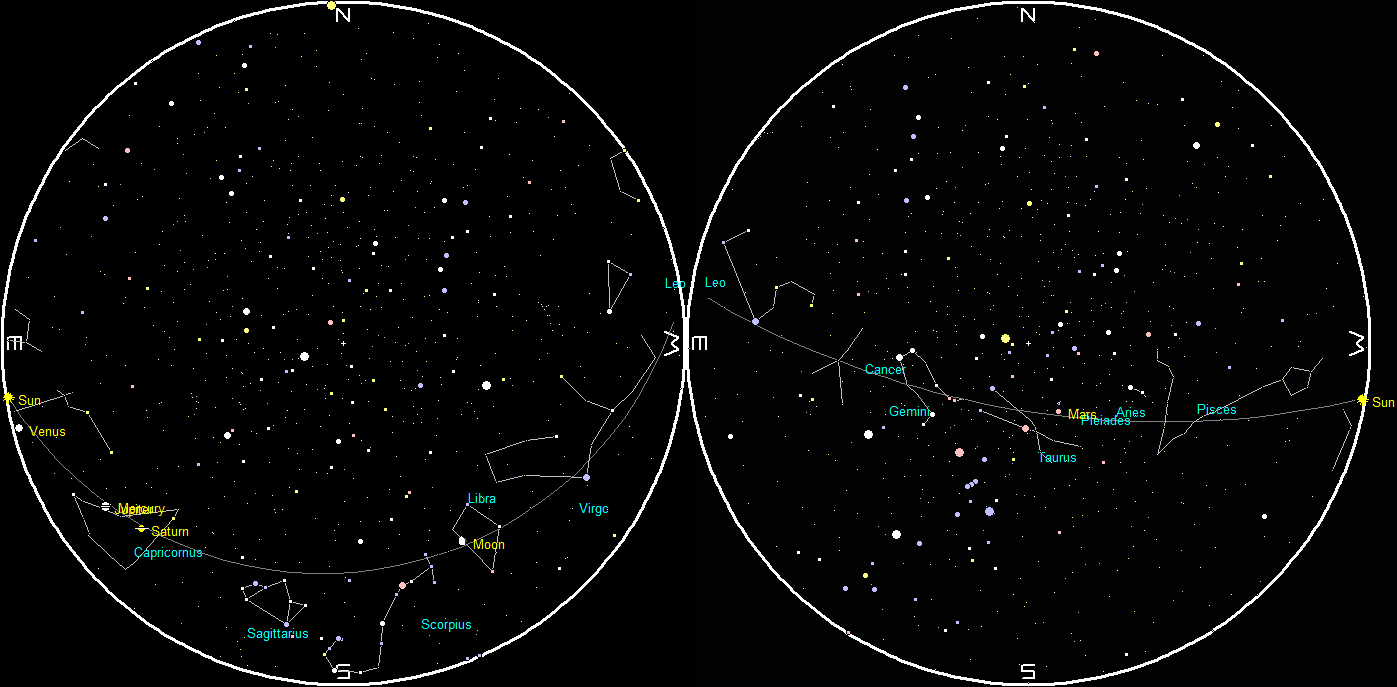
Planets and the Moon at sunset and sunrise of a single night starting with sunset on the right on March 3, 2021. The night ends on the left with sunrise on the 4th. There is a planet traffic jam in the morning and the symbols and labels for Jupiter and Mercury overlap. Unfortunately these planets rise too soon before the Sun to be seen for us up north. It is a great sight for Southern Hemisphere observers. Click on the image to enlarge. Created using my LookingUp program.
03/02/2021 – Ephemeris – Sirius and the Pup
This is Ephemeris for Tuesday, March 2nd. Today the Sun will be up for 11 hours and 14 minutes, setting at 6:32, and it will rise tomorrow at 7:16. The Moon, halfway from full to last quarter, will rise at 10:51 this evening.
Sirius is the brightest night-time star and is located in the south at 9 p.m. below and a bit left of Orion the Hunter. We’ve visited Sirius a month ago. But there is another star in the Sirius system that is practically invisible due to Sirius’ dazzling glare. Its name is Sirius B, nicknamed the Pup, alluding to Sirius’ Dog Star title. The tiny star was suspected as far back as 1834 due to Sirius’ wavy path against the more distant stars in the sky. Sirius and the Pup have 50-year orbits of each other. The Pup was first seen in 1862. It was the first of a new class of stars to be discovered, white dwarfs. The Pup is a dying star with the mass of the Sun, collapsed down to the size of the Earth after running out of hydrogen fuel in its core.
The astronomical event times given are for the Traverse City/Interlochen area of Michigan. They may be different for your location.
Addendum
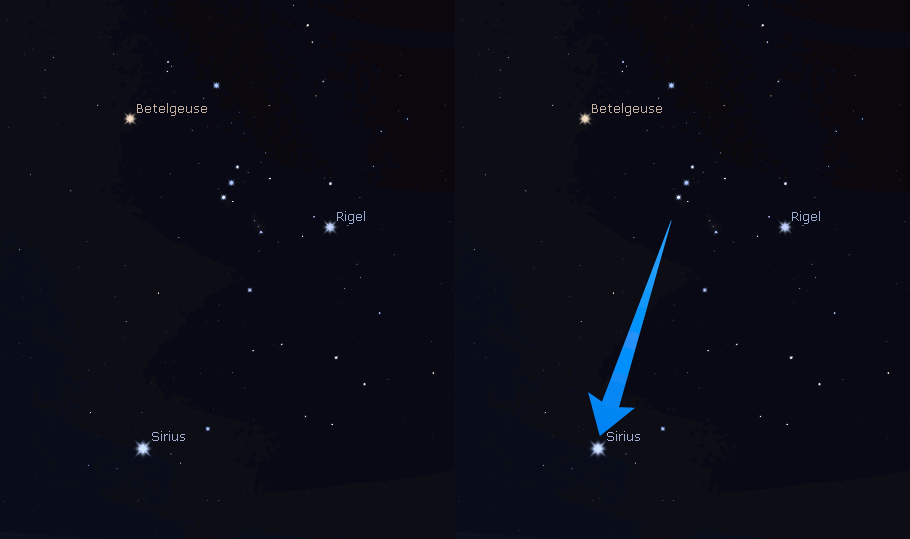
A Sirius finder animation for late January/early February at around 8 pm. Even in bright moonlight the seven bright stars of Orion can be seen. The three stars of Orion’s belt make a great pointer to Sirius. Created using Stellarium, GIMP and Libreoffice (for the arrow).
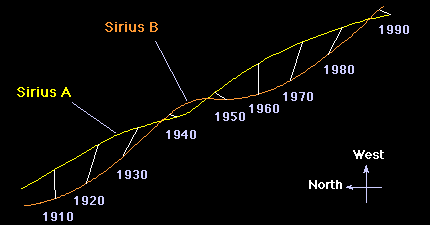
Sirius A & B’s path in the sky showing the wobble that betrayed the Pup’s presence. Credit Mike Guidry, University of Tennessee.
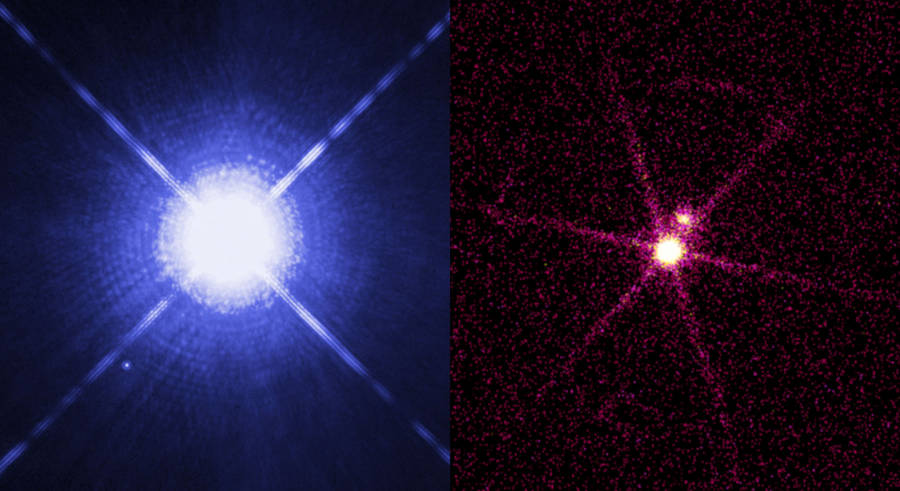
Sirius A and B imaged by two different space telescopes, revealing dramatically different views! Hubble’s image (left) shows Sirius A shining brightly in visible light, with diminutive Sirius B a tiny dot. However, in Chandra’s image (right) tiny Sirius B is dramatically brighter in X-rays! The “Universe in a Different Light” activity highlights more surprising views of some familiar objects: http://bit.ly/different-light-nsn NASA, ESA, H. Bond (STScI), and M. Barstow (University of Leicester) (left); NASA/SAO/CXC (right).
03/01/2021 – Ephemeris – Previewing March skies
This is Ephemeris for Monday, March 1st. Today the Sun will be up for 11 hours and 11 minutes, setting at 6:30, and it will rise tomorrow at 7:18. The Moon, 2 days past full, will rise at 9:33 this evening.
Let’s preview the month of March. In March the increase in daylight hours is at its greatest, with Spring 3 weeks away. Daylight hours will increase from 11 hours and 11 minutes today to 12 hours and 44 minutes on the 31st. Along with that the altitude of the Sun at local noon will increase from 38 degrees today to 49 ½ degrees at month’s end. Local noon today, by the way, for Interlochen and Traverse City is 12:54 pm, which is mainly due to the fact that our standard time meridian happens to run through Philadelphia. That’s before daylight time starts on the 14th. On that date local noon will be 1:50 pm. Spring will begin later this month on the 20th when the Sun will pass overhead for someone on the equator heading northward.
The astronomical event times given are for the Traverse City/Interlochen area of Michigan. They may be different for your location.
Addendum
March Evening Star Chart
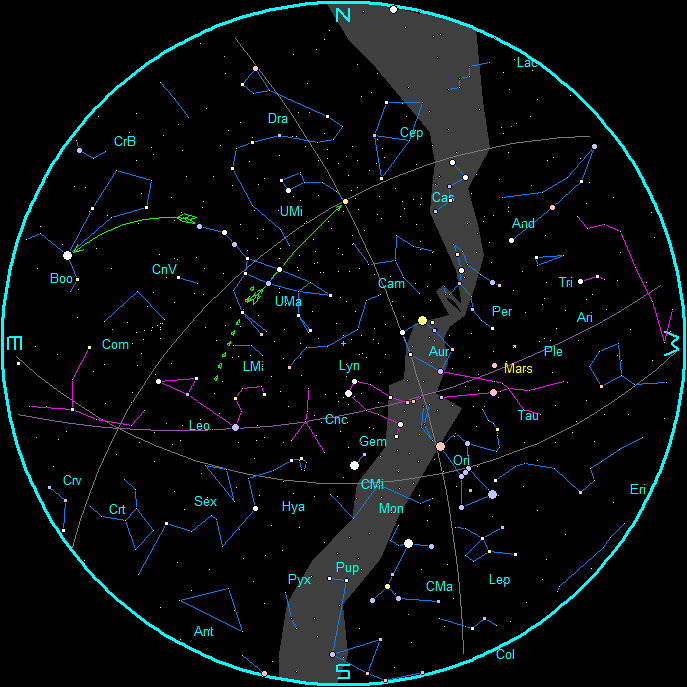
Star Chart for March 2021 (10 p.m. EDT March 15, 2021). Click on image to enlarge. Created using my LookingUp program. Click on image to enlarge. Created using my LookingUp program.
The planets and stars are plotted for the 15th at 10 p.m. EDT in the evening and 6 a.m. for the morning chart. These are the chart times. Note that Traverse City is located approximately 45 minutes behind our time meridian. (An hour and 45 minutes behind our daylight saving time meridian during EDT). To duplicate the star positions on a planisphere (rotating star finder) you may have to set it to 45 minutes or 1 hour 45 minutes earlier than your current time.
Note the chart times of 10 p.m. and 6 a.m. are for the 15th. For each week before the 15th add ½ hour (28 minutes if you’re picky). For each week after the 15th subtract ½ hour. The planet positions are updated each Wednesday on this blog. For planet positions on dates other than the 15th, check the Wednesday planet posts on this blog.
March Morning Star Chart
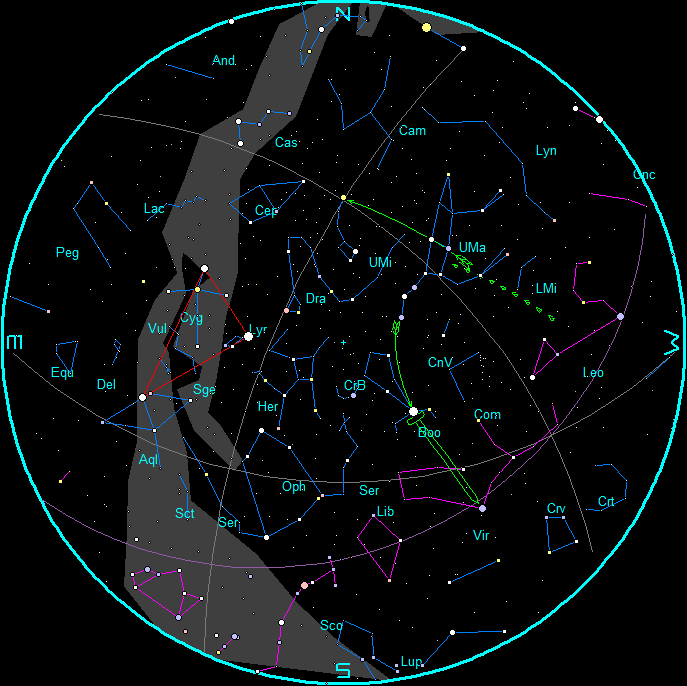
Star Chart for March mornings 2021 (6 a.m. EST March 15, 2021). Click on image to enlarge. Created using my LookingUp program.
The morning planets have yet to rise at chart time.
For a list of constellation names to go with the abbreviations click here.
- Pointer stars at the front of the bowl of the Big Dipper point to Polaris the North Star.
- The leaky bowl of the Big Dipper drips on Leo.
- Follow the arc of the handle of the Big Dipper to the star Arcturus, and
- Extend it as a spike to Spica.
- The Summer Triangle appears in red.
Twilight Limits, Nautical and Astronomical
| EST/EDT | |||||||
| Morning twilight | Evening twilight | Dark night | Moon | ||||
| Date | Astro. | Nautical | Nautical | Astro. | Start | End | Illum. |
| 2021-03-01 | 5h43m | 6h17m | 19h32m | 20h06m | 20h06m | 21h34m | 0.89 |
| 2021-03-02 | 5h41m | 6h15m | 19h33m | 20h07m | 20h07m | 22h51m | 0.81 |
| 2021-03-03 | 5h40m | 6h14m | 19h35m | 20h09m | 20h09m | – | 0.71 |
| 2021-03-04 | 5h38m | 6h12m | 19h36m | 20h10m | 20h10m | 0h09m | 0.6 |
| 2021-03-05 | 5h36m | 6h10m | 19h37m | 20h11m | 20h11m | 1h27m | 0.49 |
| 2021-03-06 | 5h34m | 6h08m | 19h39m | 20h13m | 20h13m | 2h41m | 0.37 |
| 2021-03-07 | 5h32m | 6h07m | 19h40m | 20h14m | 20h14m | 3h48m | 0.27 |
| 2021-03-08 | 5h31m | 6h05m | 19h41m | 20h15m | 20h15m | 4h47m | 0.18 |
| 2021-03-09 | 5h29m | 6h03m | 19h43m | 20h17m | 20h17m | 5h29m | 0.11 |
| 2021-03-10 | 5h27m | 6h01m | 19h44m | 20h18m | 20h18m | 5h27m | 0.05 |
| 2021-03-11 | 5h25m | 5h59m | 19h45m | 20h20m | 20h20m | 5h25m | 0.02 |
| 2021-03-12 | 5h23m | 5h57m | 19h47m | 20h21m | 20h21m | 5h23m | 0 |
| 2021-03-13 | 5h21m | 5h56m | 19h48m | 20h22m | 20h22m | 5h21m | 0.01 |
| 2021-03-14 | 6h19m | 6h54m | 20h49m | 21h24m | 21h24m | 6h19m | 0.03 |
| 2021-03-15 | 6h17m | 6h52m | 20h51m | 21h25m | 22h13m | 6h17m | 0.07 |
| 2021-03-16 | 6h15m | 6h50m | 20h52m | 21h26m | 23h15m | 6h15m | 0.13 |
| 2021-03-17 | 6h13m | 6h48m | 20h53m | 21h28m | – | 6h13m | 0.2 |
| 2021-03-18 | 6h11m | 6h46m | 20h54m | 21h29m | 0h18m | 6h11m | 0.28 |
| 2021-03-19 | 6h09m | 6h44m | 20h56m | 21h31m | 1h21m | 6h09m | 0.37 |
| 2021-03-20 | 6h11m | 6h46m | 21h01m | 21h36m | 2h23m | 6h11m | 0.46 |
| 2021-03-21 | 6h09m | 6h44m | 21h02m | 21h38m | 3h23m | 6h09m | 0.56 |
| 2021-03-22 | 6h07m | 6h42m | 21h04m | 21h39m | 4h19m | 6h07m | 0.66 |
| 2021-03-23 | 6h05m | 6h40m | 21h05m | 21h41m | 5h08m | 6h05m | 0.75 |
| 2021-03-24 | 6h03m | 6h38m | 21h07m | 21h42m | 5h51m | 6h03m | 0.84 |
| 2021-03-25 | 6h01m | 6h36m | 21h08m | 21h43m | – | – | 0.91 |
| 2021-03-26 | 5h59m | 6h34m | 21h09m | 21h45m | – | – | 0.97 |
| 2021-03-27 | 5h57m | 6h32m | 21h11m | 21h46m | – | – | 1 |
| 2021-03-28 | 5h55m | 6h31m | 21h12m | 21h48m | – | – | 1 |
| 2021-03-29 | 5h52m | 6h29m | 21h13m | 21h50m | – | – | 0.97 |
| 2021-03-30 | 5h50m | 6h27m | 21h15m | 21h51m | 21h51m | 22h50m | 0.92 |
| 2021-03-31 | 5h48m | 6h25m | 21h16m | 21h53m | 21h53m | – | 0.84 |
Twilight calendar was generated using Cartes du Ciel (Sky Charts).
See my blog post: Twilight Zone for the definitions of the different periods of twilight here: https://bobmoler.wordpress.com/2019/09/27/
NASA Calendar of Planetary Events
     Date    Time     Event
Mar  1  Mo            Venus: 6.3° W
     2  Tu  12:19 am  Moon Perigee: 365400 km
     3  We   6:32 pm  Mars-Pleiades: 2.6° S
     5  Fr  12:11 am  Mercury-Jupiter: 0.3° N
     5  Fr   7:56 pm  Moon Descending Node
     5  Fr   8:30 pm  Last Quarter
     6  Sa   5:59 am  Mercury Greatest Elongation: 27.3° W
                      In morning. Not the best for our latitude.
     7  Su   3:45 pm  Moon South Dec.: 25.2° S
     9  Tu   6:02 pm  Moon-Saturn: 3.9° N
    10  We  10:35 am  Moon-Jupiter: 4.3° N
    10  We   6:36 pm  Neptune Conjunction
    10  We   8:02 pm  Moon-Mercury: 3.9° N
    13  Sa   5:21 am  New Moon
    18  Th   1:04 am  Moon Apogee: 405300 km
    19  Fr   1:48 pm  Moon-Mars: 2.1° N
    19  Fr  11:31 pm  Moon Ascending Node
    20  Sa   5:37 am  Vernal Equinox Yea Spring!
    20  Sa   3:15 pm  Mars-Aldebaran: 6.9° N
    21  Su  10:40 am  First Quarter
    22  Mo   4:35 am  Moon North Dec.: 25.3° N
    24  We   5:58 am  Moon-Beehive: 2.7° S
    26  Fr   2:17 am  Venus Superior Conjunction
                      Enters the evening sky
    28  Su   2:48 pm  Full Moon  (supermoon)
    30  Tu   2:12 am  Moon Perigee: 360300 km
Apr  1  Th            Venus: 2° E
All event times are given for UTC-5:00: Eastern Standard Time before the 14th or UTC-4:00 Daylight Saving Time thereafter.
Sky Events Calendar by Fred Espenak and Sumit Dutta (NASA’s GSFC),
http://eclipse.gsfc.nasa.gov/SKYCAL/SKYCAL.html
If you go to the above site you can print out a list like the above for the entire year or calendar pages for your time zone.
Note that the site is now kept up for archival purposes. Fred Espenak retired from NASA several years ago and has his own site, AstroPixels, which contain the same information: http://astropixels.com/almanac/almanac.html.
Sun and Moon Rising and Setting Events
                  Ephemeris of Sky Events for Interlochen/TC
March, 2021    Local time zone: EST
+-----------------------------------------------------------------------+
| DATE |  SUN     SUN  DAYLIGHT|   TWILIGHT*    |MOON  RISE OR    ILLUM |
|      |  RISE    SET    HOURS |  END    START  |PHASE SET** TIME FRACTN|
+=======================================================================+
|Mon  1| 07:19a  06:30p  11:11 | 07:34p  06:16a |      Rise 09:33p   90%|
|Tue  2| 07:18a  06:32p  11:14 | 07:35p  06:15a |      Rise 10:51p   82%|
|Wed  3| 07:16a  06:33p  11:17 | 07:36p  06:13a |      Rise 12:09a   73%|
|Thu  4| 07:14a  06:34p  11:20 | 07:38p  06:11a |      Rise 01:26a   62%|
|Fri  5| 07:12a  06:36p  11:23 | 07:39p  06:09a |L Qtr Rise 02:41a   51%|
|Sat  6| 07:11a  06:37p  11:26 | 07:40p  06:08a |      Rise 03:48a   40%|
+------+-----------------------+----------------+-----------------------+
|Sun  7| 07:09a  06:38p  11:29 | 07:41p  06:06a |      Rise 04:46a   29%|
|Mon  8| 07:07a  06:40p  11:32 | 07:43p  06:04a |      Rise 05:34a   20%|
|Tue  9| 07:05a  06:41p  11:35 | 07:44p  06:02a |      Rise 06:12a   12%|
|Wed 10| 07:03a  06:42p  11:39 | 07:45p  06:00a |      Rise 06:43a    6%|
|Thu 11| 07:01a  06:44p  11:42 | 07:47p  05:59a |      Rise 07:09a    2%|
|Fri 12| 07:00a  06:45p  11:45 | 07:48p  05:57a |      Rise 07:31a    0%|
|Sat 13| 06:58a  06:46p  11:48 | 07:49p  05:55a |New   Set  07:06p    0%|
+------+-----------------------+----------------+-----------------------+
| EDT  |      Time Change      |                |                       |
|Sun 14| 07:56a  07:48p  11:51 | 08:51p  06:53a |      Set  09:09p    3%|
|Mon 15| 07:54a  07:49p  11:54 | 08:52p  06:51a |      Set  10:12p    6%|
|Tue 16| 07:52a  07:50p  11:57 | 08:53p  06:49a |      Set  11:15p   12%|
|Wed 17| 07:50a  07:51p  12:00 | 08:55p  06:47a |      Set  12:18a   18%|
|Thu 18| 07:49a  07:53p  12:04 | 08:56p  06:45a |      Set  01:21a   26%|
|Fri 19| 07:47a  07:54p  12:07 | 08:57p  06:44a |      Set  02:23a   35%|
|Sat 20| 07:45a  07:55p  12:10 | 08:59p  06:42a |      Set  03:23a   44%|
+------+-----------------------+----------------+-----------------------+
|Sun 21| 07:43a  07:56p  12:13 | 09:00p  06:40a |F Qtr Set  04:18a   54%|
|Mon 22| 07:41a  07:58p  12:16 | 09:01p  06:38a |      Set  05:08a   64%|
|Tue 23| 07:39a  07:59p  12:19 | 09:03p  06:36a |      Set  05:50a   73%|
|Wed 24| 07:37a  08:00p  12:22 | 09:04p  06:34a |      Set  06:26a   82%|
|Thu 25| 07:36a  08:02p  12:25 | 09:05p  06:32a |      Set  06:57a   89%|
|Fri 26| 07:34a  08:03p  12:29 | 09:07p  06:30a |      Set  07:24a   95%|
|Sat 27| 07:32a  08:04p  12:32 | 09:08p  06:28a |      Set  07:50a   99%|
+------+-----------------------+----------------+-----------------------+
|Sun 28| 07:30a  08:05p  12:35 | 09:10p  06:26a |Full  Rise 08:08p  100%|
|Mon 29| 07:28a  08:07p  12:38 | 09:11p  06:24a |      Rise 09:28p   98%|
|Tue 30| 07:26a  08:08p  12:41 | 09:12p  06:22a |      Rise 10:50p   93%|
|Wed 31| 07:24a  08:09p  12:44 | 09:14p  06:20a |      Rise 12:11a   85%|
+-----------------------------------------------------------------------+
* Nautical Twilight
** Moonrise or moonset, whichever occurs between sunrise and sunset
Created using my LookingUp for DOS output as text.
 Bob Moler's Ephemeris Blog