Archive
02/23/2022 – Ephemeris – Let’s search for the naked-eye planets for this week
This is Ephemeris for Wednesday, February 23rd. Today the Sun will be up for 10 hours and 52 minutes, setting at 6:22, and it will rise tomorrow at 7:28. The Moon, at last quarter today, will rise at 2:43 tomorrow morning.
Let’s search for the naked-eye planets for this week. The last evening planet, Jupiter, is too close to the setting Sun to be spotted now after sunset. The action now shifts to the morning sky, where Venus and Mars reside. Saturn entered the morning sky sixteen days ago, and it will be about another month or so before it’s far enough from the direction of the Sun to be spotted. Venus, our brilliant morning star, Mars and maybe even Mercury can be spotted low in the southeast by 6:45 am, about half an hour before sunrise. Mars will be below, and right of Venus, while Mercury will be near the horizon left of Venus. Mercury is brighter than Mars, but lower in the more intense twilight. Venus will rise at 5:06, with Mars following at 5:38, and Mercury rising last at 6:32.
The astronomical event times given are for the Traverse City/Interlochen area of Michigan (EST, UT – 5 hours). They may be different for your location.
Addendum
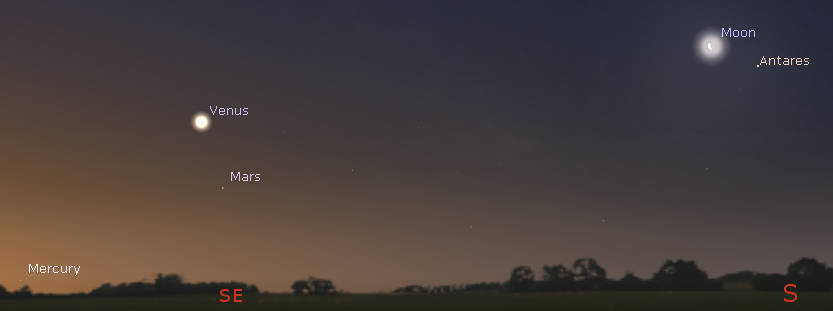
Morning planets and the waning crescent Moon at 6:45 am, or about 40 minutes before sunrise tomorrow morning, February 24, 2022. Mercury may not actually be visible. Click on the image to enlarge it. Created using Stellarium.
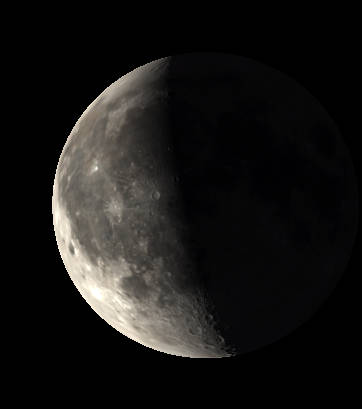
Waning Crescent Moon as it might be shown in binoculars or small telescope tomorrow morning, February 24, 2022. Created using Stellarium.
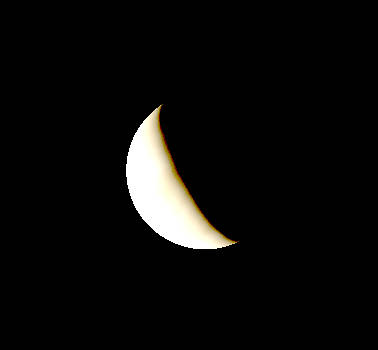
Venus through a telescope as it would appear before sunrise tomorrow morning, February 24, 2022. It’s shown larger than usual, since it’s the only planet that looks like anything in a small telescope now. Its apparent diameter is 33.72″, and it is 34.9% illuminated by the Sun.
(” means seconds of arc. 1″ is 1/3600th of a degree) Mars has an apparent diameter of 4.63″, while Mercury has one of 6.18″. Created using Stellarium, which is also the source for the apparent diameters and the illuminated fraction of Venus.
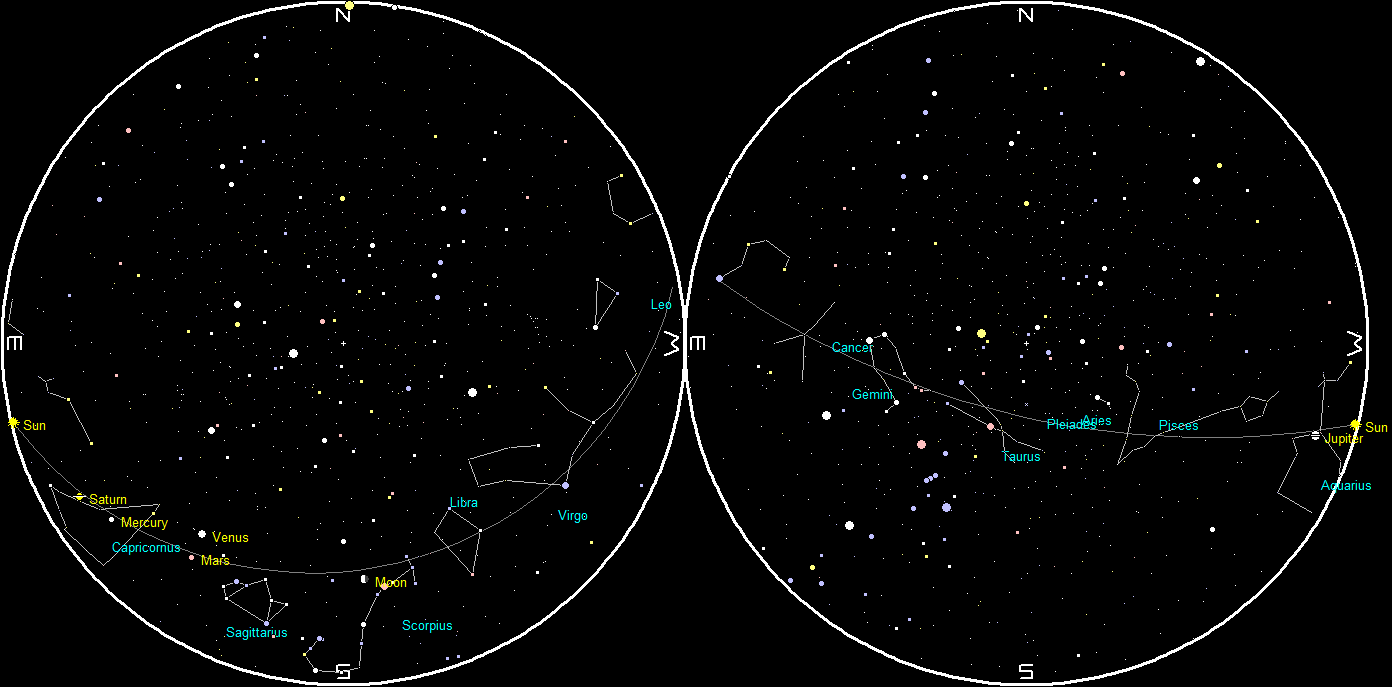
The naked-eye planets and the Moon at sunset and sunrise on a single night, starting with sunset on the right on February 23, 2022. The night ends on the left with sunrise on the 24th. Click on the image to enlarge it. Created using my LookingUp program.
 Bob Moler's Ephemeris Blog