04/20/2022 – Ephemeris – Let’s search for the naked-eye planets for this week
This is Ephemeris for Wednesday, April 20th. Today the Sun will be up for 13 hours and 44 minutes, setting at 8:34, and it will rise tomorrow at 6:48. The Moon, 3 days before last quarter, will rise at 1:51 tomorrow morning.
Let’s search for the naked-eye planets for this week. There is one bright planet in the evening sky. Mercury may be spotted around and after 9:15 this evening very low in the west-northwest and be visible for the next half hour or so. After that, the planet action shifts to the morning sky. The other 4 naked-eye planets are there. By 6 am, the planets will be spread out low from the east to southeast with brilliant Venus moving closer to Jupiter, lowest in the east. Dim Mars will be to the right and a bit above Venus, while brighter Saturn will be right and above Mars. Saturn will rise tomorrow at 4:27 am, with Mars following at 4:55. Venus will rise at 5:19 tomorrow morning, followed by Jupiter at 5:39 am. The Moon will be in the south at 6 am.
The astronomical event times given are for the Traverse City/Interlochen area of Michigan (EDT, UT – 4 hours). They may be different for your location.
Addendum
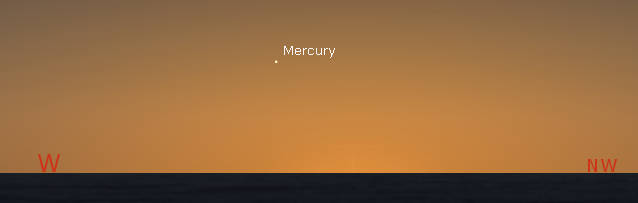
Mercury in the evening at 9:15, or about 40 minutes after sunset tonight, April 20, 2022. Created using Stellarium.
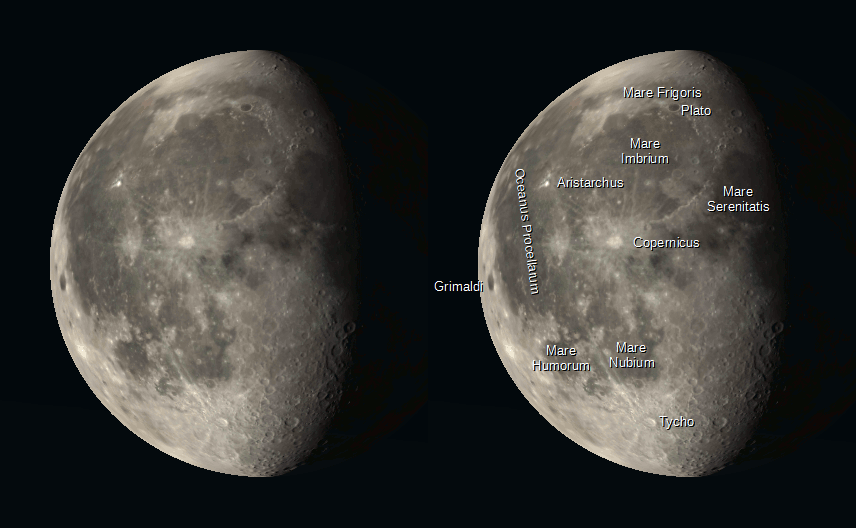
Annotated Binocular Moon. What the Moon might look like tomorrow morning, April 21, 2022. Created using Stellarium, GIMP and LibreOffice.
Translations
Mare Frigoris – Sea of Cold
Mare Humorum – Sea of Moisture
Mare Imbrium – Sea of Showers
Mare Nubium – Sea of Clouds
Mare Serenitatis – Sea of Serenity
Oceanus Procellarum – Ocean of Storms
Note that Mare is pronounced Mar-é
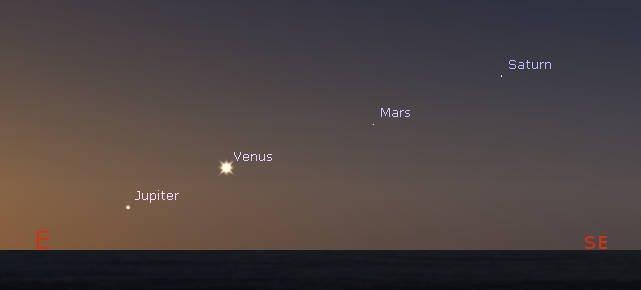
Parade of the morning planets at 6 am or about 45 minutes before sunrise tomorrow, April 21, 2022. Created using Stellarium.
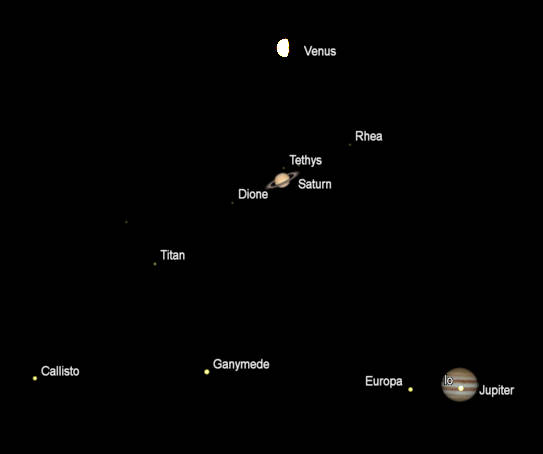
Views of Venus, Saturn, and Jupiter (north up) as they would be seen in a small telescope, with the same magnification, tomorrow morning at 6:00 am, April 21, 2022. I do not show planets less than 10 seconds of arc in diameter. Apparent diameters: Venus 18.01″, 64.0% illuminated; Saturn 16.24″, its rings 37.82″; Jupiter 34.24″. Mars is not shown, its apparent diameter is 5.56″ and is 90.2% illuminated. The moons of Jupiter and Saturn may not be visible in twilight. Io transiting the face of Jupiter definitely will not be visible. Jupiter is shown here much dimmer compared to its moons than it actually is. The ” symbol means seconds of arc (1/3600th of a degree.) Created using Cartes du Ciel (Sky Charts).
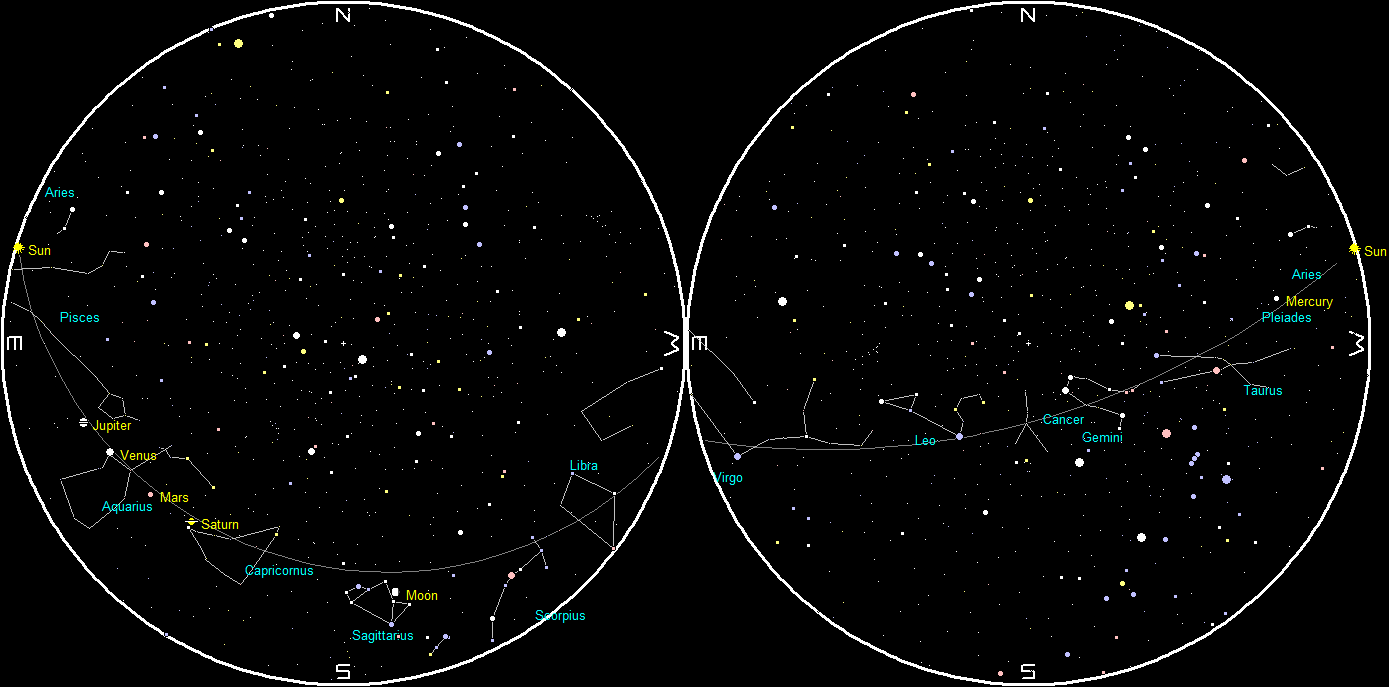
The naked-eye planets and the Moon at sunset and sunrise on a single night, starting with sunset on the right on April 20, 2022. The night ends on the left with sunrise on the 21st. Notice that all the naked-eye planets are in the morning sky now, with the Moon still hanging out in the evening sky. Click on the image to enlarge it. Created using my LookingUp program.
 Bob Moler's Ephemeris Blog