Archive
05/17/2023 – Ephemeris – Let’s find where the naked-eye planets have wandered off to this week
This is Bob Moler with Ephemeris for Wednesday, May 17th. Today the Sun will be up for 14 hours and 53 minutes, setting at 9:06, and it will rise tomorrow at 6:11. The Moon, 2 days before new, will rise at 5:30 tomorrow morning.
Let’s find where the naked-eye planets have wandered off to this week. Venus is our blazing Evening Star, seen in the west all evening. It will set after midnight. The red planet Mars has moved into Cancer, left of the namesake stars of the Gemini twins, with Pollux closest to Mars and Castor farther right. Mars is above and left of Venus by 18 degrees, or a bit less than two times the width of one’s fist held at arm’s length. Venus is closing the gap between them, but will never quite reach Mars while they are in the evening sky. The closest they will get is three and a half degrees or 7 moon diameters apart, before Venus pulls back toward the Sun faster than Mars will. In the morning, Saturn will be visible, low in the east-southeast by 5 am, rising at 3:18 am. This morning, the Moon is covering or occulting Jupiter. Daylight is making this a telescopic event.
The astronomical event times given are for the Traverse City/Interlochen area of Michigan (EDT, UT –4 hours). They may be different for your location.
Addendum
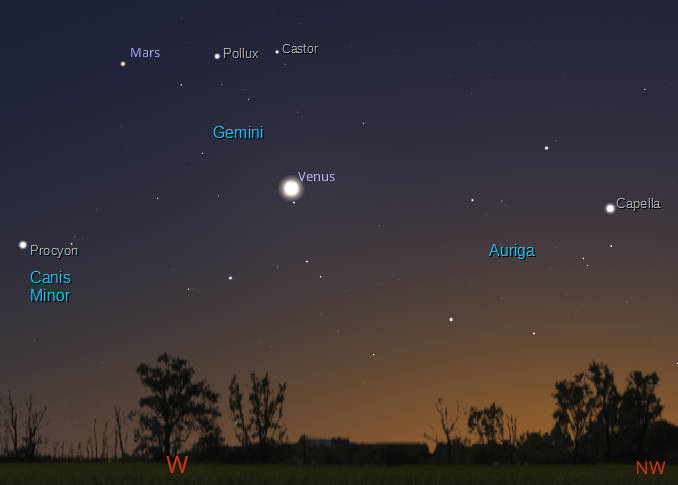
Evening planets with the stars at 10 pm tonight, May 17, 2023. Created using Stellarium and LibreOffice Draw.
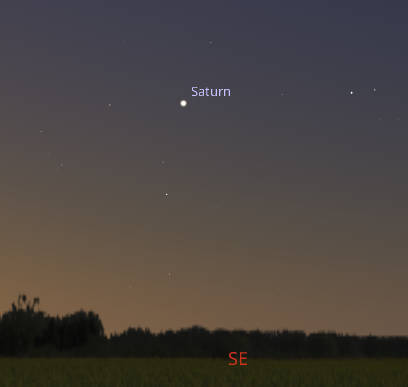
Saturn in morning twilight at 5:30 am tomorrow, May 18, 2023. Created using Stellarium.
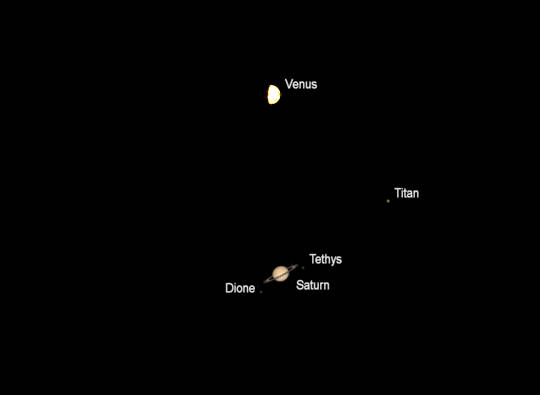
Telescopic Venus and Saturn (north up) as they would be seen in a small telescope, with the same magnification. Apparent diameters: Venus 19.65″ and is 58.9% illuminated; Saturn 16.77″, its rings 39.05″. Mars, too small to be represented here, is 4.96″ in diameter. Created using Cartes du Ciel (Sky Charts).
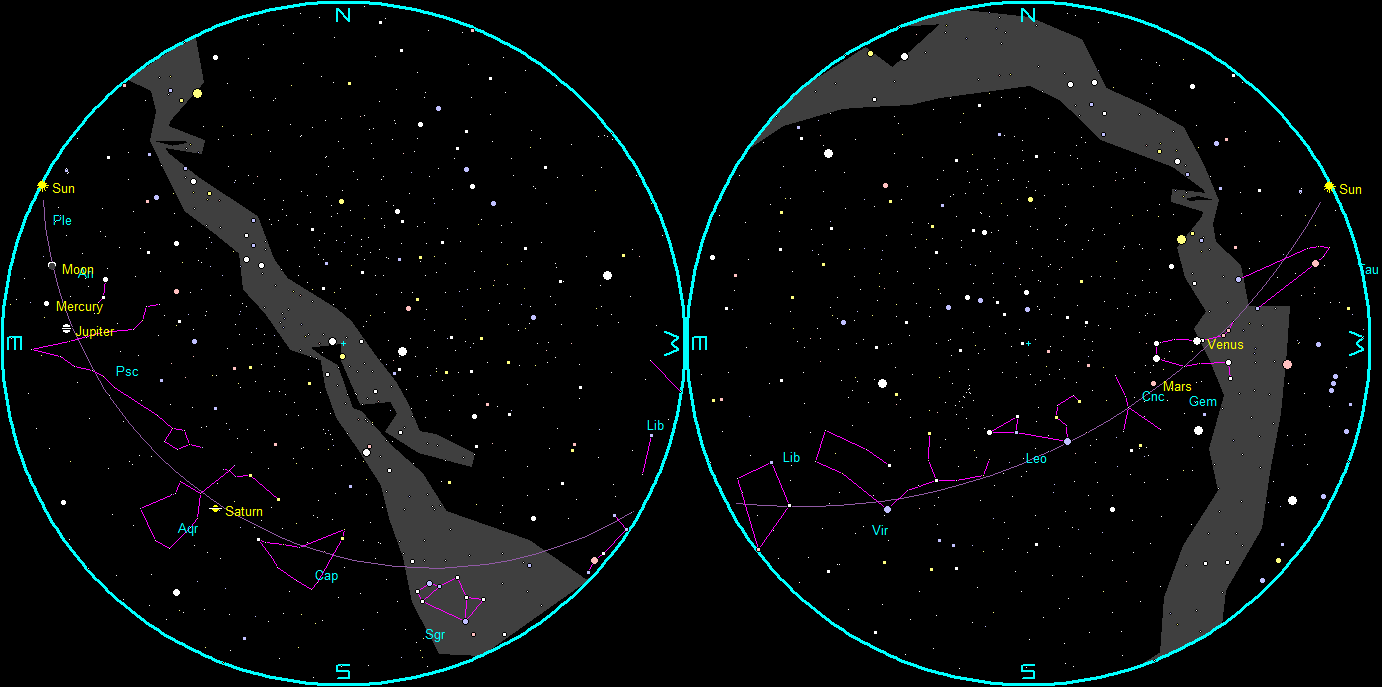
The naked-eye planets and the Moon at sunset and sunrise on a single night, starting with sunset on the right on May 17, 2023. The night ends on the left with sunrise on the 18th. Click or tap on the image to enlarge it. Created using my LookingUp app and GIMP.
 Bob Moler's Ephemeris Blog