This is Ephemeris for Wednesday, July 19th. Today the Sun will be up for 15 hours and 7 minutes, setting at 9:22, and it will rise tomorrow at 6:16. The Moon, 2 days past new, will set at 10:55 this evening.
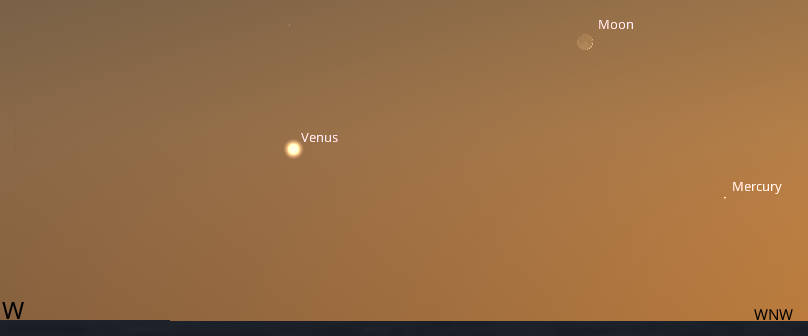
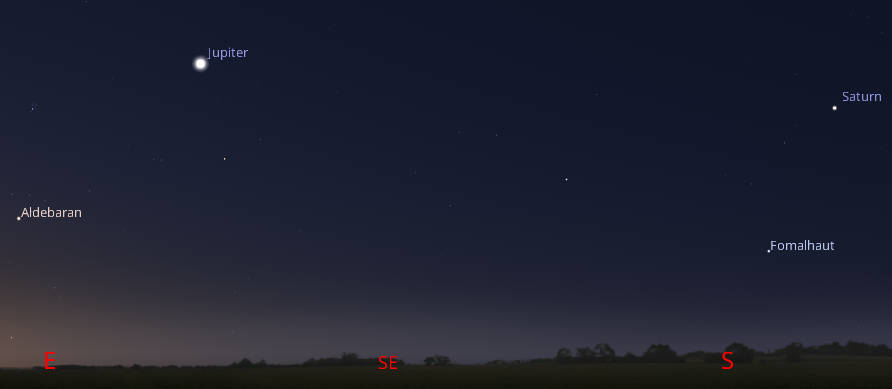
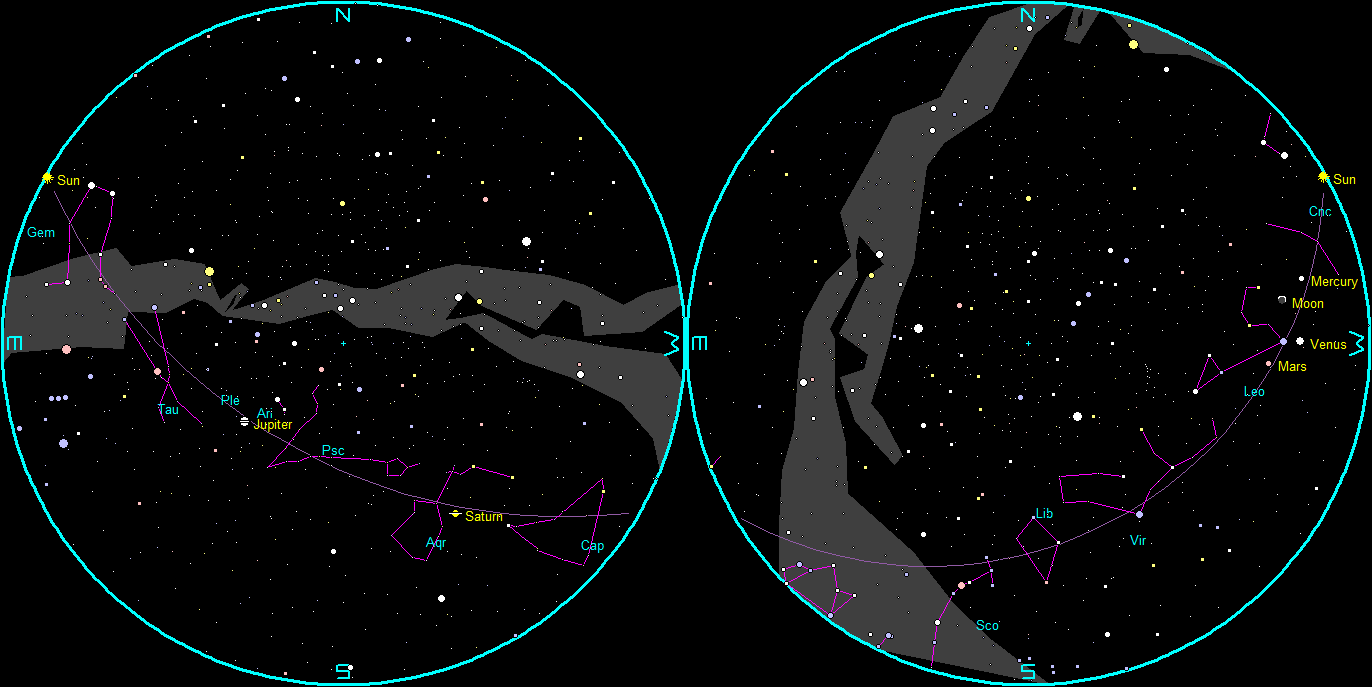
Let’s find out where the naked-eye planets have wandered off to this week. Venus is our blazing Evening Star, seen very low in the west in evening twilight. It will set at 10:31 pm, and by four minutes earlier each night. The red planet Mars is now pretty much lost in the evening twilight. We’ll see it in the morning sky in a few months. Venus too will soon leave the evening sky. Saturn will rise shortly after 11 pm. And by 5:15 am, or an hour before sunrise, it will appear in the south-southwest, the brightest “star” in that direction. It’s above the bright star Fomalhaut, normally the loneliest bright star in the sky. Jupiter will be in the east-southeast at that hour. Jupiter is the brightest star-like object in the morning sky now.
The astronomical event times given are for the Traverse City/Interlochen area of Michigan (EDT, UT –4 hours). They may be different for your location.
Addendum
Venus, Mercury and the two-day-old Moon seen low in the west-northwest at 10 pm, about 40 minutes after sunset. Mercury is most likely not visible in the bright twilight. Mid to late summer and early to mid-autumn are difficult times to see the Moon and planets close to the Sun. The opposite is true in the morning sky. Created using Stellarium.
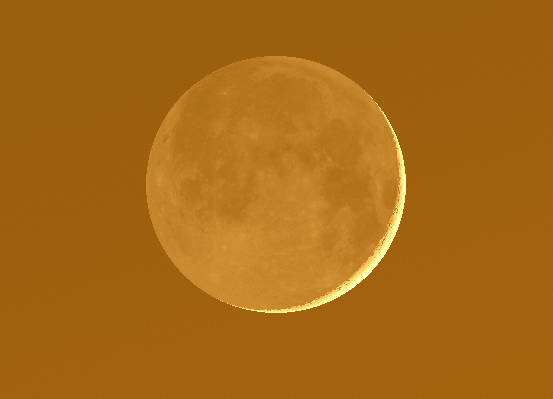
The two-day-old Moon might look like this in binoculars, showing earthshine by the nearly full Earth in its sky. Created using Stellarium and GIMP.
Jupiter and Saturn with two bright stars at 5:15 am, about an hour before sunrise. Fomalhaut will grace our evening skies this autumn, while Aldebaran will appear in late autumn and winter. Click or tap on the image to possibly enlarge it. Created using Stellarium.
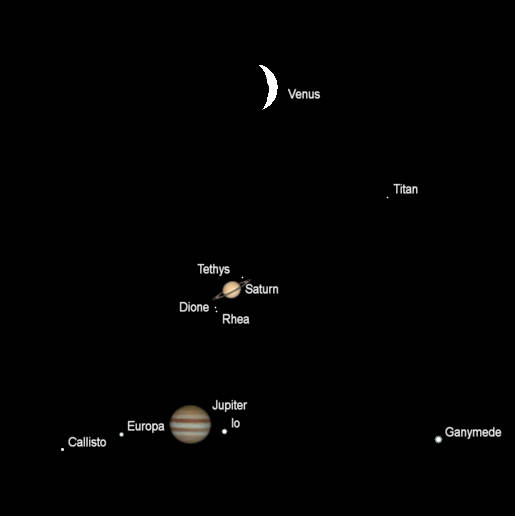
Telescopic Venus, Saturn and Jupiter (north up) as they would be seen in a small telescope, with the same magnification at 10:00 pm July 19, 2023, for Venus and 5:15 am July 20, 2023, for Jupiter and Saturn. Apparent diameters: Venus 45.30″ and is 15.7% illuminated; Saturn 18.52″, its rings 43.15″; Jupiter 38.48″. Venus now appears larger than Jupiter. Venus, Saturn and Jupiter are approaching us, so their apparent diameters are growing. The ” symbol means seconds of arc (1/3600th of a degree.) Created using Cartes du Ciel (Sky Charts).
The naked-eye planets and the Moon at sunset and sunrise on a single night, starting with sunset on the right on July 19, 2023. The night ends on the left with sunrise on the 20th. Click or tap on the image to enlarge it. Created using my LookingUp app and GIMP.
 Bob Moler's Ephemeris Blog