This is Ephemeris for Wednesday, January 24th. Today the Sun will be up for 9 hours and 29 minutes, setting at 5:39, and it will rise tomorrow at 8:09. The Moon, 1 day before full, will set at 8:36 tomorrow morning.
Let’s find out where the naked-eye planets have wandered off to this week. Three of those five planets are now easily visible. Saturn and Jupiter are the evening planets. Saturn is getting harder to spot low in the west-southwest, setting at 8:19 pm. Jupiter will move from high in the south to low in the west by midnight, and will set in the west-northwest at 1:40 am. Venus, the brilliant morning star, will rise in the east-southeast at 6:09 am, and be a brilliant beacon in the morning, shining in the southeast before the bright morning twilight claims it around 8 am. Mercury, which rises by 7:03 am might just be visible below and left of Venus by 7:30 am.
The astronomical event times given are for the Traverse City/Interlochen area of Michigan (EST, UT –5 hours). They may be different for your location.
Addendum
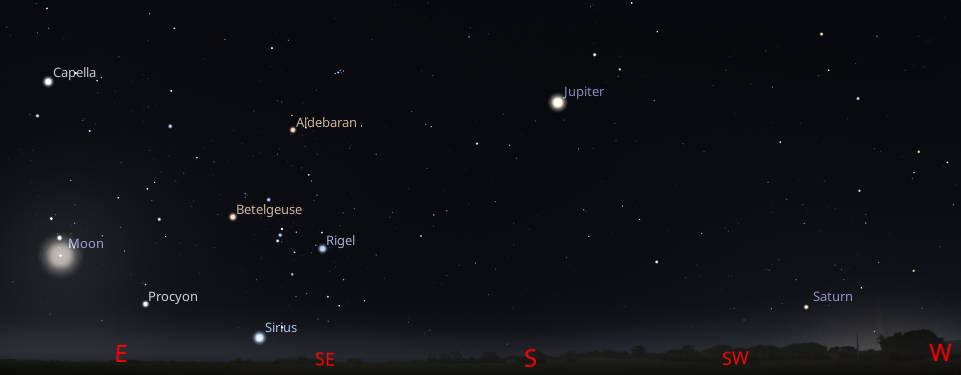
A panorama of the evening sky at 7 pm tonight, January 24, 2024, looking from the east northeast through south to the west to view the Moon, the bright winter stars, Jupiter, in the south, and Saturn, which is close to setting. Click or tap on the image to enlarge it. Created using Stellarium.
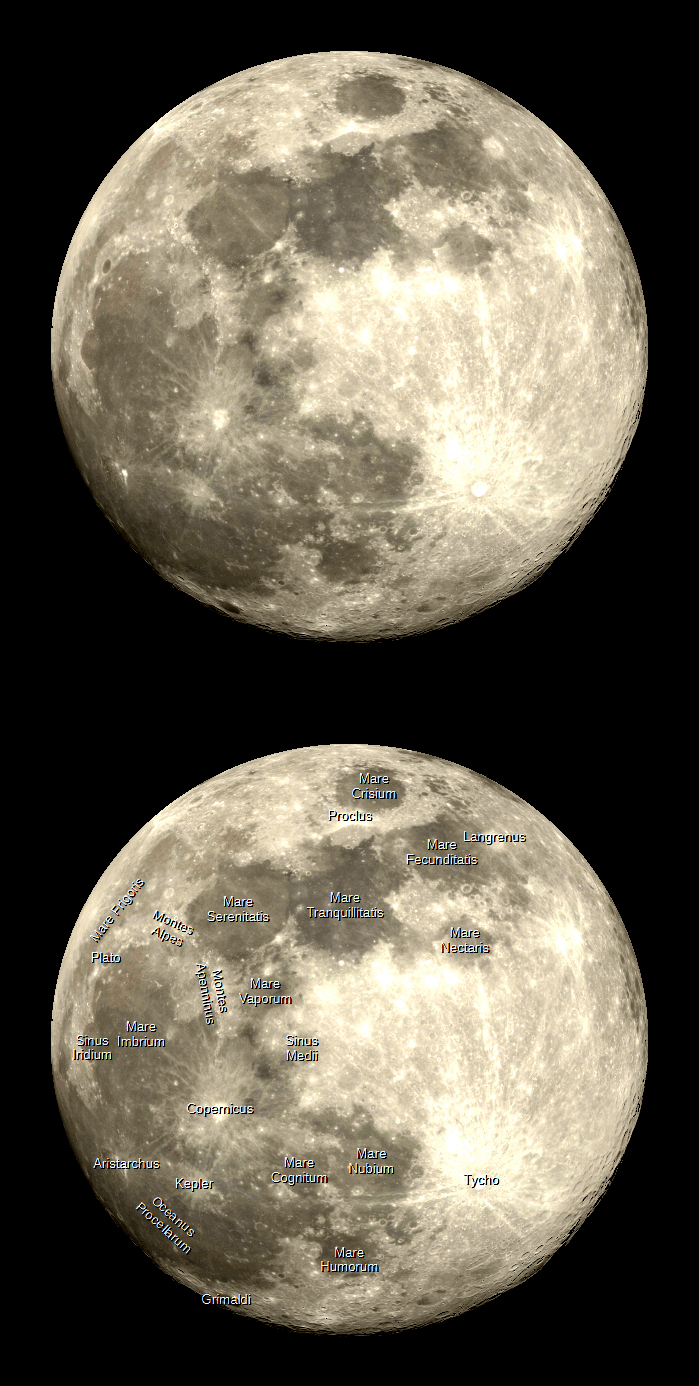
The nearly full moon visible in binoculars or small telescopes at 7 this evening, January 24, 2024, showing very little shadow detail. The Moon being fully lit by the Sun and Earth is looking at the Moon from that the same direction. This allows crater rays to be quite visible. The best example of this is the crater Tycho, to the lower right. Rays are thought to be shallow craters caused by the debris kicked out when the impact of the body that created the crater occurred. They show better at full moon because there are no shadows. Otherwise, there would be shadows in these tiny craters, making the rays less visible. Shadows help us see the bigger craters, but only when there are no shadows do these little ejecta craters show up bright. Click or tap on the image to enlarge it. Created using Stellarium, LibreOffice Draw, and GIMP.
Here are Venus and Mercury as seen about 40 minutes before sunrise. That’s about 7:30 am in the Grand Traverse area of Michigan. There’s a good chance that Mercury will be invisible because it’s seen very low in the growing twilight. Mars, just below and left of Mercury, will pass it this weekend, as Mercury moves towards the Sun and Mars moves away. Venus of course is moving towards the Sun also and Mars will pass it about a month from now. Click or tap on the image to enlarge it. Created using Stellarium.
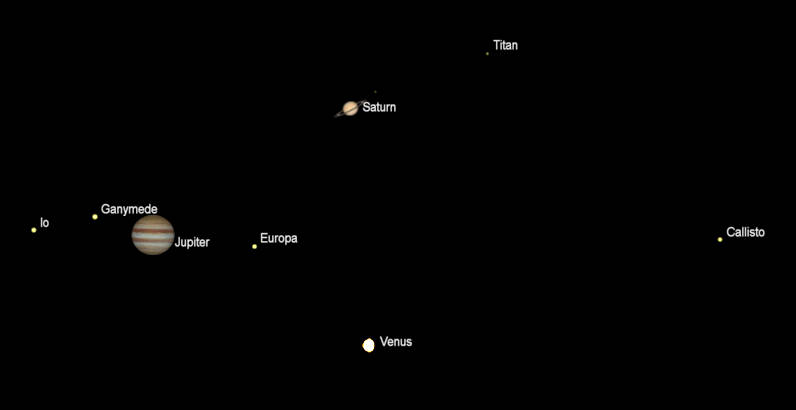
Telescopic Saturn, Jupiter and Venus (north up) as they would be seen in a small telescope, with the same magnification. At 7 pm January 24, 2024, for Saturn and Jupiter, and 7:30 am on the 25th, for Venus. Apparent diameters: Saturn 15.74″, its rings 36.66″; Jupiter 40.61″; and Venus 12.58″, 84.2% illuminated. Mercury appears too small to be shown here, but its apparent diameter is 5.52″ and is 82.5% illuminated. Jupiter’s moon Ganymede will be eclipsed by Jupiter’s shadow and disappear at 7:10 pm, and will emerge from the shadow at 8:53 pm. The ” symbol means seconds of arc (1/3600th of a degree).Click or tap on the image to enlarge it. Created using Cartes du Ciel (Sky Charts) and GIMP.
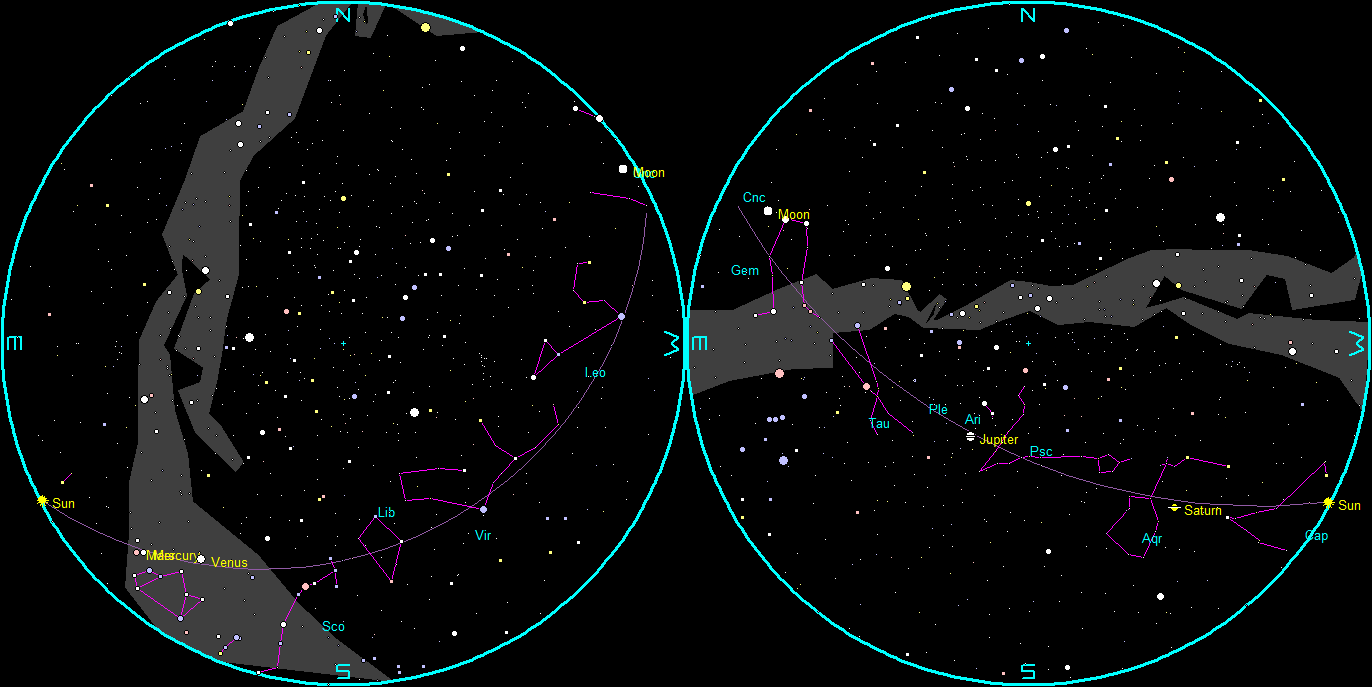
The naked-eye planets and the Moon at sunset and sunrise on a single night, starting with sunset on the right on January 24, 2024. The night ends on the left with sunrise on the 25th. The labels for Mars and Mercury overlap, though the planets do not. Mars is the reddish one. Click or tap on the image to enlarge it. Created using my LookingUp app and GIMP.

 Bob Moler's Ephemeris Blog