Home > Ephemeris Program, Naked-eye planets, Observing, Planets > Ephemeris: 01/31/2024 – Where have the naked-eye planets wandered* off to this week?

Ephemeris: 01/31/2024 – Where have the naked-eye planets wandered* off to this week?

January 31, 2024

This is Ephemeris for Wednesday, January 31st. Today the Sun will be up for 9 hours and 46 minutes, setting at 5:49, and it will rise tomorrow at 8:02. The Moon, 2 days before last quarter, will rise at 11:56 this evening.

Let’s find out where the naked-eye planets have wandered off to this week. Three of those five planets are now visible. Saturn and Jupiter are the evening planets. Saturn is getting harder to spot low in the west-southwest, nearly succumbing to evening twilight, setting at 7:59 pm. Jupiter will move from high in the south to low in the west by midnight, and will set in the west-northwest at 1:20 am. Venus, the brilliant morning star, will rise in the east-southeast at 6:18 am, and be a brilliant beacon in the morning, shining in the southeast before the bright morning twilight claims it around 7:45 am. As we advance through winter into spring Venus is going to be harder to spot before sunrise.

The astronomical event times given are for the Traverse City/Interlochen area of Michigan (EST, UT –5 hours). They may be different for your location.

Addendum
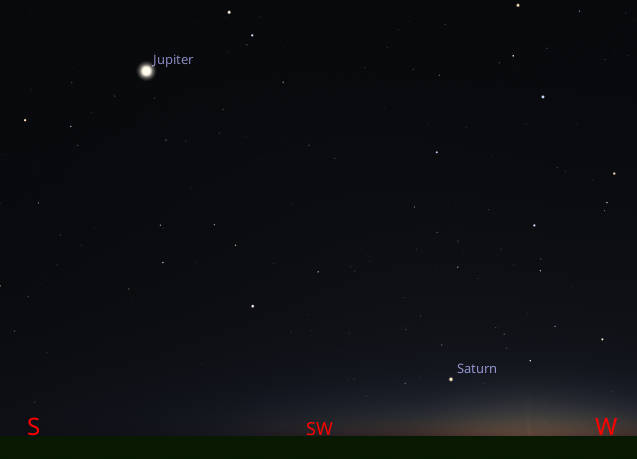
Jupiter and Saturn as they would appear in the southwestern quadrant of the sky around 7 pm or about an hour and a quarter after sunset. Saturn will set an hour later, while Jupiter will last past midnight. Created using Stellarium.
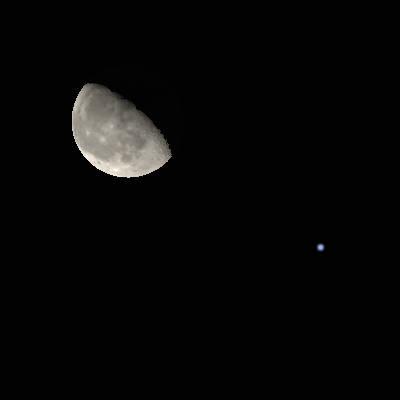
The Moon and the star Spica as they might appear in binoculars or a very low power telescope at 3 am EST (8:00 UT) tomorrow morning, February 1st 2024. The exact position of the Moon with respect to Spica may be different for your longitude as compared to about 86° west longitude where I am. Created using Stellarium.
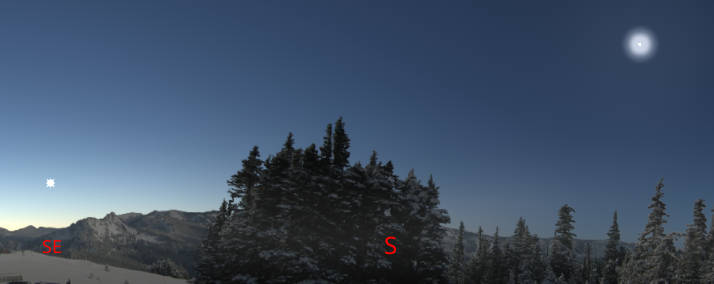
The Morning Star Venus, left, and the last quarter Moon, right, as they might appear about 7:30 am or about half an hour before sunrise February 1st 2024. Created using Stellarium.

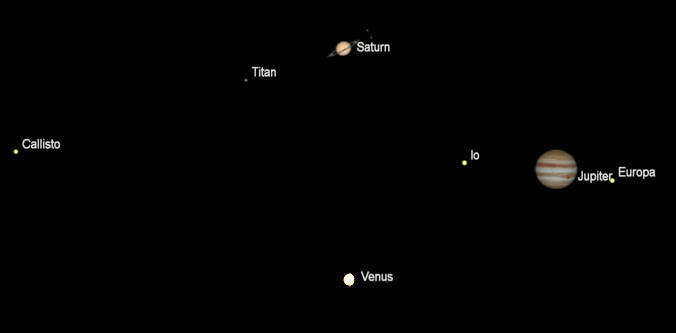
Telescopic Saturn, Jupiter and Venus (north up) as they would be seen in a small telescope, with the same magnification. At 7 pm January 31, 2024, for Saturn and Jupiter, and 7:30 am on February 1st, for Venus. Apparent diameters: Saturn 15.66″, its rings 36.48″; Jupiter 39.69″; and Venus 12.22″, 85.8% illuminated. There are some Jovian satellite events this evening. At about 7:40 pm Ganymede will appear from behind Jupiter. The image shows the Ganymede label. However, the moon will be hidden at 7:00 pm. Then at 11:12 this evening Ganymede will enter Jupiter’s shadow, and stay hidden until 12:54 am tomorrow morning. The ” symbol means seconds of arc (1/3600th of a degree). Click or tap on the image to enlarge it. Created using Cartes du Ciel (Sky Charts) and GIMP.
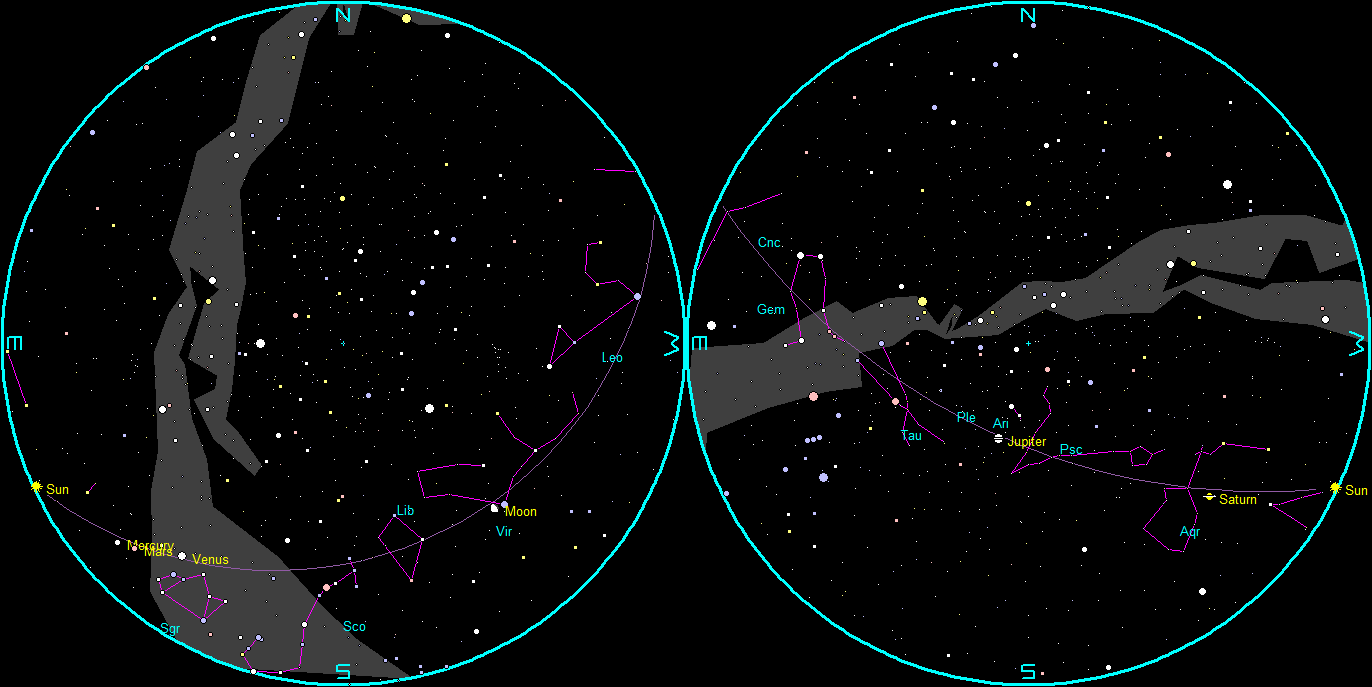
The naked-eye planets and the Moon at sunset and sunrise on a single night, starting with sunset on the right on January 31, 2024. The night ends on the left with sunrise on February 1st. The labels for Mars and Mercury overlap. Click or tap on the image to enlarge it. Created using my LookingUp app and GIMP.

* The Greeks called the moving objects in the sky Planetes meaning Wanderers, from which we get the name Planet. In reality the planets do not wander, or move aimlessly, but move in orbits, discovered by Johannes Kepler, in accordance with the laws of gravitation discovered by Isaac Newton and Albert Einstein. The ancients considered the Sun and Moon planets, because they also moved against the “fixed” stars in the sky. This made seven, adding to the five naked eye planets we know today. These seven objects became the names of the days of the week in many countries. We have retained three of them: Sun’s day, Moon’s day, and Saturn’s day. The rest are named for Norse gods and a goddess.