Home > Ephemeris Program, Naked-eye planets, Observing, Planets > Ephemeris: 02/28/2024 – Where have the naked-eye planets wandered off to this week?

Ephemeris: 02/28/2024 – Where have the naked-eye planets wandered off to this week?

February 28, 2024

This is Ephemeris for Wednesday, February 28th. Today the Sun will be up for 11 hours and 5 minutes, setting at 6:28, and it will rise tomorrow at 7:21. The Moon, halfway from full to last quarter, will rise at 10:52 this evening.

Let’s find out where the naked-eye planets have wandered off to this week, and see what planets are left to see. Saturn, and Mercury are gone, both actually in conjunction with the Sun today. Jupiter will be in the west-southwest at 8 this evening. It will set at 11:47 pm in the west. Jupiter will be visible in the evening for only about two more months. Venus, the morning star, will rise in the east-southeast at 6:27 am, but its brilliance is diminished by the bright twilight and its low position in the sky. It will be very low in the east-southeast at 7 am. Mars might be impossible to spot, being a bit to the right and above Venus. A pair of binoculars, at least, will be needed to spot it in the morning twilight.

The astronomical event times given are for the Traverse City/Interlochen area of Michigan (EST, UT –5 hours). They may be different for your location.

Addendum
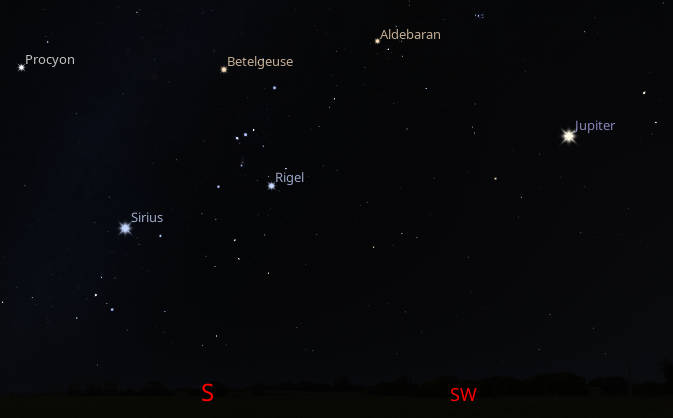
Jupiter and the bright stars of winter as they might appear about 8 pm
Jupiter and the bright stars of winter as they might appear about 8 pm tonight, February 28th 2024. Created using Stellarium.
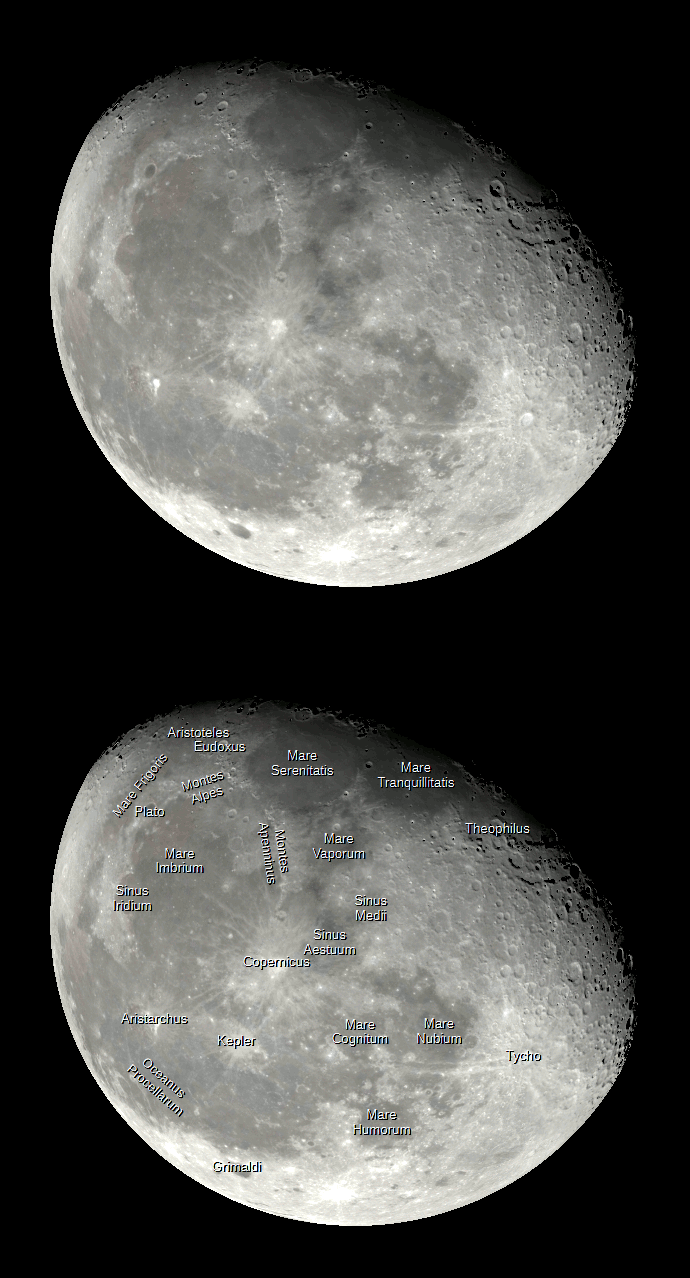
Annotated waning gibbous Moon
The moon is it might appear tonight at midnight a little over an hour after it rises. Selected features are labeled. Click or tap on the image to enlarge it. Created using Stellarium , LibreOffice Draw, and GIMP.
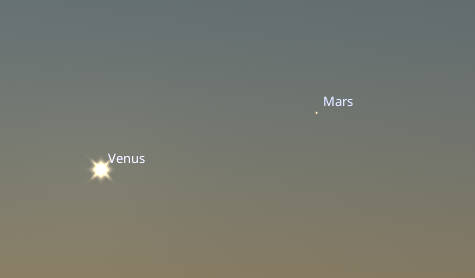
Venus and Mars as they might appear in a pair of binoculars
Venus and Mars as they might appear in a pair of binoculars low in the southeast at 7 am or a bit before, tomorrow morning, February 29th 2024. The planets are about 3° apart, which works out to be six widths of the moon or maybe half the width of the binocular field of view. Created using Stellarium.
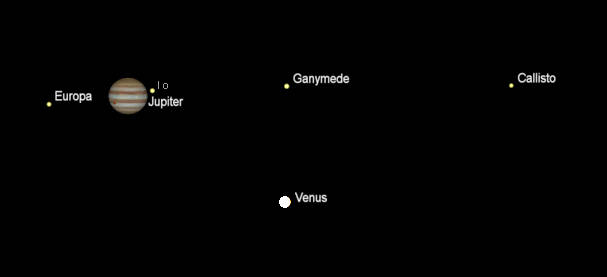
Telescopic Jupiter and Venus
Telescopic Jupiter and Venus (north up) as they would be seen in a small telescope, with the same magnification. At 8 pm EST February 28, 2024, for Jupiter, and 7 am on the 29th for Venus. Apparent diameters: Jupiter 36.53″; and Venus 11.11″, 91.2% illuminated.
Jupiter’s moon Io will pass behind (be occulted by) the planet at 8:17 pm EST. It will reappear at 11:39 pm away from the planet because until then it’ll still be in Jupiter’s shadow.
The ” symbol means seconds of arc (1/3600th of a degree). Created using Cartes du Ciel (Sky Charts) and GIMP.
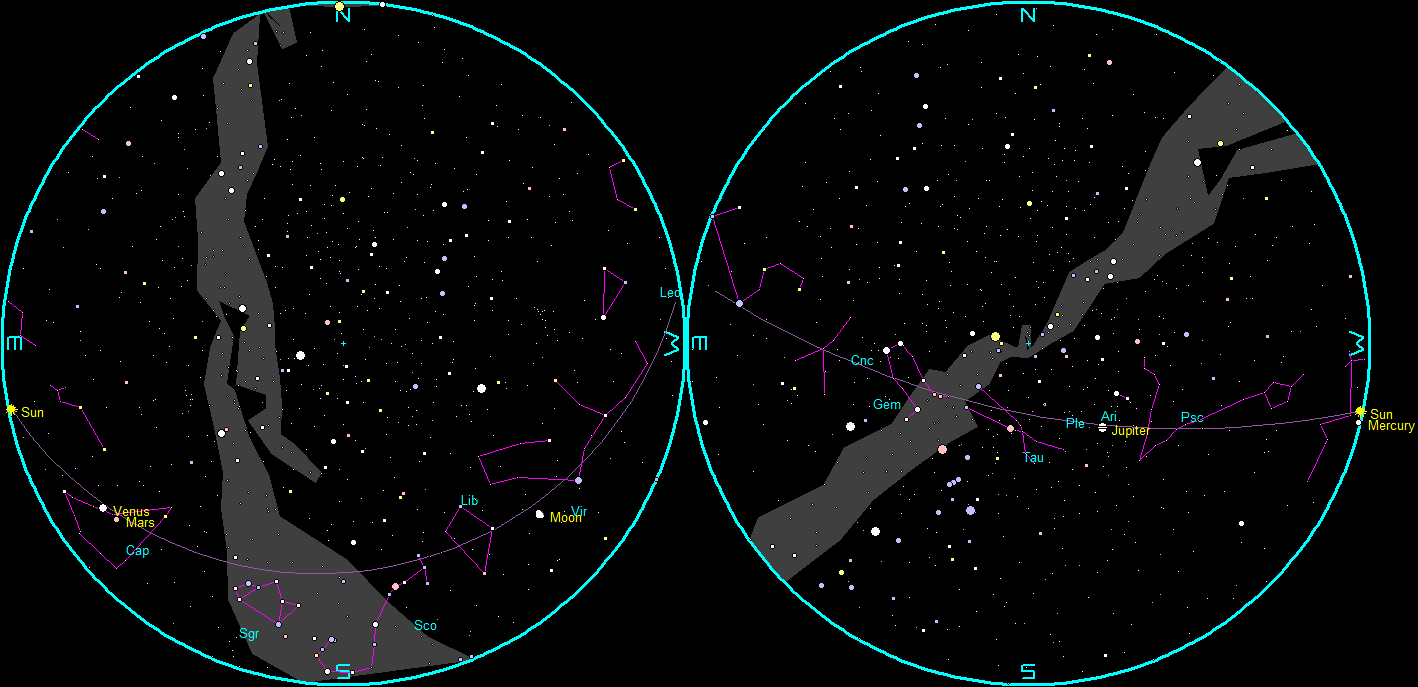
The naked-eye planets and the Moon at sunset and sunrise on a single night
The naked-eye planets and the Moon at sunset and sunrise on a single night, starting with sunset on the right on February 28, 2024. The night ends on the left with sunrise on February 29th. Saturn is not shown because, at solar conjunction it happens to be below the horizon in both views. Click or tap on the image to enlarge it. Created using my LookingUp app and GIMP.