This is Ephemeris for Wednesday, September 25th. Today the Sun will be up for 11 hours and 59 minutes, setting at 7:33, and it will rise tomorrow at 7:35. The Moon, 1 day past last quarter, will rise at 12:53 tomorrow morning.
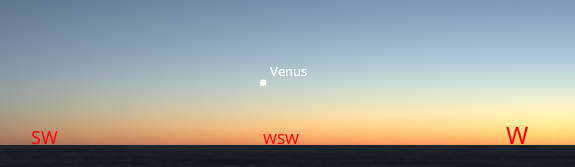
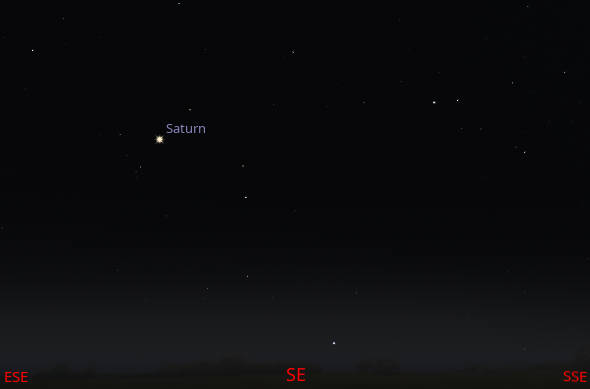
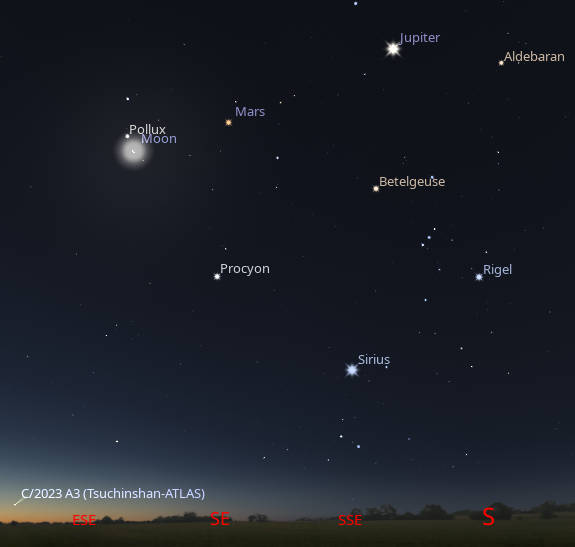
Let’s take our weekly look at the whereabouts of the naked-eye planets. Venus might be spotted in the West southwest only 6° above the horizon at 8 PM, 30 minutes after sunset. It will set at 8:38. Saturn will be low in the east-southeast at that time, but you might have to wait another half hour for it to appear. Saturn may look disappointing in telescopes this year since its rings are nearly edge on and appearing as a line through the planet like it’s stapled onto the sky. Jupiter and Mars will be up in the morning sky, with Jupiter rising about 11 PM now and by 6:30 AM tomorrow, Jupiter will be brighter than the winter stars in the south-southeast. Mars and the Moon will be left and below Jupiter.
The astronomical event times given are for the Traverse City/Interlochen area of Michigan (EDT, UT – 4 hours). Times will be different for other locations.
Addendum
Venus in evening twilight, approximately 30 minutes after sunset. For the Grand Traverse area of Michigan that would be about 8 PM, where Venus is very close to the horizon, due to the low angle of the ecliptic. Created using Stellarium.
Saturn in the southeastern sky by 9 pm. Created using Stellarium.
The morning planets Jupiter, Mars and the Moon are seen among the winter stars at 6:45 AM or about an hour before sunrise in the South southeast. Though Comet Tsuchinshan-ATLAS ia shown, it is too low and faint to be able to spot. Created using Stellarium.
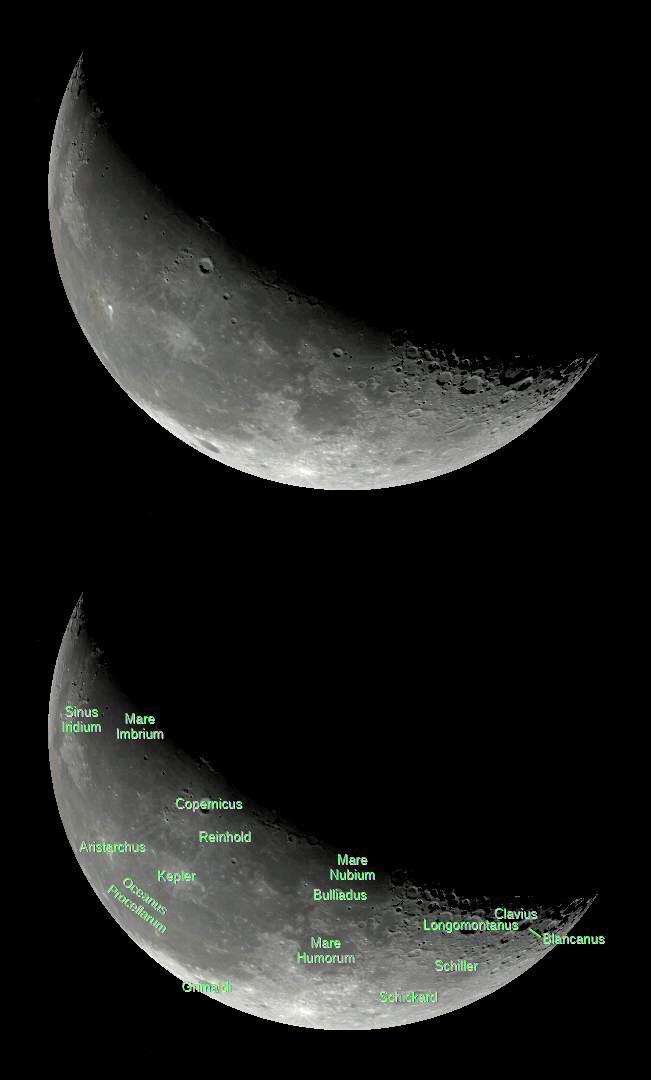
The Moon two days past last quarter. Selected features are labeled. Created using Stellarium, LibreOffice Draw, and GIMP.
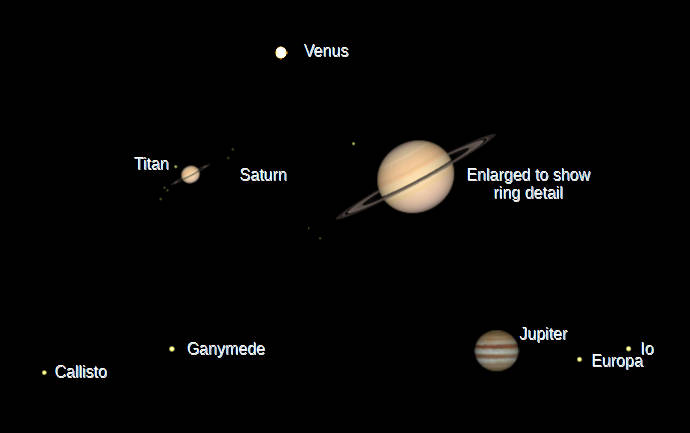
Telescopic Venus, Saturn and Jupiter (north up) as they would be seen in a small telescope with the same magnification. Venus and Saturn are from the evening of the 25th 2024, Jupiter is for 6:45 am on the 26th. Apparent diameters: Venus 12.0″, 86.1% illuminated; Saturn 19.0″, its rings 44.5″, 4.4 degrees from edge on (opening up a bit); Jupiter 41.6″; Mars, too small to be represented here, is 7.4″. Saturn’s rings are actually much brighter than depicted here. The ” means seconds of arc, or 1/3600th of a degree. Click or tap on the image to enlarge it. Created using Cartes du Ciel (Sky Charts).
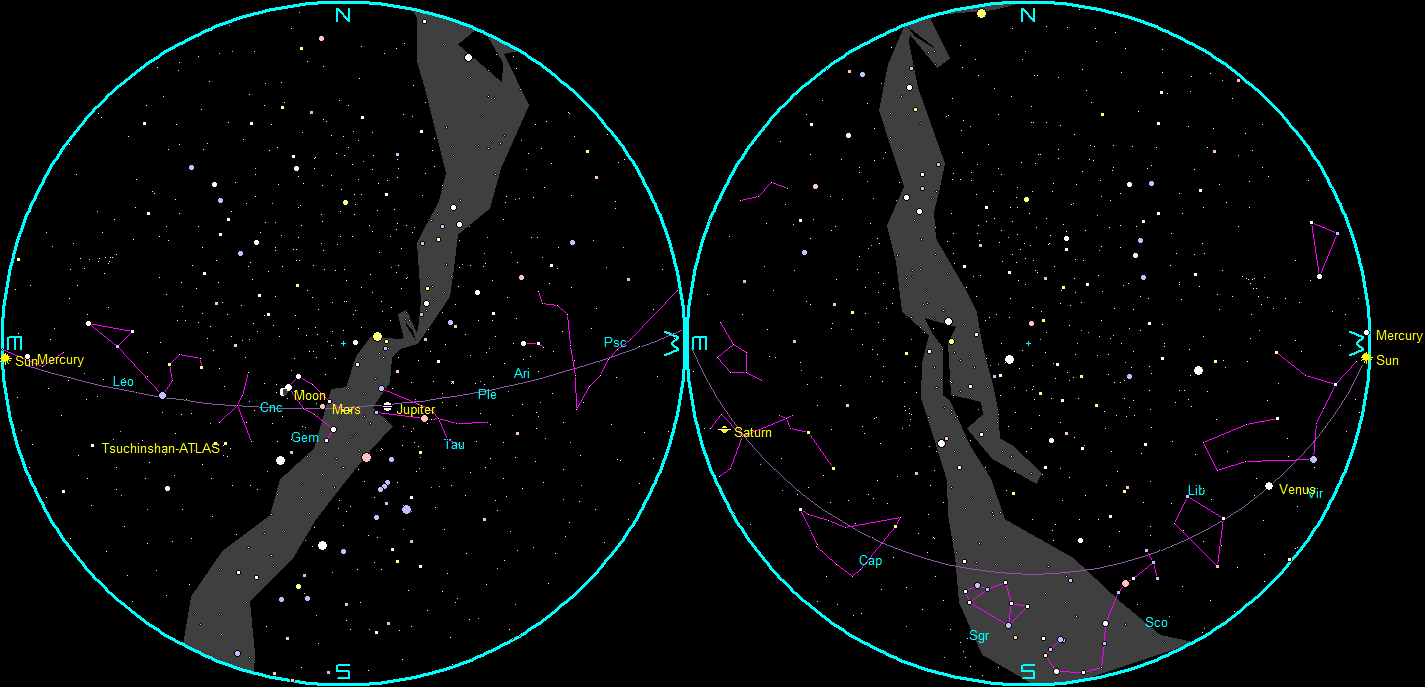
The naked-eye planets and the Moon at sunset and sunrise on a single night, starting with sunset on the right on September 25, 2024. The night ends on the left with sunrise on the 26th. Comet Tsuchinshan-ATLAS is moving northeastward in the sky. Click or tap on the image to enlarge it. Created using my LookingUp app and GIMP.
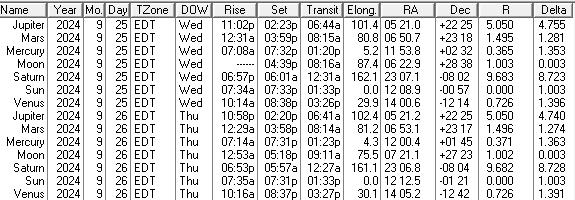
This is a low precision ephemeris of the Sun Moon and naked eye planet positions for today and tomorrow, September 25 and 26, 2024. Some of the columns are self-explanatory, others not. The transit column is the time that the body crosses the meridian and is due south. Elong, for elongation, is the angle between the Sun and that body. RA is right ascension, which is the object’s east-west position on the celestial sphere in hours and minutes. Dec is declination which is the north-south position of the object on the celestial sphere in degrees and minutes. R is the distance of that object from the Sun in astronomical units. An astronomical unit is about 93 million miles or 150 million kilometers. And Delta is the distance of that object from the Earth, also in astronomical units. I omit the ‘m’ in am and pm for compactness. The data was generated using my LookingUp for DOS app and displayed as a table by my Ephemeris Helper app.
 Bob Moler's Ephemeris Blog