Archive
Ephemeris: 10/31/2024 – Previewing November skies
This is Ephemeris for Halloween, Thursday, October 31st. The Sun will rise at 8:20. It’ll be up for 10 hours and 11 minutes, setting at 6:32. The Moon, 1 day before new, will rise at 8:34 tomorrow morning.
The month of November is one of early sunsets, especially with the return to standard time this Sunday, and shortening of daylight hours. Daylight hours will decrease from 10 hours 9 minutes tomorrow the 1st to 9 hours 4 minutes at month’s end. The altitude of the Sun above the southern horizon at local noon, which will drop from 31 degrees to 23½ degrees over the month. Apparent local noon this month will be around 12:30 PM. The sunset time on the 30th will be only 2 minutes later than the earliest sunset of the year. The sunrise time on the 30th will still have 22 minutes and a month to go until the latest sunrise. The Leonid meteor shower will have a peak on the morning of 17th with the Moon a day and a half past full spoiling the show. We are about 9 years away from the next Leonid meteor storm.
The astronomical event times given are for the Traverse City/Interlochen area of Michigan (EDT, UT – 4 hours). Times will be different for other locations.
Addendum
November Evening Star Chart
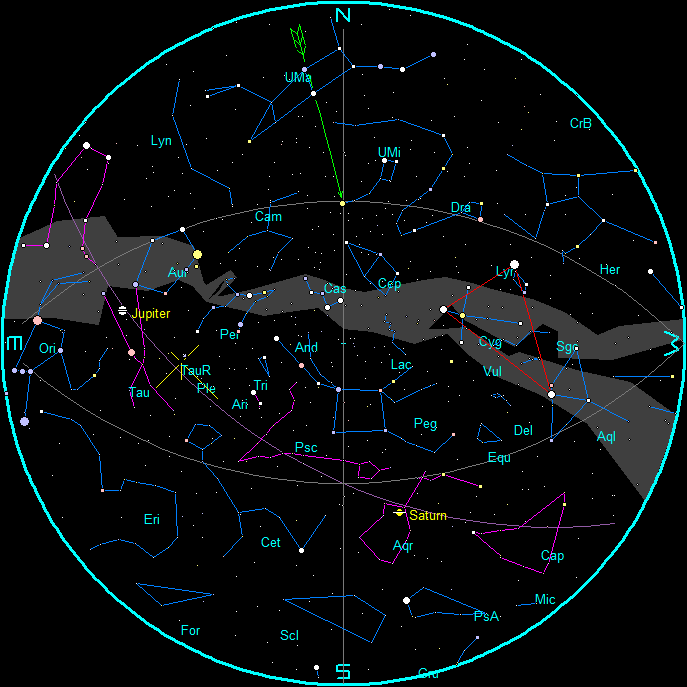
The planets and stars are plotted for the 15th at 9 p.m. EST in the evening and 6 a.m. for the morning chart. These are the chart times. Note that Traverse City is located approximately 45 minutes behind our time meridian, West 75° longitude. (An hour 45 minutes behind our daylight saving time meridian during EDT). To duplicate the star positions on a planisphere you may have to set it to 45 minutes earlier than the current time.
November Morning Star Chart
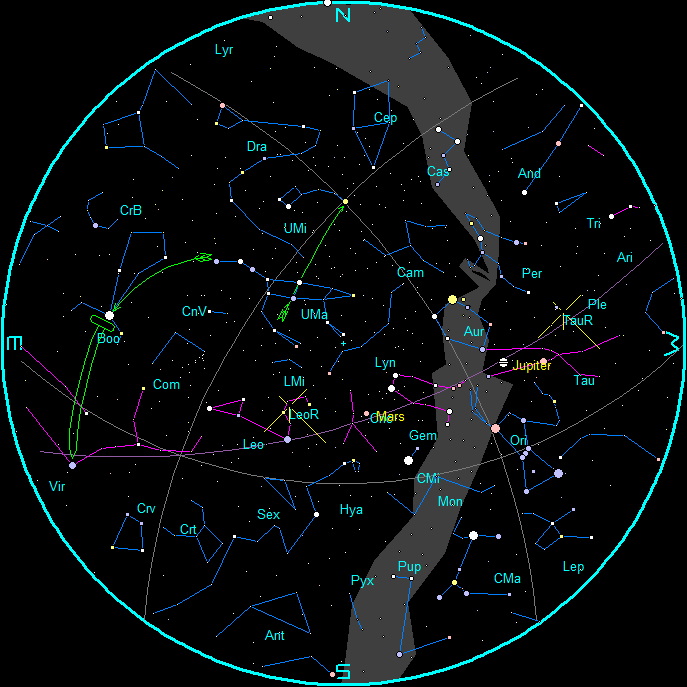
For a list of constellation names to go with the abbreviations, click here.
- Pointer stars at the front of the bowl of the Big Dipper point to Polaris, the North Star.
- Follow the arc of the handle of the Big Dipper to the star Arcturus
- The Summer Triangle is in red.
- TauR on the evening star chart can be used as the radiant for the North and South Taurid meteor showers. For dates see NASA Calendar of Planetary Events below
- LeoR on the morning star chart is the radiant of the Leonid meteor shower, which peaks on the morning of the 17th.
Twilight Limits, Nautical and Astronomical
| EDT | |||||||
| Morning | Twilight | Evening | Twilight | Dark | Night | Moon | |
| Date | Astro. | Nautical | Nautical | Astro. | Start | End | Illum. |
| 2024-11-01 | 6h44m | 7h18m | 19h35m | 20h13m | 20h13m | 6h44m | 0.00 |
| 2024-11-02 | 6h45m | 7h19m | 19h34m | 20h12m | 20h12m | 6h45m | 0.03 |
| EST | |||||||
| 2024-11-03 | 5h46m | 6h20m | 18h32m | 19h10m | 19h10m | 5h46m | 0.07 |
| 2024-11-04 | 5h47m | 6h21m | 18h31m | 19h09m | 19h09m | 5h47m | 0.13 |
| 2024-11-05 | 5h49m | 6h23m | 18h30m | 19h08m | 19h52m | 5h49m | 0.20 |
| 2024-11-06 | 5h50m | 6h24m | 18h29m | 19h07m | 20h56m | 5h50m | 0.29 |
| 2024-11-07 | 5h51m | 6h25m | 18h28m | 19h06m | 22h08m | 5h51m | 0.39 |
| 2024-11-08 | 5h52m | 6h26m | 18h27m | 19h05m | 23h25m | 5h52m | 0.50 |
| 2024-11-09 | 5h53m | 6h27m | 18h26m | 19h04m | – | 5h53m | 0.61 |
| 2024-11-10 | 5h54m | 6h29m | 18h25m | 19h03m | 0h42m | 5h54m | 0.72 |
| 2024-11-11 | 5h56m | 6h30m | 18h24m | 19h02m | 2h00m | 5h56m | 0.81 |
| 2024-11-12 | 5h57m | 6h31m | 18h23m | 19h01m | 3h19m | 5h57m | 0.90 |
| 2024-11-13 | 5h58m | 6h32m | 18h22m | 19h00m | 4h40m | 5h58m | 0.96 |
| 2024-11-14 | 5h59m | 6h33m | 18h21m | 18h56m | – | – | 0.99 |
| 2024-11-15 | 6h00m | 6h35m | 18h20m | 18h55m | – | – | 1.00 |
| 2024-11-16 | 6h01m | 6h36m | 18h20m | 18h54m | – | – | 0.98 |
| 2024-11-17 | 6h02m | 6h37m | 18h19m | 18h53m | – | – | 0.93 |
| 2024-11-18 | 6h03m | 6h38m | 18h18m | 18h53m | 18h53m | 19h22m | 0.86 |
| 2024-11-19 | 6h05m | 6h39m | 18h17m | 18h52m | 18h52m | 20h33m | 0.78 |
| 2024-11-20 | 6h06m | 6h40m | 18h17m | 18h51m | 18h51m | 21h45m | 0.68 |
| 2024-11-21 | 6h07m | 6h41m | 18h16m | 18h51m | 18h51m | 22h56m | 0.59 |
| 2024-11-22 | 6h08m | 6h43m | 18h15m | 18h50m | 18h50m | – | 0.49 |
| 2024-11-23 | 6h09m | 6h44m | 18h15m | 18h50m | 18h50m | 0h04m | 0.39 |
| 2024-11-24 | 6h10m | 6h45m | 18h14m | 18h49m | 18h49m | 1h09m | 0.30 |
| 2024-11-25 | 6h11m | 6h46m | 18h14m | 18h49m | 18h49m | 2h12m | 0.22 |
| 2024-11-26 | 6h12m | 6h47m | 18h14m | 18h48m | 18h48m | 3h15m | 0.15 |
| 2024-11-27 | 6h13m | 6h48m | 18h13m | 18h48m | 18h48m | 4h18m | 0.09 |
| 2024-11-28 | 6h14m | 6h49m | 18h13m | 18h48m | 18h48m | 5h23m | 0.04 |
| 2024-11-29 | 6h15m | 6h50m | 18h12m | 18h47m | 18h47m | 6h15m | 0.01 |
| 2024-11-30 | 6h16m | 6h51m | 18h12m | 18h47m | 18h47m | 6h16m | 0.00 |
Twilight calendar was generated using Cartes du Ciel (Sky Charts).
See my blog post: Twilight Zone for the definitions of the different periods of twilight here: https://bobmoler.wordpress.com/2018/09/27/.
NASA Calendar of Planetary Events
Date         Time     Event
Nov  1  Fr            Venus: 38.2° E
     1  Fr   7:47 am  New Moon
     3  Su   7:26 pm  Moon-Antares:  .1° N
     4  Mo   7:16 pm  Moon-Venus: 3.4° N
     5  Tu   1:26 am  South Taurid Shower: ZHR = 10
     5  Tu  12:18 pm  Moon South Dec.: 28.6° S
     9  Sa  12:56 am  First Quarter
     9  Sa  11:24 pm  Mercury-Antares: 2° N
    10  Su   8:36 pm  Moon-Saturn:  .1° S
    12  Tu  12:43 am  North Taurid Shower: ZHR = 15
    12  Tu  10:59 am  Moon Ascending Node
    14  Th   6:18 am  Moon Perigee: 360100 km
    15  Fr   4:29 pm  Full Moon
    16  Sa   1:59 am  Moon-Pleiades:  .1° S
    16  Sa   2:59 am  Mercury Elongation: 22.5° E
    16  Sa   9:48 pm  Uranus Opposition
    17  Su   7:01 am  Leonid Shower: ZHR = 15
    18  Mo   5:22 am  Moon North Dec.: 28.5° N
    19  Tu   9:07 pm  Moon-Pollux: 1.9° N
    20  We   4:07 pm  Moon-Mars: 2.6° S
    20  We   8:48 pm  Moon-Beehive: 3.1° S
    22  Fr   3:48 pm  Moon-Regulus: 3° S
    22  Fr   8:28 pm  Last Quarter
    25  Mo   4:31 pm  Moon Descending Node
    26  Tu   6:56 am  Moon Apogee: 405300 km
    27  We   6:33 am  Moon-Spica:  .5° S
Dec  1  Su            Venus: 43.6° E
All event times for November 1 & 2 are given for UTC-4 Eastern Daylight Saving Time. For dates after that, times are given for UTC-5 Eastern Standard Time.
Sky Events Calendar by Fred Espenak and Sumit Dutta (NASA’s GSFC),
http://eclipse.gsfc.nasa.gov/SKYCAL/SKYCAL.html.
If you go to the above site, you can print out a list like the above for the entire year or calendar pages for your time zone.
Sun and Moon Rising and Setting Times
LU               Ephemeris of Sky Events for Interlochen/TC
November, 2024    Local time zone: EDT
+-----------------------------------------------------------------------+
| DATE |  SUN     SUN  DAYLIGHT|   TWILIGHT*    |MOON  RISE OR    ILLUM |
|      |  RISE    SET    HOURS |  END    START  |PHASE SET** TIME FRACTN|
+=======================================================================+
|Fri  1| 08:21a  06:30p  10:09 | 07:35p  07:16a |New   Set  06:18p    0%|
|Sat  2| 08:22a  06:29p  10:06 | 07:34p  07:17a |      Set  06:43p    2%|
+------+-----------------------+----------------+-----------------------+
| EST  |      Time Change      |                |                       |
|Sun  3| 07:24a  05:27p  10:03 | 06:33p  06:18a |      Set  06:16p    6%|
|Mon  4| 07:25a  05:26p  10:01 | 06:32p  06:20a |      Set  06:58p   11%|
|Tue  5| 07:26a  05:25p  09:58 | 06:30p  06:21a |      Set  07:51p   18%|
|Wed  6| 07:28a  05:24p  09:55 | 06:29p  06:22a |      Set  08:56p   27%|
|Thu  7| 07:29a  05:22p  09:53 | 06:28p  06:23a |      Set  10:08p   37%|
|Fri  8| 07:31a  05:21p  09:50 | 06:27p  06:25a |      Set  11:24p   47%|
|Sat  9| 07:32a  05:20p  09:48 | 06:26p  06:26a |F Qtr Set  12:42a   58%|
+------+-----------------------+----------------+-----------------------+
|Sun 10| 07:33a  05:19p  09:45 | 06:25p  06:27a |      Set  02:00a   69%|
|Mon 11| 07:35a  05:18p  09:43 | 06:24p  06:28a |      Set  03:19a   79%|
|Tue 12| 07:36a  05:17p  09:40 | 06:23p  06:29a |      Set  04:39a   88%|
|Wed 13| 07:37a  05:16p  09:38 | 06:22p  06:31a |      Set  06:03a   95%|
|Thu 14| 07:39a  05:15p  09:35 | 06:22p  06:32a |      Set  07:28a   99%|
|Fri 15| 07:40a  05:14p  09:33 | 06:21p  06:33a |Full  Rise 04:48p  100%|
|Sat 16| 07:41a  05:13p  09:31 | 06:20p  06:34a |      Rise 05:28p   98%|
+------+-----------------------+----------------+-----------------------+
|Sun 17| 07:43a  05:12p  09:29 | 06:19p  06:35a |      Rise 06:19p   94%|
|Mon 18| 07:44a  05:11p  09:26 | 06:18p  06:36a |      Rise 07:22p   87%|
|Tue 19| 07:45a  05:10p  09:24 | 06:18p  06:38a |      Rise 08:32p   79%|
|Wed 20| 07:47a  05:09p  09:22 | 06:17p  06:39a |      Rise 09:45p   70%|
|Thu 21| 07:48a  05:08p  09:20 | 06:16p  06:40a |      Rise 10:56p   60%|
|Fri 22| 07:49a  05:08p  09:18 | 06:16p  06:41a |L Qtr Rise 12:04a   51%|
|Sat 23| 07:50a  05:07p  09:16 | 06:15p  06:42a |      Rise 01:09a   41%|
+------+-----------------------+----------------+-----------------------+
|Sun 24| 07:52a  05:06p  09:14 | 06:15p  06:43a |      Rise 02:12a   32%|
|Mon 25| 07:53a  05:06p  09:12 | 06:14p  06:44a |      Rise 03:15a   24%|
|Tue 26| 07:54a  05:05p  09:11 | 06:14p  06:45a |      Rise 04:18a   16%|
|Wed 27| 07:55a  05:05p  09:09 | 06:14p  06:46a |      Rise 05:23a   10%|
|Thu 28| 07:57a  05:04p  09:07 | 06:13p  06:48a |      Rise 06:30a    5%|
|Fri 29| 07:58a  05:04p  09:05 | 06:13p  06:49a |      Rise 07:39a    2%|
|Sat 30| 07:59a  05:03p  09:04 | 06:13p  06:50a |      Rise 08:47a    0%|
+-----------------------------------------------------------------------+
* Nautical Twilight
** Moonrise or moonset, whichever occurs between sunset and sunrise
Generated using my LookingUp for DOS program.
Ephemeris: 10/30/2024 – Our weekly look at the whereabouts of the naked-eye planets
This is Ephemeris for Wednesday, October 30th. Today the Sun will be up for 10 hours and 14 minutes, setting at 6:33, and it will rise tomorrow at 8:20. The Moon, 2 days before new, will rise at 7:28 tomorrow morning.
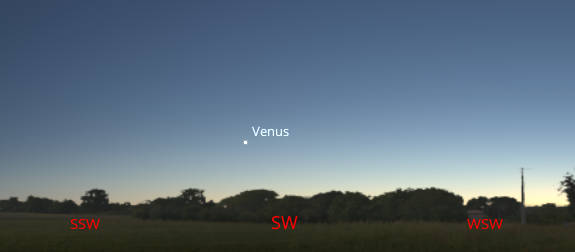
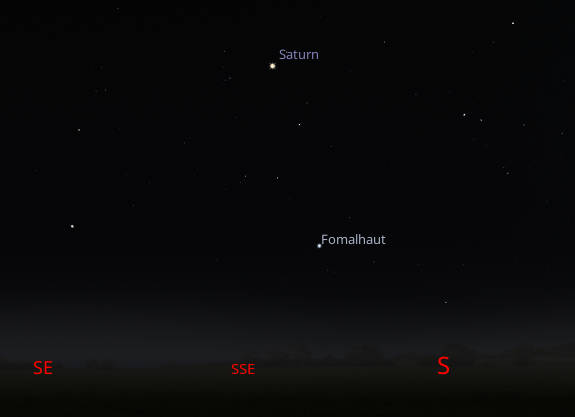
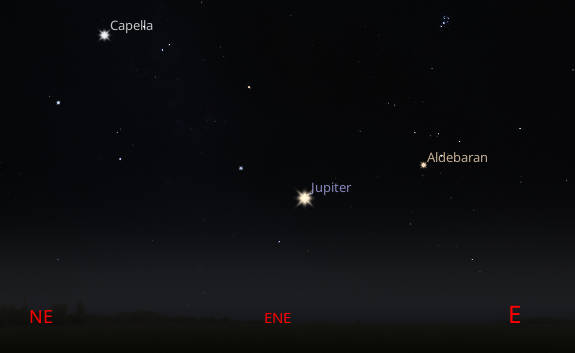
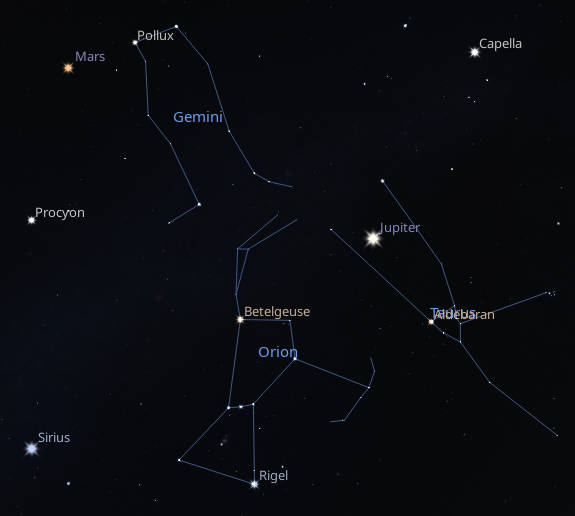
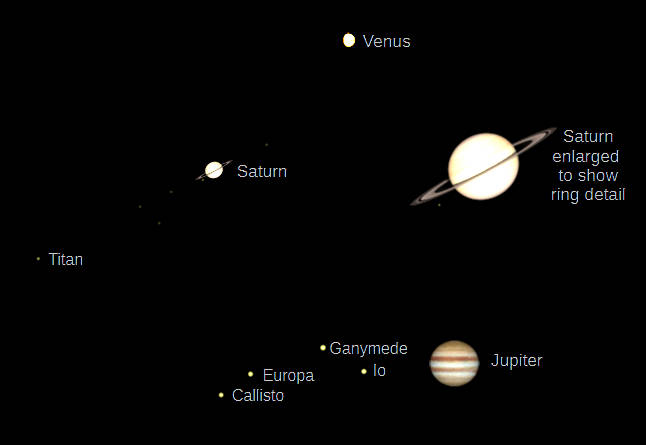
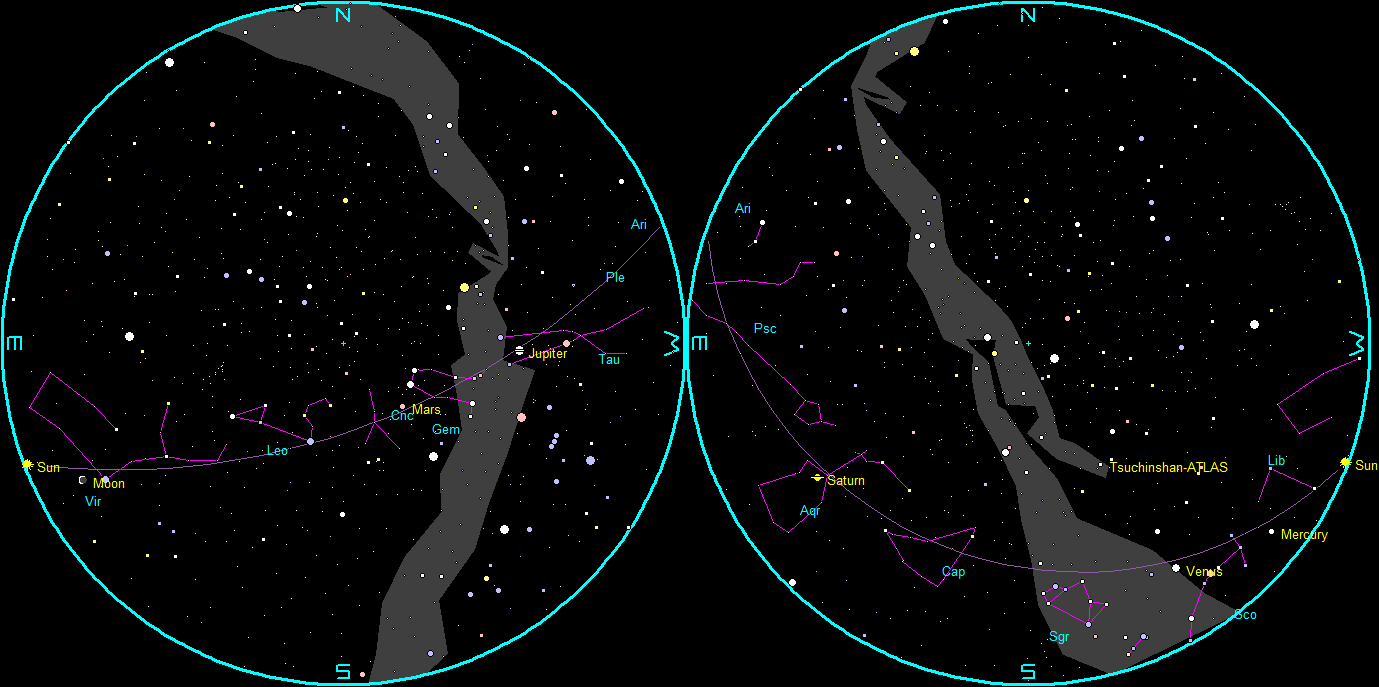
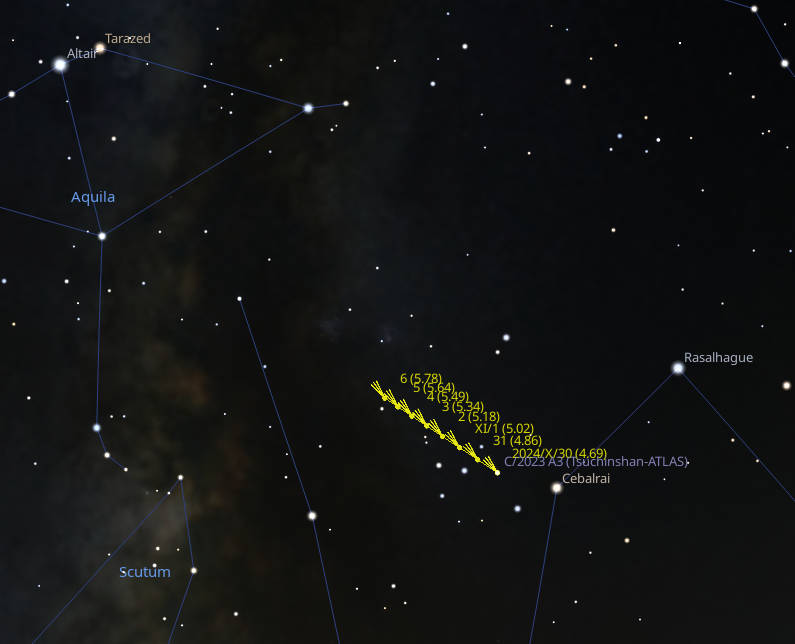
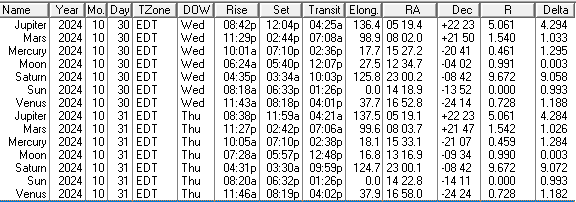
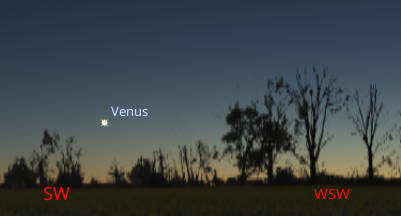
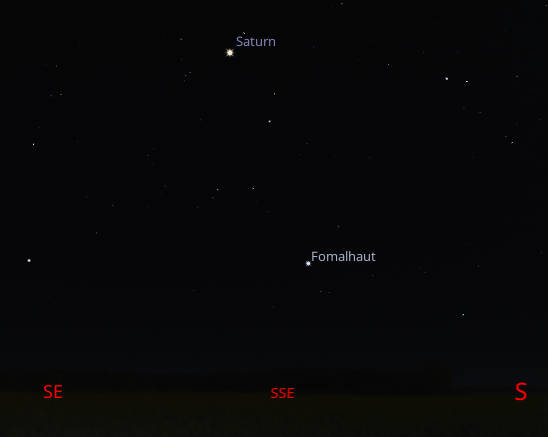
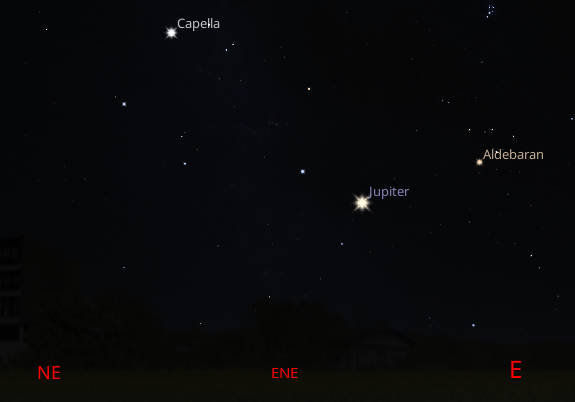
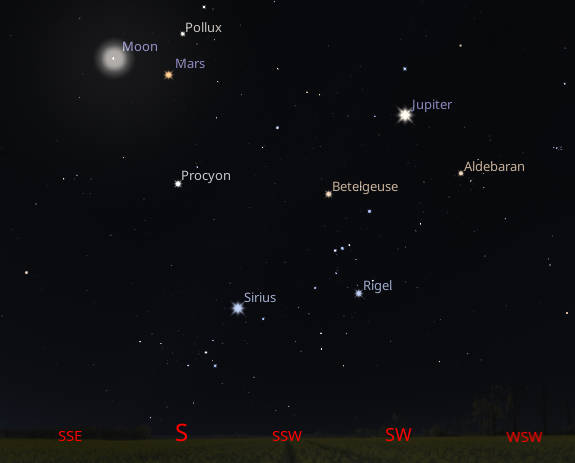
Let’s take our weekly look at the whereabouts of the naked-eye planets. Venus can be spotted low in the southwestern sky by 7 PM, about half an hour after sunset. It will set at 8:18. Comet Tsuchinshan-ATLAS is definitely a binocular object and will be a third of the way up to the zenith in the southwest around 8 PM. It will set at 11:17 PM. Saturn will be in the southeast at 8 PM. Jupiter will rise at 8:42 PM in the east northeast, and be a good object for the small telescope about an hour later. By 7:00 AM tomorrow Jupiter will be high in the west southwest, among the winter stars, while Mars, which rises tonight near 11:30, will be high in the south.
The astronomical event times given are for the Traverse City/Interlochen area of Michigan (EDT, UT – 4 hours). Times will be different for other locations.
Addendum
Ephemeris: 10/29/2024 – A star for Halloween
This is Ephemeris for Tuesday, October 29th. Today the Sun will be up for 10 hours and 17 minutes, setting at 6:34, and it will rise tomorrow at 8:18. The Moon, 3 days before new, will rise at 6:24 tomorrow morning.
Not all the ghosts and goblins out Thursday night will be children. One is out every night because it’s a star. Its name is Algol, from the Arabic for Ghoul or Demon Star. It’s normally the second-brightest star in the constellation Perseus the hero, visible in the northeast this evening. The star is located where artists have drawn the severed head of Medusa, whom he had slain. Medusa had snakes for hair so that she turned all who gazed upon her to stone. Algol is her still glittering eye. The star got this name before astronomers found out what was really wrong with it. They found out that it does a slow wink every two days, 21 hours, because it is two stars that eclipse each other. Her next 9-hour wink, is centered at 2 AM Halloween morning.
The astronomical event times given are for the Traverse City/Interlochen area of Michigan (EDT, UT – 4 hours). Times will be different for other locations.
Addendum
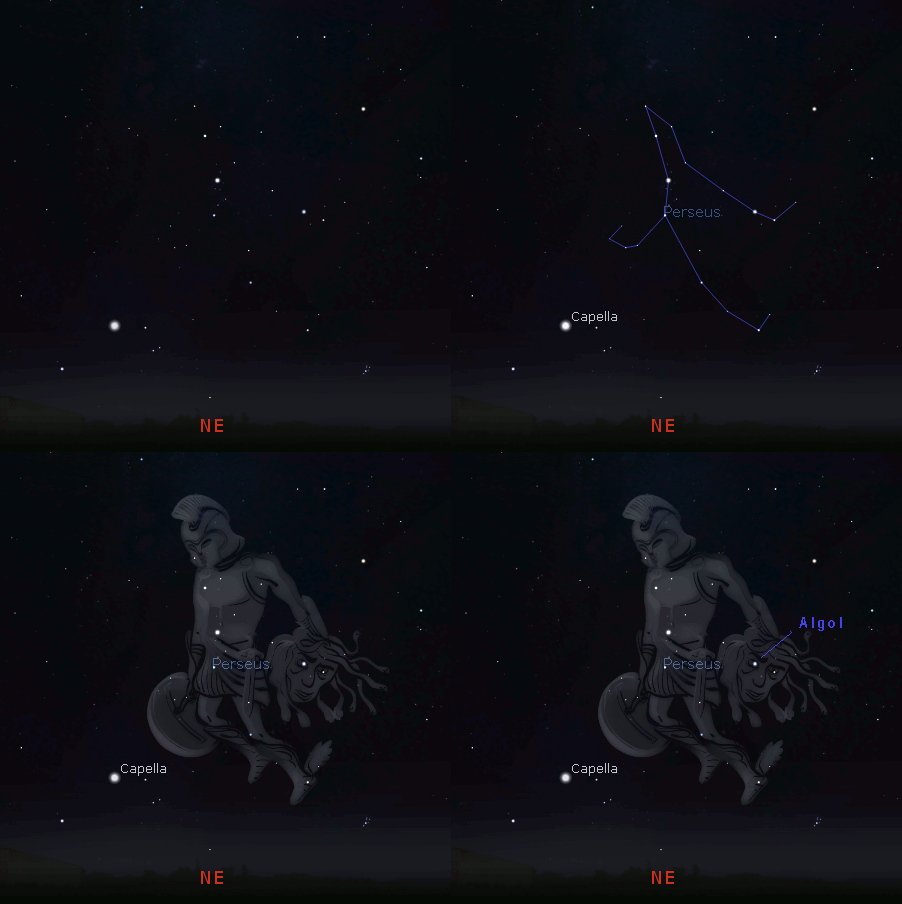
Stellarium tends to show variable stars and a brightness about halfway between the brightest and dimmest magnitudes. However, Algol stays at its peak brightness most of the time, so it usually appears as bright as Mirfak which, in the image above, is to its upper left. It’s only during the eclipse that it appears dimmer than Mirfak. That’s how you can tell that Algol is in eclipse.
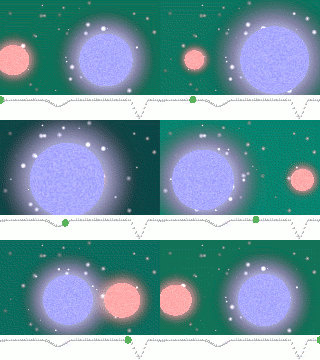
Here is where to go to find out when Algol is going to be in eclipse in the next week or so: http://www.astropical.space/algol.php
Ephemeris: 10/28/2024 – The Pleiades or Seven Sisters and their half sisters
This is Ephemeris for Monday, October 28th. Today the Sun will be up for 10 hours and 20 minutes, setting at 6:36, and it will rise tomorrow at 8:17. The Moon, halfway from last quarter to new, will rise at 5:22 tomorrow morning.
The beautiful star cluster of the Pleiades is seen low in the east northeastern sky after 9:00 PM. It is also known as the Seven Sisters. It has been known as a group of female stars in many cultures. Also, the Ancient Greeks, because they thought that the Pleiades shape looked something like a sail, Also, Pleiades is very close to the Greek name for sail, and that its appearance in the morning sky in early summer heralded the beginning of the summer sailing season on the Mediterranean Sea. According to Greek mythology the Pleiades have half sisters, also seven in number, with the same father, Atlas, but a different mother, called the Hyades which rises about an hour later, and fills out the face of Taurus the bull.
The astronomical event times given are for the Traverse City/Interlochen area of Michigan (EDT, UT – 4 hours). Times will be different for other locations.
Addendum
Ephemeris: 10/25/2024 – Finding the Pleiades or Seven Sisters
This is Ephemeris for Friday, October 25th. Today the Sun will be up for 10 hours and 28 minutes, setting at 6:40, and it will rise tomorrow at 8:13. The Moon, 1 day past last quarter, will rise at 2:09 tomorrow morning.
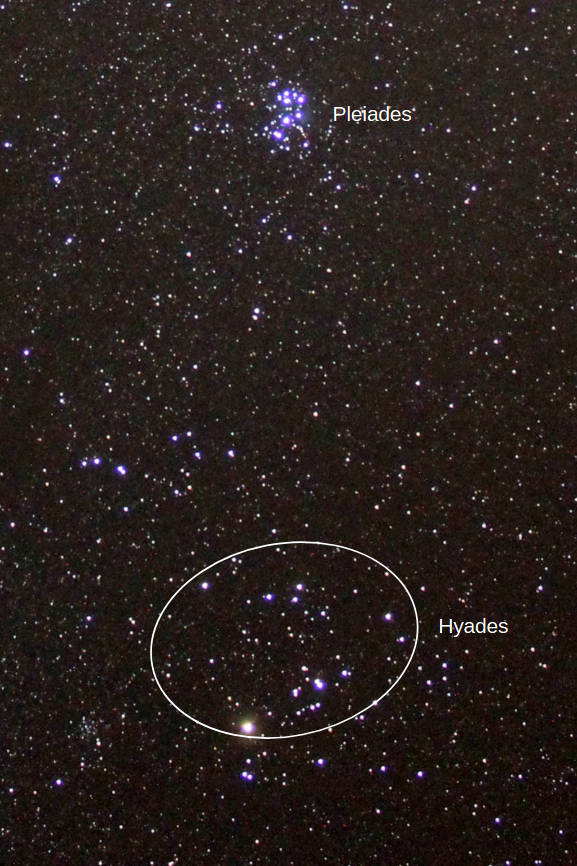
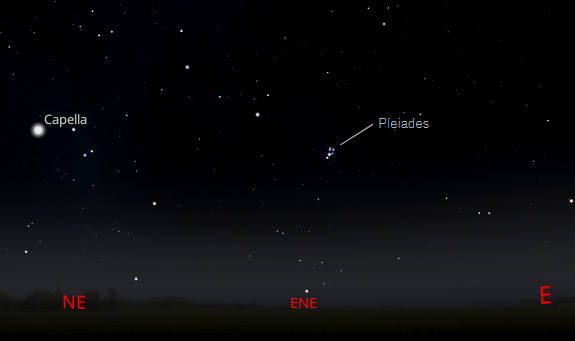
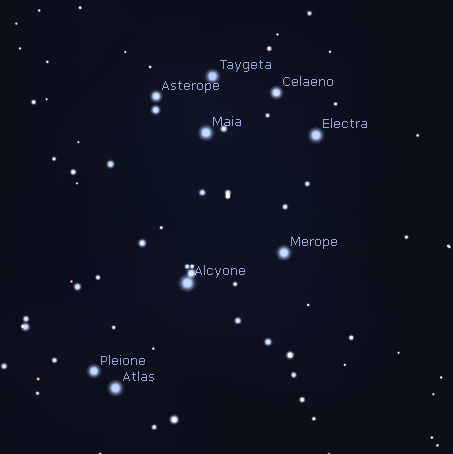
A marvelous member of the autumn skies can be found low in the east northeast after 9 in the evening. It is the famous star cluster called the Pleiades or the Seven Sisters. I might also add the ‘Tiny Dipper’. Many people can spot a tiny dipper shape in its six or seven stars, and mistake it for the Little Dipper. With binoculars, one can see over a hundred stars that appear, along with the dipper shape of the brightest. In photographs, the Pleiades actually contain wisps of the dust they are currently passing through. In Greek mythology, the sisters were daughters of the god Atlas and Pleione. The most people can see is six stars. The reason, according to mythology, is that one of the sisters married a mortal, dimming her star.
The astronomical event times given are for the Traverse City/Interlochen area of Michigan (EDT, UT – 4 hours). Times will be different for other locations.
Addendum
Ephemeris: 10/24/2024 – Looking at Comet Tsuchinshan-ATLAS for the rest of the month
This is Ephemeris for Thursday, October 24th. Today the Sun will be up for 10 hours and 31 minutes, setting at 6:42, and it will rise tomorrow at 8:12. The Moon, at last quarter today, will rise at 1:01 tomorrow morning.
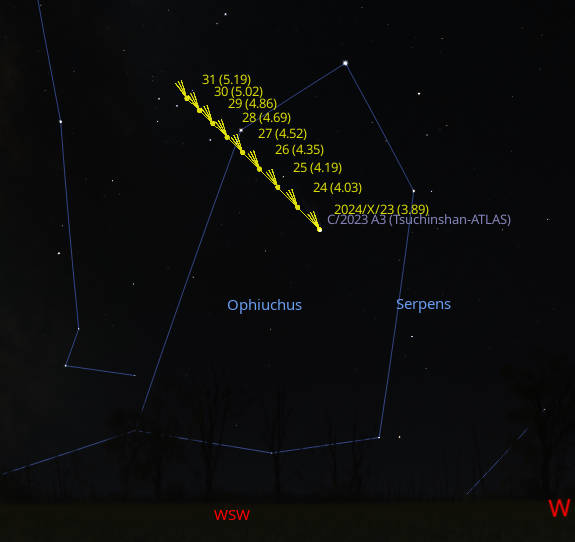
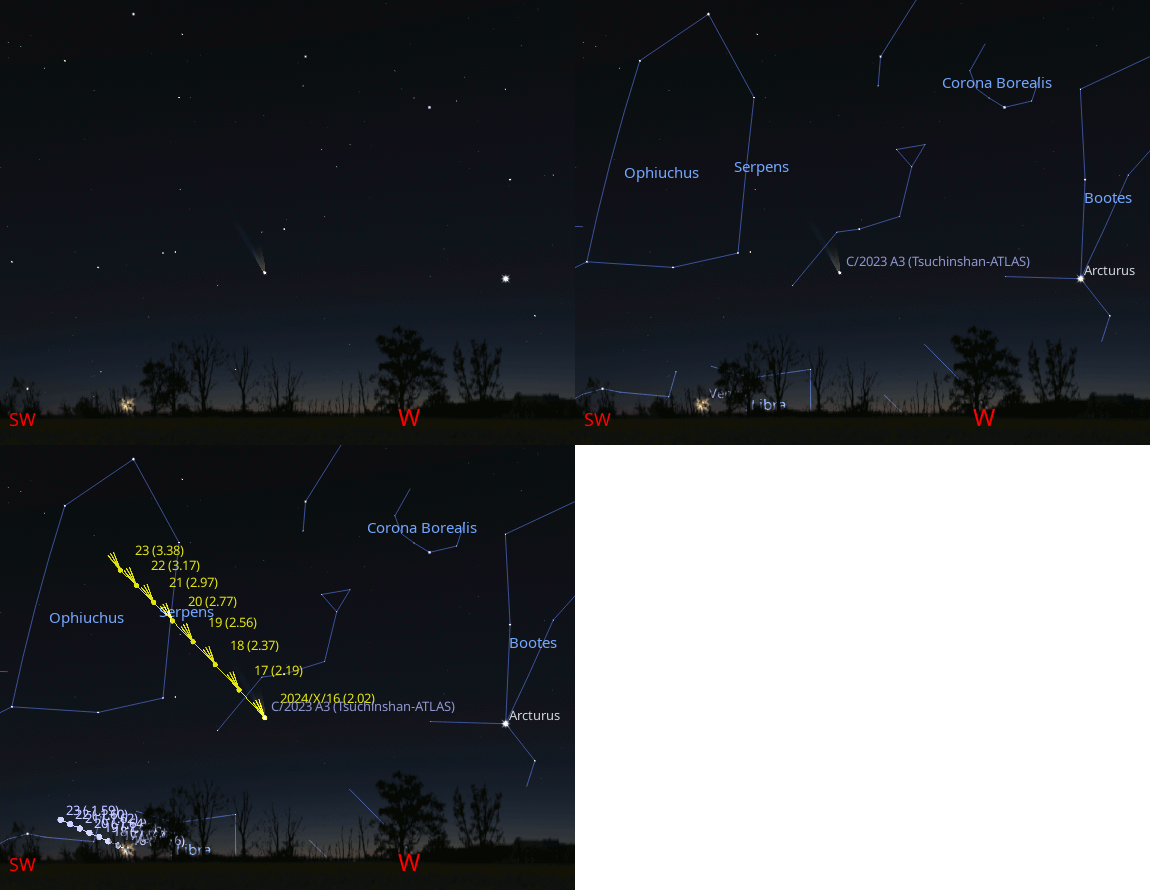
Looking at the rest of the month in viewing Comet Tsuchinshan-ATLAS in dark skies, we find it moving away from us and dimming rapidly. It will be moving across the constellation of Ophiuchus and it will be mostly in the west southwestern sky, And will need a pair of binoculars or a small telescope to spot. The comet has an easily seen tail, even when it becomes dim and only visible in binoculars. It should still have a tail. Comets sport two tails, a dust tail the bright tail that we see on comets, and a narrower ion tail. The ionized gas of the ion tail is driven back by the solar wind while the dust tail is predominantly affected by the pressure of sunlight itself. When close to the Sun it is moving more sideways, so the tails will appear to separate.
The astronomical event times given are for the Traverse City/Interlochen area of Michigan (EDT, UT – 4 hours). Times will be different for other locations.
Addendum
Ephemeris: 10/23/2024 – Taking a look at this week’s brighter solar system bodies
This is Ephemeris for Wednesday, October 23rd. Today the Sun will be up for 10 hours and 34 minutes, setting at 6:44, and it will rise tomorrow at 8:10. The Moon, 1 day before last quarter, will rise at 11:50 this evening.
Let’s take our weekly look at the whereabouts of the naked-eye planets. Venus might be spotted in the West southwest low on the horizon at 7:15 PM, 29 minutes after sunset. It will set at 8:17. Comet Tsuchinshan-ATLAS will be west after 8:30 PM the end of astronomical twilight. It will set at 10:55 PM. Saturn will be in the southeast at 8 PM. Jupiter will rise at 9:11 PM this evening in the east northeast, and be a good object for the small telescope about an hour later. By 7:00 AM tomorrow Jupiter will be high in the southwest while Mars will be high in the south to the right of the Moon.
The astronomical event times given are for the Traverse City/Interlochen area of Michigan (EDT, UT – 4 hours). Times will be different for other locations.
Addendum
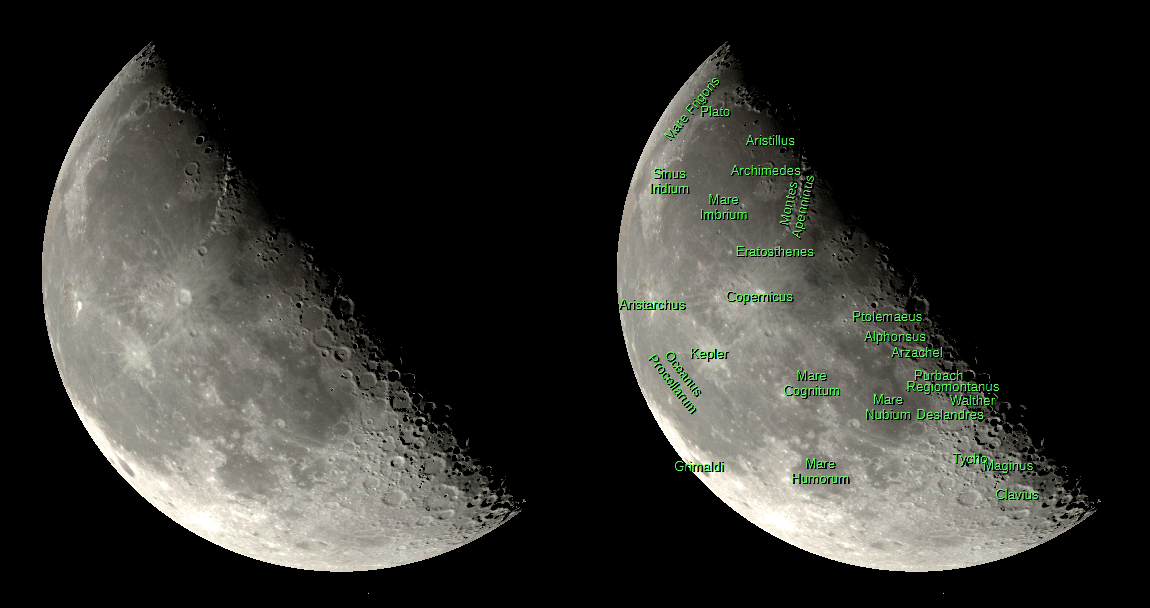
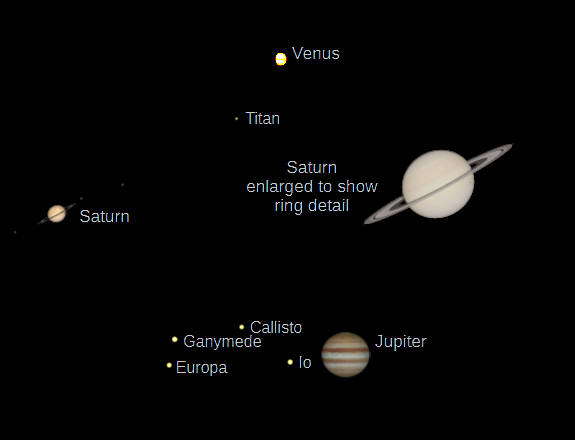
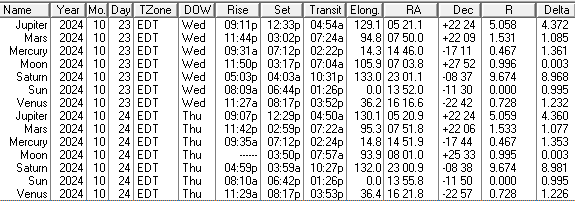
Ephemeris: 10/22/2024 – Reviewing last week’s showing of Comet Tsuchinshan-ATLAS
This is Ephemeris for Tuesday, October 22nd. Today the Sun will be up for 10 hours and 37 minutes, setting at 6:45, and it will rise tomorrow at 8:09. The Moon, 2 days before last quarter, will rise at 10:40 this evening.
Comet Tsuchinshan-ATLAS continues to head out away from the Sun and the Earth, heading back to the Oort Cloud from whence it came. It’s best showing for us came last week. Unfortunately, it was cloudy the weekend before and the first part of the week when the comet was its brightest. However, by Wednesday evening I was able to spot the comet, but not with the naked eye. I could see it in binoculars and I photographed it. Between the twilight and bright moonlight my poor eyes were not able to spot it. Now that the Moon is leaving the evening sky, and the comet is moving up above the horizon in the west, it should be easily spotted with binoculars towards 9 pm. It has faded significantly and will continue as it speeds away from us.
The astronomical event times given are for the Traverse City/Interlochen area of Michigan (EDT, UT – 4 hours). Times will be different for other locations.
Addendum
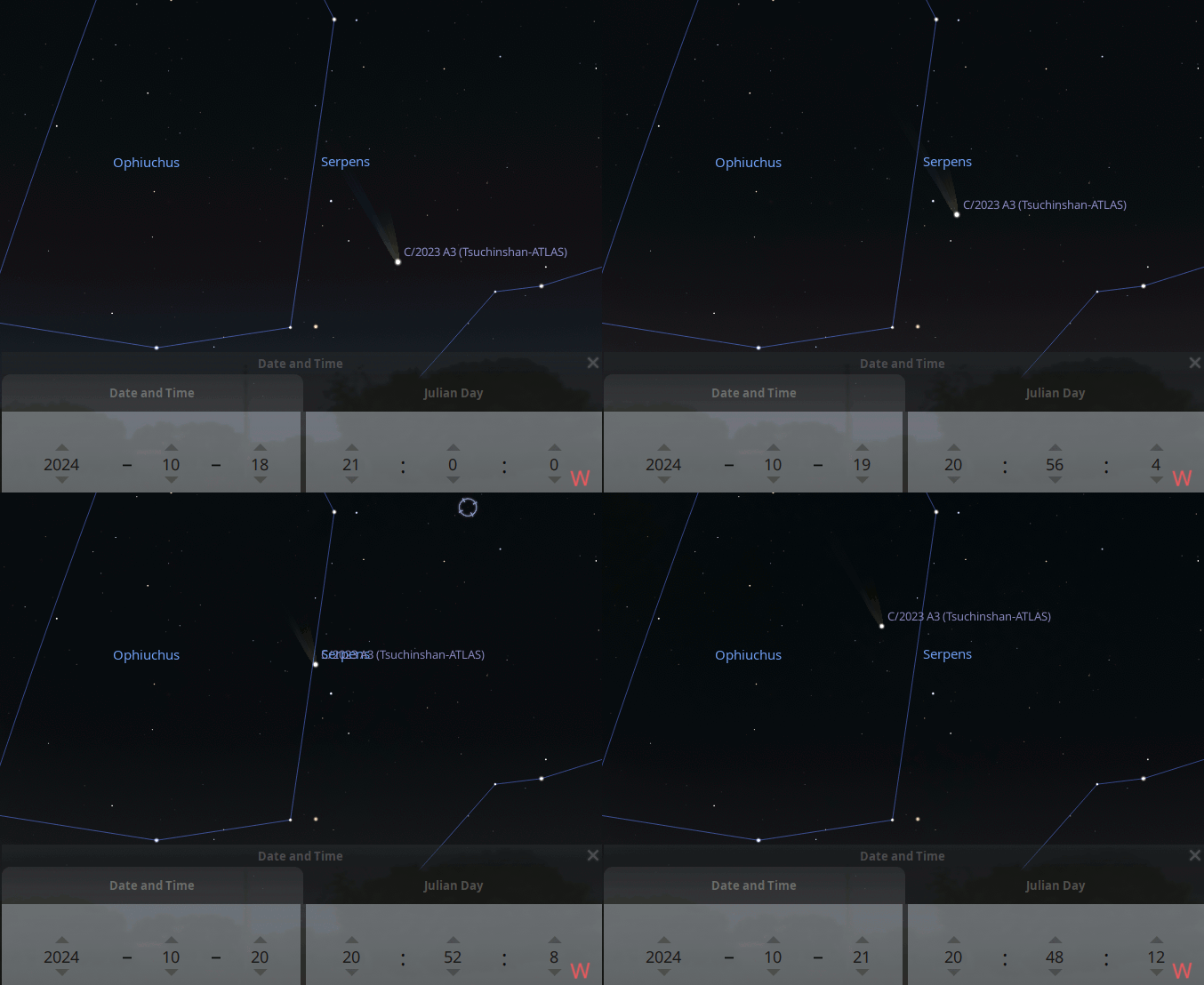
Wednesday, October 16th
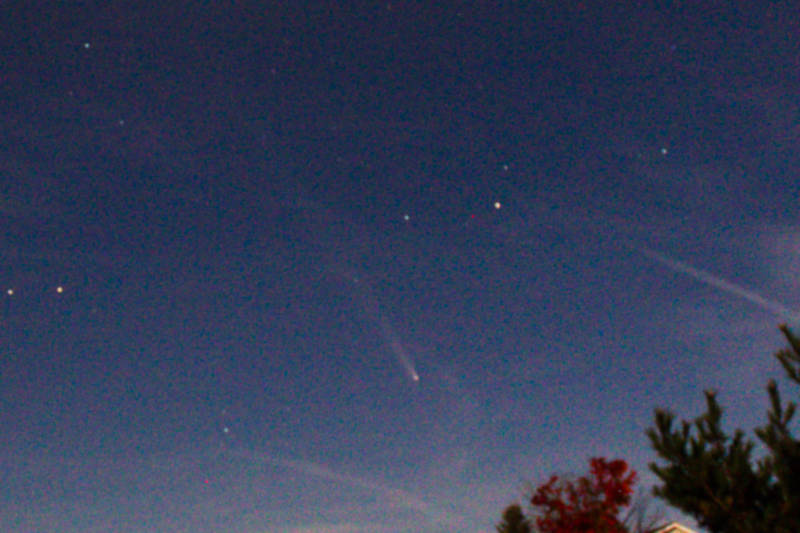
October 17th
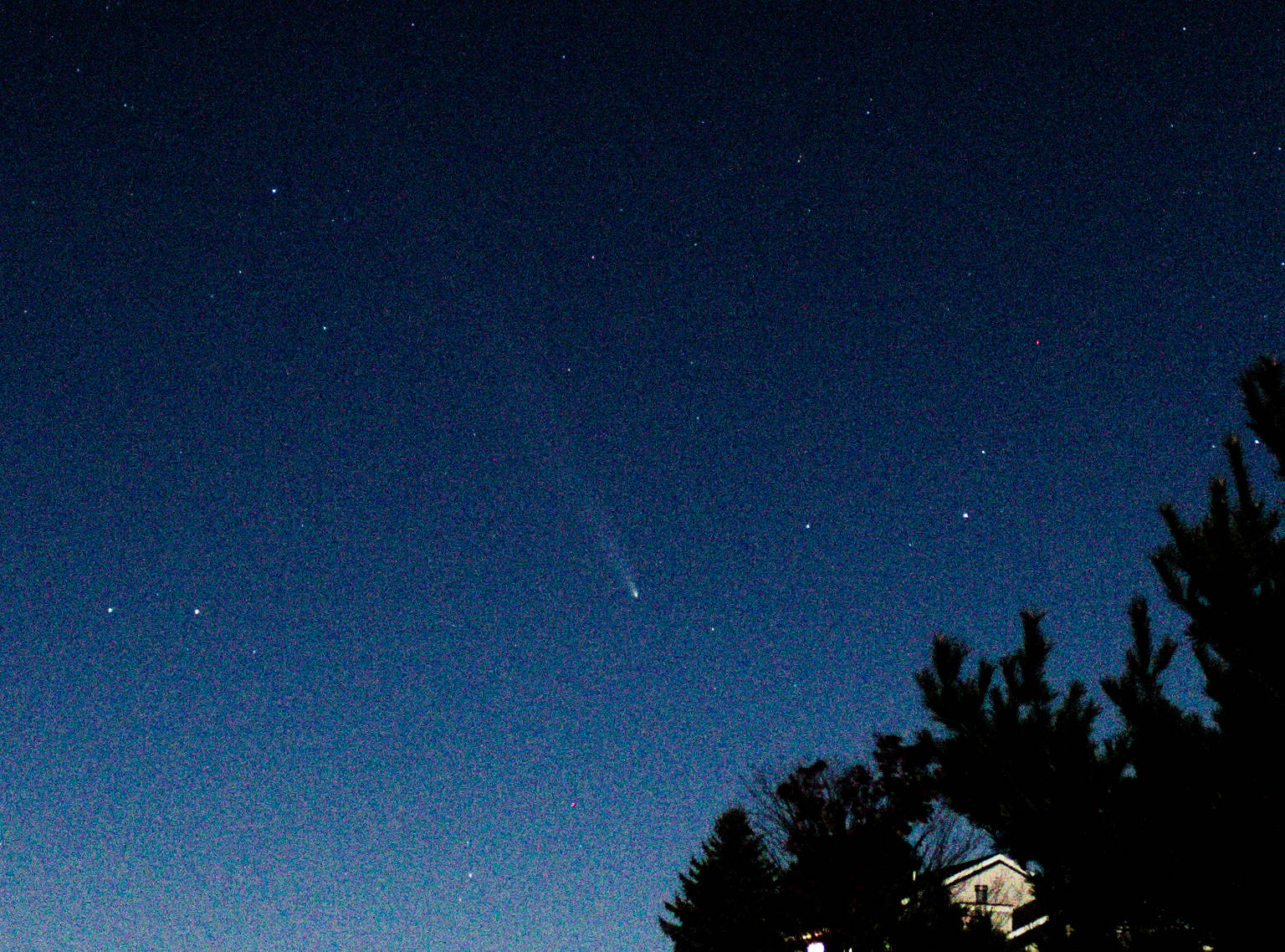
Comet track
Ephemeris: 10/21/2024 – Comets and meteors
This is Bob Moler with Ephemeris for Monday, October 21st. Today the Sun will be up for 10 hours and 40 minutes, setting at 6:47, and it will rise tomorrow at 8:08. The Moon, 3 days before last quarter, will rise at 9:35 this evening.
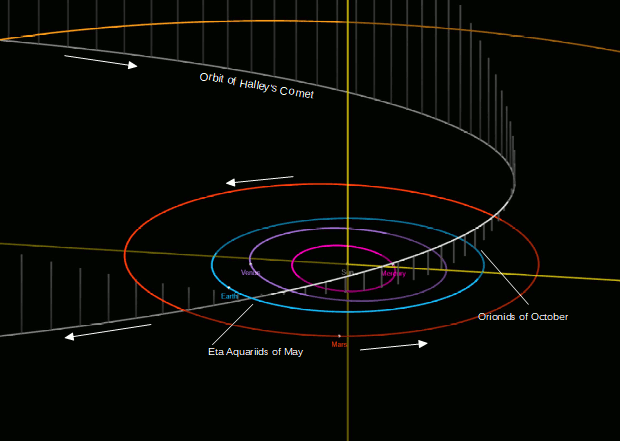
Comet Tsuchinshan-ATLAS it’s now far enough away from the sun so it stays up most of the evening, setting at 10:44 PM. It will be seen in the west southwestern sky for the most part. And now that it is dimming, it is probably best seen with binoculars. Last night was the peak of the Orionid meteor shower. The shower had to compete with a bright Moon. Meteor showers are caused by comets shedding their material as they pass close to the Sun, as the gases sublimate liberating dust and rocks. Dust and gases are blown back into the tails of a comet. The bits of rock end up in much the same orbit as the comet. If the comet’s orbit crosses the Earth’s orbit We have a meteor shower. The Orionids are caused by debris from Halley’s comet.
The astronomical event times given are for the Traverse City/Interlochen area of Michigan (EDT, UT – 4 hours). Times will be different for other locations.
Addendum
Ephemeris: 10/18/2024 – Comet Tsuchinshan-ATLAS can barely compete with the bright Moon
This is Ephemeris for Friday, October 18th. Today the Sun will be up for 10 hours and 49 minutes, setting at 6:52, and it will rise tomorrow at 8:04. The Moon, 1 day past full, will rise at 7:21 this evening.
Comet Tsuchinshan-ATLAS will be visible by 8:00 PM in the west-southwest. It’s a bit higher than it was last night and tomorrow night it’ll be a bit higher still. It also is fading and must also compete with the bright moonlight. It is the brightest comet that we’ve seen around here this century. We’ve been looking forward to this comet for more than a year and a half, since it’s discovery in January of last year. Comets were not always objects to look forward to. In ancient times when they suddenly appeared, they struck fear. They were thought to portend disasters. In fact the word disaster means ill-starred. The word comet basically comes from the Latin meaning hairy star. The Chinese had a similar name for them, they called them broom stars.
The astronomical event times given are for the Traverse City/Interlochen area of Michigan (EDT, UT – 4 hours). Times will be different for other locations.
Addendum
 Bob Moler's Ephemeris Blog